XRP is stuck near the $2 mark just as the Federal Reserve prepares to cut interest rates again.XRP is stuck near the $2 mark just as the Federal Reserve prepares to cut interest rates again.

XRP Price Prediction Ahead of Fed Rate Cut: Can Bulls Defend the $2 Mark?

2025/12/07 13:41

The crypto market is holding its breath as the Federal Reserve is widely expected to announce another rate cut next week. With an 86% probability of a 25-basis-point reduction, the move signals a shift in monetary policy—one that could ripple through traditional and digital markets alike. For XRP price, this decision comes at a critical juncture. The token is consolidating near the $2 mark, showing early signs of compression that could lead to a decisive breakout or breakdown.

How the Fed’s Decision Could Influence XRP Price Prediction

When the Fed lowers interest rates, liquidity usually flows toward higher-risk assets like cryptocurrencies. Investors see reduced borrowing costs as a green light to move capital away from bonds and into speculative sectors. In the short term, this could boost demand across the crypto market, especially for large-cap coins like XRP that have historically tracked broad market sentiment.

However, this policy shift isn’t without risk. If the rate cut sparks fears of inflation, the dollar might weaken temporarily, boosting crypto prices, but an overheated market could later face correction once inflation pressures resurface. In essence, XRP’s near-term rally potential depends not only on the cut itself but on how investors interpret the Fed’s broader tone—whether it signals a short-term stimulus or a sustained dovish stance.

Technical Analysis: XRP Price Faces a Tight Squeeze
XRP Price PredictionXRP/USD Daily chart- TradingView

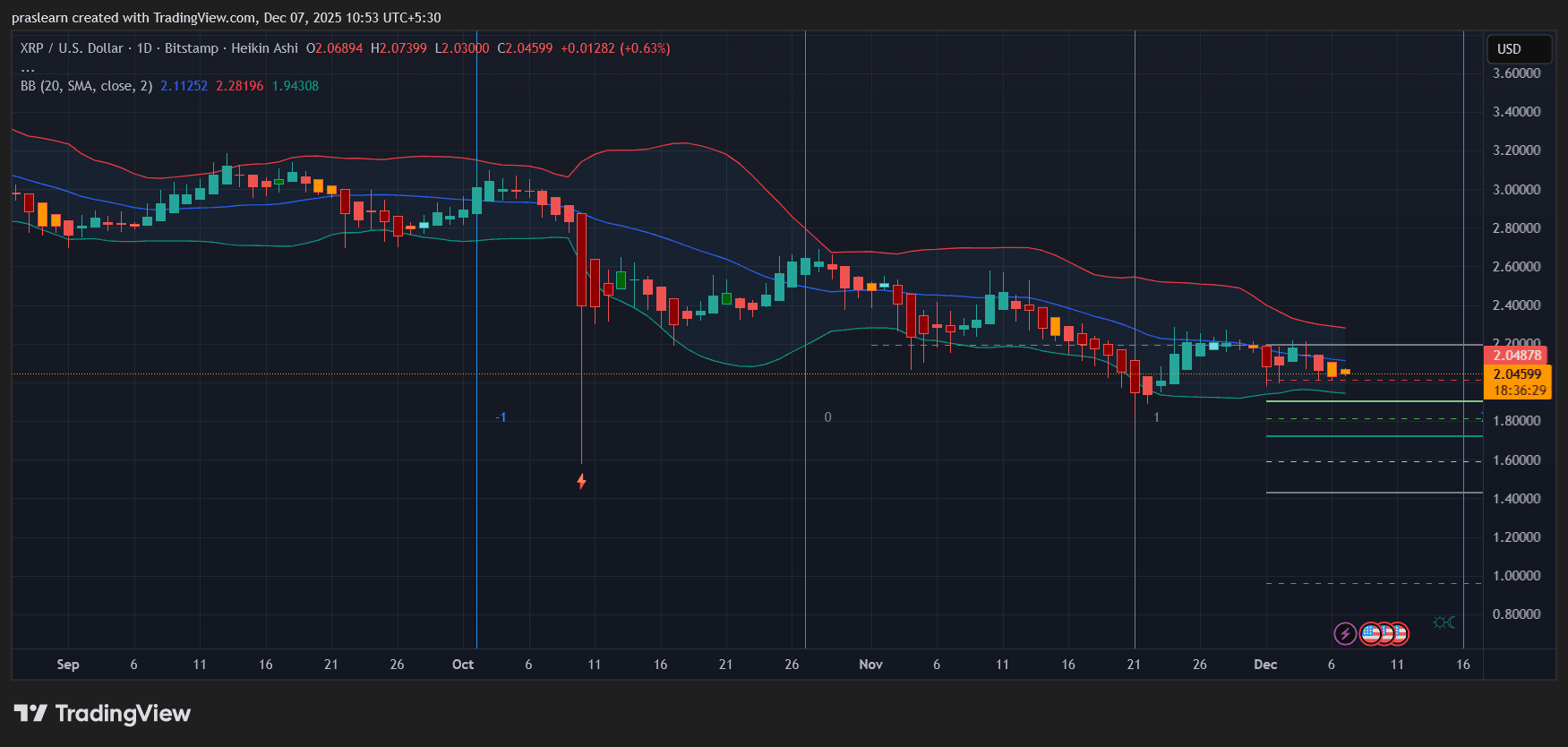
The XRP price daily chart shows price holding just above the $2.04 zone, hugging the lower Bollinger Band range. The bands have tightened, signaling a phase of volatility contraction. Historically, such setups precede large directional moves. The middle band (SMA 20) around $2.11 acts as immediate resistance, while the upper band near $2.28 defines the ceiling for bullish expansion.

The Heikin Ashi candles show mild indecision—smaller bodies and wicks on both sides—hinting at market hesitation. A sustained close above $2.12 could trigger momentum toward $2.25, followed by a potential retest of $2.40 if volume supports the breakout. Conversely, if the Fed’s policy leads to short-term dollar strength or risk-off sentiment, a drop below $1.94 would open the path to $1.80 and potentially $1.60, where historical support lies.

XRP Price Prediction: What to Expect Next

Over the next two weeks, XRP price trajectory will likely mirror macro volatility. A confirmed Fed rate cut accompanied by dovish language could ignite a mild relief rally, pushing XRP toward $2.20–$2.40 before the year-end. But if markets perceive the decision as panic-driven—an admission that the job market is deteriorating—risk assets could slip, dragging XRP back toward the $1.80 region.

The critical point here is compression. XRP’s Bollinger Band squeeze shows that the market is coiling for a significant move. Traders should watch the $2 zone closely—it’s not just psychological support but a structural pivot where bulls and bears are evenly matched. The next breakout from this range will set the tone for the rest of December.


If the Fed’s policy sparks renewed investor optimism, $XRP could rebound toward the mid-$2 range, supported by improving liquidity conditions. But if the narrative turns toward economic weakness, expect a pullback toward $1.80 before any recovery attempt. Either way, XRP is entering a volatility window where patience and precision matter more than prediction.


Disclaimer: The articles reposted on this site are sourced from public platforms and are provided for informational purposes only. They do not necessarily reflect the views of MEXC. All rights remain with the original authors. If you believe any content infringes on third-party rights, please contact service@support.mexc.com for removal. MEXC makes no guarantees regarding the accuracy, completeness, or timeliness of the content and is not responsible for any actions taken based on the information provided. The content does not constitute financial, legal, or other professional advice, nor should it be considered a recommendation or endorsement by MEXC.

You May Also Like

Vitalik Buterin Proposes Ethereum Gas Futures Market for Long-Term Fee Predictability

Vitalik Buterin Proposes Ethereum Gas Futures Market for Long-Term Fee Predictability

The post Vitalik Buterin Proposes Ethereum Gas Futures Market for Long-Term Fee Predictability appeared on BitcoinEthereumNews.com. Vitalik Buterin proposes an on-chain futures market for Ethereum gas, allowing users to pre-buy and lock in fees before potential price surges. This mechanism would provide long-term predictability for BASEFEE, helping developers and businesses plan transactions amid network volatility. Buterin’s vision introduces futures trading for gas, securing costs in advance for future Ethereum transactions. This system generates market-driven signals for BASEFEE evolution, reducing uncertainty in fee planning. Early projects like Oiler have tested gas derivatives, but a mature market is needed; Ethereum’s BASEFEE has fluctuated up to 200% in past cycles, per network data. Ethereum gas futures: Vitalik Buterin’s plan to pre-buy fees and stabilize costs. Discover how this on-chain market could transform transaction predictability—explore Ethereum’s future now! What is Vitalik Buterin’s Proposal for Pre-Buying Ethereum Gas? Vitalik Buterin, Ethereum’s co-founder, is advocating for an on-chain futures market that enables users to pre-buy gas at fixed prices, addressing the network’s long-standing issue of unpredictable transaction fees. This approach shifts focus from immediate cost reductions to long-term fee stability, allowing individuals and organizations to hedge against future spikes in BASEFEE. By creating a dedicated trading platform within Ethereum, Buterin aims to make gas pricing more transparent and manageable, fostering greater confidence in the ecosystem’s economic model. How Would an Ethereum Gas Futures Market Function? Ethereum’s current gas fee system relies on dynamic pricing through the EIP-1559 mechanism, where BASEFEE adjusts based on network congestion, often leading to volatility that can surge by over 150% during peak periods, as observed in historical data from the Ethereum Foundation’s reports. Buterin’s proposed futures market would operate as a decentralized exchange for gas contracts, where traders buy and sell claims to future gas units at agreed-upon prices. This market-driven mechanism would aggregate collective expectations, providing real-time signals on anticipated BASEFEE trends—such as potential increases tied…
Share
BitcoinEthereumNews2025/12/07 18:31
UK Looks to US to Adopt More Crypto-Friendly Approach

UK Looks to US to Adopt More Crypto-Friendly Approach

The post UK Looks to US to Adopt More Crypto-Friendly Approach appeared on BitcoinEthereumNews.com. The UK and US are reportedly preparing to deepen cooperation on digital assets, with Britain looking to copy the Trump administration’s crypto-friendly stance in a bid to boost innovation.  UK Chancellor Rachel Reeves and US Treasury Secretary Scott Bessent discussed on Tuesday how the two nations could strengthen their coordination on crypto, the Financial Times reported on Tuesday, citing people familiar with the matter.  The discussions also involved representatives from crypto companies, including Coinbase, Circle Internet Group and Ripple, with executives from the Bank of America, Barclays and Citi also attending, according to the report. The agreement was made “last-minute” after crypto advocacy groups urged the UK government on Thursday to adopt a more open stance toward the industry, claiming its cautious approach to the sector has left the country lagging in innovation and policy.  Source: Rachel Reeves Deal to include stablecoins, look to unlock adoption Any deal between the countries is likely to include stablecoins, the Financial Times reported, an area of crypto that US President Donald Trump made a policy priority and in which his family has significant business interests. The Financial Times reported on Monday that UK crypto advocacy groups also slammed the Bank of England’s proposal to limit individual stablecoin holdings to between 10,000 British pounds ($13,650) and 20,000 pounds ($27,300), claiming it would be difficult and expensive to implement. UK banks appear to have slowed adoption too, with around 40% of 2,000 recently surveyed crypto investors saying that their banks had either blocked or delayed a payment to a crypto provider.  Many of these actions have been linked to concerns over volatility, fraud and scams. The UK has made some progress on crypto regulation recently, proposing a framework in May that would see crypto exchanges, dealers, and agents treated similarly to traditional finance firms, with…
Share
BitcoinEthereumNews2025/09/18 02:21