Crypto Companies Should Be Treated Equally Under Federal Banking Laws, Says OCC Jonathan Gould, head of the Office of the Comptroller of the Currency (OCC), emphasized that crypto firms seeking a US federal bank charter should be subject to the same regulatory standards as traditional financial institutions. Speaking at a recent blockchain conference, Gould highlighted [...]Crypto Companies Should Be Treated Equally Under Federal Banking Laws, Says OCC Jonathan Gould, head of the Office of the Comptroller of the Currency (OCC), emphasized that crypto firms seeking a US federal bank charter should be subject to the same regulatory standards as traditional financial institutions. Speaking at a recent blockchain conference, Gould highlighted [...]

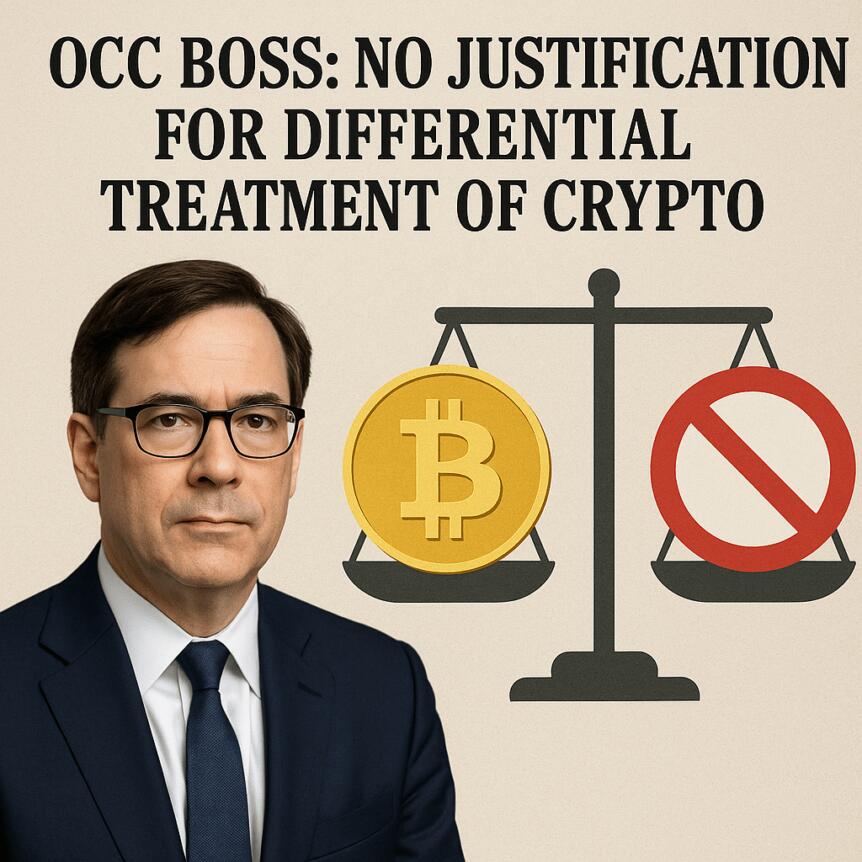
OCC Boss: No Justification for Differential Treatment of Crypto
2025/12/09 11:28
Occ Boss: No Justification For Differential Treatment Of Crypto

Crypto Companies Should Be Treated Equally Under Federal Banking Laws, Says OCC

Jonathan Gould, head of the Office of the Comptroller of the Currency (OCC), emphasized that crypto firms seeking a US federal bank charter should be subject to the same regulatory standards as traditional financial institutions. Speaking at a recent blockchain conference, Gould highlighted that the activities involved in custody and safekeeping of digital assets have been electronically managed for decades, making it unjustifiable to treat digital assets differently from conventional banking services.

Key Takeaways

  • Gould advocates for equal treatment of crypto companies under banking regulations.
  • The OCC recognizes digital assets’ longstanding electronic custody services.
  • Only two crypto-focused banks—Anchorage Digital and Erebor—hold OCC charters.
  • The regulator has seen increasing applications from entities involved in innovative digital asset activities.

Tickers mentioned: none

Sentiment: Neutral

Price impact: Neutral. The comments reflect a balanced stance aiming to integrate crypto into existing financial frameworks without immediate regulatory upheaval.

Trading idea (Not Financial Advice): Hold. The regulatory landscape remains dynamic as authorities seek an appropriate balance between innovation and oversight.

Market context: The growing interest from crypto firms in establishing federally regulated banks indicates mainstream acceptance, amid ongoing regulatory discussions.

Regulatory Perspective on Crypto Banking

Gould reaffirmed that the OCC considers the evolution of banking—from the telegraph to blockchain—as a natural progression. He mentioned that 14 applications to establish new banks, including those engaged in digital assets, have been received so far this year, almost matching the total received over the past four years. This surge underscores the industry’s drive toward official recognition and safe regulatory pathways.

“Chartering helps ensure that the banking system keeps pace with financial innovation and supports our modern economy,” Gould stated. “Entities involved with digital assets should have a clear pathway to become federally supervised banks.”

Addressing Industry Concerns

Despite some banking and trade group concerns over OCC oversight of crypto-focused banks, Gould dismissed fears that increased regulation might hinder innovation. He highlighted that the OCC has years of supervisory experience with crypto-native national trust banks, including Anchorage Digital, which has held a charter since 2021, and Erebor, which received a preliminary banking charter in October.

Gould emphasized that ongoing discussions and daily interactions with existing banks demonstrate the OCC’s openness to innovative banking initiatives. “This ongoing dialogue reinforces our confidence in the OCC’s ability to oversee both new entrants and expanded activities within the banking sector fairly and effectively,” he concluded.

This article was originally published as OCC Boss: No Justification for Differential Treatment of Crypto on Crypto Breaking News – your trusted source for crypto news, Bitcoin news, and blockchain updates.


Disclaimer: The articles reposted on this site are sourced from public platforms and are provided for informational purposes only. They do not necessarily reflect the views of MEXC. All rights remain with the original authors. If you believe any content infringes on third-party rights, please contact service@support.mexc.com for removal. MEXC makes no guarantees regarding the accuracy, completeness, or timeliness of the content and is not responsible for any actions taken based on the information provided. The content does not constitute financial, legal, or other professional advice, nor should it be considered a recommendation or endorsement by MEXC.

You May Also Like

BFX Presale Raises $7.5M as Solana Holds $243 and Avalanche Eyes $1B Treasury — Best Cryptos to Buy in 2025

BFX Presale Raises $7.5M as Solana Holds $243 and Avalanche Eyes $1B Treasury — Best Cryptos to Buy in 2025

BFX presale hits $7.5M with tokens at $0.024 and 30% bonus code BLOCK30, while Solana holds $243 and Avalanche builds a $1B treasury to attract institutions.
Share
Blockchainreporter2025/09/18 01:07
OCC Findings Suggest Major U.S. Banks Restricted Access for Digital Asset Firms Amid Debanking Probe

OCC Findings Suggest Major U.S. Banks Restricted Access for Digital Asset Firms Amid Debanking Probe

The post OCC Findings Suggest Major U.S. Banks Restricted Access for Digital Asset Firms Amid Debanking Probe appeared on BitcoinEthereumNews.com. The Office of the Comptroller of the Currency (OCC) has confirmed that nine major U.S. banks engaged in debanking practices from 2020 to 2023, restricting access for digital asset firms and other sectors. This marks the first official acknowledgment of these policies, which limited services based on customer types, affecting crypto businesses significantly. OCC report highlights inappropriate distinctions by banks like JPMorgan Chase and Bank of America, targeting crypto and high-risk sectors. Nine banks reviewed showed similar policies restricting customer access without objective risk assessments. Impacted industries include digital asset firms, with potential referrals to the Attorney General for unlawful practices. Discover how major U.S. banks’ debanking policies hit crypto firms hard, per OCC’s 2025 report. Learn the implications for digital assets and what regulators are doing next—stay informed on banking risks today! What Are the OCC’s Findings on Banks Debanking Crypto Firms? Banks debanking crypto firms involves major financial institutions limiting or denying services to digital asset businesses based on perceived risks, as detailed in a recent Office of the Comptroller of the Currency (OCC) report. From 2020 to 2023, nine of the largest U.S. banks implemented policies that required escalated reviews or outright restrictions for certain customers, including those in the crypto sector. This practice, now publicly confirmed, underscores ongoing tensions between traditional banking and emerging digital asset industries. How Did These Debanking Practices Affect Digital Asset Companies? The OCC’s six-page report, released on Wednesday, revealed that institutions such as JPMorgan Chase, Bank of America, Citigroup, Wells Fargo, U.S. Bancorp, Capital One, PNC Financial Services Group, Toronto-Dominion Bank, and Bank of Montreal made distinctions among customers that were deemed inappropriate. For digital asset firms, this meant heightened scrutiny or complete denial of banking services, hindering operations in an already volatile market. The regulator noted that these policies spanned…
Share
BitcoinEthereumNews2025/12/11 11:01