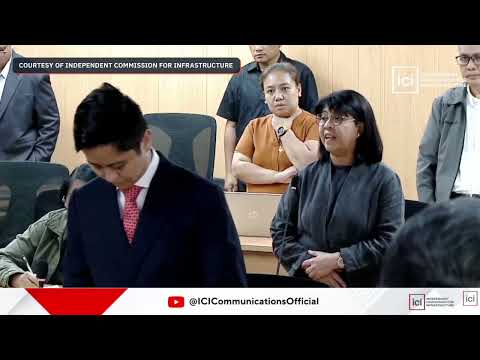
Sandro Marcos says he was giving ICI 'full authority' to release the video of his testimony if they deemed it wouldn't affect the commission's probeSandro Marcos says he was giving ICI 'full authority' to release the video of his testimony if they deemed it wouldn't affect the commission's probe

Sandro Marcos says ‘nothing to hide’ but his testimony at ICI remains secret

2025/12/09 14:45

“I am not hiding anything,” said Ilocos Norte 1st District Representative and presidential son Sandro Marcos, fresh from an appearance before the Independent Commission for Infrastructure on Thursday, December 4.

But when he faced the very commission created by his own father to investigate multi-billion infrastructure corruption, Marcos requested that his testimony be held behind closed doors.

His counsel, Michelle Lazaro, explained that the congressman preferred an executive session because he supposedly wanted to speak “as candidly as possible.” She hinted that “critical information” might be revealed, details that could “jeopardize” the commission’s investigation.
Play Video Sandro Marcos says ‘nothing to hide’ but his testimony at ICI remains secret

Of course, Sandro isn’t the first to ask for an executive session. Since the guidelines were released, only two resource persons — Land Bank of the Philippines officials and Laguna 4th District Representative Danny Domingo — have allowed their hearings to be livestreamed. 

The rest, including Marcos, chose the private route. Yet Marcos said that he self-invited himself at ICI to clear his name.

inside track logo

Still, after the hush-hush session, Marcos told the media that he was giving ICI “full authority” to release the video of his testimony if they deemed it wouldn’t affect the commission’s probe.

“I am happy for them to do so if they believe that there’s no information there that will jeopardize their investigation,” Marcos said. 

The media then asked for the video the following week, Tuesday, December 9. But it appears that Marcos and ICI are not on the same page. 

“Cong. Sandro Marcos declared under oath that he was not amenable to livestreaming or public broadcasting of his testimony. Thus, until the Commission receives a written authority from Cong. Marcos allowing the release, the commission is constrained from releasing the video recording of his testimony,” ICI Chairperson Andres Reyes said.

Reyes himself has repeatedly expressed discomfort with livestreaming, a position made clear in one of ICI’s rare public sessions.

So, was Sandro’s offer to release his testimony merely lip service, just barely enough transparency to sound good?

Is there something inside that recording that could actually “jeopardize” the probe? Because if there was really nothing to hide, why push for an executive session instead of acquiesce to a livestream?

Under ICI’s livestream guidelines, the testimony of other resource persons, before the guidelines were released, should also be accessible to the public.

“For the avoidance of doubt, the ICI Live Streaming Guidelines shall retroactively apply to the testimony of witnesses and/or resource persons, who previously appeared before the ICI, gave their consent to the audio-visual recording, including the documents, reports, presentations, and evidence that they identified, disclosed, shared, provided and/or submitted in the course of and as result of their participation in the hearings or proceedings before the ICI and gave their consent to public access thereto,” Section 5.1 of the guideline reads.

Would the video and other relevant materials also be accessible to the media and public for scrutiny?

Well, there have been a lot of questions about ICI’s power and independence. The Ombudsman said that ICI’s days are numbered. But now, the President wants Congress to pass a bill that would institutionalize a commission against corruption. – Rappler.com


Disclaimer: The articles reposted on this site are sourced from public platforms and are provided for informational purposes only. They do not necessarily reflect the views of MEXC. All rights remain with the original authors. If you believe any content infringes on third-party rights, please contact service@support.mexc.com for removal. MEXC makes no guarantees regarding the accuracy, completeness, or timeliness of the content and is not responsible for any actions taken based on the information provided. The content does not constitute financial, legal, or other professional advice, nor should it be considered a recommendation or endorsement by MEXC.

You May Also Like

BFX Presale Raises $7.5M as Solana Holds $243 and Avalanche Eyes $1B Treasury — Best Cryptos to Buy in 2025

BFX Presale Raises $7.5M as Solana Holds $243 and Avalanche Eyes $1B Treasury — Best Cryptos to Buy in 2025

BFX presale hits $7.5M with tokens at $0.024 and 30% bonus code BLOCK30, while Solana holds $243 and Avalanche builds a $1B treasury to attract institutions.
Share
Blockchainreporter2025/09/18 01:07
OCC Findings Suggest Major U.S. Banks Restricted Access for Digital Asset Firms Amid Debanking Probe

OCC Findings Suggest Major U.S. Banks Restricted Access for Digital Asset Firms Amid Debanking Probe

The post OCC Findings Suggest Major U.S. Banks Restricted Access for Digital Asset Firms Amid Debanking Probe appeared on BitcoinEthereumNews.com. The Office of the Comptroller of the Currency (OCC) has confirmed that nine major U.S. banks engaged in debanking practices from 2020 to 2023, restricting access for digital asset firms and other sectors. This marks the first official acknowledgment of these policies, which limited services based on customer types, affecting crypto businesses significantly. OCC report highlights inappropriate distinctions by banks like JPMorgan Chase and Bank of America, targeting crypto and high-risk sectors. Nine banks reviewed showed similar policies restricting customer access without objective risk assessments. Impacted industries include digital asset firms, with potential referrals to the Attorney General for unlawful practices. Discover how major U.S. banks’ debanking policies hit crypto firms hard, per OCC’s 2025 report. Learn the implications for digital assets and what regulators are doing next—stay informed on banking risks today! What Are the OCC’s Findings on Banks Debanking Crypto Firms? Banks debanking crypto firms involves major financial institutions limiting or denying services to digital asset businesses based on perceived risks, as detailed in a recent Office of the Comptroller of the Currency (OCC) report. From 2020 to 2023, nine of the largest U.S. banks implemented policies that required escalated reviews or outright restrictions for certain customers, including those in the crypto sector. This practice, now publicly confirmed, underscores ongoing tensions between traditional banking and emerging digital asset industries. How Did These Debanking Practices Affect Digital Asset Companies? The OCC’s six-page report, released on Wednesday, revealed that institutions such as JPMorgan Chase, Bank of America, Citigroup, Wells Fargo, U.S. Bancorp, Capital One, PNC Financial Services Group, Toronto-Dominion Bank, and Bank of Montreal made distinctions among customers that were deemed inappropriate. For digital asset firms, this meant heightened scrutiny or complete denial of banking services, hindering operations in an already volatile market. The regulator noted that these policies spanned…
Share
BitcoinEthereumNews2025/12/11 11:01