Solana is making a straight-for-the-liquidity play: bring XRP on-chain in a way that looks familiar to DeFi users, but legible to institutions. In a series of postsSolana is making a straight-for-the-liquidity play: bring XRP on-chain in a way that looks familiar to DeFi users, but legible to institutions. In a series of posts

XRP Is Coming To Solana Via Hex Trust And LayerZero Bridge

2025/12/12 22:00
4 min read

Solana is making a straight-for-the-liquidity play: bring XRP on-chain in a way that looks familiar to DeFi users, but legible to institutions. In a series of posts on X early Friday, Solana said XRP is “coming to Solana,” with Hex Trust and LayerZero set to bridge and issue a wrapped version of the token—wXRP—designed to be “DeFi-ready” on Solana while staying redeemable 1:1 for native XRP on the XRP Ledger.

XRP Heads To Solana As Wrapped Token

That “redeemable 1:1” line is doing a lot of work. According to Hex Trust, wXRP will be issued only when an equivalent amount of XRP is deposited into custody, and it will be burned when redeemed—classic wrapped-asset mechanics, but with a compliance wrapper aimed squarely at bigger balance sheets. The firm said it will act as issuer and custodian for the underlying XRP, describing wXRP as a 1:1-backed representation of native XRP built to support cross-chain utility and DeFi activity.

“XRP has stood the test of time and cemented itself as one of crypto’s preeminent and most liquid currencies. XRP’s long standing utility meets Solana’s high-performance execution. With significant day one liquidity, traders, holders, and institutions can use XRP within leading Solana DEXes, lending markets, and liquidity protocols, while maintaining exposure to the underlying asset and 24/7 XRPL redemption rights,” the Solana Foundation stated in a thread via X on December 12.

The other headline claim: liquidity, immediately. Hex Trust said wXRP is expected to launch with over $100 million in total value locked, framing it as “day one” depth that should help with pricing and market health once the token starts circulating across venues.

LayerZero’s role is the plumbing. Hex Trust said wXRP will be issued on LayerZero’s Omnichain Fungible Token (OFT) standard, positioning it to move across multiple networks rather than live as a one-off wrapper on a single chain. Solana is first, with Hex Trust also naming Optimism, Ethereum, and HyperEVM among initial targets, plus additional chains later.

Why now? Solana’s pitch is basically: XRP is old-school liquid, Solana is high-throughput, and the combination should unlock new use cases without forcing holders to exit the asset. The practical version of that is straightforward—wXRP becomes usable inside Solana’s DEXs, lending markets, and liquidity protocols while keeping a standing redemption path back to XRPL.

The subtle version is about who’s allowed through the door: Hex Trust says minting and redemption is designed for “authorized merchants” in a KYC/AML-compliant environment, which is the kind of sentence that tends to show up when the target user is a market maker, not a meme trader.

And yes, the messaging is trying to thread the custody needle. Solana Foundation product marketing lead Vibhu Norby described the bridge as “self-custodial from end to end” while emphasizing 1:1 redemption back to the ledger—language meant to reassure crypto-native users that this isn’t “paper XRP,” even if the underlying asset is sitting with a regulated custodian.

Via X, Norby commented on the story behind the partnership: “In November, I unexpectedly became enemy #1 of the XRP Army. Through the resulting public learning process, I had a chance to meet many OG devs, core community members, memelords, and the team at Ripple itself, and I came to an understanding of the uniqueness of XRP as an asset, and its community.”

More color is expected on Day 3 of Solana Breakpoint, where RippleX’s Luke Judges is listed on the agenda for a short “Product Keynote: Hextrust” session moderated by Norby. If this rollout goes the way Solana is implying, that slot is less ceremonial than it sounds.

At press time, XRP traded at $2.0284.
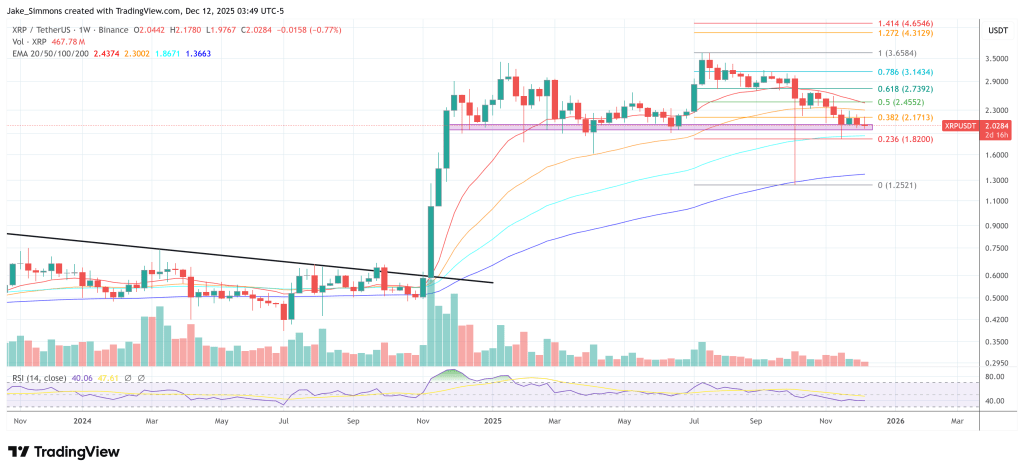
XRP price
Market Opportunity
XRP Logo
XRP Price(XRP)
$1.3816
$1.3816$1.3816
-0.82%
USD
XRP (XRP) Live Price Chart
Disclaimer: The articles reposted on this site are sourced from public platforms and are provided for informational purposes only. They do not necessarily reflect the views of MEXC. All rights remain with the original authors. If you believe any content infringes on third-party rights, please contact service@support.mexc.com for removal. MEXC makes no guarantees regarding the accuracy, completeness, or timeliness of the content and is not responsible for any actions taken based on the information provided. The content does not constitute financial, legal, or other professional advice, nor should it be considered a recommendation or endorsement by MEXC.

You May Also Like

New 15% global tariff reshapes landscape – Commerzbank

New 15% global tariff reshapes landscape – Commerzbank

The post New 15% global tariff reshapes landscape – Commerzbank appeared on BitcoinEthereumNews.com. Commerzbank’s Economic Research team, led by Dr. Vincent Stamer
Share
BitcoinEthereumNews2026/02/23 21:03
Strategy bitcoin milestone in sight as Michael Saylor prepares 100th purchase amid deep unrealized losses

Strategy bitcoin milestone in sight as Michael Saylor prepares 100th purchase amid deep unrealized losses

Investors are watching closely as Strategy bitcoin activity signals another bold move in the middle of a volatile market cycle. Michael Saylor signals 100th Bitcoin
Share
The Cryptonomist2026/02/23 20:55
From Idea to App Store: The Complete Guide to Mobile App Development in Saudi Arabia

From Idea to App Store: The Complete Guide to Mobile App Development in Saudi Arabia

Saudi Arabia is at the forefront of digital transformation. With Vision 2030 driving innovation and a rapidly growing population of tech-savvy users, mobile apps have become a core driver of business growth in the Kingdom. From e-commerce and fintech to healthcare, logistics, and on-demand services, Saudi businesses are embracing mobile apps to connect with customers and scale faster. But how do you take a mobile app idea and turn it into a successful launch on the App Store or Google Play? This guide breaks down the complete mobile app development process in Saudi Arabia — step by step. Step 1: Validate Your App Idea for the Saudi Market Before you start building, ask: What problem does my app solve for Saudi users? Is there a cultural or market gap my app can fill? How do local competitors approach the same challenge? For example, apps related to digital payments, e-learning, delivery services, and healthcare are in high demand across Saudi Arabia. Conducting market research and aligning your app idea with local user behavior is critical. Step 2: Plan Features with Local Needs in Mind Your app should start with an MVP (Minimum Viable Product) — a core version that solves the main problem. Later, you can scale with advanced features. In Saudi Arabia, consider adding: Arabic language support (essential for user adoption) Integration with local payment gateways like STC Pay, Mada, or Apple Pay Regulatory compliance (especially for fintech and health apps) Localization for user preferences (Hijri calendar, cultural UI elements) Step 3: Select the Right Development Approach You can choose: Native Apps (Swift for iOS, Kotlin for Android) — Great for scalability and performance. Cross-Platform Apps (Flutter, React Native) — Cost-effective for startups targeting both iOS and Android simultaneously. Hybrid Apps — Suitable for simpler apps with limited features. For Saudi startups and enterprises, cross-platform development is often preferred to reach a wider audience quickly and efficiently. Step 4: Design With a Local Touch The design must balance global usability standards with local cultural relevance. UI (User Interface): Clean, modern visuals that align with Saudi branding. UX (User Experience): Simple navigation, clear Arabic text support, and intuitive flows. Wireframing & Prototyping: Test early with Saudi users to ensure adoption. A user-friendly design is one of the top reasons apps succeed in the Kingdom’s competitive market. Step 5: Develop Your Mobile App Once the design is ready, the coding begins. Saudi app development companies often follow Agile methodology, ensuring flexibility and faster delivery. Front-End Development: Interface and user interactions. Back-End Development: Databases, servers, and APIs. Integration: Secure connections between front-end and back-end. Strong collaboration between developers, designers, and business analysts ensures your app aligns with Saudi market needs. Step 6: Testing Across Devices and Networks Saudi users rely on different devices and network speeds. That’s why rigorous testing is critical: Functionality Testing: Features work as expected. Performance Testing: The app runs smoothly on both 4G and 5G networks. Localization Testing: Arabic text displays correctly, without alignment issues. Security Testing: Data protection compliance with Saudi cybersecurity standards. Step 7: App Store & Google Play Launch in Saudi Arabia To publish your app: Apple App Store (iOS): Requires an Apple Developer account and strict guideline compliance. Google Play Store (Android): Faster approval but still requires detailed app info. You’ll also need metadata in both English and Arabic — titles, descriptions, and screenshots — to maximize visibility among Saudi users. Step 8: Market Your App in Saudi Arabia Launching an app is only the beginning. You need a marketing strategy tailored to the Kingdom: App Store Optimization (ASO): Use Arabic and English keywords. Social Media Campaigns: Leverage platforms like Snapchat, Twitter (X), and Instagram, which are highly popular in Saudi Arabia. Influencer Marketing: Collaborate with Saudi influencers for early traction. Paid Ads: Google Ads and Saudi-focused Facebook/Instagram ads. Partnerships: Collaborate with local businesses to reach a wider audience. Step 9: Gather Feedback and Optimize Once your app is live, monitor: User reviews on app stores Analytics on engagement, retention, and churn rates Suggestions from Saudi users for culturally relevant features Continuous updates and improvements are vital to stay competitive. Step 10: Scale With Advanced Features Once your MVP gains traction, you can expand with advanced features such as: AI and machine learning for personalization Blockchain-based payments for fintech apps AR/VR features for retail and gaming apps IoT integration for smart home and mobility solutions Saudi Arabia’s digital ecosystem is growing rapidly — apps that adapt quickly will thrive. Conclusion Mobile app development in Saudi Arabia is not just about building an app — it’s about aligning with Vision 2030, cultural needs, and user expectations. By following a clear process — from idea validation to launch and beyond — you can transform your concept into a profitable digital product. Whether you’re a startup or an enterprise in Saudi Arabia, the opportunity is massive. With the right strategy, you can move from idea to App Store and create an app that truly resonates with Saudi users. From Idea to App Store: The Complete Guide to Mobile App Development in Saudi Arabia was originally published in Coinmonks on Medium, where people are continuing the conversation by highlighting and responding to this story
Share
Medium2025/09/18 14:46