

Bitcoin Price Prediction: BTC Stalls in a Tight Range as This DeFi Crypto Dominates December Demand

The post Bitcoin Price Prediction: BTC Stalls in a Tight Range as This DeFi Crypto Dominates December Demand appeared first on Coinpedia Fintech News
Bitcoin may be consolidating in a tight and uneventful range, but investor enthusiasm hasn’t cooled across the broader market, it’s simply redirecting. As BTC struggles to break out, market data shows liquidity flowing aggressively into high-growth, utility-driven projects, with Mutuum Finance (MUTM) emerging as the clear leader. December has been dominated by one narrative: the surge of DeFi-native demand, and MUTM now sits at the center of it, nearing a full sellout of its Phase 6 presale while crossing $19.33 million raised and 18,450+ unique holders.
What sets MUTM apart is its uniquely structured overcollateralized liquidity engine, a model designed to thrive during periods of sideways BTC movement, when traders seek yield, borrowing flexibility, and exposure outside Bitcoin’s stagnation. With its V1 launch approaching, rising wallet accumulation, MUTM is riding December’s momentum and defining it as the next big crypto.
Bitcoin Consolidation Signals a Pause Before the Next Major Move
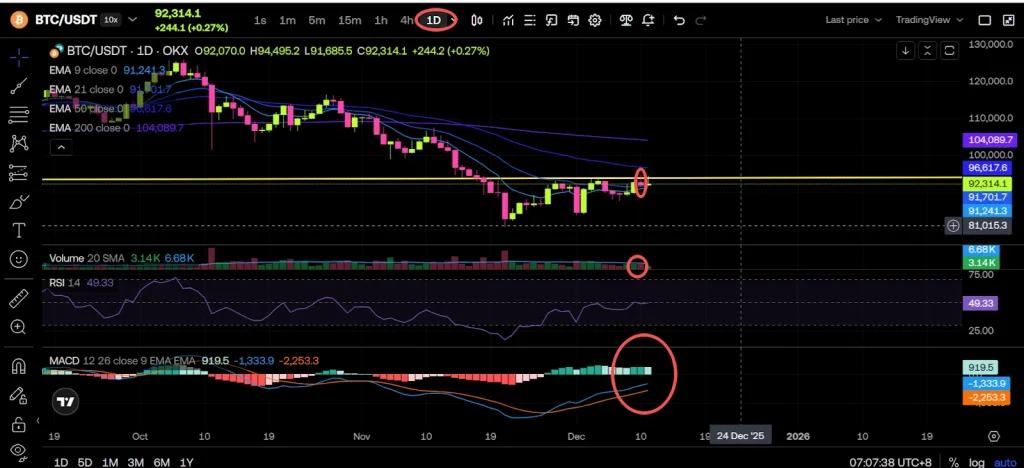
Bitcoin has slipped into a textbook consolidation phase following the Federal Reserve’s December meeting, as the market digests the event’s impact and bullish expectations cool off. The rejection near $94,500, shown by a bearish candle with a long upper wick, highlights clear seller strength at higher levels, while the close above the EMA21 provides only mild technical support rather than a trend-saving signal. Momentum remains flat: the MACD lines are running parallel and a choppy histogram indicate that bullish acceleration has fully stalled, leaving BTC stuck in a neutral range until a fresh catalyst emerges. And while this tightening structure typically precedes a strong breakout in one direction or another, many investors are already shifting attention toward high-momentum alternatives, naturally leading the conversation toward this DeFi crypto.
MUTM Presale Draws Strong Investor Interest
Mutuum Finance (MUTM) is emerging as the DeFi crypto of 2025. Its presale has already attracted over 18,450 participants and raised more than $19.33 million. Phase 6 tokens are currently priced at $0.035, offering investors a final opportunity before Phase 7 increases the price by 20% to $0.04. Unlike many altcoins driven purely by speculation, Mutuum Finance emphasizes adoption and practical utility, positioning it as the next big crypto for early-stage investors.
Dual Lending Architecture Fuels Growth
A key driver of Mutuum Finance’s adoption is its dual lending framework. The Peer-to-Contract (P2C) model pools large, stable assets like USDT and SOL into fully audited smart contracts. Interest rates adjust dynamically based on pool utilization. For instance, lending $15,000 USDT can generate mtUSDT tokens yielding around 15% annually, providing roughly $2,250 in returns. Borrowers can pledge assets, such as $2,000 in ADA, to borrow $1,500 in liquidity without selling their holdings. Stability factors and liquidation thresholds ensure optimal fund usage and solvency.
The Peer-to-Peer (P2P) lending module allows users to negotiate terms directly, accepting higher risks for potentially higher returns. Specialized pools also enable lending, borrowing, and staking, providing steady yields and increasing engagement within the MUTM ecosystem. This approach makes MUTM particularly attractive for active DeFi users seeking real utility.
Driving Value with Fee-to-Buyback
Mutuum Finance strengthens token value through its fee-to-buyback mechanism. Fees generated from lending, borrowing, and staking are used to repurchase MUTM tokens, which are then distributed to mtToken stakers. This cycle connects real on-chain activity with tangible rewards, encouraging sustained engagement rather than speculative trading. By incentivizing participation and creating a self-reinforcing growth model, MUTM establishes itself as the crypto with lasting utility and strong upside potential.
Bitcoin is stuck in a tight range near $94K, leaving traders hungry for yield and alternatives. Mutuum Finance (MUTM) is dominating December demand, with Phase 6 nearly sold out at $0.035, over 18,450 holders, and $19.33M raised. Its dual lending system and fee-to-buyback model offer real DeFi utility, making MUTM the DeFi crypto to watch and the next big crypto for early investors as BTC stalls.
For more information about Mutuum Finance (MUTM) visit the links below:
Website:https://mutuum.com/
Linktree:https://linktr.ee/mutuumfinance


You May Also Like

EU plans to fine Google high triple-digit million euro sum – report

Cathie Wood’s ARK Invest Buys $13.7M in Circle Shares While Selling Robinhood Stock

The changing face of elder care in Malaysia — Sayed Mohammad Reza Yamani Sayed Umar



