The weekly chart for Dogecoin shows a signal that could be of greater significance due to its rarity. Crypto analyst Cryptollica pointed to DOGE’s weekly RSI taggingThe weekly chart for Dogecoin shows a signal that could be of greater significance due to its rarity. Crypto analyst Cryptollica pointed to DOGE’s weekly RSI tagging

Dogecoin Hits Rare Weekly RSI Level Seen Only 4 Times In 11 Years

2025/12/16 19:00

The weekly chart for Dogecoin shows a signal that could be of greater significance due to its rarity. Crypto analyst Cryptollica pointed to DOGE’s weekly RSI tagging roughly 33.6 and claimed that level has shown up only four times in 11 years. “DOGE WEEKLY RSI. 4 times in 11 years ..,” he posted.

What This Means For The Dogecoin Price

DOGE, for context, was trading around $0.129 at the time of writing, down roughly mid-single digits on the day. The hook is simple: a weekly RSI that low usually means sellers have been in control for a while — and on a weekly timeframe, that kind of pressure tends to carry more weight than intraday noise. This isn’t “RSI brushed 30 on a 15-minute candle.” It’s slower, heavier, and tied to the bigger trend.
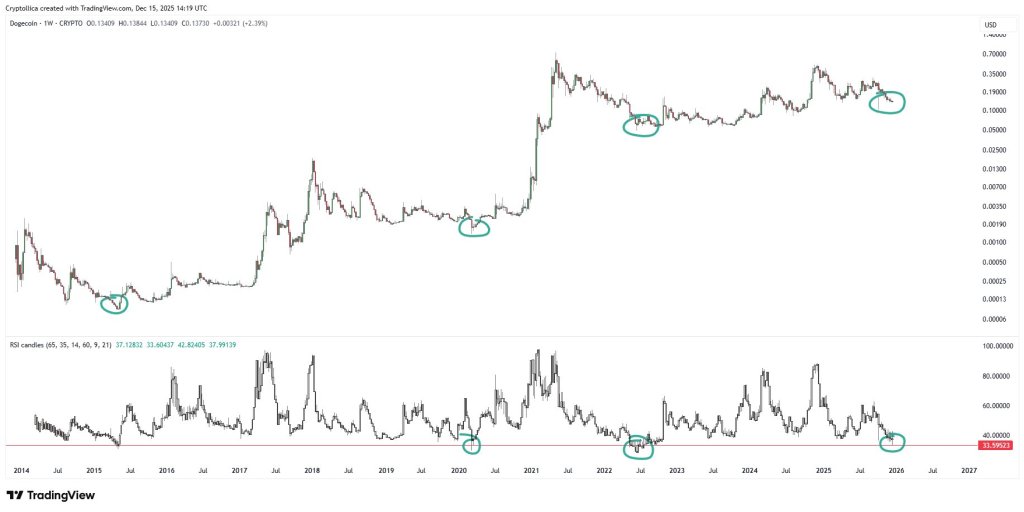
Dogecoin's weekly chart flashes rare RSI signal

Still, it’s not quite as plug-and-play as the screenshot makes it look. Cryptollica’s point is that the same zone showed up around (1) early May 2015, (2) March 2020, (3) mid-June 2022, and (4) now. The post is the spark; what traders actually care about is what happened next. And this is where Dogecoin’s history gets… very Dogecoin.

On May 6, 2015, DOGE was quoted around $0.000087. Beyond the price being basically dust, the backdrop was messy: weeks earlier, Dogecoin co-founder Jackson Palmer said he was stepping away from the crypto community, calling out what he described as a “toxic” culture.

The bounce didn’t show up on schedule. DOGE drifted for a long time, then later caught the 2017–18 mania, briefly touching $0.017 on Jan. 7, 2018. From roughly $0.000087, that’s about +19,000% to that local-cycle high — a good reminder that “oversold” on a weekly chart can show up early and still end up pointing the right way. In mid-March 2020 (peak COVID panic), DOGE traded around $0.001537. When the panic eased and liquidity returned to markets, DOGE went on to print its next cycle top at $0.7316 on May 8, 2021.

That’s roughly +47,000% from the March 2020 level to the 2021 high. It’s also the stretch where DOGE stopped being “just” a joke coin and started behaving like a retail risk-on barometer — with Musk-era attention pouring gasoline on it.

By mid-June 2022, the bear-market washout was in full effect. DOGE was around $0.053. The recovery came in waves: a late-2022 pop tied to Musk/Twitter speculation and broader risk-on bursts, then a bigger 2024 meme-led rip.

By March 28, 2024, DOGE was back around $0.220 — roughly +315% from the June 2022 level to the next notable local high. Not 2021-level insanity, but still a real multi-x.

And now, as of Tuesday, Dec. 16, 2025, Dogecoin was changing hands around $0.129. The “signal” crowd will look at that weekly RSI print and argue the market is back in the same psychological neighborhood as those prior exhaustion points.

The bullish case writes itself: if this weekly RSI zone has tended to show up near seller fatigue in the past, then seeing it again could mean risk/reward is quietly shifting. Not a promise — more like a reason to stop ignoring DOGE and start watching it.

But RSI isn’t a timing tool. Oversold can stay oversold. Weekly signals can hang around, whip traders around, or get flattened if broader risk keeps leaking.

For now, it’s a setup, not an outcome. If DOGE starts reclaiming levels and holding them, the “rare signal” crowd will take the victory lap. If it keeps bleeding, this gets filed under interesting, early, and painful — like a lot of trading ideas.

At press time, DOGE traded at $0.12878.

Dogecoin price chart
Market Opportunity
SuperRare Logo
SuperRare Price(RARE)
$0.02197
$0.02197$0.02197
-0.76%
USD
SuperRare (RARE) Live Price Chart
Disclaimer: The articles reposted on this site are sourced from public platforms and are provided for informational purposes only. They do not necessarily reflect the views of MEXC. All rights remain with the original authors. If you believe any content infringes on third-party rights, please contact service@support.mexc.com for removal. MEXC makes no guarantees regarding the accuracy, completeness, or timeliness of the content and is not responsible for any actions taken based on the information provided. The content does not constitute financial, legal, or other professional advice, nor should it be considered a recommendation or endorsement by MEXC.

You May Also Like

The Channel Factories We’ve Been Waiting For

The Channel Factories We’ve Been Waiting For

The post The Channel Factories We’ve Been Waiting For appeared on BitcoinEthereumNews.com. Visions of future technology are often prescient about the broad strokes while flubbing the details. The tablets in “2001: A Space Odyssey” do indeed look like iPads, but you never see the astronauts paying for subscriptions or wasting hours on Candy Crush.  Channel factories are one vision that arose early in the history of the Lightning Network to address some challenges that Lightning has faced from the beginning. Despite having grown to become Bitcoin’s most successful layer-2 scaling solution, with instant and low-fee payments, Lightning’s scale is limited by its reliance on payment channels. Although Lightning shifts most transactions off-chain, each payment channel still requires an on-chain transaction to open and (usually) another to close. As adoption grows, pressure on the blockchain grows with it. The need for a more scalable approach to managing channels is clear. Channel factories were supposed to meet this need, but where are they? In 2025, subnetworks are emerging that revive the impetus of channel factories with some new details that vastly increase their potential. They are natively interoperable with Lightning and achieve greater scale by allowing a group of participants to open a shared multisig UTXO and create multiple bilateral channels, which reduces the number of on-chain transactions and improves capital efficiency. Achieving greater scale by reducing complexity, Ark and Spark perform the same function as traditional channel factories with new designs and additional capabilities based on shared UTXOs.  Channel Factories 101 Channel factories have been around since the inception of Lightning. A factory is a multiparty contract where multiple users (not just two, as in a Dryja-Poon channel) cooperatively lock funds in a single multisig UTXO. They can open, close and update channels off-chain without updating the blockchain for each operation. Only when participants leave or the factory dissolves is an on-chain transaction…
Share
BitcoinEthereumNews2025/09/18 00:09
Wyoming-based crypto bank Custodia files rehearing petition against Fed

Wyoming-based crypto bank Custodia files rehearing petition against Fed

The post Wyoming-based crypto bank Custodia files rehearing petition against Fed appeared on BitcoinEthereumNews.com. A Wyoming-based crypto bank has filed another
Share
BitcoinEthereumNews2025/12/16 22:06
US economy adds 64,000 jobs in November but unemployment rate climbs to 4.6%

US economy adds 64,000 jobs in November but unemployment rate climbs to 4.6%

The post US economy adds 64,000 jobs in November but unemployment rate climbs to 4.6% appeared on BitcoinEthereumNews.com. The economy moved in two directions at
Share
BitcoinEthereumNews2025/12/16 22:18