This article was first published on The Bit Journal. Binance whale liquidation is a phrase traders see often, but it rarely carries this much weight. In a matterThis article was first published on The Bit Journal. Binance whale liquidation is a phrase traders see often, but it rarely carries this much weight. In a matter

$11.58M Gone in Seconds: Binance Whale Liquidation Stuns Traders

This article was first published on The Bit Journal.

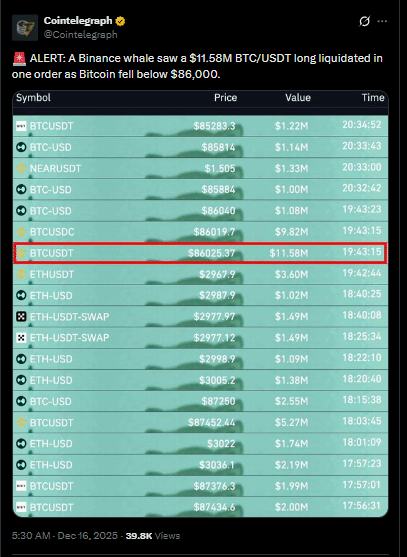
Binance whale liquidation is a phrase traders see often, but it rarely carries this much weight. In a matter of moments, a single leveraged trade worth $11.58 million vanished as the market dipped below a critical level. The event did not unfold during panic or chaos. It happened during a routine pullback, which makes the lesson even sharper.

The liquidation occurred when prices fell below $86,000, a level many traders had been watching closely. According to the source, the position was a BTC/USDT long placed on Binance. As the market moved against it, the exchange’s risk system automatically closed the trade. There was no room to recover once the margin limit was crossed.
Bitcoin price dipSource: X (Formerly Twitter)

A Brief Dip With Heavy Consequences

At the time of the liquidation, Bitcoin was trading around $85,900, according to real-time data from an official source. The price drop was not extreme by historical standards. Still, for leveraged positions, even small moves can be costly.

The trader behind the position expected prices to keep rising. That assumption had support from recent momentum. Yet markets do not move in straight lines. When the pullback arrived, leverage magnified the loss instead of the opportunity.

This is where many traders struggle. Leverage feels safe during strong trends, but it leaves little margin for error when conditions change. Once the liquidation price is reached, the system reacts instantly. Emotion, confidence, and long-term belief no longer matter.

Why Binance Whale Liquidation Matters to the Whole Market

A Binance whale liquidation is never just about one trader. Extensive forced closures add sudden selling pressure. That pressure can push prices lower and trigger other liquidations, creating a chain reaction.

Market researchers have studied this pattern closely. Analysis published by the Bank for International Settlements explains how leveraged liquidations often intensify short-term volatility before markets stabilize again. These events tend to flush out excessive risk rather than signal more profound weakness.

In this case, trading activity spiked soon after the liquidation. Screens shared across social platforms showed the order hitting the books in one sweep. Similar behavior has occurred during previous Bitcoin corrections, where leverage unwinds faster than sentiment shifts.

What Current Data Suggests About Risk

Derivatives data shows that open interest remains elevated across major exchanges. This suggests traders continue to take on leveraged exposure. History shows that such conditions can persist, but they often come with sharp resets.

A derivatives strategist recently explained in a market commentary that leverage does not respond to narratives. It responds to numbers. When margin thresholds break, positions close without delay. This is why even experienced traders can face sudden losses.

For financial students and analysts, this serves as a practical lesson. Automated systems enforce discipline where human judgment may hesitate. Understanding this structure is key to reading modern crypto markets.

The Broader Picture Remains Intact

Despite the loss, the long-term outlook for Bitcoin has not changed. Prices remain well above levels seen earlier in the year. Institutional interest, ETF-related flows, and long-term holders continue to support the market.

Still, Binance whale liquidation events remind traders that timing and position size matter as much as direction. Markets reward patience more often than boldness during volatile phases.

Developers building trading platforms and analysts modeling risk can draw the same conclusion. Volatility is not the enemy. Poor risk control is.

Final Thought 

In the end, Binance whale liquidation tells a familiar story in a modern setting. Leverage turns routine pullbacks into defining moments. As Bitcoin matures, discipline remains the quiet skill that separates survival from sudden loss. The market always teaches. The cost depends on how closely the lesson is heard.

Glossary of Key Terms

Binance Whale Liquidation: Forced closure of a massive leveraged trade on Binance when margin requirements are breached.

Whale: A trader or organization with a large position that is capable of moving markets.

Leverage:Borrowed money used to amplify potential returns (and losses) of an investment position.

Liquidation: A process by which an exchange is forced to close a position in order to prevent further losses when its margin, or equity, has run out.

BTC/USDT: A pair of Bitcoin trading in exchange for USDT.

FAQs About Binance Whale Liquidation

1. What caused the Binance whale liquidation?

The liquidation occurred when prices fell below the trader’s margin level, triggering an automatic closure of the leveraged position.

2. Why do whale liquidations affect the market?

Large liquidations add sudden selling pressure, which can push prices lower and trigger more forced trades.

3. Is leverage always dangerous in crypto trading?

Leverage increases risk because even small price moves can lead to significant losses when margin limits are reached.

4. Does this liquidation change Bitcoin’s long-term outlook?

No. The event reflects short-term volatility, not a shift in the broader market trend.

Sources

Coinmarketcap

bis.org

Read More: $11.58M Gone in Seconds: Binance Whale Liquidation Stuns Traders">$11.58M Gone in Seconds: Binance Whale Liquidation Stuns Traders


Market Opportunity
Bitdealer Logo
Bitdealer Price(BIT)
$0.002709
$0.002709$0.002709
-0.44%
USD
Bitdealer (BIT) Live Price Chart
Disclaimer: The articles reposted on this site are sourced from public platforms and are provided for informational purposes only. They do not necessarily reflect the views of MEXC. All rights remain with the original authors. If you believe any content infringes on third-party rights, please contact service@support.mexc.com for removal. MEXC makes no guarantees regarding the accuracy, completeness, or timeliness of the content and is not responsible for any actions taken based on the information provided. The content does not constitute financial, legal, or other professional advice, nor should it be considered a recommendation or endorsement by MEXC.

You May Also Like

Bitcoin ETF Investors React to Fed’s Decision

Bitcoin ETF Investors React to Fed’s Decision

The post Bitcoin ETF Investors React to Fed’s Decision appeared on BitcoinEthereumNews.com. In a surprise move, spot Bitcoin ETFs experienced their first significant daily outflows in over a week, following the Federal Reserve’s adjusted policy outlook. This shift reflects the market’s readiness to respond to any hint of change on the regulatory landscape, as well as its sensitivity to central bank cues. Continue Reading:Bitcoin ETF Investors React to Fed’s Decision Source: https://en.bitcoinhaber.net/bitcoin-etf-investors-react-to-feds-decision
Share
BitcoinEthereumNews2025/09/18 18:51
US Senators Introduce SAFE Crypto Act to Target Rising Crypto Scams

US Senators Introduce SAFE Crypto Act to Target Rising Crypto Scams

The post US Senators Introduce SAFE Crypto Act to Target Rising Crypto Scams appeared first on Coinpedia Fintech News Crypto scams are getting faster, smarter and
Share
CoinPedia2025/12/17 18:33
From Idea to App Store: The Complete Guide to Mobile App Development in Saudi Arabia

From Idea to App Store: The Complete Guide to Mobile App Development in Saudi Arabia

Saudi Arabia is at the forefront of digital transformation. With Vision 2030 driving innovation and a rapidly growing population of tech-savvy users, mobile apps have become a core driver of business growth in the Kingdom. From e-commerce and fintech to healthcare, logistics, and on-demand services, Saudi businesses are embracing mobile apps to connect with customers and scale faster. But how do you take a mobile app idea and turn it into a successful launch on the App Store or Google Play? This guide breaks down the complete mobile app development process in Saudi Arabia — step by step. Step 1: Validate Your App Idea for the Saudi Market Before you start building, ask: What problem does my app solve for Saudi users? Is there a cultural or market gap my app can fill? How do local competitors approach the same challenge? For example, apps related to digital payments, e-learning, delivery services, and healthcare are in high demand across Saudi Arabia. Conducting market research and aligning your app idea with local user behavior is critical. Step 2: Plan Features with Local Needs in Mind Your app should start with an MVP (Minimum Viable Product) — a core version that solves the main problem. Later, you can scale with advanced features. In Saudi Arabia, consider adding: Arabic language support (essential for user adoption) Integration with local payment gateways like STC Pay, Mada, or Apple Pay Regulatory compliance (especially for fintech and health apps) Localization for user preferences (Hijri calendar, cultural UI elements) Step 3: Select the Right Development Approach You can choose: Native Apps (Swift for iOS, Kotlin for Android) — Great for scalability and performance. Cross-Platform Apps (Flutter, React Native) — Cost-effective for startups targeting both iOS and Android simultaneously. Hybrid Apps — Suitable for simpler apps with limited features. For Saudi startups and enterprises, cross-platform development is often preferred to reach a wider audience quickly and efficiently. Step 4: Design With a Local Touch The design must balance global usability standards with local cultural relevance. UI (User Interface): Clean, modern visuals that align with Saudi branding. UX (User Experience): Simple navigation, clear Arabic text support, and intuitive flows. Wireframing & Prototyping: Test early with Saudi users to ensure adoption. A user-friendly design is one of the top reasons apps succeed in the Kingdom’s competitive market. Step 5: Develop Your Mobile App Once the design is ready, the coding begins. Saudi app development companies often follow Agile methodology, ensuring flexibility and faster delivery. Front-End Development: Interface and user interactions. Back-End Development: Databases, servers, and APIs. Integration: Secure connections between front-end and back-end. Strong collaboration between developers, designers, and business analysts ensures your app aligns with Saudi market needs. Step 6: Testing Across Devices and Networks Saudi users rely on different devices and network speeds. That’s why rigorous testing is critical: Functionality Testing: Features work as expected. Performance Testing: The app runs smoothly on both 4G and 5G networks. Localization Testing: Arabic text displays correctly, without alignment issues. Security Testing: Data protection compliance with Saudi cybersecurity standards. Step 7: App Store & Google Play Launch in Saudi Arabia To publish your app: Apple App Store (iOS): Requires an Apple Developer account and strict guideline compliance. Google Play Store (Android): Faster approval but still requires detailed app info. You’ll also need metadata in both English and Arabic — titles, descriptions, and screenshots — to maximize visibility among Saudi users. Step 8: Market Your App in Saudi Arabia Launching an app is only the beginning. You need a marketing strategy tailored to the Kingdom: App Store Optimization (ASO): Use Arabic and English keywords. Social Media Campaigns: Leverage platforms like Snapchat, Twitter (X), and Instagram, which are highly popular in Saudi Arabia. Influencer Marketing: Collaborate with Saudi influencers for early traction. Paid Ads: Google Ads and Saudi-focused Facebook/Instagram ads. Partnerships: Collaborate with local businesses to reach a wider audience. Step 9: Gather Feedback and Optimize Once your app is live, monitor: User reviews on app stores Analytics on engagement, retention, and churn rates Suggestions from Saudi users for culturally relevant features Continuous updates and improvements are vital to stay competitive. Step 10: Scale With Advanced Features Once your MVP gains traction, you can expand with advanced features such as: AI and machine learning for personalization Blockchain-based payments for fintech apps AR/VR features for retail and gaming apps IoT integration for smart home and mobility solutions Saudi Arabia’s digital ecosystem is growing rapidly — apps that adapt quickly will thrive. Conclusion Mobile app development in Saudi Arabia is not just about building an app — it’s about aligning with Vision 2030, cultural needs, and user expectations. By following a clear process — from idea validation to launch and beyond — you can transform your concept into a profitable digital product. Whether you’re a startup or an enterprise in Saudi Arabia, the opportunity is massive. With the right strategy, you can move from idea to App Store and create an app that truly resonates with Saudi users. From Idea to App Store: The Complete Guide to Mobile App Development in Saudi Arabia was originally published in Coinmonks on Medium, where people are continuing the conversation by highlighting and responding to this story
Share
Medium2025/09/18 14:46