The post How Did Solana Stay Online During the 4th Largest DDoS Attack Ever Recorded? appeared first on Coinpedia Fintech News For most blockchains, a sustainedThe post How Did Solana Stay Online During the 4th Largest DDoS Attack Ever Recorded? appeared first on Coinpedia Fintech News For most blockchains, a sustained

How Did Solana Stay Online During the 4th Largest DDoS Attack Ever Recorded?
Solana’s Bold “Hello Wall St.” Viral Ad Ignite Hype — Can SOL Hit $200 Next?

The post How Did Solana Stay Online During the 4th Largest DDoS Attack Ever Recorded? appeared first on Coinpedia Fintech News

For most blockchains, a sustained DDoS attack at internet-scale would mean stalled transactions, missed blocks, and visible network stress. That didn’t happen this time.

Over the past week, the Solana network has been operating under a massive distributed denial-of-service (DDoS) attack that peaked near 6 terabits per second, ranking it as the fourth-largest DDoS attack ever recorded on any distributed system.

Despite the scale, on-chain data shows the network continued to function normally.

A Week Under Attack With No Network Slowdown

A DDoS attack is designed to overwhelm a network by flooding it with traffic, usually causing slowdowns or outages.

SolanaFloor reported that the Solana network had been facing a “sustained DDoS attack for the past week, peaking near 6 Tbps,” while noting that data showed “no impact, with sub-second confirmations and stable slot latency.”

Pipe Network described the scale as unusual even by internet standards.

Transaction Speeds Remain Steady Under Pressure

Data shared showed that transactions continued to confirm in under a second, with block production staying on schedule throughout the attack. In simple terms, users were able to send and confirm transactions as usual, even while the network was being flooded with attack traffic.
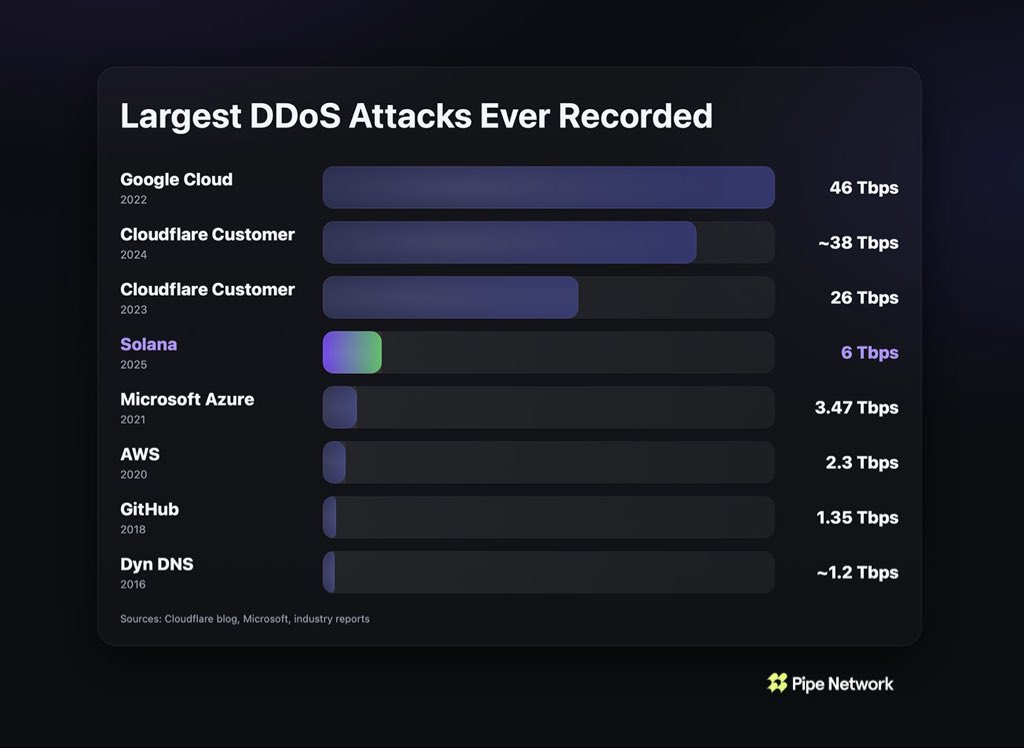
Pipe Network - Solana DDoS attack

DDoS attacks of this scale have historically targeted cloud providers such as Google Cloud and Cloudflare, making Solana’s ability to stay online stand out.

A Clear Contrast With Other Blockchain Disruptions

According to reports, the episode also contrasts with a recent DDoS attack on the Sui network, which resulted in block production delays and degraded performance.

As details of the attack spread, the crypto community took to X to point out the scale of the event and the lack of visible impact on the network.

This has reinforced Solana’s strong reputation as a trustworthy network built to handle heavy demand.


Market Opportunity
Everscale Logo
Everscale Price(EVER)
$0.00867
$0.00867$0.00867
-1.47%
USD
Everscale (EVER) Live Price Chart
Disclaimer: The articles reposted on this site are sourced from public platforms and are provided for informational purposes only. They do not necessarily reflect the views of MEXC. All rights remain with the original authors. If you believe any content infringes on third-party rights, please contact service@support.mexc.com for removal. MEXC makes no guarantees regarding the accuracy, completeness, or timeliness of the content and is not responsible for any actions taken based on the information provided. The content does not constitute financial, legal, or other professional advice, nor should it be considered a recommendation or endorsement by MEXC.

You May Also Like

Kalshi Jumps to 62% Market Share While Polymarket Eyes $10B Valuation

Kalshi Jumps to 62% Market Share While Polymarket Eyes $10B Valuation

The post Kalshi Jumps to 62% Market Share While Polymarket Eyes $10B Valuation appeared on BitcoinEthereumNews.com. Fintech 19 September 2025 | 16:03 Event-based trading platforms are no longer niche experiments – they’re emerging as a major arena where finance, crypto, and information converge. After months of subdued activity, volumes are climbing again, and U.S.-regulated Kalshi has unexpectedly taken the lead. Betting on Everything From Rates to Sports Analysts at Bernstein describe prediction markets as a new “interface for information,” where users speculate not only on sports results but also on Federal Reserve decisions, quarterly earnings, and even crypto price moves. This year alone, more than $200 million changed hands on Polymarket contracts linked to the Fed’s recent 25 bps rate cut, while $85 million traded on Kalshi around the same decision. Mainstream brokers like Coinbase and Robinhood are watching closely, with ambitions to capture some of the momentum. With U.S. sports betting already worth tens of billions annually, the overlap is too big to ignore. Against that backdrop, Kalshi has delivered one of its strongest months since the 2024 elections. The platform reports $1.3 billion in trading volume so far in September, accounting for 62% of global prediction market activity. Just a year ago, Kalshi’s share stood at 3%. CEO Tarek Mansour called the growth “remarkable,” noting that the exchange still serves only U.S. clients. Polymarket’s Pushback Its main rival, Polymarket, has logged about $773 million in trades this month. While that trails Kalshi for now, Polymarket has unique advantages: as a crypto-native platform, it has carved out strong global demand and is working toward a formal U.S. relaunch via its acquisition of derivatives exchange QCEX. The two platforms now stand as the clear leaders of the sector, though they embody different philosophies — one regulated from the ground up, the other built around decentralization. Investors Take Notice The boom hasn’t escaped venture capital. Reports suggest…
Share
BitcoinEthereumNews2025/09/19 21:34
Visa Expands USDC Stablecoin Settlement For US Banks

Visa Expands USDC Stablecoin Settlement For US Banks

The post Visa Expands USDC Stablecoin Settlement For US Banks appeared on BitcoinEthereumNews.com. Visa Expands USDC Stablecoin Settlement For US Banks
Share
BitcoinEthereumNews2025/12/17 15:23
Bitcoin Lightning Network Capacity Surges to Historic Peak as Exchange Adoption Accelerates

Bitcoin Lightning Network Capacity Surges to Historic Peak as Exchange Adoption Accelerates

The Bitcoin Lightning Network has reached an all-time high in total network capacity, marking a significant milestone for the layer-2 scaling solution designed to enable fast and inexpensive Bitcoin transactions. The surge comes as major cryptocurrency exchanges increasingly integrate Lightning functionality, bringing the technology to millions of users who previously relied solely on slower, more expensive on-chain transactions. This capacity expansion reflects growing confidence in Lightning's reliability and utility after years of development and real-world testing. What began as an experimental protocol discussed primarily among technical enthusiasts has matured into infrastructure that some of the industry's largest platforms now consider essential to their operations.
Share
MEXC NEWS2025/12/17 17:14



