The post Is Ethereum Price Building a Base for a 2026 Breakout? appeared first on Coinpedia Fintech News The Ethereum price is currently demonstrating clear structuralThe post Is Ethereum Price Building a Base for a 2026 Breakout? appeared first on Coinpedia Fintech News The Ethereum price is currently demonstrating clear structural

Is Ethereum Price Building a Base for a 2026 Breakout?

Ethereum price

The post Is Ethereum Price Building a Base for a 2026 Breakout? appeared first on Coinpedia Fintech News

The Ethereum price is currently demonstrating clear structural strength in its price action, despite surface-level volatility. Although short-term price movements are still confined to a range, but the hard facts that came from deeper on-chain metrics and the 2025 ETF net flows trend indicate a strong accumulation phase is in progress. This bodes well for a significant upward move brewing for future months.

Ethereum Price and Whale Realized Levels Signal Strong Support

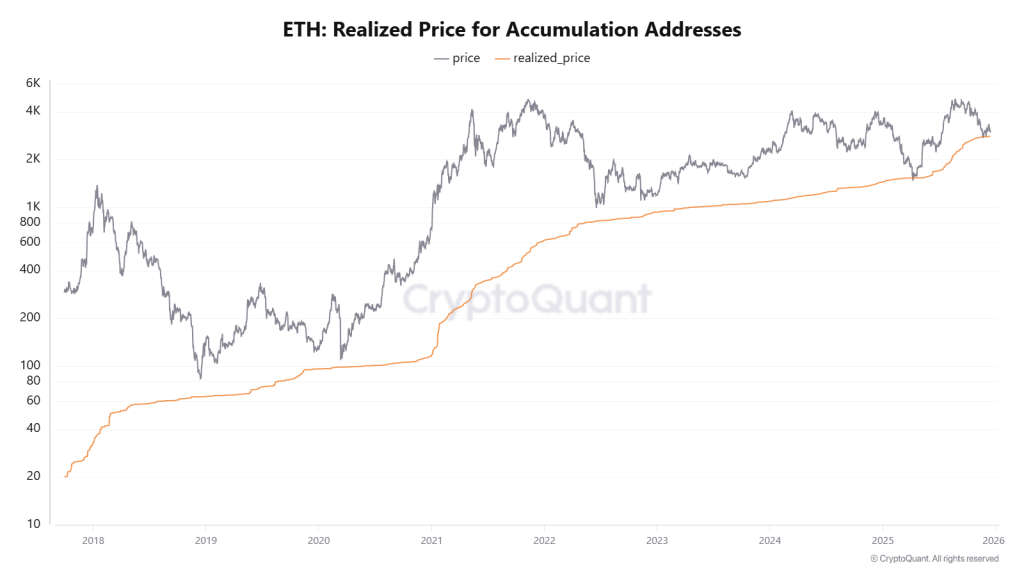
One of the most notable developments on the Ethereum price chart comes from realized price data tied to accumulation addresses. According to on-chain metric chart from CryptoQuant, large holders have steadily increased their cost basis over recent months. In June, the realized price for these accumulation wallet addresses stood near $1,560. Since then, it has climbed toward the $3,000 zone.

This rise in realized price alone reflects consistent buying rather than short-term trading. Importantly, realized price often acts as a psychological and structural support level, where smart money will do everything in power to minimize losses. As long as whales continue accumulating above this zone, it becomes increasingly difficult for the Ethereum price USD to sustain deep breakdowns below it.

Why Whale Accumulation Matters for Ethereum Crypto

Whales typically accumulate with a longer time horizon, especially when preparing for broader market expansions. Their continued buying suggests confidence that current prices represent value rather than excess. This behavior reinforces the idea that downside risks may be absorbed gradually instead of triggering sharp capitulation.
Is Ethereum Price Building a Base for a 2026 Breakout?

From a structural perspective, this accumulation trend places the Ethereum price in a different position compared to speculative-driven rallies. Instead of rapid spikes, price stabilization near rising realized levels often precedes more sustained trend expansions.

Ethereum ETF Flows Reinforce Institutional Confidence

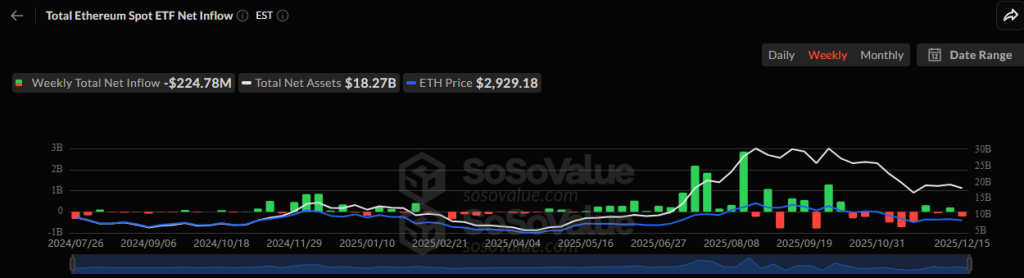
Beyond on-chain data, ETF activity adds another layer of confirmation. Throughout the year, the Ethereum ETF landscape has recorded more weeks of inflows than outflows. This consistency suggests institutional participation is supporting the market, even during periods of broader uncertainty.
Is Ethereum Price Building a Base for a 2026 Breakout?

Notably, since September, the pace of weekly outflows has been declining. This shift points toward improving sentiment rather than distribution. While ETF flows have not triggered immediate upside, they appear to be playing a stabilizing role in maintaining the Ethereum price USD above critical zones.

Aligning On-Chain Data With Ethereum Price Forecast

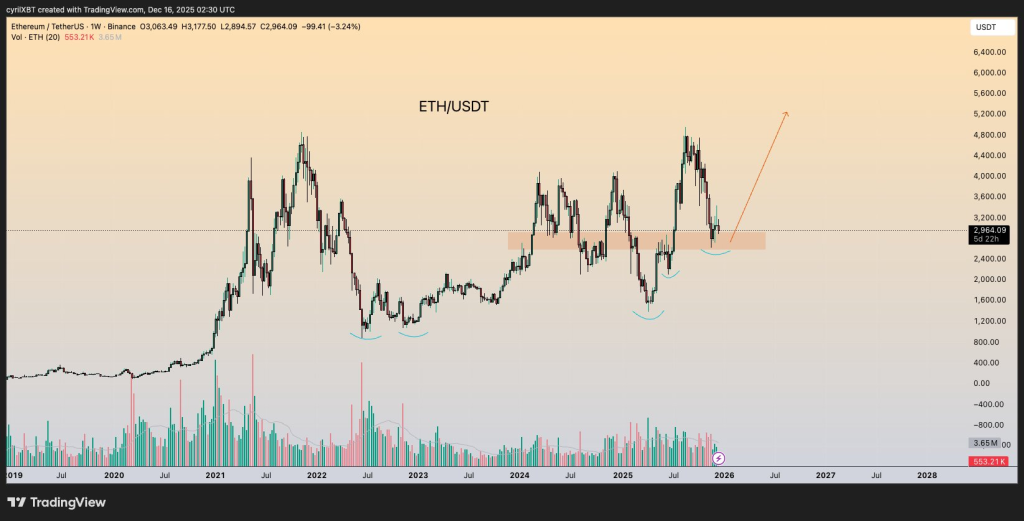
When whale accumulation trends and ETF flows are viewed together, a clearer picture emerges. Rather than signaling exhaustion, current conditions suggest preparation. December may function as a consolidation phase rather than a breakout month.
Is Ethereum Price Building a Base for a 2026 Breakout?

As a result, Ethereum price prediction models increasingly focus on early 2026. If accumulation continues and institutional demand remains steady, projections extend toward higher psychological levels during Q1. This alignment between on-chain conviction and capital flows strengthens longer-term Ethereum price forecast assumptions.


Market Opportunity
Everclear Logo
Everclear Price(CLEAR)
$0.00373
$0.00373$0.00373
0.00%
USD
Everclear (CLEAR) Live Price Chart
Disclaimer: The articles reposted on this site are sourced from public platforms and are provided for informational purposes only. They do not necessarily reflect the views of MEXC. All rights remain with the original authors. If you believe any content infringes on third-party rights, please contact service@support.mexc.com for removal. MEXC makes no guarantees regarding the accuracy, completeness, or timeliness of the content and is not responsible for any actions taken based on the information provided. The content does not constitute financial, legal, or other professional advice, nor should it be considered a recommendation or endorsement by MEXC.

You May Also Like

The Channel Factories We’ve Been Waiting For

The Channel Factories We’ve Been Waiting For

The post The Channel Factories We’ve Been Waiting For appeared on BitcoinEthereumNews.com. Visions of future technology are often prescient about the broad strokes while flubbing the details. The tablets in “2001: A Space Odyssey” do indeed look like iPads, but you never see the astronauts paying for subscriptions or wasting hours on Candy Crush.  Channel factories are one vision that arose early in the history of the Lightning Network to address some challenges that Lightning has faced from the beginning. Despite having grown to become Bitcoin’s most successful layer-2 scaling solution, with instant and low-fee payments, Lightning’s scale is limited by its reliance on payment channels. Although Lightning shifts most transactions off-chain, each payment channel still requires an on-chain transaction to open and (usually) another to close. As adoption grows, pressure on the blockchain grows with it. The need for a more scalable approach to managing channels is clear. Channel factories were supposed to meet this need, but where are they? In 2025, subnetworks are emerging that revive the impetus of channel factories with some new details that vastly increase their potential. They are natively interoperable with Lightning and achieve greater scale by allowing a group of participants to open a shared multisig UTXO and create multiple bilateral channels, which reduces the number of on-chain transactions and improves capital efficiency. Achieving greater scale by reducing complexity, Ark and Spark perform the same function as traditional channel factories with new designs and additional capabilities based on shared UTXOs.  Channel Factories 101 Channel factories have been around since the inception of Lightning. A factory is a multiparty contract where multiple users (not just two, as in a Dryja-Poon channel) cooperatively lock funds in a single multisig UTXO. They can open, close and update channels off-chain without updating the blockchain for each operation. Only when participants leave or the factory dissolves is an on-chain transaction…
Share
BitcoinEthereumNews2025/09/18 00:09
Wyoming-based crypto bank Custodia files rehearing petition against Fed

Wyoming-based crypto bank Custodia files rehearing petition against Fed

The post Wyoming-based crypto bank Custodia files rehearing petition against Fed appeared on BitcoinEthereumNews.com. A Wyoming-based crypto bank has filed another
Share
BitcoinEthereumNews2025/12/16 22:06
US economy adds 64,000 jobs in November but unemployment rate climbs to 4.6%

US economy adds 64,000 jobs in November but unemployment rate climbs to 4.6%

The post US economy adds 64,000 jobs in November but unemployment rate climbs to 4.6% appeared on BitcoinEthereumNews.com. The economy moved in two directions at
Share
BitcoinEthereumNews2025/12/16 22:18



