The post New Whale Buyers Now Drive 50% of Bitcoin’s Realized Cap – A Shift From Old Cycles? appeared first on Coinpedia Fintech News Bitcoin’s price has been volatileThe post New Whale Buyers Now Drive 50% of Bitcoin’s Realized Cap – A Shift From Old Cycles? appeared first on Coinpedia Fintech News Bitcoin’s price has been volatile

New Whale Buyers Now Drive 50% of Bitcoin’s Realized Cap – A Shift From Old Cycles?
Bitcoin Whales Quietly Buying the Dip—Is a $120K Rebound Coming?

The post New Whale Buyers Now Drive 50% of Bitcoin’s Realized Cap – A Shift From Old Cycles? appeared first on Coinpedia Fintech News

Bitcoin’s price has been volatile, but the bigger story right now isn’t the chart. It’s who’s buying and at what levels.

New on-chain data shows that nearly 50% of Bitcoin’s realized cap now comes from new whale buyers, a sharp break from how past Bitcoin cycles played out.

Realized cap tracks the value of Bitcoin at the price each coin last moved on-chain. So when new whales approach a 50% share, it means half of the capital invested in Bitcoin was formed at recent price levels, not during early low-cost accumulation phases.

New Whales Are Playing a Different Game

According to the data, these new whales are mainly institutions and ETFs buying Bitcoin at higher prices and in larger volumes. That alone sets them apart from long-term holders who accumulated cheaply and sold into strength during previous bull runs.

More importantly, their behavior during pullbacks looks different.

This should not be interpreted as a short-term bullish or bearish signal, but as evidence that the structure of the Bitcoin market itself is changing, the report adds.
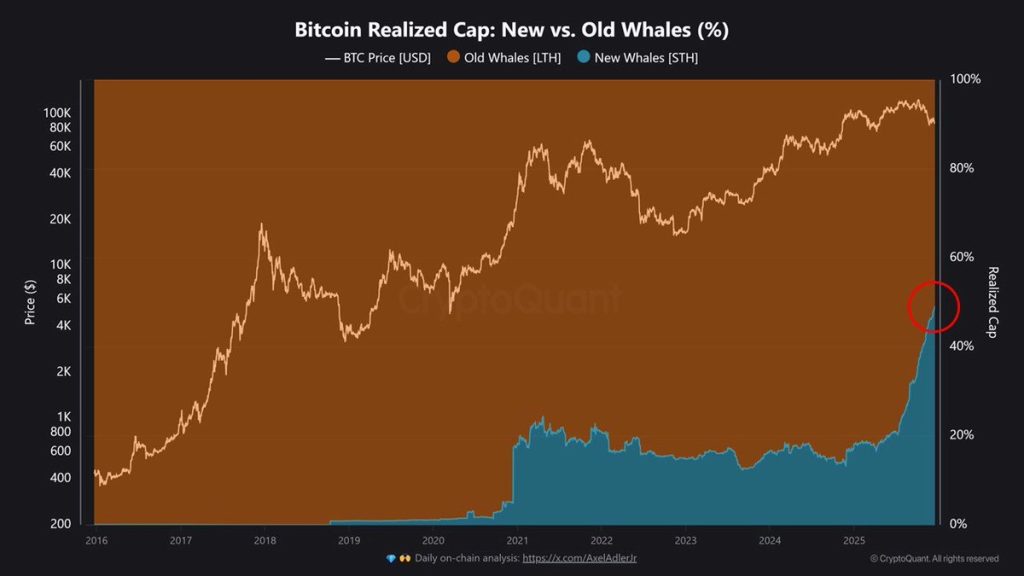
bitcoin realized cap

Demand Is Rising, Not Rotating

Short-term holder data backs this up. Supply held by coins younger than 155 days grew by roughly 100,000 BTC in 30 days, reaching an all-time high. That suggests fresh demand is still coming in, even as prices fluctuate.

  • Also Read :
  •   Are Banks Trying to Kill Stablecoin Rewards? 125 Crypto Groups Push Back
  •   ,

At the same time, long-term holders remain mostly inactive. Exchange flows show that selling pressure came largely from smaller participants, while large wallets stepped in to absorb supply.

Cumulative volume delta data reinforces this split. Whale wallets posted a positive $135 million delta, while retail and mid-sized traders showed negative flows.

What This Shift Really Signals

This data points to something deeper.

Bitcoin is entering a transition toward a more mature asset shaped by sustained institutional accumulation.

For a market long defined by boom-and-bust cycles, that change matters. And it may explain why Bitcoin’s behavior is starting to look less familiar and more structural with each passing month.

Never Miss a Beat in the Crypto World!

Stay ahead with breaking news, expert analysis, and real-time updates on the latest trends in Bitcoin, altcoins, DeFi, NFTs, and more.

bell icon Subscribe to News

FAQs

Does higher institutional participation make Bitcoin less risky for everyday investors?

Not necessarily. While institutional buyers can stabilize liquidity and reduce extreme volatility over time, they can also introduce new risks, such as synchronized reactions to macro events, regulatory changes, or ETF inflows/outflows. Retail investors may face sharper moves tied to traditional financial markets rather than purely crypto-native cycles.

What happens if prices fall sharply while new whales hold most of the recent capital?

The response may differ from past cycles. Instead of panic selling, institutions may hedge, rebalance, or add exposure at predefined levels. This could lead to faster stabilization—but if forced liquidations occur (for example, due to macro stress), downside moves could still be abrupt.

Who benefits most from this evolving market structure?

Long-term participants and infrastructure providers—such as custodians, derivatives platforms, and on-chain analytics firms—stand to benefit from a more capital-heavy, institutionally driven Bitcoin market. Short-term speculators, meanwhile, may find fewer momentum-driven opportunities than in earlier cycles.


Market Opportunity
Nowchain Logo
Nowchain Price(NOW)
$0.00201
$0.00201$0.00201
-4.28%
USD
Nowchain (NOW) Live Price Chart
Disclaimer: The articles reposted on this site are sourced from public platforms and are provided for informational purposes only. They do not necessarily reflect the views of MEXC. All rights remain with the original authors. If you believe any content infringes on third-party rights, please contact service@support.mexc.com for removal. MEXC makes no guarantees regarding the accuracy, completeness, or timeliness of the content and is not responsible for any actions taken based on the information provided. The content does not constitute financial, legal, or other professional advice, nor should it be considered a recommendation or endorsement by MEXC.

You May Also Like

Stijgt de Solana koers naar $150 door institutioneel treasury gebruik?

Stijgt de Solana koers naar $150 door institutioneel treasury gebruik?

Solana staat centraal in een nieuwe ontwikkeling binnen corporate treasury management. Mangocueticals heeft samen met Cube Group een formele SOL treasury strategie
Share
Coinstats2025/12/20 23:16
CEO Sandeep Nailwal Shared Highlights About RWA on Polygon

CEO Sandeep Nailwal Shared Highlights About RWA on Polygon

The post CEO Sandeep Nailwal Shared Highlights About RWA on Polygon appeared on BitcoinEthereumNews.com. Polygon CEO Sandeep Nailwal highlighted Polygon’s lead in global bonds, Spiko US T-Bill, and Spiko Euro T-Bill. Polygon published an X post to share that its roadmap to GigaGas was still scaling. Sentiments around POL price were last seen to be bearish. Polygon CEO Sandeep Nailwal shared key pointers from the Dune and RWA.xyz report. These pertain to highlights about RWA on Polygon. Simultaneously, Polygon underlined its roadmap towards GigaGas. Sentiments around POL price were last seen fumbling under bearish emotions. Polygon CEO Sandeep Nailwal on Polygon RWA CEO Sandeep Nailwal highlighted three key points from the Dune and RWA.xyz report. The Chief Executive of Polygon maintained that Polygon PoS was hosting RWA TVL worth $1.13 billion across 269 assets plus 2,900 holders. Nailwal confirmed from the report that RWA was happening on Polygon. The Dune and https://t.co/W6WSFlHoQF report on RWA is out and it shows that RWA is happening on Polygon. Here are a few highlights: – Leading in Global Bonds: Polygon holds 62% share of tokenized global bonds (driven by Spiko’s euro MMF and Cashlink euro issues) – Spiko U.S.… — Sandeep | CEO, Polygon Foundation (※,※) (@sandeepnailwal) September 17, 2025 The X post published by Polygon CEO Sandeep Nailwal underlined that the ecosystem was leading in global bonds by holding a 62% share of tokenized global bonds. He further highlighted that Polygon was leading with Spiko US T-Bill at approximately 29% share of TVL along with Ethereum, adding that the ecosystem had more than 50% share in the number of holders. Finally, Sandeep highlighted from the report that there was a strong adoption for Spiko Euro T-Bill with 38% share of TVL. He added that 68% of returns were on Polygon across all the chains. Polygon Roadmap to GigaGas In a different update from Polygon, the community…
Share
BitcoinEthereumNews2025/09/18 01:10
ViaHonest Introduces a Next-Generation RWA Marketplace for Authentic Physical Goods.

ViaHonest Introduces a Next-Generation RWA Marketplace for Authentic Physical Goods.

Summary: ViaHonest, a top-notch platform, has unleashed digital certificates of authenticity, tamper-proof item identifiers, and a transparent 2.5% commission,
Share
Techbullion2025/12/20 23:46