TLDR: Circle’s IPO reinforced transparency and regulatory trust for stablecoin adoption. USDC expanded to 30 blockchains, boosting liquidity and crosschain transfersTLDR: Circle’s IPO reinforced transparency and regulatory trust for stablecoin adoption. USDC expanded to 30 blockchains, boosting liquidity and crosschain transfers

How Circle’s IPO and USDC Expansion Shaped Digital Finance in 2025

TLDR:

  • Circle’s IPO reinforced transparency and regulatory trust for stablecoin adoption.
  • USDC expanded to 30 blockchains, boosting liquidity and crosschain transfers.
  • Arc blockchain enabled enterprise-grade financial workflows and onchain settlement.
  • Applications like CPN and StableFX facilitated faster global payments and FX operations.

Circle’s IPO and stablecoin expansion in 2025 played a pivotal role in advancing internet-native financial infrastructure. 

By combining regulatory alignment, asset growth, and technological innovation, Circle strengthened the adoption of digital dollars across global markets. 

The company focused on integrating USDC, EURC, and USYC into mainstream financial workflows, moving digital assets from experimental tools to operational instruments.

The IPO, coupled with conditional approval for a national trust charter, reinforced institutional confidence and transparency. 

Circle leveraged this momentum to scale USDC across multiple blockchains, expand liquidity, and integrate it into cross-border payments, FX, and treasury operations. These initiatives positioned Circle as a central player in modernizing digital finance.

IPO and Regulatory Foundations

Circle’s IPO marked a critical step toward operating at the core of regulated financial markets. Conditional approval for the First National Digital Currency Bank, N.A., strengthened federal oversight over USDC reserves, supporting safe custody and fiduciary services for institutional clients.

Regulatory clarity in the U.S. under the GENIUS Act established fully reserved stablecoins as a legal foundation for financial infrastructure. 

In Europe, MiCA-compliant stablecoins, including USDC and EURC, gained acceptance, while Dubai and Abu Dhabi recognized Circle’s digital assets for cross-border payments and treasury operations.

These frameworks encouraged banks, fintechs, and exchanges to integrate stablecoins into their core systems. 

Circle’s platforms, such as CPN and Circle Gateway, incorporated compliance tools, enabling partners to adopt digital assets confidently without building separate infrastructure.

USDC Expansion and Market Integration

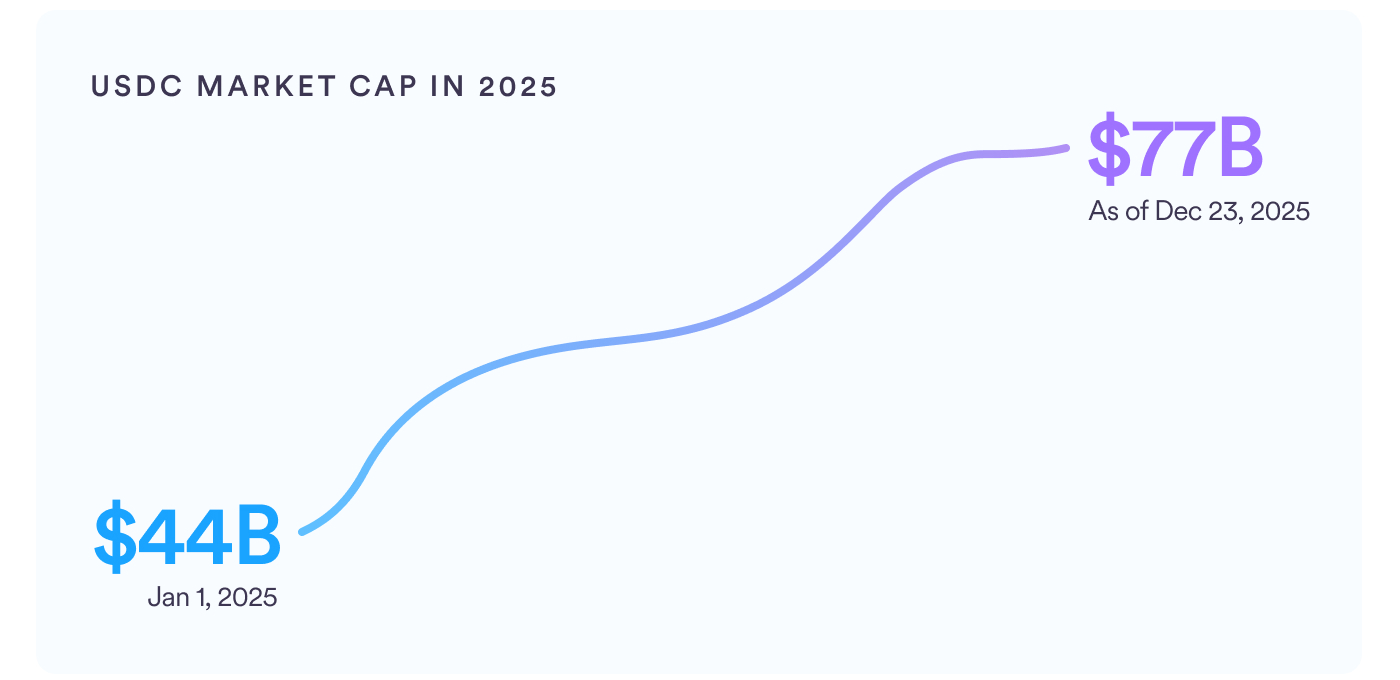
USDC experienced substantial growth throughout 2025, with market capitalization reaching $77 billion by December. Native support expanded across 30 blockchains, while CCTP enabled crosschain transfers, making USDC a cornerstone of internet-native liquidity.
Source: Circle 

Exchanges such as Binance, Kraken, Bybit, and OKX increased USDC depth and trading volumes, improving market resilience and execution efficiency.

EURC also gained prominence as Europe’s largest euro-denominated stablecoin under MiCA, supporting payments and FX flows. 

USYC, Circle’s tokenized money market fund, saw assets grow to $1.54 billion, providing institutional-grade, yield-bearing collateral with real-time onchain settlement.

This expansion strengthened Circle’s role as a provider of operational cash and collateral for global markets. Financial institutions leveraged USDC and USYC for treasury operations, cross-border settlement, and capital market workflows.

Applications, Infrastructure, and Real-World Use

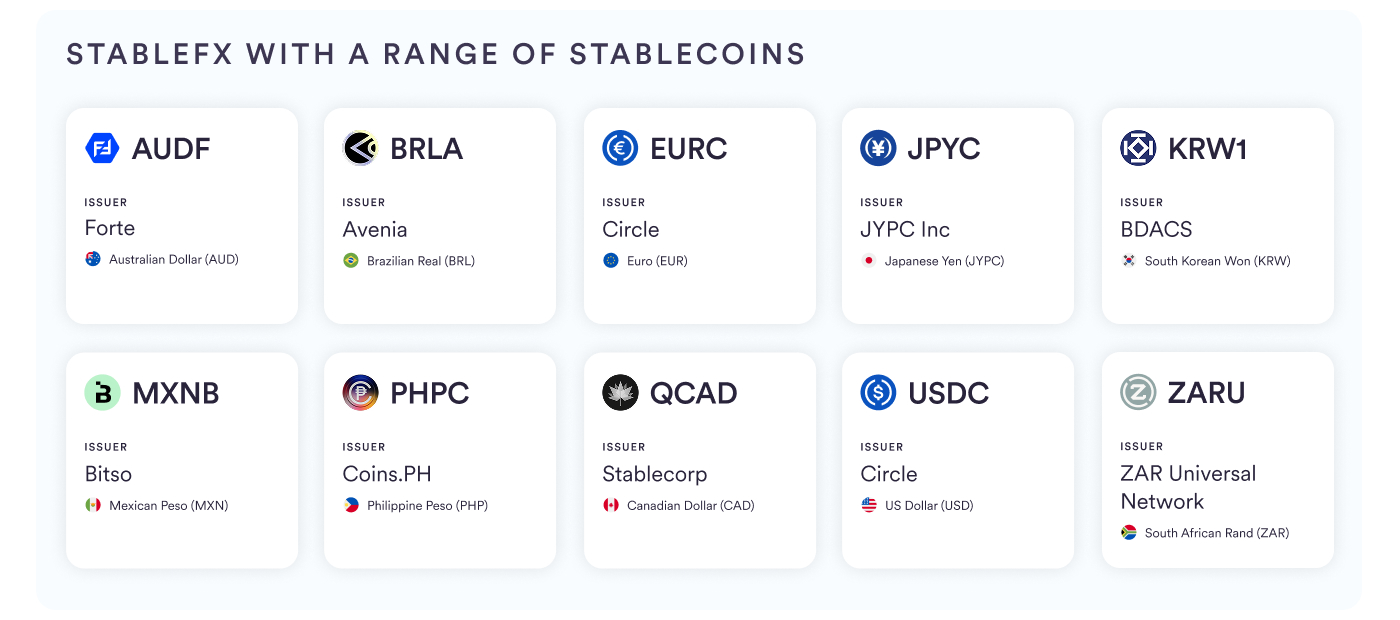
Circle extended the utility of USDC and other assets through applications like CPN, StableFX, Mint, Gateway, and Wallets. 

CPN enabled near-instant cross-border payments, reducing operational delays for businesses and remittance services. StableFX offered onchain FX execution for multiple currencies, including regional stablecoins.
Source: Circle

Arc, Circle’s EVM-compatible Layer-1 blockchain, provided a high-performance environment for real-world economic activity. Institutions and developers tested financial workflows, credit, FX, and autonomous agent payments. 

AI-driven payments and machine-to-machine transactions demonstrated new capabilities for programmable finance.

Real-world adoption also included payroll, remittances, and small-business finance. Partners such as Nubank and Thunes used USDC to deliver faster, more reliable services to users, while the Circle Foundation advanced financial inclusion in underserved communities.

Through its IPO, regulatory compliance, and USDC expansion, Circle positioned itself as a central driver of digital finance in 2025. 

Its full-stack ecosystem, combining digital assets, applications, and Arc blockchain, established a foundation for scalable, internet-native financial infrastructure.

The post How Circle’s IPO and USDC Expansion Shaped Digital Finance in 2025 appeared first on Blockonomi.


Market Opportunity
USDCoin Logo
USDCoin Price(USDC)
$1.0004
$1.0004$1.0004
0.00%
USD
USDCoin (USDC) Live Price Chart
Disclaimer: The articles reposted on this site are sourced from public platforms and are provided for informational purposes only. They do not necessarily reflect the views of MEXC. All rights remain with the original authors. If you believe any content infringes on third-party rights, please contact service@support.mexc.com for removal. MEXC makes no guarantees regarding the accuracy, completeness, or timeliness of the content and is not responsible for any actions taken based on the information provided. The content does not constitute financial, legal, or other professional advice, nor should it be considered a recommendation or endorsement by MEXC.

You May Also Like

Shiba Inu Price Stalls Near Lows – What Could Matter in 2026 For SHIB To Takeoff?

Shiba Inu Price Stalls Near Lows – What Could Matter in 2026 For SHIB To Takeoff?

Shiba Inu has had a tough year, and its not hiding on the chart. TheCryptoBasic shared on X that the SHIB price has printed its first-ever weekly death cross in
Share
Coinstats2025/12/25 06:00
Unleashing A New Era Of Seller Empowerment

Unleashing A New Era Of Seller Empowerment

The post Unleashing A New Era Of Seller Empowerment appeared on BitcoinEthereumNews.com. Amazon AI Agent: Unleashing A New Era Of Seller Empowerment Skip to content Home AI News Amazon AI Agent: Unleashing a New Era of Seller Empowerment Source: https://bitcoinworld.co.in/amazon-ai-seller-tools/
Share
BitcoinEthereumNews2025/09/18 00:10
South Korea Blockchain Industry: Eric Trump’s Amazing Vision for Asia’s Digital Future

South Korea Blockchain Industry: Eric Trump’s Amazing Vision for Asia’s Digital Future

BitcoinWorld South Korea Blockchain Industry: Eric Trump’s Amazing Vision for Asia’s Digital Future Eric Trump, co-founder of World Liberty Financial (WLFI) and the second son of President Donald Trump, recently made a compelling statement that has resonated throughout the global digital asset community. Speaking via video message to the prestigious Korea Blockchain Week 2025 conference in Seoul, he highlighted the undeniable potential of the South Korea blockchain industry. Trump expressed profound admiration for the nation’s remarkable passion and dynamic energy for blockchain technology, declaring it uniquely positioned to lead Asia’s digital future. What Fuels South Korea’s Blockchain Passion? During his recent travels, which included visits to bustling Hong Kong and technologically advanced Japan, Trump observed a distinct difference. He noted that few countries rival South Korea’s fervent enthusiasm and exceptional proficiency in virtual assets. This isn’t just a casual interest; it’s a deep-seated commitment that permeates various levels of society and business. The nation’s rapid adoption rates, innovative startup ecosystem, and a tech-savvy population create fertile ground for blockchain advancements. This collective drive ensures that the South Korea blockchain industry remains at the forefront of innovation, consistently pushing boundaries and exploring new applications for distributed ledger technology. How is South Korea Building a Robust Blockchain Framework? A critical factor underpinning South Korea’s rise is its proactive approach to regulation and institutional support. Trump specifically emphasized that the country’s rapidly developing institutional and legal framework is unrivaled across Asia. This robust foundation provides much-needed clarity and security for both developers and investors. Key aspects of this evolving framework include: Clearer Regulatory Guidelines: Efforts to establish comprehensive rules for virtual assets, fostering a more stable environment. Government Support: Initiatives and funding programs aimed at boosting blockchain research and development. Industry Collaboration: Strong partnerships between government bodies, academic institutions, and private enterprises to drive innovation. This strategic development is a clear indicator that the South Korea blockchain industry is not only embracing the future but actively shaping it with foresight and meticulous planning. Korea Blockchain Week: A Global Stage for the South Korea Blockchain Industry The Korea Blockchain Week (KBW) conference itself serves as a testament to the nation’s leadership. Trump lauded the event for its consistent success in bringing together diverse blockchain communities for years, evolving into a truly global festival for blockchain and Web3. KBW acts as a vital nexus, facilitating: Knowledge Exchange: Experts share insights on the latest trends and technological breakthroughs. Networking Opportunities: Connecting innovators, investors, and policymakers from around the world. Showcasing Innovation: Providing a platform for emerging projects and established players within the South Korea blockchain industry to demonstrate their advancements. Such high-profile events solidify South Korea’s reputation as a pivotal hub for digital innovation, drawing international attention and investment. What Does South Korea’s Blockchain Leadership Mean for Asia and Beyond? Eric Trump’s confident assertion that South Korea is set to establish itself as a leader in the blockchain industry carries significant weight. This leadership isn’t just about domestic success; it has profound implications for the broader Asian market and the global blockchain landscape. South Korea’s advancements can serve as a blueprint for other nations seeking to harness the power of blockchain. Its regulatory successes, technological innovations, and vibrant community can inspire and guide regional development. The nation’s commitment to fostering a dynamic environment ensures that the South Korea blockchain industry will continue to attract talent and capital, driving forward the evolution of Web3 technologies. Challenges remain, of course, including global regulatory harmonization and scaling solutions. However, South Korea’s proven dedication positions it exceptionally well to navigate these complexities and emerge as a dominant force. In conclusion, Eric Trump’s observations at Korea Blockchain Week 2025 underscore a powerful truth: South Korea is not merely participating in the blockchain revolution; it is actively leading it. With unparalleled passion, a robust legal and institutional framework, and a commitment to fostering global collaboration, the South Korea blockchain industry is undeniably poised for extraordinary growth. Its journey promises to shape the future of digital assets and Web3, not just in Asia, but across the entire world. Frequently Asked Questions (FAQs) Q1: Why is Eric Trump commenting on the South Korea blockchain industry? Eric Trump, as co-founder of World Liberty Financial (WLFI), is involved in the financial sector and has a keen interest in emerging technologies like blockchain. His comments highlight the global recognition of South Korea’s significant advancements in this field. Q2: What makes South Korea’s blockchain framework “unrivaled in Asia”? South Korea has been proactive in developing comprehensive institutional and legal frameworks for virtual assets. This includes clearer regulatory guidelines, government support for R&D, and strong industry collaboration, providing a stable and secure environment for blockchain innovation. Q3: What is Korea Blockchain Week (KBW)? Korea Blockchain Week (KBW) is a major annual conference in Seoul that brings together diverse blockchain communities. It serves as a global festival for blockchain and Web3, facilitating knowledge exchange, networking, and showcasing innovations from the global and local industry. Q4: What does South Korea’s leadership mean for the future of Web3? South Korea’s leadership in the blockchain industry means it can serve as a blueprint for other nations. Its innovations, regulatory successes, and vibrant community will likely inspire and guide regional and global development, driving the evolution and adoption of Web3 technologies worldwide. Q5: Are there any challenges for the South Korea blockchain industry? While poised for leadership, the South Korea blockchain industry still faces challenges such as navigating global regulatory harmonization, ensuring scalability of solutions, and addressing ongoing security concerns common to the broader crypto space. However, its robust framework positions it well to tackle these. If you found this insight into the dynamic South Korea blockchain industry valuable, please consider sharing it with your network! Spread the word about Asia’s potential leader in digital innovation. To learn more about the latest crypto market trends, explore our article on key developments shaping the blockchain industry’s institutional adoption. This post South Korea Blockchain Industry: Eric Trump’s Amazing Vision for Asia’s Digital Future first appeared on BitcoinWorld.
Share
Coinstats2025/09/23 11:05