Bitcoin Nears Red Yearly Close: Galaxy Digital Explains The Setup
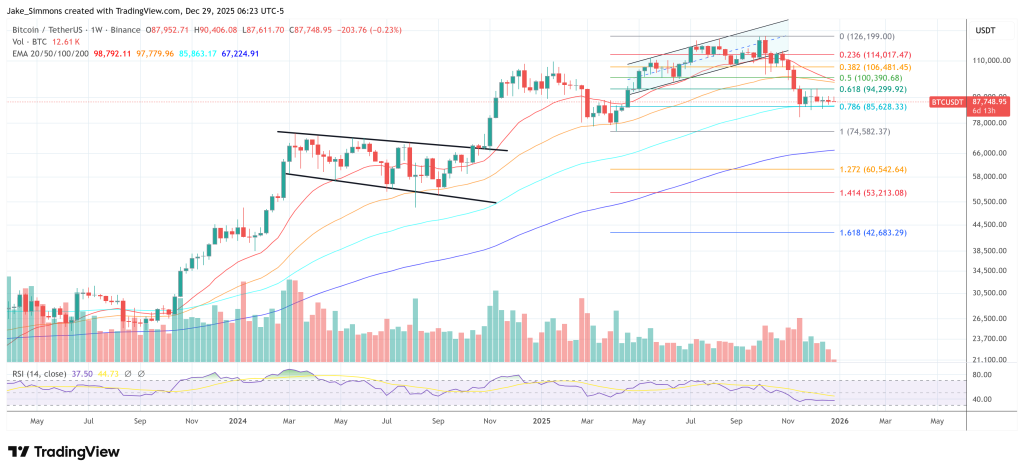
Bitcoin is heading into New Year’s Eve on the verge of printing a red yearly candle, an awkward setup after a year packed with pro-crypto policy and institutional headlines. Galaxy Digital head of research Alex Thorn said BTC is down 6.3% year-to-date and 8.25% year-over-year, and would need a daily close above $93,389 on New Year’s Eve to finish 2025 positive.
The late-year mood has been defined by a soft Q4 tape and a deeper drawdown than many bulls expected this late in the cycle. Thorn noted BTC traded as low as roughly 36% below its Oct. 6, 2025 all-time high of $125,296, even as a steady stream of bullish headlines landed throughout the year.
“Despite the tepid finish, 2025 was a banner year for Bitcoin. Even Bitcoin’s staunchest supporters wouldn’t have believed some of 2025’s headlines just a few years ago… 2025 has been filled with dozens of positive headlines for Bitcoin that in the past would have sparked euphoria. Today, these victories feel like par for the course. Maybe we really are ‘tired of winning?’” Thorn wrote in Galaxy’s weekly research note.
Bitcoin On Verge Of Red Yearly Candle
Thorn argued that part of the market’s stalled feel is mechanical, not philosophical. He pointed to a large month-end options expiry as a potential catalyst for loosening the range-bound behavior he described between the mid-$80,000s and $90,000.
Related Reading: Why $100,000 Is Bitcoin’s Most Important Resistance Level
“A significant options expiry at the end of the month clear some of the outstanding dealer gamma that has encouraged bitcoin to stay pinned between major $85k and $90k, and January may prompt some portfolio managers to take a fresh look at the world’s oldest cryptocurrency. There are reasons why the quiet period we’ve seen for the last month will not persist in the near term.”
He also cited headwinds that hit spot demand and risk appetite: “significant whale distribution,” an Oct. 10 leverage wipeout, and competition from other macro trades such as AI, hyperscalers, gold, and the “Mag 7.” One of Thorn’s key observations was the divergence between bitcoin’s drawdown and US bitcoin ETF behavior.
He said US bitcoin ETF cumulative inflows are down only 9% from their October peak of $62 billion, even though bitcoin fell sharply from its highs and, in his estimate, 60% of ETF inflows are underwater at current prices.
That resilience, he argued, makes the source of selling more notable. “So, who has been selling?” Thorn wrote. “The call is coming from inside the house.” Since July 2025, he said coins held by long-term holders have declined more sharply than at any point in the eight years since the 2017 bull run, suggesting older on-chain holders have been net sellers into newer brokerage-led demand.
Thorn framed that distribution as painful in the short run but constructive for the asset’s long-run maturity, lifting the average cost basis and broadening ownership. He highlighted bitcoin’s realized market cap above $1.1 trillion and a realized price above $56,000 as evidence of the network’s rising aggregate principal.
In a Dec. 21 post summarizing Galaxy’s 2026 outlook, Thorn said Galaxy predicts bitcoin to hit $250,000 by year-end 2027, while calling 2026 “too chaotic to predict.” Options markets, he noted, are currently pricing roughly equal odds of $70,000 or $130,000 by end-June 2026, and $50,000 or $250,000 by year-end 2026, reflecting unusually wide uncertainty bands.
He also pointed to a structural decline in longer-term volatility and a changed skew: the BTC vol smile now prices puts as more expensive than calls, which he described as a shift toward patterns more typical of macro assets than high-growth markets.
Looking into 2026, Thorn’s near-term marker is whether BTC can “firmly re-establish” itself above $100,000–$105,000. Over the longer run, he argued the bigger story is demand for non-dollar hedges—and how little incremental allocation might be needed to move the market.
“We believe it is likely only a matter of time before ‘Bitcoin follows gold to become widely adopted as a monetary debasement hedge.’ It doesn’t take much to start a stampede in that direction – a few major allocators, central banks, or nation states might be all it takes to spark the fuse and light a fire.”
At press time, BTC traded at $87,748.
You May Also Like

The Channel Factories We’ve Been Waiting For

Trading time: Tonight, the US GDP and the upcoming non-farm data will become the market focus. Institutions are bullish on BTC to $120,000 in the second quarter.