

WLFI Price Drops 56% as Political Hype Fails to Hold
This article was first published on The Bit Journal.
The WLFI price drop has shocked analysts and traders as the political buzz around this token fails to translate into sustained gains. Launched with high expectations and deep political connections, the native token of World Liberty Financial now trades sharply lower than its peak, raising questions about risk, sentiment, and long-term viability.
According to the source, WLFI’s launch saw strong interest, but momentum faded quickly as the token struggled to hold higher price levels. This broader market cooldown and critique of political involvement have played a heavy role in the ongoing WLFI price drop.
A Token Built on Political Momentum Faces Technical Barriers
In its first months, WLFI gained attention not because of deep DeFi fundamentals, but due to its association with political figures and promises of expansion into real-world assets. Early price charts show the WLFI price drop accelerating as sellers repeatedly outpaced buyers at key resistance around $0.20–$0.24. Volume data confirms cooling interest, typical of tokens that lack broad organic demand.
Such patterns suggest that traders now view the WLFI token not as a high-conviction investment, but as a speculative play tied to external narratives rather than technical strength or use cases.
 WLFI Price Trend Since September Shows a Sharp 56% Decline
Massive Fundraising Efforts Did Not Translate Into Stability
World Liberty Financial and its partners conducted significant fundraising to support the project. A key development was a $1.5 billion capital raise aimed at establishing a corporate treasury strategy focused on the WLFI token. This involved issuing shares and integrating the token into broader financial structures.
Even with this infusion, markets reacted cautiously. Large capital events can sometimes signal confidence, but they can also create pressure on price if investors treat token sales as exits. For WLFI, visibility around the fundraising coincided with heightened scrutiny and volatility, contributing to the ongoing WLFI price drop.
Regulatory Scrutiny Clouds Confidence
As the WLFI price drop continued, regulatory attention grew louder. Lawmakers and market observers questioned political influence and governance clarity. The close link between a major political family and a crypto project pushed WLFI into a wider debate over conflicts of interest in decentralized finance.
While the project denied any wrongdoing, uncertainty alone weakened confidence. In crypto markets, unanswered questions often matter as much as facts, and this hesitation added pressure to the ongoing WLFI price drop.
Community Friction And Market Psychology
Market sentiment has worked against the WLFI token. Debates over governance, security, and token control divided the community. Some investors pushed for buybacks or burns, while others worried about too much centralized power.
That split slowed recovery. When holders disagree, trust fades, and price action often stalls. The prolonged WLFI price drop shows how investor psychology can weigh just as heavily as fundamentals.
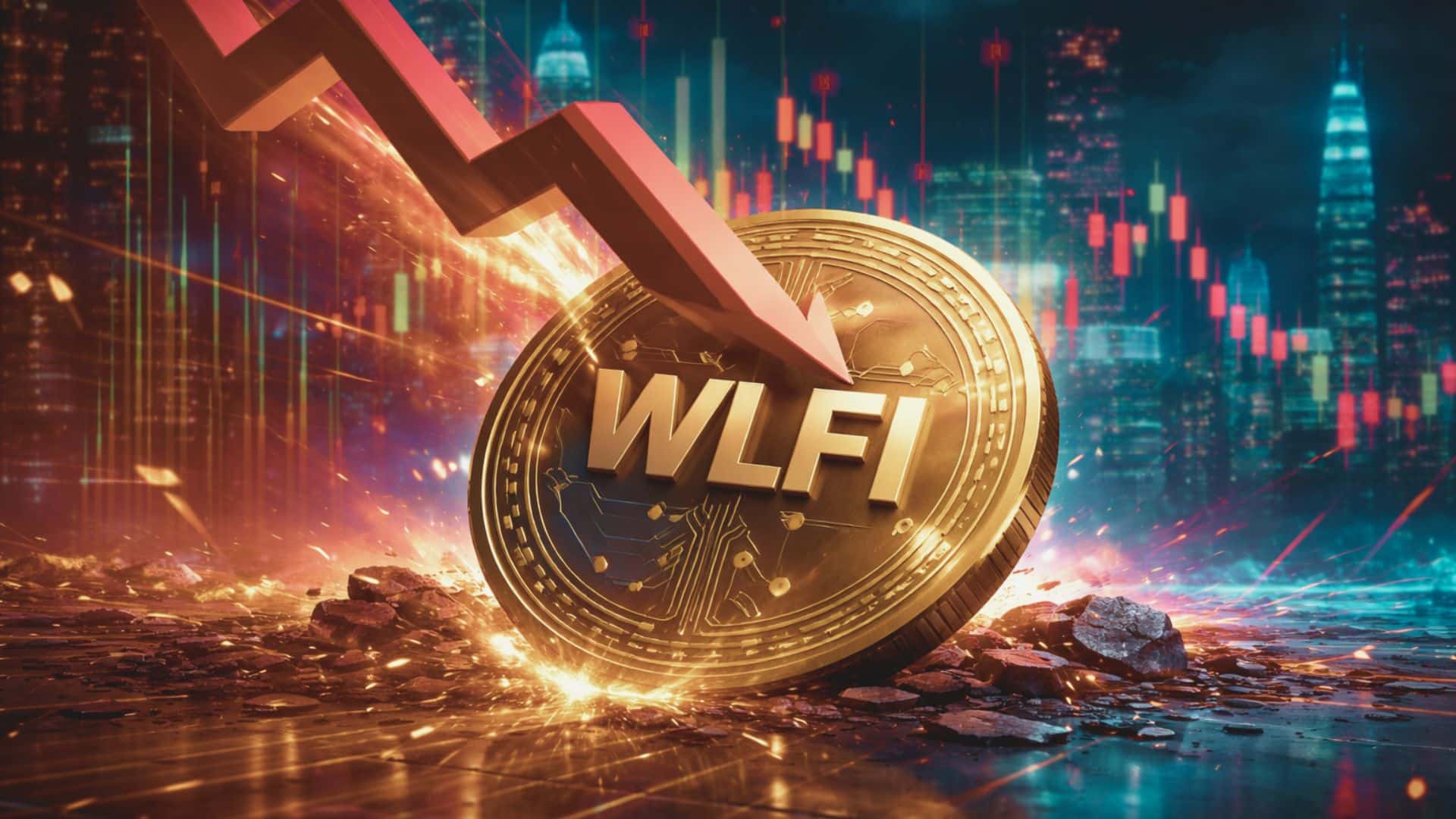 WLFI Price Drop Hits 56% as Regulatory Doubts Grow Louder
The Way Forward: Utility Over Hype
Looking ahead, the fate of the WLFI token may depend less on headlines and more on clear utility. Plans to expand into real-world assets and integrate with existing DeFi protocols could give the project new life if executed transparently and with strong community engagement. Clearer use cases can help move WLFI away from being perceived as primarily a politically linked experiment.
Conclusion
The WLFI price drop is a stark lesson in how markets reward substance over signal. Without sustained liquidity, strong adoption, and solid governance, even well-capitalized tokens tied to powerful names can struggle.
For those studying markets, the broader WLFI story offers valuable insights into how narratives, regulation, and psychology interact in modern crypto.
Glossary Of Key Terms
Resistance level: A price range where selling pressure often limits gains.
Liquidity: Ease of buying or selling without affecting price.
Decentralized finance (DeFi): Financial services on public blockchains without central intermediaries.
Token treasury: A reserve of tokens managed to support a project’s operations or strategy.
FAQs About WLFI Price Drop
Why has the WLFI price dropped?
Cooling demand, resistance barriers, and scrutiny have weighed on price.
Is WLFI still traded actively?
Yes, but volume is lower than at launch, reflecting cautious sentiment.
What role did the $1.5B fundraising play?
It boosted visibility but failed to prevent selling pressure and volatility.
Can WLFI recover long-term?
Recovery depends on real-world use, clear utility, and renewed confidence.
Sources/References
KuCoin
Binance
Read More: WLFI Price Drops 56% as Political Hype Fails to Hold">WLFI Price Drops 56% as Political Hype Fails to Hold
You May Also Like
XRP’s Bearish Market Holds Surprising Short-Term Potential

Shenzhou Machinery Launches Cold-Resistant Industrial Centrifuges at ECWATECH 2025 in Moscow, Accelerates Expansion in Eastern Europe
