In Q1 2025, crypto media in Western Europe entered a phase of noticeable realignment. As the soft enforcement of MiCA began reshaping content boundaries—particularly around what qualifies as promotional—publishers also faced algorithmic turbulence from Google’s March core update and evolving…In Q1 2025, crypto media in Western Europe entered a phase of noticeable realignment. As the soft enforcement of MiCA began reshaping content boundaries—particularly around what qualifies as promotional—publishers also faced algorithmic turbulence from Google’s March core update and evolving…

Q1 2025 reveals crypto media’s visibility reset in Western Europe

In Q1 2025, crypto media in Western Europe entered a phase of noticeable realignment. As the soft enforcement of MiCA began reshaping content boundaries—particularly around what qualifies as promotional—publishers also faced algorithmic turbulence from Google’s March core update and evolving discovery standards across platforms. Many crypto-focused outlets—lacking the compliance readiness, structural rigor, and content governance now expected in regulated discovery ecosystems—appeared unprepared for these shifts and saw their reach decline. Yet a small segment not only held ground—they grew.

Building on Outset PR’s earlier report  on Latin America’s crypto media landscape, we analyzed the Q1 2025 performance of 133 publications across Western Europe, including 87 crypto-native and 46 generalist outlets. We break down what the data shows—and how a few standout platforms have found new ways to win the visibility game in crypto media.

Visibility can no longer be assumed

Drawing on SimilarWeb data, we found that between January and March 2025, 82% of crypto-native publications tracked by Outset PR experienced a decline in web traffic. Total traffic fell from 26.57 million visits in January to 22.85 million in February, and then to 22.22 million in March—a cumulative drop of 16.3%.

This was not a one-time anomaly. It marked a turning point shaped by overlapping forces: the soft rollout of MiCA enforcement, evolving definitions of promotional content, Google’s March core algorithm update, new platform content standards, and search behavior shaped by macroeconomic uncertainty.

Traffic concentration follows a power-law pattern

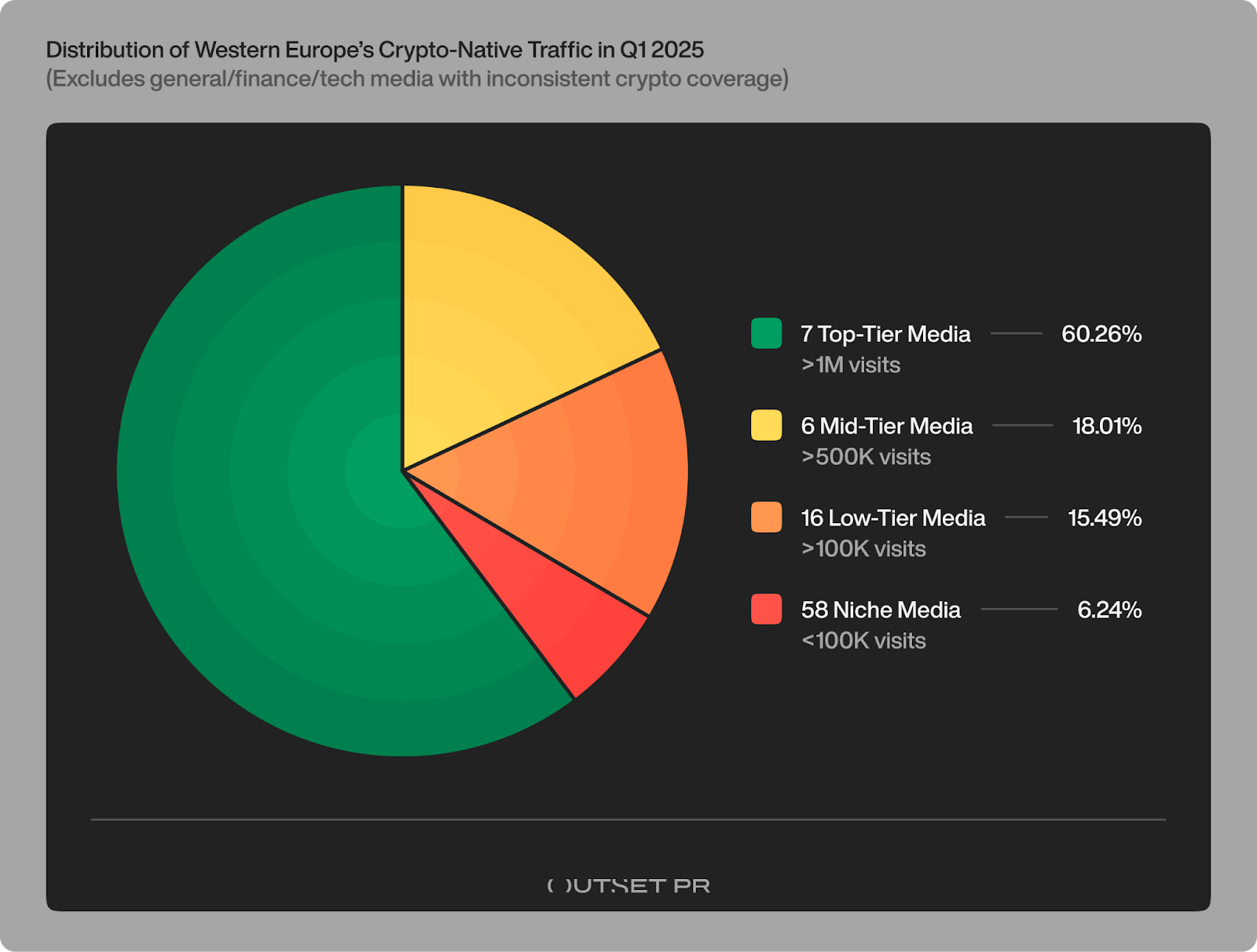
Among the 87 crypto-native publications analyzed, traffic distribution followed a sharp power-law curve—revealing how a small number of high-performing platforms dominate visibility:

  • Only seven outlets exceeded 1 million monthly visits, yet they accounted for 60.26% of all crypto-native traffic. Their edge came from strong regional presence, solid SEO, and the ability to meet compliance standards.
  • The next six outlets, with between 500,000 to 900,000 visits, accounted for 18.01% of total traffic.
  • Sixteen mid-tier outlets (100,000–500,000) contributed just 15.49%, typically showing niche authority without scalable infrastructure.
  • The remaining 58 outlets attracted fewer than 100,000 monthly visits each—collectively representing only 6.24% of total traffic. Notably, this segment includes 13 of Q1’s 16 growing outlets—underscoring that while some platforms are gaining momentum, their absolute reach remains modest. Growth alone does not guarantee influence in a fragmented visibility landscape.
Q1 2025 reveals crypto media’s visibility reset in Western Europe - 1

Distribution of Western Europe’s Crypto-Native Traffic, Q1 2025. Source: Outset PR analysis, based on SimilarWeb data

This stark concentration highlights a growing visibility gap: access to trusted narratives is increasingly filtered through a few structurally resilient channels. 

Country-level hubs of visibility

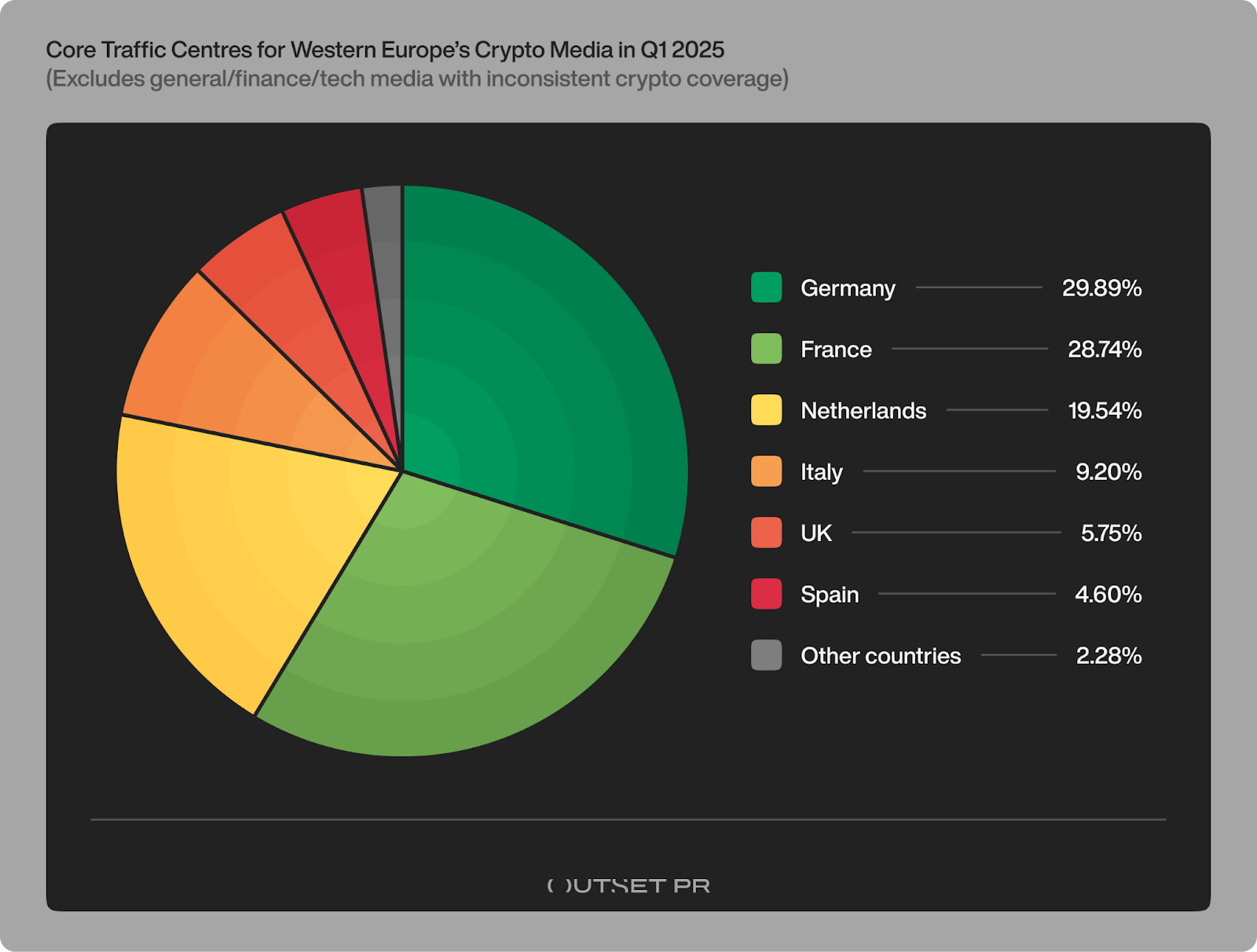
While MiCA applies regionally, traffic and media influence remain concentrated in specific geographic areas:

  • Germany (29.89%) and France (28.74%) emerged as the two largest crypto media hubs, hosting several high-traffic platforms with consistent reach and compliance structures.
  • The Netherlands (19.54%) followed with notable performance, though skewed toward a few leading outlets.
  • Italy (9.20%), the United Kingdom (5.75%) showed more limited reach, with no crypto-native outlet exceeding 500K monthly visits.
  • Spain (4.60%), though lower in total share, stood out as an exception—hosting at least one crypto-native platform with over 1 million monthly visits.
Q1 2025 reveals crypto media’s visibility reset in Western Europe - 2

Core Traffic Centres for Western Europe’s Crypto Media, Q1 2025. Source: Outset PR analysis, based on SimilarWeb data

Markets with mature compliance cultures and robust editorial ecosystems were better positioned to maintain visibility in the post-MiCA environment, while others lacked scalable platforms capable of withstanding regulatory and algorithmic shifts.

Why generalist outlets stayed on top

Generalist outlets held a clear upper hand over crypto-native platforms in Q1 2025. Among the 46 non-crypto-dedicated publications studied, total traffic reached 106.25 million visits—more than four times the combined reach of crypto-native sites. Notably, 19 finance-focused outlets consistently exceeded 1 million monthly visits, accounting for 95.29% of total generalist traffic.

Their edge likely comes from greater editorial depth, topic diversity, and technical infrastructure, allowing them to adapt more easily to shifting market and compliance demands.

A key factor driving this dominance was Google Discover visibility. According to data from SimilarWeb, Ahrefs, and Outset PR’s internal testing, only 29.89% of crypto-native sites were eligible for Discover listings, and just 22.99% had consistent visibility. In contrast, 32.61% of generalist platforms maintained steady Discover presence—giving them a structural advantage in traffic acquisition.

With Discover increasingly favoring structured, compliant, and authoritative content, generalist outlets were better positioned to capture algorithmic preference and sustain long-term reach in a post-MiCA ecosystem.

Lessons from the resilient few

  • Multilingual expansion: Several growing outlets expanded across multiple Western European languages. Regionally adapted domains, clearer disclaimers, and SEO-tuned editorial structures may have helped align with MiCA expectations while preserving visibility.
  • Group infrastructure & compliance support: Top performers often belonged to larger media groups. Shared SEO systems, internal compliance, and performance-focused editorial workflows provided the agility needed to adapt.
  • Niche positioning & local authority: Outlets focused on specific jurisdictions or verticals with structured content and localized credibility showed consistent performance, indicating that specialization offers resilience.
  •  Editorial flexibility: For several Q1 gainers, growth followed visible shifts in editorial strategy: away from repetitive or AI-generated content, and toward informative, transparent, and regulation-aware reporting.

Final thought

Media is how crypto tells its story. And as expectations rise—from platforms, regulators, and users—visibility may increasingly depend on structure, clarity, and responsiveness.

Crypto has always evolved under pressure—and so has the information ecosystem around it. Q1 2025 may mark the start of a new phase: one where presence is filtered not just by reach, but by resilience and readiness.

No longer shaped by volume alone, this environment rewards trust, transparency, and the ability to stay relevant as standards continue to shift. If that trend holds, the outlets adapting today could become tomorrow’s benchmarks in crypto storytelling.


Market Opportunity
Core DAO Logo
Core DAO Price(CORE)
$0.1172
$0.1172$0.1172
-0.42%
USD
Core DAO (CORE) Live Price Chart
Disclaimer: The articles reposted on this site are sourced from public platforms and are provided for informational purposes only. They do not necessarily reflect the views of MEXC. All rights remain with the original authors. If you believe any content infringes on third-party rights, please contact service@support.mexc.com for removal. MEXC makes no guarantees regarding the accuracy, completeness, or timeliness of the content and is not responsible for any actions taken based on the information provided. The content does not constitute financial, legal, or other professional advice, nor should it be considered a recommendation or endorsement by MEXC.

You May Also Like

Crypto News: Donald Trump-Aligned Fed Governor To Speed Up Fed Rate Cuts?

Crypto News: Donald Trump-Aligned Fed Governor To Speed Up Fed Rate Cuts?

The post Crypto News: Donald Trump-Aligned Fed Governor To Speed Up Fed Rate Cuts? appeared on BitcoinEthereumNews.com. In recent crypto news, Stephen Miran swore in as the latest Federal Reserve governor on September 16, 2025, slipping into the board’s last open spot right before the Federal Open Market Committee kicks off its two-day rate discussion. Traders are betting heavily on a 25-basis-point trim, which would bring the federal funds rate down to 4.00%-4.25%, based on CME FedWatch Tool figures from September 15, 2025. Miran, who’s been Trump’s top economic advisor and a supporter of his trade ideas, joins a seven-member board where just three governors come from Democratic picks, according to the Fed’s records updated that same day. Crypto News: Miran’s Background and Quick Path to Confirmation The Senate greenlit Miran on September 15, 2025, with a tight 48-47 vote, following his nomination on September 2, 2025, as per a recent crypto news update. His stint runs only until January 31, 2026, stepping in for Adriana D. Kugler, who stepped down in August 2025 for reasons not made public. Miran earned his economics Ph.D. from Harvard and worked at the Treasury back in Trump’s first go-around. Afterward, he moved to Hudson Bay Capital Management as an economist, then looped back to the White House in December 2024 to head the Council of Economic Advisers. There, he helped craft Trump’s “reciprocal tariffs” approach, aimed at fixing trade gaps with China and the EU. He wouldn’t quit his White House gig, which irked Senator Elizabeth Warren at the September 7, 2025, confirmation hearings. That limited time frame means Miran gets to cast a vote straight away at the FOMC session starting September 16, 2025. The full board now features Chair Jerome H. Powell (Trump pick, term ends 2026), Vice Chair Philip N. Jefferson (Biden, to 2036), and folks like Lisa D. Cook (Biden, to 2028) and Michael S. Barr…
Share
BitcoinEthereumNews2025/09/18 03:14
Fed Makes First Rate Cut of the Year, Lowers Rates by 25 Bps

Fed Makes First Rate Cut of the Year, Lowers Rates by 25 Bps

The post Fed Makes First Rate Cut of the Year, Lowers Rates by 25 Bps appeared on BitcoinEthereumNews.com. The Federal Reserve has made its first Fed rate cut this year following today’s FOMC meeting, lowering interest rates by 25 basis points (bps). This comes in line with expectations, while the crypto market awaits Fed Chair Jerome Powell’s speech for guidance on the committee’s stance moving forward. FOMC Makes First Fed Rate Cut This Year With 25 Bps Cut In a press release, the committee announced that it has decided to lower the target range for the federal funds rate by 25 bps from between 4.25% and 4.5% to 4% and 4.25%. This comes in line with expectations as market participants were pricing in a 25 bps cut, as against a 50 bps cut. This marks the first Fed rate cut this year, with the last cut before this coming last year in December. Notably, the Fed also made the first cut last year in September, although it was a 50 bps cut back then. All Fed officials voted in favor of a 25 bps cut except Stephen Miran, who dissented in favor of a 50 bps cut. This rate cut decision comes amid concerns that the labor market may be softening, with recent U.S. jobs data pointing to a weak labor market. The committee noted in the release that job gains have slowed, and that the unemployment rate has edged up but remains low. They added that inflation has moved up and remains somewhat elevated. Fed Chair Jerome Powell had also already signaled at the Jackson Hole Conference that they were likely to lower interest rates with the downside risk in the labor market rising. The committee reiterated this in the release that downside risks to employment have risen. Before the Fed rate cut decision, experts weighed in on whether the FOMC should make a 25 bps cut or…
Share
BitcoinEthereumNews2025/09/18 04:36
UK Looks to US to Adopt More Crypto-Friendly Approach

UK Looks to US to Adopt More Crypto-Friendly Approach

The post UK Looks to US to Adopt More Crypto-Friendly Approach appeared on BitcoinEthereumNews.com. The UK and US are reportedly preparing to deepen cooperation on digital assets, with Britain looking to copy the Trump administration’s crypto-friendly stance in a bid to boost innovation.  UK Chancellor Rachel Reeves and US Treasury Secretary Scott Bessent discussed on Tuesday how the two nations could strengthen their coordination on crypto, the Financial Times reported on Tuesday, citing people familiar with the matter.  The discussions also involved representatives from crypto companies, including Coinbase, Circle Internet Group and Ripple, with executives from the Bank of America, Barclays and Citi also attending, according to the report. The agreement was made “last-minute” after crypto advocacy groups urged the UK government on Thursday to adopt a more open stance toward the industry, claiming its cautious approach to the sector has left the country lagging in innovation and policy.  Source: Rachel Reeves Deal to include stablecoins, look to unlock adoption Any deal between the countries is likely to include stablecoins, the Financial Times reported, an area of crypto that US President Donald Trump made a policy priority and in which his family has significant business interests. The Financial Times reported on Monday that UK crypto advocacy groups also slammed the Bank of England’s proposal to limit individual stablecoin holdings to between 10,000 British pounds ($13,650) and 20,000 pounds ($27,300), claiming it would be difficult and expensive to implement. UK banks appear to have slowed adoption too, with around 40% of 2,000 recently surveyed crypto investors saying that their banks had either blocked or delayed a payment to a crypto provider.  Many of these actions have been linked to concerns over volatility, fraud and scams. The UK has made some progress on crypto regulation recently, proposing a framework in May that would see crypto exchanges, dealers, and agents treated similarly to traditional finance firms, with…
Share
BitcoinEthereumNews2025/09/18 02:21



