Hyperliquid’s founder is doubling down on what he says is the project’s non-negotiable premise: credibility comes from refusing the usual backroom economics. InHyperliquid’s founder is doubling down on what he says is the project’s non-negotiable premise: credibility comes from refusing the usual backroom economics. In

Hyperliquid Founder Reasserts Hardline Ethos: ‘No Insiders Allowed’

Hyperliquid’s founder is doubling down on what he says is the project’s non-negotiable premise: credibility comes from refusing the usual backroom economics. In a Jan. 1 post on X, Jeff Yan framed “integrity” and “credible neutrality” as design constraints, not marketing language.

Hyperliquid Reaffirms ‘No Insiders’ Ethos

“Integrity has always been one of Hyperliquid’s core values. The house of all finance must be credibly neutral. This means no private investors, no market maker deals, and no protocol fees to any company,” he wrote, drawing a straight line between governance legitimacy and the absence of paid counterparties.

That posture also extends to the origin story. “The initial state of any blockchain is a crucial part of its story that can never be erased. The original ethos of Bitcoin was a permissionless network accessible to all. Hyperliquid’s genesis distribution followed this spirit, going entirely to early users with core contributors excluded,” the post continued, adding that “the full distribution is verifiable onchain without obfuscation.”

The founder acknowledged that this approach is not always convenient for would-be partners or ecosystem builders accustomed to preferential terms. “This principle of fairness frustrates a few users and builders who are used to special treatment,” he said, arguing it forces the community to “do things the hard way”, including “zero tolerance” for “integrity yellow flags” among team members.

It is not the first time he has put the stance in blunt terms. In a January 2024 post, he summarized the policy as: “No investors. No paid market makers. No fees to the dev team… No insiders @HyperliquidX.”

Lighter Debut Sparks Controversy

The timing matters because the on-chain perpetuals category is now fighting not just over latency and liquidity, but over distribution optics, and Hyperliquid’s most visible new rival has become a live case study.

Lighter, an Ethereum-based perpetual futures exchange that also operates as an Ethereum layer-2, launched earlier this week and has climbed quickly in the rankings. On Dec. 30, it airdropped 250 million LIT tokens, 25% of its 1 billion total supply, to early users, with another 25% set aside for future growth programs.

The controversy is the other half. Lighter allocated 50% of supply to employees and investors, subject to a one-year lockup and three-year vesting, a structure that has triggered debate across DeFi about whether “community-first” narratives still hold when insiders retain an equal share of the cap table.

In other words, Lighter’s launch has intensified the same ideological fault line Hyperliquid is trying to own: whether the cleanest on-chain market structure is primarily about product performance or about refusing the incentives that come with investors, paid liquidity, and insider allocations.

At press time, HYPE traded at $24,51.
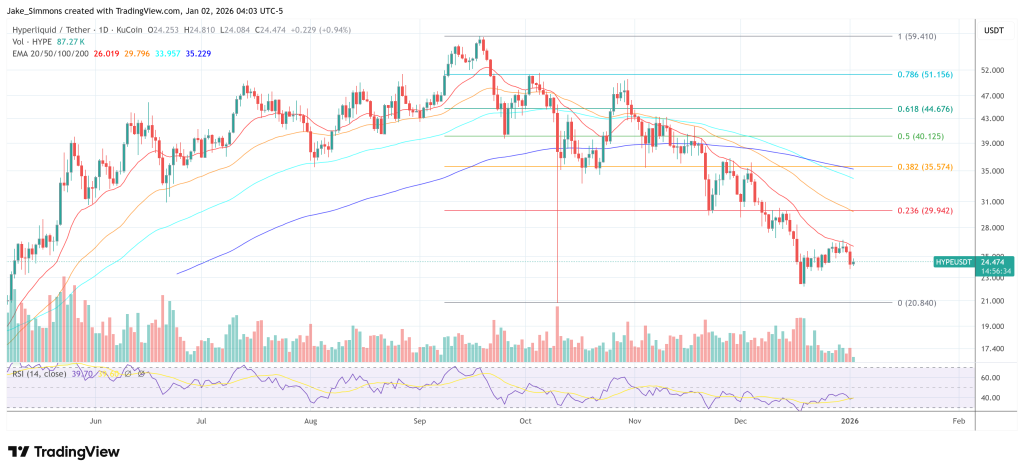
Hyperliquid price chart
Market Opportunity
USUAL Logo
USUAL Price(USUAL)
$0.02817
$0.02817$0.02817
+0.78%
USD
USUAL (USUAL) Live Price Chart
Disclaimer: The articles reposted on this site are sourced from public platforms and are provided for informational purposes only. They do not necessarily reflect the views of MEXC. All rights remain with the original authors. If you believe any content infringes on third-party rights, please contact service@support.mexc.com for removal. MEXC makes no guarantees regarding the accuracy, completeness, or timeliness of the content and is not responsible for any actions taken based on the information provided. The content does not constitute financial, legal, or other professional advice, nor should it be considered a recommendation or endorsement by MEXC.

You May Also Like

CME Group to Launch Solana and XRP Futures Options

CME Group to Launch Solana and XRP Futures Options

The post CME Group to Launch Solana and XRP Futures Options appeared on BitcoinEthereumNews.com. An announcement was made by CME Group, the largest derivatives exchanger worldwide, revealed that it would introduce options for Solana and XRP futures. It is the latest addition to CME crypto derivatives as institutions and retail investors increase their demand for Solana and XRP. CME Expands Crypto Offerings With Solana and XRP Options Launch According to a press release, the launch is scheduled for October 13, 2025, pending regulatory approval. The new products will allow traders to access options on Solana, Micro Solana, XRP, and Micro XRP futures. Expiries will be offered on business days on a monthly, and quarterly basis to provide more flexibility to market players. CME Group said the contracts are designed to meet demand from institutions, hedge funds, and active retail traders. According to Giovanni Vicioso, the launch reflects high liquidity in Solana and XRP futures. Vicioso is the Global Head of Cryptocurrency Products for the CME Group. He noted that the new contracts will provide additional tools for risk management and exposure strategies. Recently, CME XRP futures registered record open interest amid ETF approval optimism, reinforcing confidence in contract demand. Cumberland, one of the leading liquidity providers, welcomed the development and said it highlights the shift beyond Bitcoin and Ethereum. FalconX, another trading firm, added that rising digital asset treasuries are increasing the need for hedging tools on alternative tokens like Solana and XRP. High Record Trading Volumes Demand Solana and XRP Futures Solana futures and XRP continue to gain popularity since their launch earlier this year. According to CME official records, many have bought and sold more than 540,000 Solana futures contracts since March. A value that amounts to over $22 billion dollars. Solana contracts hit a record 9,000 contracts in August, worth $437 million. Open interest also set a record at 12,500 contracts.…
Share
BitcoinEthereumNews2025/09/18 01:39
VanEck’s crypto heat index flashes first Bitcoin bull call since 2025 bottom

VanEck’s crypto heat index flashes first Bitcoin bull call since 2025 bottom

The post VanEck’s crypto heat index flashes first Bitcoin bull call since 2025 bottom appeared on BitcoinEthereumNews.com. Key Takeaways VanEck’s MarketVector Crypto
Share
BitcoinEthereumNews2026/01/06 10:25
Cryptos Signal Divergence Ahead of Fed Rate Decision

Cryptos Signal Divergence Ahead of Fed Rate Decision

The post Cryptos Signal Divergence Ahead of Fed Rate Decision appeared on BitcoinEthereumNews.com. Crypto assets send conflicting signals ahead of the Federal Reserve’s September rate decision. On-chain data reveals a clear decrease in Bitcoin and Ethereum flowing into centralized exchanges, but a sharp increase in altcoin inflows. The findings come from a Tuesday report by CryptoQuant, an on-chain data platform. The firm’s data shows a stark divergence in coin volume, which has been observed in movements onto centralized exchanges over the past few weeks. Bitcoin and Ethereum Inflows Drop to Multi-Month Lows Sponsored Sponsored Bitcoin has seen a dramatic drop in exchange inflows, with the 7-day moving average plummeting to 25,000 BTC, its lowest level in over a year. The average deposit per transaction has fallen to 0.57 BTC as of September. This suggests that smaller retail investors, rather than large-scale whales, are responsible for the recent cash-outs. Ethereum is showing a similar trend, with its daily exchange inflows decreasing to a two-month low. CryptoQuant reported that the 7-day moving average for ETH deposits on exchanges is around 783,000 ETH, the lowest in two months. Other Altcoins See Renewed Selling Pressure In contrast, other altcoin deposit activity on exchanges has surged. The number of altcoin deposit transactions on centralized exchanges was quite steady in May and June of this year, maintaining a 7-day moving average of about 20,000 to 30,000. Recently, however, that figure has jumped to 55,000 transactions. Altcoins: Exchange Inflow Transaction Count. Source: CryptoQuant CryptoQuant projects that altcoins, given their increased inflow activity, could face relatively higher selling pressure compared to BTC and ETH. Meanwhile, the balance of stablecoins on exchanges—a key indicator of potential buying pressure—has increased significantly. The report notes that the exchange USDT balance, around $273 million in April, grew to $379 million by August 31, marking a new yearly high. CryptoQuant interprets this surge as a reflection of…
Share
BitcoinEthereumNews2025/09/18 01:01