

Cardano Price Prediction 2026–2030: Can ADA Hit $0.45 Soon?
- Cardano Stabilizes Near $0.38 as Sellers Defend Descending Resistance
- Dip buying offers short-term relief, but broader bearish structure remains intact.
- Exchange inflows and leverage buildup continue to cap upside momentum.
Cardano price today trades near $0.385, attempting to stabilize after another rejection below descending resistance. The move follows a sharp selloff earlier in the week that dragged ADA to fresh December lows before dip buyers stepped in near the $0.37 area. Despite the bounce, price remains pinned beneath resistance as persistent selling pressure prevents a sustained recovery.
Sellers continue to fade rallies, leaving ADA locked in a corrective phase rather than transitioning into a basing structure. Momentum remains muted as buyers struggle to reclaim key technical levels.
Also Read: XRP Price Prediction 2025–2029: Can XRP Break Above $2.00 Soon?
Cardano’s Base Holds, but the Trend Remains Intact
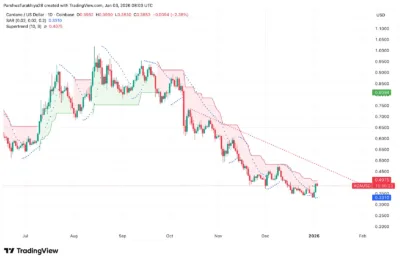
Cardano continues to respect the $0.37 support zone, an area that has attracted dip buyers following the recent selloff. This zone represents the last consistently defended level preventing a retest of December lows.
However, the broader trend has not improved. On the daily chart, ADA remains firmly below a descending trendline that has capped price since August. Each attempt to rally into this trendline has been met with renewed selling, reinforcing seller dominance.
The Supertrend remains bearish near $0.4075, while Parabolic SAR continues to print above price, confirming that downside pressure remains active despite short-term stabilization. Until ADA reclaims these levels, any upside move remains corrective rather than trend-forming.
Source: Tradingview
EMA Structure Highlights Heavy Overhead Supply
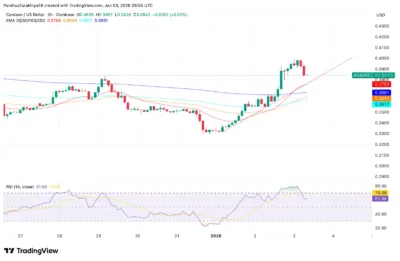
Lower-timeframe price action explains why ADA has struggled to build momentum. On the two-hour chart, ADA rebounded from the $0.33–$0.34 zone and briefly pushed toward $0.39, lifting price above short-term moving averages.
However, price stalled as it approached higher EMAs, with the 200 EMA continuing to act as resistance. RSI rolled over from near overbought levels, signaling fading upside strength rather than renewed trend participation.
Source: Tradingview
This structure suggests short-term relief rather than a trend shift. Buyers must reclaim and hold above key EMAs to shift momentum away from the current bearish bias.
Spot Netflows Reveal Ongoing Distribution
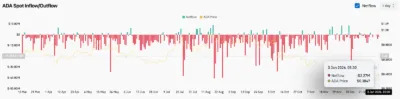
On-chain data continues to act as a headwind. ADA has recorded persistent net exchange inflows, including a -$2.27 million netflow reading on January 3. This pattern extends a broader trend of supply moving onto exchanges throughout Q4.
These inflows suggest that holders are using rebounds to distribute tokens back into the market. This steady sell-side activity has limited follow-through and kept price capped below resistance.
Source: Coinglass
The pattern remains consistent: rebounds stabilize price temporarily, but ongoing distribution prevents a sustained recovery.
Derivatives Data Shows Leverage Building
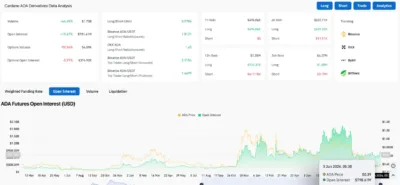
Derivatives positioning adds another layer of risk. ADA futures open interest has risen to approximately $798 million, up more than 10% on the day, while trading volume jumped 64% to $1.73 billion.
Source: Coinglass
Liquidation data shows longs absorbing most of the pressure, with $4.27 million in long liquidations compared with $3.19 million in shorts over the past 24 hours. Long-to-short ratios remain skewed toward longs, increasing downside risk if price fails to hold support. Rising leverage without structural confirmation leaves ADA vulnerable to sharp downside moves.
Key Support and Resistance Levels for Cardano
For the bullish case to gain traction, ADA must hold above $0.37 and secure a daily close above $0.41, opening room toward $0.45. A decisive reclaim of this zone would mark the first meaningful step toward trend repair. On the downside, a daily close below $0.37 would invalidate the current base and expose the recent lows near $0.33, increasing downside risk.
A daily close above $0.41 would signal improving momentum and reduce downside pressure, allowing ADA to challenge higher resistance near $0.45. Failure to hold $0.37 would confirm that seller control remains intact. A breakdown would expose $0.33, with further downside risk if selling pressure accelerates.
Cardano Price Prediction 2026–2030
| Year | Minimum Price | Average Price | Maximum Price |
| 2026 | $0.34 | $0.40 | $0.45 |
| 2027 | $0.38 | $0.46 | $0.55 |
| 2028 | $0.45 | $0.55 | $0.65 |
| 2029 | $0.52 | $0.62 | $0.75 |
| 2030 | $0.60 | $0.70 | $0.85 |
2026
Cardano enters 2026 stabilizing above key demand after a sharp corrective phase. Holding $0.37 remains critical, while a reclaim of $0.41 would be required to unlock recovery potential. Failure to reclaim resistance keeps price range-bound and vulnerable to renewed selling.
2027
If sell-side pressure gradually fades and structural conditions improve, ADA could trade within a broader range as volatility compresses. Price action during this period is likely to remain cyclical rather than trend-driven.
2028
With reduced distribution and improving market structure, Cardano could attempt a more sustained recovery phase. Upside progress is likely to occur in measured phases rather than sharp breakouts.
2029
By 2029, a clearer trend shift could emerge if ADA continues to hold higher support levels and demand remains consistent. Sustained acceptance above long-term resistance would be critical for maintaining upside momentum.
2030
By 2030, long-term structural clarity should be evident. If Cardano has successfully transitioned into a higher trading range, price action could reflect a more established trend. Failure to maintain gains would suggest continued long-term consolidation.
Conclusion
Cardano’s price is stabilizing above key support, but the broader trend has not yet turned bullish. Persistent exchange inflows, rising leverage, and technical resistance continue to cap upside.
Until ADA can reclaim the $0.41 resistance zone, rallies remain corrective rather than trend-defining. The coming sessions will determine whether consolidation resolves into recovery or another leg lower. ADA sits at a critical inflection point supported, but not yet freed from seller control.
FAQs
1. Why is Cardano price not rising despite stabilization?
Persistent exchange inflows suggest ongoing distribution, with holders using rebounds to sell into strength.
2. What is the key support level for ADA?
The primary support level is $0.37.
3. What resistance must ADA break to turn bullish?
A daily close above $0.41 is required to confirm a trend shift.
4. Could ADA fall to $0.33?
Yes. A loss of $0.37 would expose the recent demand zone near $0.33.
5. Is Cardano in a long-term downtrend?
Yes. ADA remains below its descending trendline and key moving averages, keeping the broader structure bearish despite short-term stabilization.
Also Read: Pudgy Penguins (PUDGY) Price Prediction 2025–2029: Can PUDGY Break $0.015 Soon?
The post Cardano Price Prediction 2026–2030: Can ADA Hit $0.45 Soon? appeared first on 36Crypto.


You May Also Like

Judge Strikes Down Trump-Era Courthouse Arrest Policy

Game, set... protest! Top tennis stars ramp up Wimbledon revolt over prize money

EUR/JPY Stalls: Critical 184.00 Level Holds as Markets Decipher ECB and BoJ Policy Signals



