

Vitalik Buterin Says Ethereum Solved The Blockchain Trilemma
Ethereum co-founder Vitalik Buterin said the network has effectively “solved” the blockchain trilemma: decentralization, consensus, and high bandwidth, arguing that the missing ingredients are now live on mainnet or within reach as zero-knowledge Ethereum virtual machines (ZK-EVMs) move toward production use.
In a Jan. 3 post on X, Buterin framed the moment around two technical developments: PeerDAS, which he said is now live on Ethereum mainnet, and ZK-EVMs, which he described as being at an “alpha stage” with “production-quality performance” while “remaining work is safety.”
“These are not minor improvements; they are shifting Ethereum into being a fundamentally new and more powerful kind of decentralized network,” Buterin wrote. “To see why, let’s look at the two major types of p2p network so far.”
Buterin drew a contrast between early peer-to-peer systems that could scale throughput but lacked agreement on shared state, and blockchains that achieved robust consensus but paid for it with constrained bandwidth. He pointed to BitTorrent as a model of decentralized distribution without consensus, and to Bitcoin as a model of decentralization and consensus that keeps bandwidth low because “it’s not ‘distributed’ in the sense of work being split up, it’s replicated.”
Ethereum Will Solve The Blockchain Trilemma
The claim, in Buterin’s telling, is that Ethereum is entering a third category. “Now, Ethereum with PeerDAS (2025) and ZK-EVMs (expect small portions of the network using it in 2026), we get: decentralized, consensus and high bandwidth,” he said. “The trilemma has been solved — not on paper, but with live running code, of which one half (data availability sampling) is on mainnet today, and the other half (ZK-EVMs) is production-quality on performance today — safety is what remains.”
Buterin cast this as the culmination of a multi-year roadmap rather than a sudden breakthrough. He described it as a “10-year journey,” pointing back to early data availability sampling research and noting that ZK-EVM efforts began around 2020. The arc of his argument is that data availability sampling changes what a decentralized network can safely publish and verify at scale, while ZK-EVMs change how nodes can validate execution, shifting validation toward proof-based verification as the technology matures.
Looking ahead, Buterin laid out an approximate timeline for how he expects the vision to roll out over the next four years. In 2026, he expects “large non-ZKEVM-dependent gas limit increases” tied to BALs and ePBS, alongside what he described as the first opportunities to run a ZK-EVM node.
From 2026 through 2028, he anticipates a sequence of changes, gas repricings, adjustments to state structure, moving execution payloads into blobs, and other steps, aimed at making higher gas limits safe. Between 2027 and 2030, he expects “large further gas limit increases,” with ZK-EVMs becoming “the primary way to validate blocks on the network.”
He also flagged what he called a “third piece” of the puzzle: distributed block building. The long-term goal, he wrote, is a world where “the full block is never constituted in one single place,” though he stressed it “will not be necessary for a long time.” The nearer-term focus is distributing “meaningful authority in block building,” either through in-protocol mechanisms—he floated expanding FOCIL as a primary transaction channel—or through out-of-protocol systems such as distributed builder marketplaces.
For Buterin, distributing block building is not just an engineering preference but a risk and fairness question: he argued it would reduce the chance of “centralized interference with real-time transaction inclusion,” while creating “a better environment for geographical fairness.”
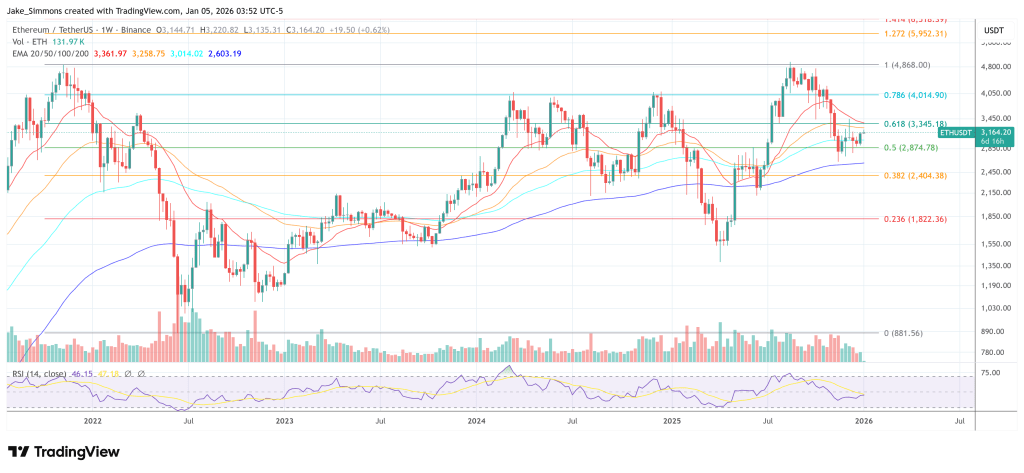
At press time, ETH traded at $3,164.


You May Also Like

CoreWeave (CRWV) Stock Surges 12% on $8.5B GPU-Backed Financing Deal — Here’s the Full Picture

Iran’s foreign minister targeted in assassination attempt, wife killed




