In this Stacks (STX) price prediction 2026, 2027-2030,  we will analyze the price patterns of STX by using accurate trader-friendly technical analysis indicatorsIn this Stacks (STX) price prediction 2026, 2027-2030,  we will analyze the price patterns of STX by using accurate trader-friendly technical analysis indicators

Stacks (STX) Price Prediction 2026, 2027-2030

For feedback or concerns regarding this content, please contact us at crypto.news@mexc.com
  • Bullish STX price prediction for 2026 is $0.3734 to $0.5214.
  • Stacks (STX) price might reach $5 soon.
  • Bearish (STX) price prediction for 2026 is $0.1626.

In this Stacks (STX) price prediction 2026, 2027-2030,  we will analyze the price patterns of STX by using accurate trader-friendly technical analysis indicators and predict the future movement of the cryptocurrency. 

TABLE OF CONTENTS
INTRODUCTION
  • Stacks (STX) Current Market Status (STX)
  • What is Stacks (STX)?
  • Stacks (STX) 24H Technicals
STACKS (STX) PRICE PREDICTION 2026
  • Stacks (STX) Support and Resistance Levels
  • Stacks (STX) Price Prediction 2026 — RVOL, MA, and RSI
  • Stacks (STX) Price Prediction 2026 — ADX, RVI
  • Comparison of STX with BTC, ETH
STACKS (STX) PRICE PREDICTION 2027, 2028-2030
CONCLUSION
FAQ

Stacks (STX) Current Market Status

Current Price $0.3536
24 – Hour Price Change 7.69% Up
24 – Hour Trading Volume $66.75M
Market Cap $641.07M
Circulating Supply 1.81B STX
All – Time High $3.84 (On April 01, 2024)  
All – Time Low $0.04501 (On Mar 13, 2020)  
STX Current Market Status (Source: CoinMarketCap)

What is Stacks (STX)

TICKER STX
BLOCKCHAIN Stacks
CATEGORY Layer 2 Blockchain
LAUNCHED ON June 2019
UTILITIES Governance, security, gas fees & rewards

Stacks is a layer-1 blockchain solution designed to bring smart contracts and decentralized applications (DApps) to Bitcoin (BTC). It achieves this without altering the core features that make Bitcoin so powerful, such as its security and stability. Powered by the Stacks token (STX), this platform fuels smart contract execution, transaction processing, and the registration of new digital assets on the Stacks 2.0 blockchain. Essentially, Stacks enhances Bitcoin’s capabilities without forking or changing the original blockchain.

Recently, Stacks has kicked off its Nakamoto upgrade to make transactions even faster. Named after Bitcoin’s mysterious creator, Satoshi Nakamoto, this upgrade will separate the block production schedule of Stacks from that of Bitcoin. Network operators now have a two-week window to implement the upgrade, after which a hard fork will finalize the changes. The Nakamoto upgrade introduces a new method for producing Stacks blocks using a proof-of-transfer consensus algorithm. Users will burn Bitcoin (BTC) to mine Stacks blocks and earn rewards. This process began in April, with block “signers” coming online to validate transaction “tenures.”

Stacks 24H Technicals
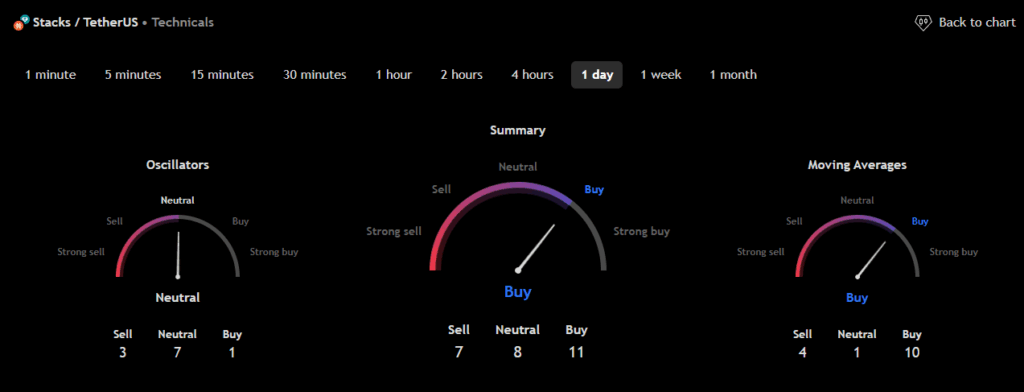
(Source: TradingView)

Stacks (STX) Price Prediction 2026

Stacks (STX) ranks 81st on CoinMarketCap in terms of its market capitalization. The overview of the Stacks price prediction for 2026 is explained below with a daily time frame.

STX/USDT Descending Channel Pattern (Source: TradingView)

In the above chart, Stacks (STX) laid out a descending channel pattern. Descending channel patterns are short-term bearish in that a stock moves lower within a descending channel, but they often form longer-term uptrends as continuation patterns. Higher prices often follow the descending channel pattern. But only after an upside penetration of the upper trend line. A descending channel is drawn by connecting the lower highs and lower lows of a security’s price with parallel trendlines to show a downward trend.

A trader could make a selling bet within a descending channel when the security price reaches its resistance trendline. An ascending channel is the opposite of a descending channel. Both ascending and descending channels are primary channels followed by technical analysts.

At the time of analysis, the price of Stacks (STX) was recorded at $0.3536. If the pattern trend continues, then the price of STX might reach the resistance levels of  $0.3738 and $0.6734. If the trend reverses, then the price of STX may fall to the support of $0.2993 and $0.2353.

Stacks (STX) Resistance and Support Levels

The chart given below elucidates the possible resistance and support levels of Stacks (STX) in 2026.

STX/USDT Resistance and Support Levels (Source: TradingView)

From the above chart, we can analyze and identify the following as resistance and support levels of Stacks (STX) for 2026.

Resistance Level 1 $0.3734
Resistance Level 2 $0.5214
Support Level 1 $0.2372
Support Level 2 $0.1626

STX Resistance & Support Levels

Stacks (STX) Price Prediction 2026 — RVOL, MA, and RSI

The technical analysis indicators such as Relative Volume (RVOL), Moving Average (MA), and Relative Strength Index (RSI) of Stacks (STX) are shown in the chart below.

STX/USDT RVOL, MA, RSI (Source: TradingView)

From the readings on the chart above, we can make the following inferences regarding the current Stacks (STX) market in 2026.

INDICATOR PURPOSE READING INFERENCE
50-Day Moving Average (50MA) Nature of the current trend by comparing the average price over 50 days 50 MA = $0.2885Price = $0.3502
(50MA < Price)
Bullish/Uptrend
Relative Strength Index (RSI) Magnitude of price change;Analyzing oversold & overbought conditions 69.4017
<30 = Oversold
50-70 = Neutral>70 = Overbought
Neutral
Relative Volume (RVOL) Asset’s trading volume in relation to its recent average volumes Below cutoff line Weak Volume

Stacks (STX) Price Prediction 2026 — ADX, RVI

In the below chart, we analyze the strength and volatility of Stacks (STX) using the following technical analysis indicators — Average Directional Index (ADX) and Relative Volatility Index (RVI).

STX/USDT ADX, RVI (Source: TradingView)

From the readings on the chart above, we can make the following inferences regarding the price momentum of Stacks (STX).

INDICATOR PURPOSE READING INFERENCE
Average Directional Index (ADX) Strength of the trend momentum 41.6185 Weak Trend
Relative Volatility Index (RVI) Volatility over a specific period 49.33
<50 = Low
>50 = High
Low Volatility

Comparison of STX with BTC, ETH

Let us now compare the price movements of Stacks (STX) with those of Bitcoin (BTC) and Ethereum (ETH).

BTC Vs ETH Vs STX Price Comparison (Source: TradingView)

From the above chart, we can interpret that the price action of STX is similar to that of BTC and ETH. That is, when the price of BTC and ETH increases or decreases, the price of STX also increases or decreases, respectively.

Stacks (STX) Price Prediction 2027, 2028 – 2030

With the help of the aforementioned technical analysis indicators and trend patterns, let us predict the price of Stacks (STX) between 2027, 2028, 2029, and 2030.

Year  Bullish Price  Bearish Price
Stacks (STX) Price Prediction 2027 $7 $0.1
Stacks (STX) Price Prediction 2028 $9 $0.09
Stacks (STX) Price Prediction 2029 $11 $0.08
Stacks (STX) Price Prediction 2030 $13 $0.07

Conclusion

If Stacks (STX) establishes itself as a good investment in 2026, this year would be favorable to the cryptocurrency. In conclusion, the bullish Stacks (STX) price prediction for 2026 is $0.5214. Comparatively, if unfavorable sentiment is triggered, the bearish Stacks (STX) price prediction for 2026 is $0.1626. 

If the market momentum and investors’ sentiment positively elevate, then Stacks (STX) might hit $5. Furthermore, with future upgrades and advancements in the Stacks ecosystem, STX might surpass its current all-time high (ATH) of $3.84 and mark a new ATH. 

FAQ

1. What is Stacks (STX)?

Stacks is a layer-1 blockchain solution that is designed to bring smart contracts and decentralized applications (DApps) to Bitcoin (BTC). 

2. Where can you buy Stacks (STX)?

Traders can trade Stacks (STX) on cryptocurrency exchanges such as Binance, Bybit, OKX, Bitget, and CoinTR Pro. 

3. Will Stacks (STX) record a new ATH soon?

With the ongoing developments and upgrades within the Stacks platform, Stacks (STX) has a high possibility of reaching its ATH soon.

4. What is the current all-time high (ATH) of Stacks (STX)?

Stacks (STX) hit its current all-time high (ATH) of $3.84 on April 01, 2024.

5. What is the lowest price of Stacks (STX)?

According to CoinMarketCap, STX hit its all-time low (ATL) of $0.04501 On March 13, 2020.

6. Will Stacks (STX) hit $5?

If Stacks (STX) becomes one of the active cryptocurrencies that majorly maintain a bullish trend, it might rally to hit $5 soon.7

7. What will be the Stacks (STX) price by 2027?

Stacks (STX) price might reach $7 by 2027.

8. What will be the Stacks (STX) price by 2028?

Stacks (STX) price might reach $9 by 2028.

9. What will be the Stacks (STX) price by 2029?

Stacks (STX) price might reach $11 by 2029.

10. What will be the Stacks (STX) price by 2030?

Stacks (STX) price might reach $13 by 2030.


Top Crypto Predictions

Injective (INJ) Price Prediction 

Sui (SUI) Price Prediction

Aptos (APT) Price Prediction 

Disclaimer: The opinion expressed in this chart is solely the author’s. It does not represent any investment advice. TheNewsCrypto team encourages all to do their own research before investing.


Market Opportunity
Stacks Logo
Stacks Price(STX)
$0.1682
$0.1682$0.1682
0.00%
USD
Stacks (STX) Live Price Chart

Get Covered, Share 1M USDT

Get Covered, Share 1M USDTGet Covered, Share 1M USDT

Higher VVIP tiers, higher compensation odds.

Disclaimer: The articles reposted on this site are sourced from public platforms and are provided for informational purposes only. They do not necessarily reflect the views of MEXC. All rights remain with the original authors. If you believe any content infringes on third-party rights, please contact crypto.news@mexc.com for removal. MEXC makes no guarantees regarding the accuracy, completeness, or timeliness of the content and is not responsible for any actions taken based on the information provided. The content does not constitute financial, legal, or other professional advice, nor should it be considered a recommendation or endorsement by MEXC.

You May Also Like

The changing face of elder care in Malaysia — Sayed Mohammad Reza Yamani Sayed Umar

The changing face of elder care in Malaysia — Sayed Mohammad Reza Yamani Sayed Umar

JULY 10 — An elderly society is becoming increasingly prevalent in Malaysia at present. It is projected that the p...
Share
Malaymail2026/07/10 15:24
Not a loophole: Singapore AI export controls let China tap US AI legally

Not a loophole: Singapore AI export controls let China tap US AI legally

American AI technology is reaching Chinese tech giants through a route that US export controls were never designed to close: Singapore. The city-state sits outside
Share
The Cryptonomist2026/07/10 14:46
Unlocking Massive Value: Curve Finance Revenue Sharing Proposal for CRV Holders

Unlocking Massive Value: Curve Finance Revenue Sharing Proposal for CRV Holders

BitcoinWorld Unlocking Massive Value: Curve Finance Revenue Sharing Proposal for CRV Holders The dynamic world of decentralized finance (DeFi) is constantly evolving, bringing forth new opportunities and innovations. A significant development is currently unfolding at Curve Finance, a leading decentralized exchange (DEX). Its founder, Michael Egorov, has put forth an exciting proposal designed to offer a more direct path for token holders to earn revenue. This initiative, centered around a new Curve Finance revenue sharing model, aims to bolster the value for those actively participating in the protocol’s governance. What is the “Yield Basis” Proposal and How Does it Work? At the core of this forward-thinking initiative is a new protocol dubbed Yield Basis. Michael Egorov introduced this concept on the CurveDAO governance forum, outlining a mechanism to distribute sustainable profits directly to CRV holders. Specifically, it targets those who stake their CRV tokens to gain veCRV, which are essential for governance participation within the Curve ecosystem. Let’s break down the initial steps of this innovative proposal: crvUSD Issuance: Before the Yield Basis protocol goes live, $60 million in crvUSD will be issued. Strategic Fund Allocation: The funds generated from the sale of these crvUSD tokens will be strategically deployed into three distinct Bitcoin-based liquidity pools: WBTC, cbBTC, and tBTC. Pool Capping: To ensure balanced risk and diversified exposure, each of these pools will be capped at $10 million. This carefully designed structure aims to establish a robust and consistent income stream, forming the bedrock of a sustainable Curve Finance revenue sharing mechanism. Why is This Curve Finance Revenue Sharing Significant for CRV Holders? This proposal marks a pivotal moment for CRV holders, particularly those dedicated to the long-term health and governance of Curve Finance. Historically, generating revenue for token holders in the DeFi space can often be complex. The Yield Basis proposal simplifies this by offering a more direct and transparent pathway to earnings. By staking CRV for veCRV, holders are not merely engaging in governance; they are now directly positioned to benefit from the protocol’s overall success. The significance of this development is multifaceted: Direct Profit Distribution: veCRV holders are set to receive a substantial share of the profits generated by the Yield Basis protocol. Incentivized Governance: This direct financial incentive encourages more users to stake their CRV, which in turn strengthens the protocol’s decentralized governance structure. Enhanced Value Proposition: The promise of sustainable revenue sharing could significantly boost the inherent value of holding and staking CRV tokens. Ultimately, this move underscores Curve Finance’s dedication to rewarding its committed community and ensuring the long-term vitality of its ecosystem through effective Curve Finance revenue sharing. Understanding the Mechanics: Profit Distribution and Ecosystem Support The distribution model for Yield Basis has been thoughtfully crafted to strike a balance between rewarding veCRV holders and supporting the wider Curve ecosystem. Under the terms of the proposal, a substantial portion of the value generated by Yield Basis will flow back to those who contribute to the protocol’s governance. Returns for veCRV Holders: A significant share, specifically between 35% and 65% of the value generated by Yield Basis, will be distributed to veCRV holders. This flexible range allows for dynamic adjustments based on market conditions and the protocol’s performance. Ecosystem Reserve: Crucially, 25% of the Yield Basis tokens will be reserved exclusively for the Curve ecosystem. This allocation can be utilized for various strategic purposes, such as funding ongoing development, issuing grants, or further incentivizing liquidity providers. This ensures the continuous growth and innovation of the platform. The proposal is currently undergoing a democratic vote on the CurveDAO governance forum, giving the community a direct voice in shaping the future of Curve Finance revenue sharing. The voting period is scheduled to conclude on September 24th. What’s Next for Curve Finance and CRV Holders? The proposed Yield Basis protocol represents a pioneering approach to sustainable revenue generation and community incentivization within the DeFi landscape. If approved by the community, this Curve Finance revenue sharing model has the potential to establish a new benchmark for how decentralized exchanges reward their most dedicated participants. It aims to foster a more robust and engaged community by directly linking governance participation with tangible financial benefits. This strategic move by Michael Egorov and the Curve Finance team highlights a strong commitment to innovation and strengthening the decentralized nature of the protocol. For CRV holders, a thorough understanding of this proposal is crucial for making informed decisions regarding their staking strategies and overall engagement with one of DeFi’s foundational platforms. FAQs about Curve Finance Revenue Sharing Q1: What is the main goal of the Yield Basis proposal? A1: The primary goal is to establish a more direct and sustainable way for CRV token holders who stake their tokens (receiving veCRV) to earn revenue from the Curve Finance protocol. Q2: How will funds be generated for the Yield Basis protocol? A2: Initially, $60 million in crvUSD will be issued and sold. The funds from this sale will then be allocated to three Bitcoin-based pools (WBTC, cbBTC, and tBTC), with each pool capped at $10 million, to generate profits. Q3: Who benefits from the Yield Basis revenue sharing? A3: The proposal states that between 35% and 65% of the value generated by Yield Basis will be returned to veCRV holders, who are CRV stakers participating in governance. Q4: What is the purpose of the 25% reserve for the Curve ecosystem? A4: This 25% reserve of Yield Basis tokens is intended to support the broader Curve ecosystem, potentially funding development, grants, or other initiatives that contribute to the platform’s growth and sustainability. Q5: When is the vote on the Yield Basis proposal? A5: A vote on the proposal is currently underway on the CurveDAO governance forum and is scheduled to run until September 24th. If you found this article insightful and valuable, please consider sharing it with your friends, colleagues, and followers on social media! Your support helps us continue to deliver important DeFi insights and analysis to a wider audience. To learn more about the latest DeFi market trends, explore our article on key developments shaping decentralized finance institutional adoption. This post Unlocking Massive Value: Curve Finance Revenue Sharing Proposal for CRV Holders first appeared on BitcoinWorld.


Share
Coinstats2025/09/18 00:35

Record Ads, Stock Down 7%

Record Ads, Stock Down 7%Record Ads, Stock Down 7%

Jul 29: Meta earnings face the market's question.
