Ethereum surges past the $2,800 mark on July 10, ahead of the project’s ten-year anniversary. So far, the token has jumped by more than 6.4%. According to data from crypto.news, the token’s value reached a peak at $2,816 on July…Ethereum surges past the $2,800 mark on July 10, ahead of the project’s ten-year anniversary. So far, the token has jumped by more than 6.4%. According to data from crypto.news, the token’s value reached a peak at $2,816 on July…

Ethereum rises beyond $2,800 nearing 10-year anniversary

2 min read

Ethereum surges past the $2,800 mark on July 10, ahead of the project’s ten-year anniversary. So far, the token has jumped by more than 6.4%.

According to data from crypto.news, the token’s value reached a peak at $2,816 on July 10 at around 7:16 AM UTC. The last time Ethereum (ETH) reached above $2,800 was back in mid-June before it fell into slump and never managed to climb back up until now.

However, the token only peaked briefly before experiencing a slight correction and settling back down to the $2,790 mark. At press time, the token is currently trading hands at $2,791, having jumped by 6.34% in the past 24 hours.

Its market cap also enjoyed a boost fueled by its recent price surge, going up by 6.37%. The second largest cryptocurrency now boasts a market cap of $336.9 billion.
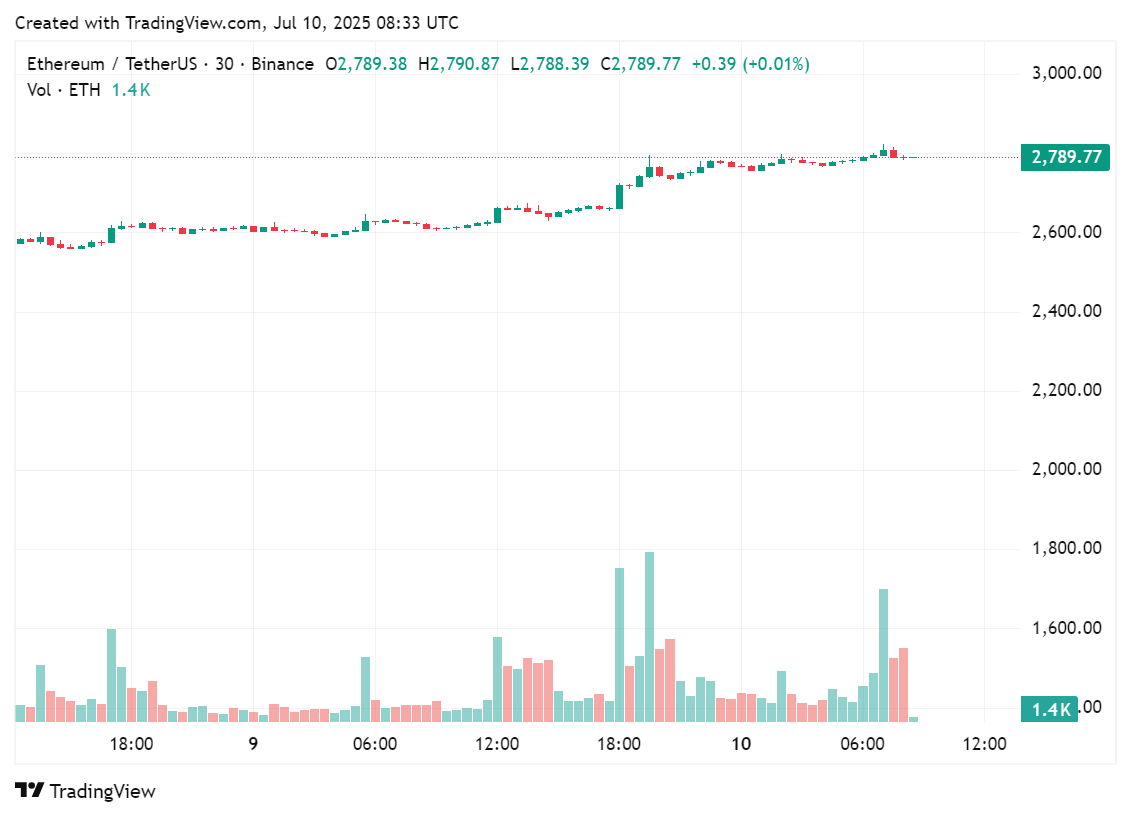
Price chart for Ethereum in the past few hours of trading, July 10, 2025 | Source: crypto.news

Not only that, the daily trading volume for ETH also experienced a jump compared to the previous day. According to data from CoinGecko, the daily trading volume for ETH has seen a 86.4% increase to $30.9 billion. This indicates a significant rise in recent market activity.

Through the past week, the token has gone up 7.3%. Meanwhile in the past month, ETH has experienced modest gains of 4.3%.

Ethereum Foundation moves $2.7m to internal wallet, anniversary gift?

According to on-chain data from PeckShieldAlert, the Ethereum Foundation recently transferred a chunk of 1,000 ETH worth approximately $2.7 million by current market prices to an internal address. The transfer occurred at around 6:00 AM UTC on July 10.

At the moment, the internally-linked address holds as much as 14,000 ETH or nearly $40 million in value.

Earlier in June, the Ethereum Foundation announced that it would be implementing a new treasury policy designed to ensure long-term sustainability while supporting the ecosystem’s continued growth.

Although EF has historically relied on holding its own ETH, the new strategy would see the foundation executing more regular ETH sales to maintain a fiat reserve and expanding its staking and DeFi deployments.

On July 30, 2015, Ethereum made its debut in the crypto space by launching its first decentralized blockchain. Officially named Frontier at the time, it became the project’s first live mainnet which included Genesis block mining.

Since that first launch, Ethereum has evolved through many upgrades and innovations, with its latest Pectra upgrade going live recently on May 7, 2025.


Market Opportunity
Moonveil Logo
Moonveil Price(MORE)
$0.0007192
$0.0007192$0.0007192
-4.51%
USD
Moonveil (MORE) Live Price Chart
Disclaimer: The articles reposted on this site are sourced from public platforms and are provided for informational purposes only. They do not necessarily reflect the views of MEXC. All rights remain with the original authors. If you believe any content infringes on third-party rights, please contact service@support.mexc.com for removal. MEXC makes no guarantees regarding the accuracy, completeness, or timeliness of the content and is not responsible for any actions taken based on the information provided. The content does not constitute financial, legal, or other professional advice, nor should it be considered a recommendation or endorsement by MEXC.

You May Also Like

Trading time: Tonight, the US GDP and the upcoming non-farm data will become the market focus. Institutions are bullish on BTC to $120,000 in the second quarter.

Trading time: Tonight, the US GDP and the upcoming non-farm data will become the market focus. Institutions are bullish on BTC to $120,000 in the second quarter.

Daily market key data review and trend analysis, produced by PANews.
Share
PANews2025/04/30 13:50
Ethereum Fusaka Upgrade Set for December 3 Mainnet Launch, Blob Capacity to Double

Ethereum Fusaka Upgrade Set for December 3 Mainnet Launch, Blob Capacity to Double

Ethereum developers confirmed the Fusaka upgrade will activate on mainnet on December 3, 2025, following a systematic testnet rollout beginning on October 1 on Holesky. The major hard fork will implement around 11-12 Ethereum Improvement Proposals targeting scalability, node efficiency, and data availability improvements without adding new user-facing features. According to Christine Kim, the upgrade introduces a phased blob capacity expansion through Blob Parameter Only forks occurring two weeks after Fusaka activation. Initially maintaining current blob limits of 6/9 target/max, the first BPO fork will increase capacity to 10/15 blobs one week later. A second BPO fork will further expand limits to 14/21 blobs, more than doubling total capacity within two weeks. Strategic Infrastructure Overhaul Fusaka prioritizes backend protocol improvements over user-facing features, focusing on making Ethereum faster and less resource-intensive. The upgrade includes PeerDAS implementation through EIP-7594, allowing validator nodes to verify data by sampling small pieces rather than downloading entire blobs. This reduces bandwidth and storage requirements while enhancing Layer 2 rollup scalability. The upgrade builds on recent gas limit increases from 30 million to 45 million gas, with ongoing discussions for further expansion. EIP-7935 proposes increasing limits to 150 million gas, potentially enabling significantly higher transaction throughput. These improvements complement broader scalability efforts, including EIP-9698, which suggests a 100x gas limit increase over two years to reach 2,000 transactions per second. Fusaka removes the previously planned EVM Object Format redesign to reduce complexity while maintaining focus on essential infrastructure improvements. The upgrade introduces bounded base fees for blob transactions via EIP-7918, creating more predictable transaction costs for data-heavy applications. Enhanced spam resistance and security improvements strengthen network resilience against scalability bottlenecks and attacks. Technical Implementation and Testing Timeline The Fusaka rollout follows a conservative four-phase approach across Ethereum testnets before mainnet deployment. Holesky upgrade occurs October 1, followed by Sepolia on October 14 and Hoodi on October 28. Each testnet will undergo the complete BPO fork sequence to validate the blob capacity expansion mechanism. BPO forks activate automatically based on predetermined epochs rather than requiring separate hard fork processes. On mainnet, the first BPO fork launches December 17, increasing blob capacity to 10/15 target/max. The second BPO fork activates January 7, 2026, reaching the final capacity of 14/21 blobs. This automated approach enables flexible blob scaling without requiring full network upgrades. Notably, node operators face release deadlines ranging from September 25 for Holesky to November 3 for mainnet preparation. The staggered timeline, according to the developers, allows comprehensive testing while giving infrastructure providers sufficient preparation time. Speculatively, the developers use this backward-compatible approach to ensure smooth transitions with minimal disruption to existing applications. PeerDAS implementation reduces node resource demands, potentially increasing network decentralization by lowering barriers for smaller operators. The technology enables more efficient data availability sampling, crucial for supporting growing Layer 2 rollup adoption. Overall, these improvements, combined with increased gas limits, will enable Ethereum to handle higher transaction volumes while maintaining security guarantees. Addressing Network Scalability Pressures The Fusaka upgrade addresses mounting pressure for Ethereum base layer improvements amid criticism of Layer 2 fragmentation strategies. Critics argue that reliance on rollups has created isolated chains with limited interoperability, complicating user experiences. The upgrade’s focus on infrastructure improvements aims to enhance base layer capacity while supporting continued Layer 2 growth. The recent validator queue controversy particularly highlights ongoing network scalability challenges. According to a Cryptonews report covered yesterday, currently, over 2M ETH sits in exit queues facing 43-day delays, while entry queues process in just 7 days.Ethereum Validator Queue (Source: ValidatorQueue) However, Vitalik Buterin defended these delays as essential for network security, comparing validator commitments to military service requiring “friction in quitting.” The upgrade coincides with growing institutional interest in Ethereum infrastructure, with VanEck predicting that Layer 2 networks could reach $1 trillion market capitalization within six years. Fusaka’s emphasis on data availability and node efficiency supports Ethereum’s evolution toward seamless cross-chain interoperability. The upgrade complements initiatives like the Open Intents Framework, where Coinbase Payments recently joined as a core contributor. The initiative, if successful, will address the $21B surge in cross-chain crime. These coordinated efforts aim to unify the fragmented multichain experience while maintaining Ethereum’s security and decentralization principles
Share
CryptoNews2025/09/19 16:37
VectorUSA Achieves Fortinet’s Engage Preferred Services Partner Designation

VectorUSA Achieves Fortinet’s Engage Preferred Services Partner Designation

TORRANCE, Calif., Feb. 3, 2026 /PRNewswire/ — VectorUSA, a trusted technology solutions provider, specializes in delivering integrated IT, security, and infrastructure
Share
AI Journal2026/02/05 00:02