Crypto has a habit of solving yesterday’s problems really well. Cold storage solved exchange risk. Hardware wallets solved hot wallet exploits. Multisig helped Crypto has a habit of solving yesterday’s problems really well. Cold storage solved exchange risk. Hardware wallets solved hot wallet exploits. Multisig helped

Crypto Wallets Weren’t Built for Quantum Risk – BMIC Thinks It’s Time to Change That

Crypto has a habit of solving yesterday’s problems really well.

Cold storage solved exchange risk. Hardware wallets solved hot wallet exploits. Multisig helped with internal controls. Each step made sense at the time it appeared. The issue is that most of these solutions were designed in an era when the threat model was relatively narrow.

Quantum risk wasn’t part of that picture.

For most wallet designs, the assumption has always been simple: current cryptography is strong enough, and future problems can be dealt with later. That assumption held up for a long time. It’s starting to feel less comfortable now.

BMIC’s Starting Point Is Different

BMIC ($BMIC) wants to answer this question: What happens if the cryptography wallets that we rely on today aren’t enough tomorrow? 

The project just launched a crypto presale for its native token – $BMIC.

BMIC doesn’t assume that today’s security standards will be enough forever. Instead, the team is building the wallet with change in mind from the start. The idea is to allow different cryptographic approaches to work side by side, so new protections can be added as standards evolve, rather than forcing a clean break every few years.

It’s a practical mindset. Rather than tearing everything down when assumptions change, BMIC aims to give users a system that can adjust in place, without turning upgrades into stressful, all-or-nothing moments.

Security That Doesn’t Ask for Attention

One of the quieter ideas behind BMIC is that better security shouldn’t mean more effort for the user. Advanced protections tend to fail when they get in the way of normal behavior.

That’s where AI-assisted monitoring comes into play. Rather than forcing users to constantly think about threats, the system is designed to watch for unusual patterns and risks in the background, stepping in only when needed.

Security, in this model, behaves more like infrastructure than a feature – always present, rarely noticed.

Why This Matters More Than It Sounds

Quantum risk isn’t the only issue BMIC is responding to. It’s also reacting to the simple reality that crypto assets now outlive most of the tools built to protect them.

Devices get replaced. Support ends. Software assumptions change. But private keys don’t expire, and blockchains don’t reset. Over long time horizons, the weakest link isn’t usually price volatility — it’s outdated security models that linger too long.

BMIC’s bet is that wallets need to be designed with that time horizon in mind.
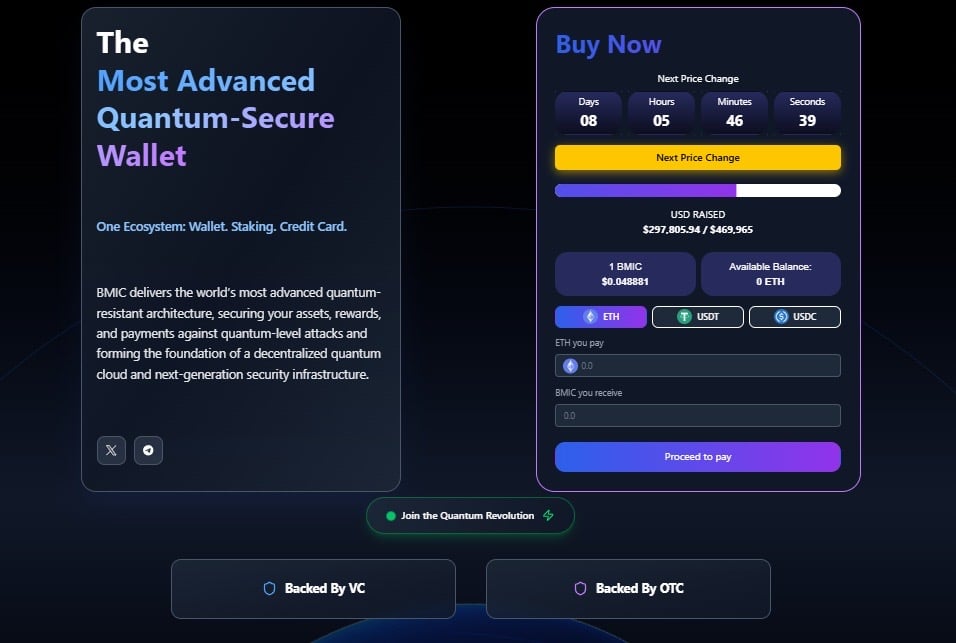
Where the Crypto Presale Fits In

At the time of writing, the project has raised just over $300,000, with $BMIC priced at $0.048881.

The total supply is capped at 1.5 billion tokens, with half allocated to the public presale. The remaining supply is distributed across staking and rewards, liquidity and exchange listings, ecosystem reserves, marketing, and a small team allocation.

The token itself is positioned as part of the security ecosystem, supporting access to advanced features, staking participation, and future security-related services. If you want to know how to buy $BMIC, check out the official website and follow the easy steps. 

A Different Kind of Crypto Bet

BMIC isn’t offering a shortcut, and it isn’t pretending to know exactly how the future will unfold. What it’s doing instead is acknowledging something most projects avoid: that crypto security won’t stand still, and neither will the threats around it.

Backing a project like BMIC is less about chasing upside and more about aligning with a long-term view of how custody needs to evolve. That won’t appeal to everyone — and it probably shouldn’t. But for those who believe the next phase of crypto will be defined by resilience rather than novelty, it’s a bet rooted in preparation, not prediction.

Learn more about BMIC

Presale: https://bmic.ai/

Social: https://x.com/BMIC_ai

Telegram: https://t.me/+6d1dX_uwKKdhZDFk

This article has been provided by one of our commercial partners and does not reflect Cryptonomist’s opinion. Please be aware our commercial partners may use affiliate programs to generate revenues through the links on this article.


Market Opportunity
Threshold Logo
Threshold Price(T)
$0.009779
$0.009779$0.009779
-0.02%
USD
Threshold (T) Live Price Chart
Disclaimer: The articles reposted on this site are sourced from public platforms and are provided for informational purposes only. They do not necessarily reflect the views of MEXC. All rights remain with the original authors. If you believe any content infringes on third-party rights, please contact service@support.mexc.com for removal. MEXC makes no guarantees regarding the accuracy, completeness, or timeliness of the content and is not responsible for any actions taken based on the information provided. The content does not constitute financial, legal, or other professional advice, nor should it be considered a recommendation or endorsement by MEXC.

You May Also Like

Unprecedented Surge: Gold Price Hits Astounding New Record High

Unprecedented Surge: Gold Price Hits Astounding New Record High

BitcoinWorld Unprecedented Surge: Gold Price Hits Astounding New Record High While the world often buzzes with the latest movements in Bitcoin and altcoins, a traditional asset has quietly but powerfully commanded attention: gold. This week, the gold price has once again made headlines, touching an astounding new record high of $3,704 per ounce. This significant milestone reminds investors, both traditional and those deep in the crypto space, of gold’s enduring appeal as a store of value and a hedge against uncertainty. What’s Driving the Record Gold Price Surge? The recent ascent of the gold price to unprecedented levels is not a random event. Several powerful macroeconomic forces are converging, creating a perfect storm for the precious metal. Geopolitical Tensions: Escalating conflicts and global instability often drive investors towards safe-haven assets. Gold, with its long history of retaining value during crises, becomes a preferred choice. Inflation Concerns: Persistent inflation in major economies erodes the purchasing power of fiat currencies. Consequently, investors seek assets like gold that historically maintain their value against rising prices. Central Bank Policies: Many central banks globally are accumulating gold at a significant pace. This institutional demand provides a strong underlying support for the gold price. Furthermore, expectations around interest rate cuts in the future also make non-yielding assets like gold more attractive. These factors collectively paint a picture of a cautious market, where investors are looking for stability amidst a turbulent economic landscape. Understanding Gold’s Appeal in Today’s Market For centuries, gold has held a unique position in the financial world. Its latest record-breaking performance reinforces its status as a critical component of a diversified portfolio. Gold offers a tangible asset that is not subject to the same digital vulnerabilities or regulatory shifts that can impact cryptocurrencies. While digital assets offer exciting growth potential, gold provides a foundational stability that appeals to a broad spectrum of investors. Moreover, the finite supply of gold, much like Bitcoin’s capped supply, contributes to its perceived value. The current market environment, characterized by economic uncertainty and fluctuating currency values, only amplifies gold’s intrinsic benefits. It serves as a reliable hedge when other asset classes, including stocks and sometimes even crypto, face downward pressure. How Does This Record Gold Price Impact Investors? A soaring gold price naturally raises questions for investors. For those who already hold gold, this represents a significant validation of their investment strategy. For others, it might spark renewed interest in this ancient asset. Benefits for Investors: Portfolio Diversification: Gold often moves independently of other asset classes, offering crucial diversification benefits. Wealth Preservation: It acts as a robust store of value, protecting wealth against inflation and economic downturns. Liquidity: Gold markets are highly liquid, allowing for relatively easy buying and selling. Challenges and Considerations: Opportunity Cost: Investing in gold means capital is not allocated to potentially higher-growth assets like equities or certain cryptocurrencies. Volatility: While often seen as stable, gold prices can still experience significant fluctuations, as evidenced by its rapid ascent. Considering the current financial climate, understanding gold’s role can help refine your overall investment approach. Looking Ahead: The Future of the Gold Price What does the future hold for the gold price? While no one can predict market movements with absolute certainty, current trends and expert analyses offer some insights. Continued geopolitical instability and persistent inflationary pressures could sustain demand for gold. Furthermore, if global central banks continue their gold acquisition spree, this could provide a floor for prices. However, a significant easing of inflation or a de-escalation of global conflicts might reduce some of the immediate upward pressure. Investors should remain vigilant, observing global economic indicators and geopolitical developments closely. The ongoing dialogue between traditional finance and the emerging digital asset space also plays a role. As more investors become comfortable with both gold and cryptocurrencies, a nuanced understanding of how these assets complement each other will be crucial for navigating future market cycles. The recent surge in the gold price to a new record high of $3,704 per ounce underscores its enduring significance in the global financial landscape. It serves as a powerful reminder of gold’s role as a safe haven asset, a hedge against inflation, and a vital component for portfolio diversification. While digital assets continue to innovate and capture headlines, gold’s consistent performance during times of uncertainty highlights its timeless value. Whether you are a seasoned investor or new to the market, understanding the drivers behind gold’s ascent is crucial for making informed financial decisions in an ever-evolving world. Frequently Asked Questions (FAQs) Q1: What does a record-high gold price signify for the broader economy? A record-high gold price often indicates underlying economic uncertainty, inflation concerns, and geopolitical instability. Investors tend to flock to gold as a safe haven when they lose confidence in traditional currencies or other asset classes. Q2: How does gold compare to cryptocurrencies as a safe-haven asset? Both gold and some cryptocurrencies (like Bitcoin) are often considered safe havens. Gold has a centuries-long history of retaining value during crises, offering tangibility. Cryptocurrencies, while newer, offer decentralization and can be less susceptible to traditional financial system failures, but they also carry higher volatility and regulatory risks. Q3: Should I invest in gold now that its price is at a record high? Investing at a record high requires careful consideration. While the price might continue to climb due to ongoing market conditions, there’s also a risk of a correction. It’s crucial to assess your personal financial goals, risk tolerance, and consider diversifying your portfolio rather than putting all your capital into a single asset. Q4: What are the main factors that influence the gold price? The gold price is primarily influenced by global economic uncertainty, inflation rates, interest rate policies by central banks, the strength of the U.S. dollar, and geopolitical tensions. Demand from jewelers and industrial uses also play a role, but investment and central bank demand are often the biggest drivers. Q5: Is gold still a good hedge against inflation? Historically, gold has proven to be an effective hedge against inflation. When the purchasing power of fiat currencies declines, gold tends to hold its value or even increase, making it an attractive asset for preserving wealth during inflationary periods. To learn more about the latest crypto market trends, explore our article on key developments shaping Bitcoin’s price action. This post Unprecedented Surge: Gold Price Hits Astounding New Record High first appeared on BitcoinWorld.
Share
Coinstats2025/09/18 02:30
USD/CNH stays below 7.0000 – BBH

USD/CNH stays below 7.0000 – BBH

The post USD/CNH stays below 7.0000 – BBH appeared on BitcoinEthereumNews.com. USD/CNH remains under 7.0000 as China’s December inflation data showed headline CPI
Share
BitcoinEthereumNews2026/01/09 22:13
The Economics of Self-Isolation: A Game-Theoretic Analysis of Contagion in a Free Economy

The Economics of Self-Isolation: A Game-Theoretic Analysis of Contagion in a Free Economy

Exploring how the costs of a pandemic can lead to a self-enforcing lockdown in a networked economy, analyzing the resulting changes in network structure and the existence of stable equilibria.
Share
Hackernoon2025/09/17 23:00