

XRP price prediction: Will the Clarity Act vote move the market?
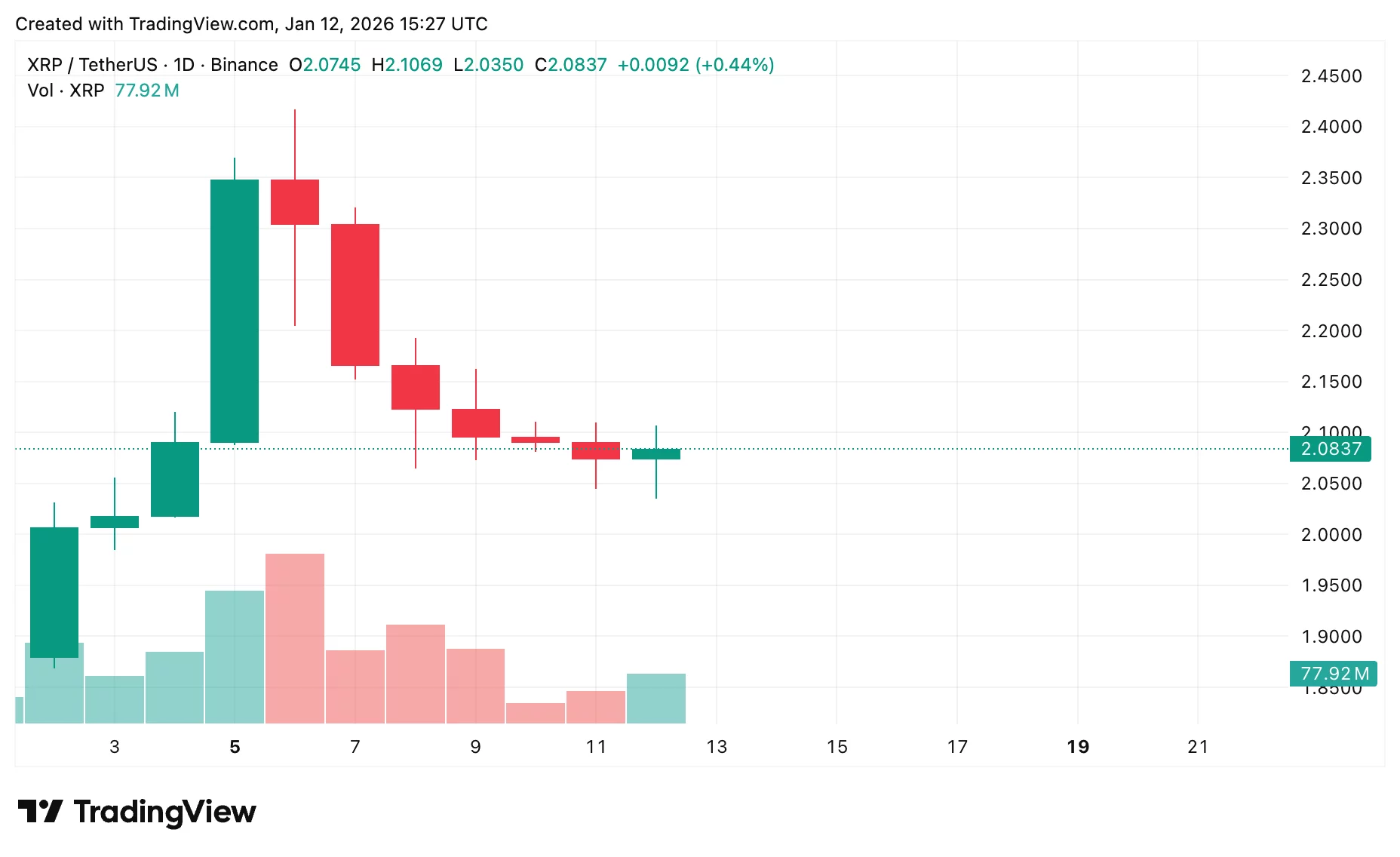
As of January 12, the XRP price is lingering between $2.03 and $2.10, reflecting a market in wait-and-see mode.
Table of Contents
- Current market scenario
- Upside outlook
- Downside risks
- XRP price prediction based on current levels
Traders are largely on the sidelines, awaiting January 15, when U.S. lawmakers vote on the Digital Asset Market Structure and Clarity Act.
- As of January 12, 2026, XRP is trading between $2.03 and $2.10, reflecting cautious market sentiment ahead of the January 15 Clarity Act vote.
- The Clarity Act aims to clarify regulatory oversight, reduce compliance uncertainty, and could boost institutional participation if passed.
- Key support for XRP is at $2.00, with potential resistance levels at $2.18, $2.32, and $2.50 in a bullish scenario.
- Downside risks include a drop below $2.00, with possible targets at $1.90 and $1.80 if support fails.
- Short-term trading is expected to remain range-bound, with regulatory news likely driving price movements more than typical market trends.
Current market scenario
Ripple (XRP) is near $2.08, dropping roughly 0.8% over 24 hours and close to 1.7% across the past week. This decline from the January 6 high of $2.40 appears driven by short-term profit-taking as traders exercise caution.
Despite the pullback, XRP remains comfortably above its late-2025 lows, indicating that the overall trend remains intact.
Attention is now on the January 15 vote on the Clarity Act, which seeks to clarify regulatory oversight and the CFTC’s role, as well as to curb wash trading and improve reserve transparency.
Reduced compliance uncertainty could encourage institutional participation, boosting liquidity and demand. In the near term, markets are likely to remain volatile, with positive news providing upside momentum and delays or amendments creating temporary pressure.
Upside outlook
Chart analysis shows $2.00 as a key support for the XRP price. Defending this level could spark a bounce toward $2.18, and breaking the next resistance would strengthen the bullish case, opening the way to $2.32 and $2.50.
Given the historical trading activity at these levels, any sustained rally would require active participation. Supportive regulatory news could further increase the likelihood of a move higher
Downside risks
The $2.00 level is in focus for XRP. A failure here could push it down to $1.90, and if that support gives way, $1.80 is the next key area. Combine that with ongoing regulatory uncertainty, and the XRP outlook could be wobbly for a while.
XRP price prediction based on current levels
The XRP forecast is pretty balanced, but all eyes are on the upcoming Clarity Act vote. In the short term, XRP could trade between $2.00 and $2.18 while the market awaits a clear signal.
If the vote is favorable, we might see a push toward $2.32–$2.50, but a negative outcome could send it back down toward $1.90–$1.80. The XRP price prediction is driven more by regulatory developments than by typical market trends.


You May Also Like

Y Combinator rolls out new deal package for crypto startups

China solar panel exports to Africa jump by 83% as demand for clean energy surges

Amazon (AMZN) Stock; Rises on $33B Southeast Asia AI and cloud push



