Analyze the performance of SDP and Moment-SOS relaxations on synthetic hyperbolic datasets.Analyze the performance of SDP and Moment-SOS relaxations on synthetic hyperbolic datasets.

Optimization Performance on Synthetic Gaussian and Tree Embeddings

Abstract and 1. Introduction

  1. Related Works

  2. Convex Relaxation Techniques for Hyperbolic SVMs

    3.1 Preliminaries

    3.2 Original Formulation of the HSVM

    3.3 Semidefinite Formulation

    3.4 Moment-Sum-of-Squares Relaxation

  3. Experiments

    4.1 Synthetic Dataset

    4.2 Real Dataset

  4. Discussions, Acknowledgements, and References

    \

A. Proofs

B. Solution Extraction in Relaxed Formulation

C. On Moment Sum-of-Squares Relaxation Hierarchy

D. Platt Scaling [31]

E. Detailed Experimental Results

F. Robust Hyperbolic Support Vector Machine

4.1 Synthetic Dataset

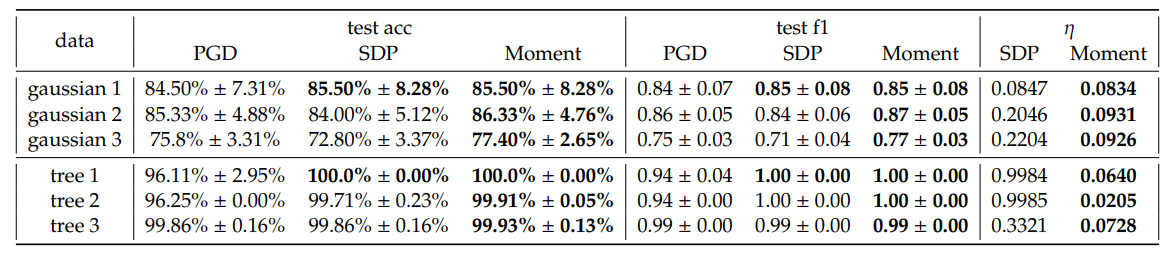
\ In general, we observe a small gain in average test accuracy and weighted F1 score from SDP and Moment relative to PGD. Notably, we observe that Moment often shows more consistent improvements compared to SDP, across most of the configurations. In addition, Moment gives smaller optimality gaps 𝜂 than SDP. This matches our expectation that Moment is tighter than the SDP.

\ Although in some case, for example when 𝐾 = 5, Moment achieves significantly smaller losses compared to both PGD and SDP, it is generally not the case. We emphasize that these losses are not direct measurements of the max-margin hyperbolic separators’ generalizability; rather, they are combinations of margin maximization and penalization for misclassification that scales with 𝐶. Hence, the observation that the performance in test accuracy and weighted F1 score is better, even though the loss computed using extracted solutions from SDP and Moment is sometimes higher than that from PGD, might be due to the complicated loss landscape. More specifically, the observed increases in loss can be attributed to the intricacies of the landscape rather than the effectiveness of the optimization methods. Based on the accuracy and F1 score results, empirically SDP and Moment methods identify solutions that generalize better than those obtained by running gradient descent alone. We provide a more detailed analysis on the effect of hyperparameters in Appendix E.2 and runtime in Table 4. Decision boundary for Gaussian 1 is visualized in Figure 5.

\ Figure 3: Three Synthetic Gaussian (top row) and Three Tree Embeddings (bottom row). All features are in H2 but visualized through stereographic projection on B2. Different colors represent different classes. For tree dataset, the graph connections are also visualized but not used in training. The selected tree embeddings come directly from Mishne et al. [6].

\ Synthetic Tree Embedding. As hyperbolic spaces are good for embedding trees, we generate random tree graphs and embed them to H2 following Mishne et al. [6]. Specifically, we label nodes as positive if they are children of a specified node and negative otherwise. Our models are then evaluated for subtree classification, aiming to identify a boundary that includes all the children nodes within the same subtree. Such task has various practical applications. For example, if the tree represents a set of tokens, the decision boundary can highlight semantic regions in the hyperbolic space that correspond to the subtrees of the data graph. We emphasize that a common feature in such subtree classification task is data imbalance, which usually lead to poor generalizability. Hence, we aim to use this task to assess our methods’ performances under this challenging setting. Three embeddings are selected and visualized in Figure 3 and performance is summarized in Table 1. The runtime of the selected trees can be found in Table 4. Decision boundary of tree 2 is visualized in Figure 6.

\ Similar to the results of synthetic Gaussian datsets, we observe better performance from SDP and Moment compared to PGD, and due to data imbalance that GD methods typically struggle with, we have a larger gain in weighted F1 score in this case. In addition, we observe large optimality gaps for SDP but very tight gap for Moment, certifying the optimality of Moment even when class-imbalance is severe.

\ Table 1: Performance on synthetic Gaussian and tree dataset for 𝐶 = 10.0: 5-fold test accuracy and weighted F1 score plus and minus 1 standard deviation, and the average relative optimality gap 𝜂 for SDP and Moment.
\

:::info Authors:

(1) Sheng Yang, John A. Paulson School of Engineering and Applied Sciences, Harvard University, Cambridge, MA (shengyang@g.harvard.edu);

(2) Peihan Liu, John A. Paulson School of Engineering and Applied Sciences, Harvard University, Cambridge, MA (peihanliu@fas.harvard.edu);

(3) Cengiz Pehlevan, John A. Paulson School of Engineering and Applied Sciences, Harvard University, Cambridge, MA, Center for Brain Science, Harvard University, Cambridge, MA, and Kempner Institute for the Study of Natural and Artificial Intelligence, Harvard University, Cambridge, MA (cpehlevan@seas.harvard.edu).

:::


:::info This paper is available on arxiv under CC by-SA 4.0 Deed (Attribution-Sharealike 4.0 International) license.

:::

\

Market Opportunity
Treehouse Logo
Treehouse Price(TREE)
$0.107
$0.107$0.107
-2.99%
USD
Treehouse (TREE) Live Price Chart
Disclaimer: The articles reposted on this site are sourced from public platforms and are provided for informational purposes only. They do not necessarily reflect the views of MEXC. All rights remain with the original authors. If you believe any content infringes on third-party rights, please contact service@support.mexc.com for removal. MEXC makes no guarantees regarding the accuracy, completeness, or timeliness of the content and is not responsible for any actions taken based on the information provided. The content does not constitute financial, legal, or other professional advice, nor should it be considered a recommendation or endorsement by MEXC.

You May Also Like

CME Group to launch options on XRP and SOL futures

CME Group to launch options on XRP and SOL futures

The post CME Group to launch options on XRP and SOL futures appeared on BitcoinEthereumNews.com. CME Group will offer options based on the derivative markets on Solana (SOL) and XRP. The new markets will open on October 13, after regulatory approval.  CME Group will expand its crypto products with options on the futures markets of Solana (SOL) and XRP. The futures market will start on October 13, after regulatory review and approval.  The options will allow the trading of MicroSol, XRP, and MicroXRP futures, with expiry dates available every business day, monthly, and quarterly. The new products will be added to the existing BTC and ETH options markets. ‘The launch of these options contracts builds on the significant growth and increasing liquidity we have seen across our suite of Solana and XRP futures,’ said Giovanni Vicioso, CME Group Global Head of Cryptocurrency Products. The options contracts will have two main sizes, tracking the futures contracts. The new market will be suitable for sophisticated institutional traders, as well as active individual traders. The addition of options markets singles out XRP and SOL as liquid enough to offer the potential to bet on a market direction.  The options on futures arrive a few months after the launch of SOL futures. Both SOL and XRP had peak volumes in August, though XRP activity has slowed down in September. XRP and SOL options to tap both institutions and active traders Crypto options are one of the indicators of market attitudes, with XRP and SOL receiving a new way to gauge sentiment. The contracts will be supported by the Cumberland team.  ‘As one of the biggest liquidity providers in the ecosystem, the Cumberland team is excited to support CME Group’s continued expansion of crypto offerings,’ said Roman Makarov, Head of Cumberland Options Trading at DRW. ‘The launch of options on Solana and XRP futures is the latest example of the…
Share
BitcoinEthereumNews2025/09/18 00:56
Adam Wainwright Takes The Mound Again Honor Darryl Kile

Adam Wainwright Takes The Mound Again Honor Darryl Kile

The post Adam Wainwright Takes The Mound Again Honor Darryl Kile appeared on BitcoinEthereumNews.com. Adam Wainwright of the St. Louis Cardinals in the dugout during the second inning against the Miami Marlins at Busch Stadium on July 18, 2023 in St. Louis, Missouri. (Photo by Brandon Sloter/Image Of Sport/Getty Images) Getty Images St. Louis Cardinals lifer Adam Wainwright is a pretty easygoing guy, and not unlikely to talk with you about baseball traditions and barbecue, or even share a joke. That personality came out last week during our Zoom call when I mentioned for the first time that I’m a Chicago Cubs fan. He responded to the mention of my fandom, “So far, I don’t think this interview is going very well.” Yet, Wainwright will return to Busch Stadium on September 19 on a more serious note, this time to honor another former Cardinal and friend, the late Darryl Kile. Wainwright will take the mound not as a starting pitcher, but to throw out the game’s ceremonial first pitch. Joining him on the mound will be Kile’s daughter, Sierra, as the two help launch a new program called Playing with Heart. “Darryl’s passing was a reminder that heart disease doesn’t discriminate, even against elite athletes in peak physical shape,” Wainwright said. “This program is about helping people recognize the risks, take action, and hopefully save lives.” Wainwright, who played for the St. Louis Cardinals as a starting pitcher from 2005 to 2023, aims to merge the essence of baseball tradition with a crucial message about heart health. Kile, a beloved pitcher for the Cardinals, tragically passed away in 2002 at the age of 33 as a result of early-onset heart disease. His sudden death shook the baseball world and left a lasting impact on teammates, fans, and especially his family. Now, more than two decades later, Sierra Kile is stepping forward with Wainwright to…
Share
BitcoinEthereumNews2025/09/18 02:08
XLM Price Prediction: Stellar Targets $0.26-$0.27 Range by February 2026

XLM Price Prediction: Stellar Targets $0.26-$0.27 Range by February 2026

The post XLM Price Prediction: Stellar Targets $0.26-$0.27 Range by February 2026 appeared on BitcoinEthereumNews.com. Zach Anderson Jan 14, 2026 13:31 XLM
Share
BitcoinEthereumNews2026/01/15 10:06