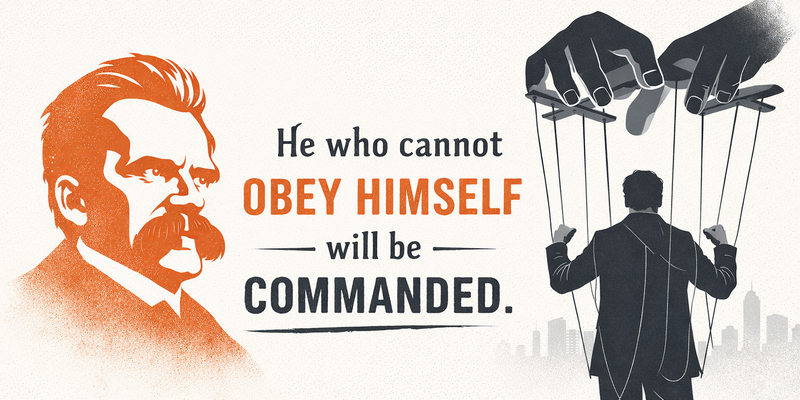
“He who cannot obey himself will be commanded.” — Friedrich Nietzsche Nietzsche is not praising blind obedience. He is pointing to a practical truth“He who cannot obey himself will be commanded.” — Friedrich Nietzsche Nietzsche is not praising blind obedience. He is pointing to a practical truth

Discipline isn’t optional: Nietzsche’s line that hits hard today
3 min read

“He who cannot obey himself will be commanded.” — Friedrich Nietzsche

Nietzsche is not praising blind obedience. He is pointing to a practical truth about freedom. If you cannot follow your own principles, your own plan, your own values, you will end up following someone else’s. The “commander” may be a boss, a trend, a craving, a fear, or the loudest voice in the room. Either way, the outcome is the same. A life steered from the outside.

What does it mean to “obey yourself”?

Self-obedience is not self-punishment. It is self-governance. It means deciding what matters, then doing what that decision requires, even when motivation drops. It is the ability to act from intention rather than impulse. In modern language, Nietzsche is talking about self-discipline and personal responsibility.

This matters because the mind is not a single, unified captain. It is a crowd. One part wants long-term growth. Another wants comfort now. When the “crowd” wins, you do not become free. You become predictable. And predictable people are easy to direct, by advertising, peer pressure, workplace politics, or digital distraction.

How we get “commanded” without noticing

Most control today does not look like control. It looks like convenience. A feed decides what you see next. A notification decides when you stop thinking. A deadline decides what gets your best hours. Even your own habits can become a commander. If you reach for the phone every time you feel bored, boredom commands you. If you avoid hard conversations, discomfort commands you.

Nietzsche’s point is simple. If you do not set your own rules, you will live by default rules. And default rules are usually written by someone who benefits from your attention, your labour, or your silence.

Self-obedience in practice

You do not need grand philosophy to apply this. You need a few repeatable commitments.

  • Write a small code: Pick three weekly non-negotiables, like a workout, a deep work block, and one relationship action.
  • Build friction against impulses: Turn off non-essential notifications. Add a 10-minute pause before big decisions.
  • Keep promises to yourself: If you say you will read two pages, read two pages. Reliability is built in inches.
  • Choose your commanders on purpose: Let a calendar command your priorities, not your moods. Let a craft or mission command your effort, not random opinions.

In Nietzsche’s larger philosophy, freedom is not comfort. It is becoming capable. It is shaping your instincts, training your attention, and turning raw desire into deliberate action. That is why self-command comes first.

The leadership lesson

People who cannot govern themselves often seek governance from others. They cling to strong leaders, rigid ideologies, or constant validation. Self-mastery makes healthy leadership possible, because it reduces the urge to control others to feel stable.

Nietzsche’s warning is an invitation. Obeying yourself is how you earn autonomy. Start with one promise today, keep it, and watch how quickly the world stops pulling the steering wheel.


Disclaimer: The articles reposted on this site are sourced from public platforms and are provided for informational purposes only. They do not necessarily reflect the views of MEXC. All rights remain with the original authors. If you believe any content infringes on third-party rights, please contact service@support.mexc.com for removal. MEXC makes no guarantees regarding the accuracy, completeness, or timeliness of the content and is not responsible for any actions taken based on the information provided. The content does not constitute financial, legal, or other professional advice, nor should it be considered a recommendation or endorsement by MEXC.

You May Also Like

Galaxy Digital’s 2025 Loss: SOL Bear Market

Galaxy Digital’s 2025 Loss: SOL Bear Market

The post Galaxy Digital’s 2025 Loss: SOL Bear Market appeared on BitcoinEthereumNews.com. Galaxy Digital, a digital assets and artificial intelligence infrastructure
Share
BitcoinEthereumNews2026/02/04 09:49
FCA, crackdown on crypto

FCA, crackdown on crypto

The post FCA, crackdown on crypto appeared on BitcoinEthereumNews.com. The regulation of cryptocurrencies in the United Kingdom enters a decisive phase. The Financial Conduct Authority (FCA) has initiated a consultation to set minimum standards on transparency, consumer protection, and digital custody, in order to strengthen market confidence and ensure safer operations for exchanges, wallets, and crypto service providers. The consultation was published on May 2, 2025, and opened a public discussion on operational responsibilities and safeguarding requirements for digital assets (CoinDesk). The goal is to make the rules clearer without hindering the sector’s evolution. According to the data collected by our regulatory monitoring team, in the first weeks following the publication, the feedback received from professionals and operators focused mainly on custody, incident reporting, and insurance requirements. Industry analysts note that many responses require technical clarifications on multi-sig, asset segregation, and recovery protocols, as well as proposals to scale obligations based on the size of the operator. FCA Consultation: What’s on the Table The consultation document clarifies how to apply rules inspired by traditional finance to the crypto perimeter, balancing innovation, market integrity, and user protection. In this context, the goal is to introduce minimum standards for all firms under the supervision of the FCA, an essential step for a more transparent and secure sector, with measurable benefits for users. The proposed pillars Obligations towards consumers: assessment on the extension of the Consumer Duty – a requirement that mandates companies to provide “good outcomes” – to crypto services, with outcomes for users that are traceable and verifiable. Operational resilience: introduction of continuity requirements, incident response plans, and periodic testing to ensure the operational stability of platforms even in adverse scenarios. Financial Crime Prevention: strengthening AML/CFT measures through more stringent transaction monitoring and structured counterpart checks. Custody and safeguarding: definition of operational methods for the segregation of client assets, secure…
Share
BitcoinEthereumNews2025/09/18 05:40
HKMA Launches Fintech Blueprint with AI, DLT, Quantum and Cybersecurity Focus

HKMA Launches Fintech Blueprint with AI, DLT, Quantum and Cybersecurity Focus

The Hong Kong Monetary Authority (HKMA) published a Fintech Promotion Blueprint to support responsible innovation and fintech development in the banking sector.
Share
Fintechnews2026/02/04 10:20