How to earn $5000 per day from the stock market? A cautious look at ai crypto trading
FinancePolice aims to explain the decision factors you should consider before running an AI-based system. Use this as a starting point to compare approaches and verify platform terms before risking significant capital.
Quick reality check: ai crypto trading and the $5,000-per-day claim
Short answer, upfront: reliably earning $5,000 per trading day is uncommon for retail traders and typically requires either very large account capital or substantial leverage, both of which bring meaningful downside risk, margin exposure, and operational complexity. This pattern is reflected in investor guidance and day trading alerts that warn many retail traders do not outperform after costs, and that high daily profit targets are unrealistic for most individuals, especially without institutional infrastructure FINRA investor alert. FINRA AI considerations.
When people say ai crypto trading can automate decisions, they often mean machine learning models that find patterns and place orders via exchange APIs. Those models can help find short-term edges, but they are vulnerable to overfitting and sudden regime shifts that make historical gains turn out to be fragile in live markets, a risk discussed in the ML literature on finance The Probability of Backtest Overfitting.
It is uncommon for retail traders to consistently earn $5,000 per day; achieving that typically requires large capital or high leverage, rigorous validation, and strong operational controls.
Crypto markets add another layer of complexity. Higher volatility, fragmented liquidity across venues, and different custody models increase slippage and execution costs compared with many regulated equity venues, and public reports on crypto market structure show these features matter for automated strategies Chainalysis crypto market report. More context is available in our crypto coverage.
This article walks through what ai crypto trading involves, the technical and operational building blocks, realistic capital and leverage considerations, and a stepwise validation path so readers can test ideas without overexposing capital.
What ai crypto trading means: markets, assets, and key differences from equities
In practice, ai crypto trading refers to algorithmic systems that use machine learning models to make buy and sell decisions for crypto assets, often connecting to exchanges via APIs to execute strategies automatically. Models can range from simple signal classifiers to complex reinforcement learning approaches, but the common thread is automated decision-making based on historical and real-time data.
Crypto market structure differs from regulated equity exchanges in several ways that affect execution and risk. Liquidity is often fragmented across many venues and can vary widely by asset and time of day, which increases the chance of slippage when larger orders hit thin order books Chainalysis crypto market report.
Custody in crypto also works differently. Holding on-exchange balances exposes traders to counterparty and settlement risk, and self-custody adds operational burdens like secure key management. Because oversight and protections are still evolving, traders should confirm platform disclosures and policies before running automated systems on an exchange CFTC advisory on algorithmic trading. See our coverage of exchange developments here.

Core components of an AI trading system: data, model, execution, and monitoring
Building a viable ai crypto trading system starts with reliable data. Clean historical tick or candlestick data, consistent time alignment, and documented feature engineering are foundational to avoid simple errors that break models in live trading. Good data hygiene reduces avoidable mismatches between backtest and reality Advances in Financial Machine Learning.
Model training needs rigorous validation. Cross-validation, walk-forward testing, and out-of-sample checks help reveal overfitting. Without these steps, a model that looks excellent on past data can fail quickly in new market regimes, so plan experiments that separate parameter tuning from final performance estimates The Probability of Backtest Overfitting.
Starter backtesting framework checklist for validating ML trading models
Use as minimum pre-launch gate
Execution matters as much as modeling. Latency, API reliability, and order-routing behavior affect fills and realized costs. Simulate transaction costs, market impact, and slippage in your backtests so strategy metrics are realistic before any live capital is used Chainalysis crypto market report.
Finally, monitoring and controls are essential. Automated kill-switches, P&L attribution, and alerting for abnormal fill rates or latency help limit damage when models encounter unexpected conditions. Firms and platforms are expected to have these controls, and retail traders using automation should plan similar stop conditions and surveillance for their setups SEC statement on automation supervision.
Why $5,000 per day is uncommon: what research and regulator alerts say
Several investor alerts and academic papers show that many retail day traders lose money or fail to outperform after accounting for trading costs and fees; this evidence makes a consistent $5,000-per-day outcome unlikely for most individuals without institutional advantages FINRA investor alert.
Backtest performance often overstates live expectations because of sample selection, data-snooping, and failure to simulate realistic transaction costs. Studies on backtest overfitting document how multiple testing can create spurious strategies that do not generalize to new data The Probability of Backtest Overfitting.
When you add commissions, spreads, and slippage, a strategy’s net returns can fall sharply compared with naive gross profit figures. That effect is especially visible for high-frequency or intraday approaches where small cost differences compound quickly, and it explains why many retail traders see performance drop after fees are included The Probability of Backtest Overfitting.
Capital, leverage, and position sizing: what it realistically takes to target $5,000/day
Targeting $5,000 per day can mean two practical cases: either you have very large capital and aim for modest percentage returns, or you use leverage to amplify smaller capital into that dollar outcome. Both approaches have tradeoffs; large capital reduces margin stress but requires higher skill to scale, while leverage multiplies both gains and losses and adds counterparty and margin risk Advances in Financial Machine Learning.
Simple examples help illustrate the math without promising outcomes. If a strategy averages a small daily percentage return, you can compute how much capital would be needed to reach $5,000 per day, but remember past model returns rarely replicate exactly in live trading due to costs and market impact.
Be careful with leverage. Margin increases tail risk and can trigger liquidations on rapid moves, which is why regulators and broker rules around margin and leverage are important to read and understand before amplifying size FINRA investor alert.
Backtesting and validation: avoiding overfitting and false patterns
Cross-validation and walk-forward testing help detect overfitting. Use a reserved out-of-sample period that was not touched during model selection, and prefer walk-forward runs that mimic how you would update parameters in real time, which gives more realistic performance estimates The Probability of Backtest Overfitting.
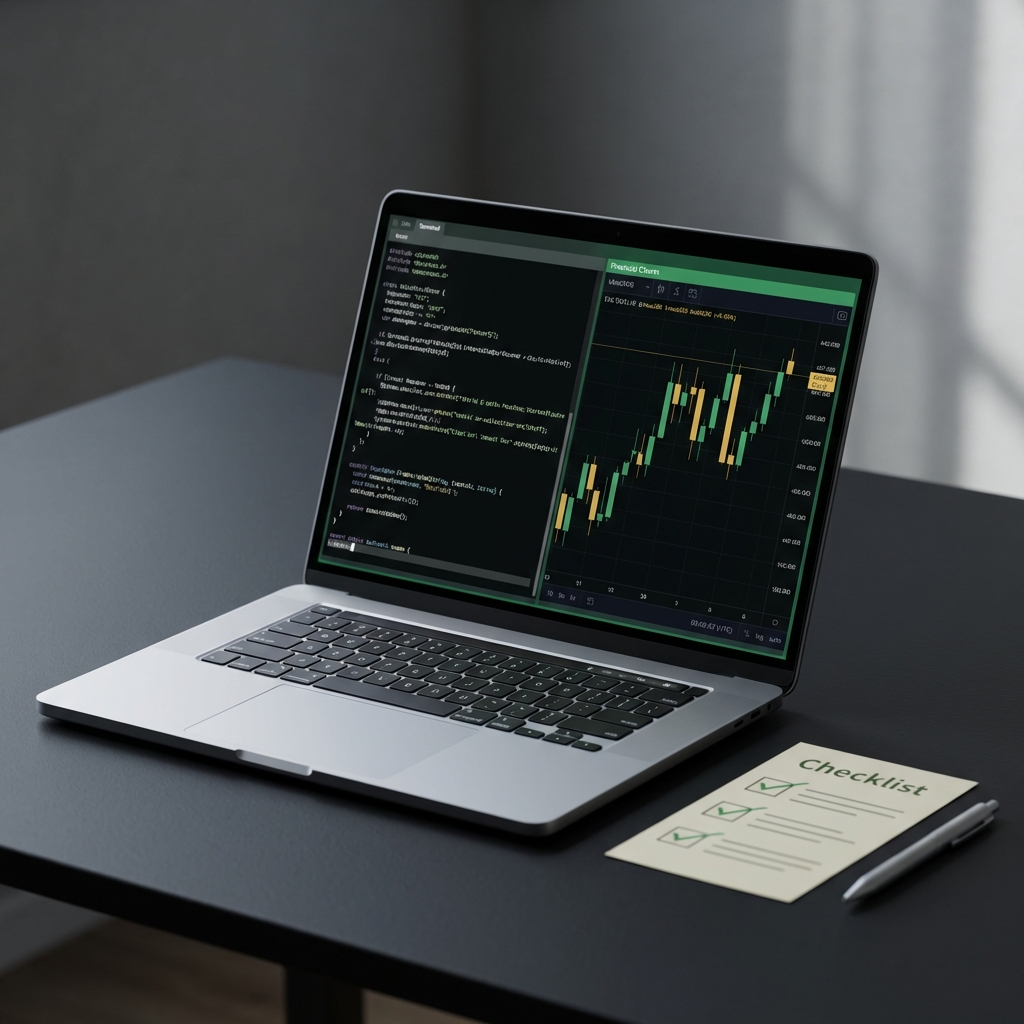
Include slippage, fee schedules, and market-impact models in simulations. For crypto, consider venue-specific spreads and variable liquidity; failing to model these will give overly optimistic backtest metrics Chainalysis crypto market report.
Stage live testing carefully. Start with paper trading or a simulated environment, move to a small live pilot, and only scale after observed live metrics align with conservative backtest projections. This staged approach reduces the chance that you scale a fragile strategy based only on historical fit The Probability of Backtest Overfitting.
Regulatory, custody, and operational risks for AI-driven crypto strategies
Regulators expect firms that deploy algorithmic trading to maintain testing, monitoring, and controls, and public guidance highlights the need for supervision of automated activity; retail traders should treat these expectations as a checklist when using automation through brokers or exchanges SEC statement on automation supervision. Law firm summaries such as Sidley also outline evolving expectations.
Crypto adds custody and counterparty considerations that differ from regulated equity markets. Platform terms, insurance disclosures, and settlement practices vary, so verify how an exchange handles custody and insolvency risk before entrusting significant capital or running automated bots CFTC advisory on algorithmic trading. The CFTC AI report is also informative CFTC AI report.
Get the one-page safe-testing checklist
Download a concise one-page checklist that outlines minimum testing and stop conditions to run a safe pilot of an automated trading idea.
Download checklist
Also check your broker or exchange policies on API use, margin, and algorithmic activity. Some platforms limit automation or require additional documentation; knowing these rules ahead of time prevents unexpected account restrictions or compliance issues FINRA investor alert.
Practical risk controls: drawdown limits, stop rules, and diversification
Set position-level rules like maximum percent of capital per trade and absolute size caps. These reduce concentration risk and help ensure a single mispriced fill cannot wipe out gains from many good trades Advances in Financial Machine Learning.
Define portfolio-level limits such as maximum daily loss, maximum running drawdown, and rules for halting trading after consecutive losses. Hard stops and automated kill-switches are simple controls that prevent runaway losses when models encounter regime changes SEC statement on automation supervision.
Stress-test strategies for worst-case slippage, fee shocks, and extended fill delays. Use conservative transaction-cost assumptions in planning so you do not scale on unrealistic cost projections The Probability of Backtest Overfitting.
Common mistakes retail traders make with AI and algorithmic systems
A frequent error is overfitting to past data by trying many model variations and selecting the one that performed best historically without adjusting for multiple testing. That process creates a selection bias that looks like skill but often fails out of sample The Probability of Backtest Overfitting.
Poor data hygiene, incorrect time alignment between market events and features, and using inconsistent data sources can produce misleading signals. Clean, consistent datasets reduce these operational risks and improve the chance that historical behavior maps to live conditions Advances in Financial Machine Learning.
Psychology and scaling errors are common too. Rapidly increasing live capital after a short winning streak exposes traders to tail events and invalidates many risk assumptions that were implicit during the backtest or pilot FINRA investor alert.
Sample scenario: a conservative test plan for an AI crypto trading idea
Start with a clear hypothesis: define exactly what signal you expect, how it trades, and why it should persist. Document assumptions and the exact data used for training so later failures can be traced to a clear change, not vague model drift The Probability of Backtest Overfitting.
Run backtests with transaction-cost modelling, then perform walk-forward tests and reserve a final out-of-sample period. After that, move to paper trading and monitor live metrics such as fill rates and realized slippage versus model assumptions Advances in Financial Machine Learning.
For a live pilot, keep capital small, limit position sizes, and track simple metrics: P&L, max drawdown, consecutive losing days, fill quality, and latency. Document every parameter change and do not modify strategy rules until you have an audit trail that explains why changes are needed Chainalysis crypto market report. Monitor market events such as leveraged liquidations discussed in our bitcoin analysis here.
Run backtests with transaction-cost modelling, then perform walk-forward tests and reserve a final out-of-sample period. After that, move to paper trading and monitor live metrics such as fill rates and realized slippage versus model assumptions Advances in Financial Machine Learning.
Checklist: minimum tests and controls before trading live
Validation checks: reproducible backtests, transaction-cost assumptions included, cross-validation, and a reserved out-of-sample test. Only proceed to live pilots after these are satisfied The Probability of Backtest Overfitting.
Infrastructure checks: secure API keys, monitoring alerts, automated halts, backup procedures, and an audit trail for changes. These controls reduce common operational failure modes SEC statement on automation supervision.
Legal and account checks: confirm margin rules, API use policies, and account insurer or custody disclosures. If you trade crypto, review platform custody terms and proof-of-reserves type disclosures when available CFTC advisory on algorithmic trading.
How to evaluate brokers, exchanges, and infrastructure for AI trading
Check API reliability, documented latency figures, and rate limits. Platforms with frequent API interruptions or poorly documented limits are harder to run stable automated strategies on, which affects fill rates and realized performance SEC statement on automation supervision.
Compare fee schedules, margin policies, and liquidation rules. Small differences in fees or how exchanges handle partial fills can change whether a strategy remains profitable after costs CFTC advisory on algorithmic trading.
For crypto, verify custody arrangements and any insurance or reserve disclosures the platform provides. If custody is unclear, consider the operational risk before entrusting large balances or running capital-intensive automation Chainalysis crypto market report.
Summary and cautious next steps if you decide to experiment
Recap: consistently earning $5,000 per day is uncommon for retail traders and generally implies either very large capital or use of leverage, each with its own risks. Public guidance from regulators and research on machine learning in finance support a cautious approach to automated strategies FINRA investor alert.
Safe next steps: study validation methods, practice rigorous backtesting with transaction-cost modelling, start with paper trading, run small live pilots, and document every assumption. Confirm broker and exchange disclosures about APIs, margin, and custody before scaling any live system SEC statement on automation supervision.
If you keep experimenting, treat this as a learning process rather than an income promise. Use conservative sizing, strict stop rules, and maintain an audit trail so you can trace failures and avoid repeating avoidable mistakes The Probability of Backtest Overfitting.
For most retail traders it is unlikely; reaching that level reliably typically requires large capital or significant leverage, and AI systems add model and operational risks that make consistent daily profits uncommon.
Key technical risks include overfitting, poor data hygiene, incorrect time alignment, unmodeled transaction costs, and execution failures that cause live performance to differ from backtests.
Start with clear hypotheses, reproducible backtests including realistic costs, walk-forward tests, paper trading, and a small live pilot with strict position and drawdown limits.
FinancePolice provides educational context; do not treat this article as financial advice or a promise of income. Verify details with primary sources and your platform documentation.
References
- https://www.finra.org/investors/insights/day-trading-your-questions-answered
- https://papers.ssrn.com/sol3/papers.cfm?abstract_id=2326253
- https://blog.chainalysis.com/reports/2024-crypto-market-report
- https://www.cftc.gov/pressroom/speeches/automation-algorithmic-trading-oversight-2024
- https://www.wiley.com/en-us/Advances+in+Financial+Machine+Learning-p-9781119482086
- https://www.sec.gov/news/statement/2025/automation-supervision-controls
- https://financepolice.com/advertise/
- https://financepolice.com/category/crypto/
- https://financepolice.com/coinbase-acquires-the-clearing-company-strategic-boost-to-prediction-markets-in-2025/
- https://financepolice.com/bitcoin-price-analysis-btc-slips-below-90000-as-leveraged-liquidations-rock-market/
- https://www.sidley.com/en/insights/newsupdates/2025/02/artificial-intelligence-us-financial-regulator-guidelines-for-responsible-use
- https://www.cftc.gov/media/10626/TAC_AIReport050224/download
- https://www.finra.org/rules-guidance/key-topics/fintech/report/artificial-intelligence-in-the-securities-industry/key-challenges
You May Also Like

Ethereum unveils roadmap focusing on scaling, interoperability, and security at Japan Dev Conference

Cloud mining is gaining popularity around the world. LgMining’s efficient cloud mining platform helps you easily deploy digital assets and lead a new wave of crypto wealth.