a16z: How does the CLARITY Act create a regulatory framework for cryptocurrencies?
By Miles Jennings, Head of Crypto Policy and General Counsel, a16z
Compiled by: Luffy, Foresight News
The U.S. House of Representatives recently advanced an important new "market structure" bill with overwhelming bipartisan support (294 votes in favor, 134 votes against, and 78 Democrats in favor). The bill, the Digital Asset Market Clarity Act (House Bill No. 3633), will establish a clear regulatory framework for the digital asset market. The bill has now entered the Senate review stage, and the Senate is developing its own version of market structure legislation, and the CLARITY Act will provide reference for it.
If passed, the bill will establish clear "rules of the game" for blockchain systems, ending years of uncertainty that stifled innovation, hurt consumers, and favored profiteers who pursued opacity over entrepreneurs who pursued transparency. Just as the Securities Act of 1933 established investor protection mechanisms and promoted a century of capital formation in the United States, the CLARITY Act is expected to become a law of the times.
When our legal framework fosters innovation while protecting consumers, America leads the way and the world benefits. The CLARITY Act provides that opportunity. While this legislation builds on last year’s bipartisan work, the Financial Innovation and Technology for the 21st Century Act (FIT21), it improves on it in several key ways, here’s what entrepreneurs need to know and why this bill is critical to reconciling innovation, consumer protection, and U.S. national security.
Combined with the just-signed GENIUS Act (more on that connection below), the need for a broader market structure bill becomes even more pressing.
Why it matters: The big picture
Despite more than a decade of development, the U.S. has yet to establish a comprehensive regulatory framework. However, cryptocurrency is no longer just a trend in the tech world, it has become infrastructure: blockchain systems are now the basis for payment systems (including through stablecoins), cloud infrastructure, digital markets, and more.
But these protocols and applications were built in the absence of clear rules. The result? Legitimate entrepreneurs face regulatory capriciousness, while speculators take advantage of legal ambiguity. The CLARITY Act would reverse this.
By providing projects with a transparent path to compliance and ensuring regulators have more effective tools to police real risks, the CLARITY Act (along with a new stablecoin bill called the GENIUS Act) will bring the already massive crypto industry out of the shadows and into a regulated economy. The new legislation will create a framework for responsible innovation, much like the foundational laws that helped open markets thrive and protect consumers in the 20th century.
In addition to providing a clear compliance path, the Act also establishes clearer rules that give entrepreneurs legal certainty, allowing them to confidently innovate and conduct business domestically. This will ultimately reduce the pressure on legitimate entrepreneurs to go overseas to conduct business.
This legal clarity will open the door to the next generation of decentralized infrastructure, financial instruments, and user-owned applications, all of which will be built in the U.S. Ensuring that blockchain systems are developed in the U.S. will also ensure that global digital and financial infrastructure is free from reliance on blockchain systems created and controlled by, for example, China, while also ensuring that U.S. regulatory standards apply to core financial infrastructure used today by those outside the crypto community.
What effect will this new legislation have?
Creating a clear regulatory path for digital goods
The CLARITY Act creates a regulatory framework for digital assets that give users ownership rights in blockchain systems.
The bill ’s “control-based” maturity framework allows blockchain projects to launch digital products and enter the public market without excessive regulatory burdens or uncertainty.
Enable supervision of blockchain-based intermediaries
The bill ensures that centralized entities in the crypto space, such as exchanges, brokers, and dealers, are strictly supervised. These intermediaries are required to:
- Registered with the Commodity Futures Trading Commission (CFTC);
- Adhere to similar compliance standards as traditional financial institutions.
These requirements increase transparency in core market infrastructure, help prevent fraud and abuse, and enhance consumer trust. They will also fill a regulatory gap that currently allows companies like FTX to operate unfettered in the U.S. market.
Strong safeguards to protect consumers while promoting innovation
The CLARITY Act also contains direct consumer protections, including:
- Require digital product issuers to fulfill mandatory public disclosure obligations to ensure that retail participants have access to basic and important information;
- Limit insider trading and restrain the behavior of early stakeholders who exploit information asymmetry to harm the interests of users.
These measures also provide entrepreneurs with a clearer roadmap for building decentralized blockchain systems, helping to promote innovation.
Which government agency is responsible for regulation?
The CLARITY Act will provide a clear and structured path for the transition of regulatory authority over digital assets from the U.S. Securities and Exchange Commission (SEC) to the Commodity Futures Trading Commission (CFTC).
Let’s compare how current law and the CLARITY Act (if passed) would address the unique properties of blockchain systems:
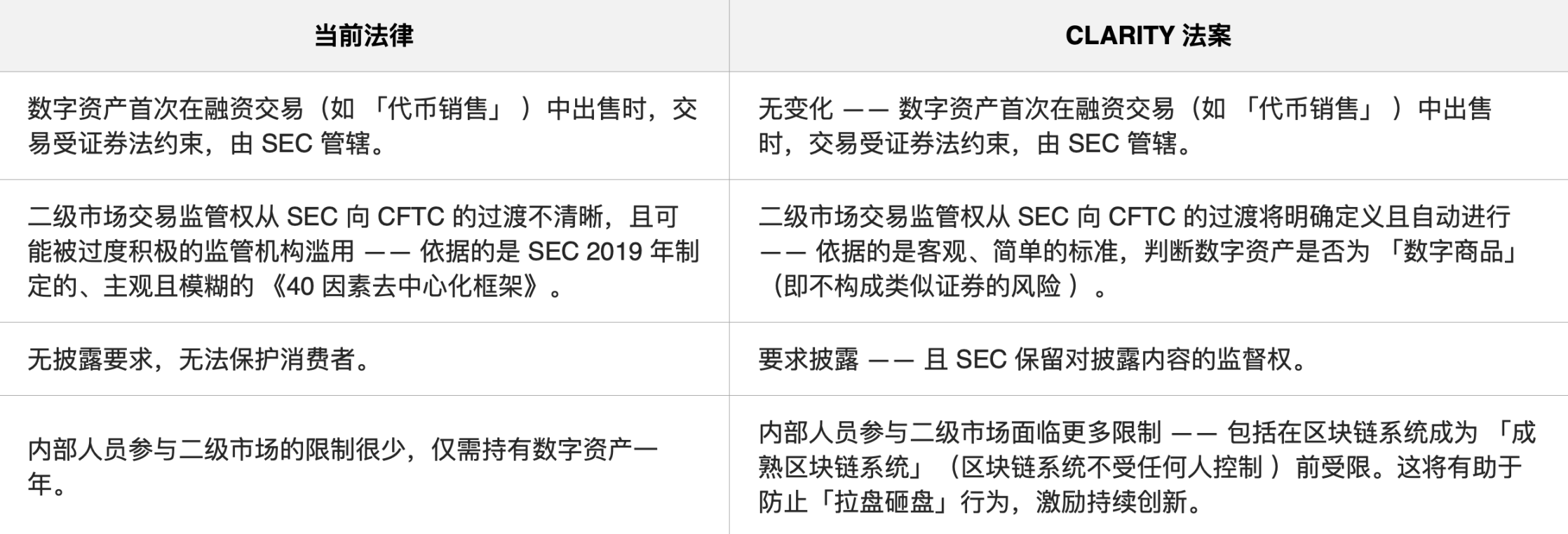
How does a “control-based” maturity framework for blockchain systems work?
Unlike the traditional “efforts”-based decentralization test developed by the SEC in 2019, the CLARITY Act’s maturity framework uses clear, objective, and easily measurable standards.
These standards focus on who controls the underlying blockchain system and its associated digital goods. This is more consistent with other regulatory regimes (such as money transmission) and removes perverse incentives that drive developers to stop development for fear of being seen as centralized. More importantly, this approach will help legitimate developers develop and continue to develop (rather than abandoning their projects), while making it more difficult for bad actors to exploit legal ambiguity, including by engaging in "performative decentralization" (rather than actual decentralization).
Specifically, the bill framework incentivizes decentralization and protects consumers by:
- Imposing more oversight and strict regulatory burdens during the formation stage of blockchain systems (when there is centralized control), when the risks of digital assets native to blockchain systems are most similar to securities;
- As the project matures (no centralized control, reduced risk, and most similar to commodities), regulatory requirements are reduced.
As with previous legislative efforts to “transition from centralization to decentralization” (compare the differences with FIT21 below), regulatory obligations applicable to projects within the “maturity” range include:
- Mandatory disclosure: will increase transparency;
- Sales restrictions on insiders: protect consumers at an early stage and prevent insiders (such as relevant entrepreneurs and investors) from taking advantage of asymmetric information that other consumers are not aware of.
But unlike FIT21, the CLARITY Act lists seven objective, measurable criteria for determining when a particular blockchain system is no longer controlled by an individual or a jointly managed group (such as a foundation), and therefore its native digital assets no longer pose securities-like risks. Because this approach is centered on eliminating control, it protects consumer investors while unlocking the full potential of blockchain technology. And, because it uses measurable criteria, the framework provided by the CLARITY Act is easier for regulators to apply and developers to follow.
In short, this new framework is a significant improvement over the traditional regulatory framework, as securities laws are not designed for assets such as blockchain systems, whose risk characteristics may change from securities-like to commodity-like. This new framework has also received widespread support from the industry.
What impact will it have on specific industries such as DeFi?
The CLARITY Act provides important protections for DeFi. Specifically, the bill:
Exempt DeFi protocols and applications from the regulatory requirements established by the bill for digital commodity trading intermediaries (such as exchanges and brokers);
Establish standards for DeFi. To qualify, a DeFi system must not act as an intermediary, ensuring that a particular DeFi system does not reintroduce the risks that regulation is intended to mitigate.
Additionally, the bill will provide DeFi projects with the legal clarity they need to:
- Launching and selling their own native tokens, a process that was previously risky and unclear;
- Adopt decentralized governance without worrying about being classified as centralized;
- Many projects have already provided self-hosting services, and now with the passage of this bill, individuals will have the "right to self-hosting."
CLARITY builds a level playing field for DeFi projects. This also paves the way for integrating the advantages of DeFi into the broader financial system and unleashing its true potential to a wider range of consumers.
However, the CLARITY Act is not perfect. Because it focuses only on digital commodities, it does not cover other regulated digital assets such as tokenized securities and derivatives. Moreover, while the CLARITY Act exempts DeFi systems from federal intermediary rules, it does not preempt state regulation, which means that the DeFi industry is still vulnerable to inconsistent or excessive state-level policy intervention. These gaps should be addressed in the Senate, in future legislation, or through coordinated regulatory guidance (such as rulemaking by the SEC and CFTC).
Is the CLARITY Act better than the current system?
Yes; the CLARITY Act improves the situation for the following reasons:
- The current lack of regulation in the industry: Some may argue that no regulation is better than some, but the current lack of regulatory clarity benefits bad actors and speculators who use uncertainty to exploit consumers (not to mention regulators who can abuse their power without restraint). FTX is a prime example of these problems, harming not only the industry as a whole, but thousands of consumers. Without timely action, we will open the door to more bad actors like the former FTX CEO.
- Lack of transparency in the industry: Without mandatory disclosure and listing standards, consumers are often exposed to scams and fraud. This lack of transparency fosters a "casino" culture and gives rise to purely speculative products such as Meme coins.
- Lack of protection for the industry: Without clear constraints on the regulatory powers of various federal agencies, blockchain projects (especially DeFi projects) remain at risk of excessive regulatory intervention, which has been common during previous administrations.
- Lack of standards in the industry: Without standards around decentralization/control, consumers face unknown risks when using blockchain systems. For example, they may believe that their assets (including stablecoins) are safe. But if these blockchain systems are controlled by a single entity (someone could just shut it down), the assets may not be safe. As all industries mature, the development of standards will become more common.
How does the CLARITY Act compare to previous legislative efforts, such as FIT21?
The CLARITY Act actually incorporates the lessons learned from FIT21 and makes improvements based on them:
- Enhanced transparency: Close loopholes in FIT21 that may have allowed some legacy projects to circumvent disclosure requirements. The CLARITY Act provides a framework for applying disclosure obligations to legacy projects that are still active.
- Strengthen consumer protection: Make it harder for insiders to exploit information asymmetry. For example, the CLARITY Act severely restricts project insiders from selling assets before the project matures (i.e., while they still control the project).
- The maturity framework is more reasonable: it adopts a decentralized control-based test, which greatly improves the fuzzy approach of FIT21. The framework is also more precise because the CLARITY Act proposes seven objective and measurable criteria for determining whether a blockchain system is mature.
- Improved regulatory oversight: Providing greater flexibility to regulators will help ensure that the regulatory framework evolves and expands as the industry matures.
How does the CLARITY Act relate to the recently passed GENIUS Act?
The newly passed GENIUS Act is a critical step in modernizing the financial system. The House of Representatives made history by passing this major legislation with overwhelming bipartisan support (308-122, with 102 Democrats supporting). However, this new legislation on stablecoins has greatly increased the need for broader market structure legislation such as the CLARITY Act.
Why? Because the GENIUS Act will accelerate the adoption of stablecoins, thereby driving more financial activities to migrate to the blockchain and increasing reliance on blockchain for a wide range of payments and commercial activities. This trend is already happening as ubiquitous payment processors, traditional financial institutions, mature payment networks, etc. increasingly accept and adopt stablecoins.
But current stablecoin legislation does not regulate the blockchains on which all these assets operate, nor does it require these “channels” to be secure, decentralized, or transparently governed. This gap exposes consumers and the broader economy to new systemic risks.
With the GENIUS Act signed into law, the need for the CLARITY Act has become even more urgent.
The CLARITY Act provides the necessary standards and oversight to ensure that the infrastructure supporting stablecoins (underlying blockchains, protocols, and other tools) meets security, transparency, and control standards. Its objective and measurable requirements for defining mature blockchain systems also make it clearer for entrepreneurs how to meet these standards.
Without these complementary protections, stablecoin adoption could accelerate the use of unregulated, opaque, or even hostile infrastructure. Passing the CLARITY Act ensures that stablecoins operate on secure networks, further protecting consumers, reducing financial risks, and cementing the dollar’s strong position and leadership in the next generation of the financial system.
What happens next?
With the CLARITY Act having passed the U.S. House of Representatives, it will now move to the Senate. The Senate Banking and Agriculture Committees are likely to consider the bill.
They are amended through their respective amendment procedures and then submitted to the full Senate for a vote.
More likely, however, a bipartisan group of senators will introduce a separate Senate version of the cryptocurrency market structure bill, which could be similar in many ways to the CLARITY Act. The Senate Banking and Agriculture Committees will then consider the bill through their own procedures and, if approved, send it to the full Senate for a vote.
If both chambers of Congress pass their own bills, the House and Senate will need to reconcile any differences, either through an informal negotiating process or a more formal consultative committee, and each chamber will then vote on a final compromise version.
When might this happen? Key leaders in the House and Senate have set a goal of sending a market structure bill to the president for his signature by the end of September.


You May Also Like

How Stablecoins Are Changing Business Payments

Lowe’s (LOW) Stock Falls After Earnings Beat Gets Overshadowed by Weak Guidance