A fresh debate in the XRP Ledger (XRPL) community is converging on a specific “golden ticket” thesis: XRP’s breakout utility case won’t come from narratives, butA fresh debate in the XRP Ledger (XRPL) community is converging on a specific “golden ticket” thesis: XRP’s breakout utility case won’t come from narratives, but

XRP’s ‘Golden Ticket’ Might Not Be What You Think, Expert Says

2026/01/29 07:30
3 min read

A fresh debate in the XRP Ledger (XRPL) community is converging on a specific “golden ticket” thesis: XRP’s breakout utility case won’t come from narratives, but from plumbing: Ripple’s regulated payments stack sourcing liquidity directly from the on-chain XRPL DEX, and Ripple Prime settling institutional flow on-ledger.

The XRP Golden Ticket Theory

The idea surfaced in an exchange on X after one user, Alex Cobb, a well-known commentator within the XRP community, argued that US market-structure legislation, the CLARITY Act, is “XRPs golden ticket.” Another renowned community member, Krippenreiter, pushed the focus back on product rails rather than policy catalysts: “Personally I think Ripple Payments sourcing liquidity from the onchain XRPL DEX and Ripple Prime settling post trade on the XRP Ledger are XRPs golden tickets.”

Krippenreiter clarified that the phrasing tracks what Ripple has previously messaged about how it intends to use the XRPL in institutional contexts. “The ideal is to do everything on-chain, so yes. Anything happening on-chain settles on XRPL,” they wrote, adding: “I said ‘post-trade settlement’ because that’s what Ripple initially publicly stated for what they plan on using XRPL for.”

That distinction matters because routing liquidity through a public DEX, especially for regulated entities, creates a different compliance surface than using a ledger as a settlement layer after execution happens elsewhere. In the thread, attorney Bill Morgan framed the gating issue bluntly: “Eventually, once it can source liquidity from the XRPL DEX without risk of regulatory non-compliance.”

Others pointed to Permissioned Domains and a permissioned DEX construct as the major blocker for regulated liquidity sourcing, with Krippenreiter describing “credentials,” “permissioned domain,” and “permissioned dex” as the solution set. Morgan noted the implication extends beyond Ripple: if that’s a blocker for Ripple, “it will be a block for any other institution that may wish to use the XRPL DEX.”

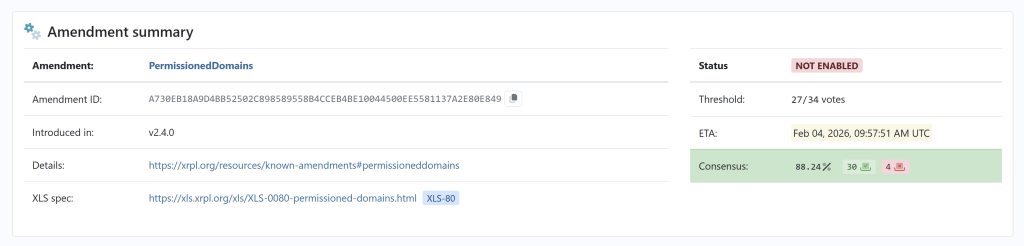
Notably, the Permissioned Domains amendment is on track to go live next week, XRPScan shows 27 of 34 validator votes (88.24% consensus) and an estimated activation time of Feb. 4, 2026 at 09:57:51 UTC, provided it remains above the required threshold through the enablement window.
XRPScan

The same thread pulled Ripple Prime into the picture. Luke Judges (middle management at Ripple) said, “Prime underrated, we need more CEXs to support XRPL inventory. Working on it.”

Krippenreiter suggested that, beyond exchange inventory, privacy could be the other hard prerequisite for Prime’s deeper XRPL integration, calling it “the blocker” in circulating rumors.

That maps onto Ripple’s own public framing: in an October 2 post, Ripple engineering leader J. Ayo Akinyele argued that “finance cannot function without confidentiality, yet blockchains are built on transparency,” and that institutional-grade adoption requires privacy that still supports compliance.

Akinyele put the institutional constraint in plain terms: “Without privacy, financial institutions cannot safely use public ledgers for core workflows. Without accountability, regulators cannot sign off. With programmable privacy, we can have both.”

The discussion landed just as Ripple and GTreasury rolled out “Ripple Treasury,” positioning it as enterprise treasury infrastructure that blends traditional cash operations with digital-asset rails.

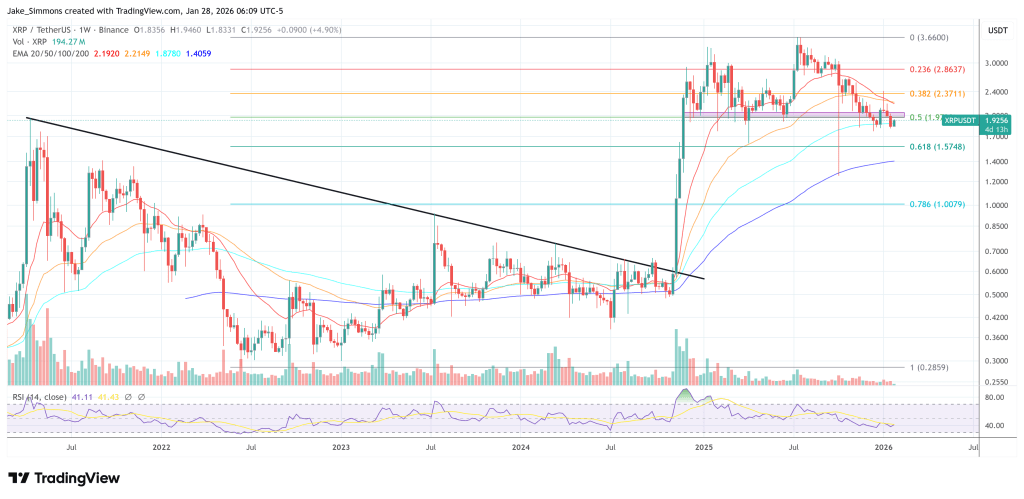
At press time, XRP traded at $1.9256.
XRP price chart
Disclaimer: The articles reposted on this site are sourced from public platforms and are provided for informational purposes only. They do not necessarily reflect the views of MEXC. All rights remain with the original authors. If you believe any content infringes on third-party rights, please contact service@support.mexc.com for removal. MEXC makes no guarantees regarding the accuracy, completeness, or timeliness of the content and is not responsible for any actions taken based on the information provided. The content does not constitute financial, legal, or other professional advice, nor should it be considered a recommendation or endorsement by MEXC.

You May Also Like

Let insiders trade – Blockworks

Let insiders trade – Blockworks

The post Let insiders trade – Blockworks appeared on BitcoinEthereumNews.com. This is a segment from The Breakdown newsletter. To read more editions, subscribe ​​“The most valuable commodity I know of is information.” — Gordon Gekko, Wall Street Ten months ago, FBI agents raided Shayne Coplan’s Manhattan apartment, ostensibly in search of evidence that the prediction market he founded, Polymarket, had illegally allowed US residents to place bets on the US election. Two weeks ago, the CFTC gave Polymarket the green light to allow those very same US residents to place bets on whatever they like. This is quite the turn of events — and it’s not just about elections or politics. With its US government seal of approval in hand, Polymarket is reportedly raising capital at a valuation of $9 billion — a reflection of the growing belief that prediction markets will be used for much more than betting on elections once every four years. Instead, proponents say prediction markets can provide a real service to the world by providing it with better information about nearly everything. I think they might, too — but only if insiders are free to participate. Yesterday, for example, Polymarket announced new betting markets on company earnings reports, with a promise that it would improve the information that investors have to work with.  Instead of waiting three months to find out how a company is faring, investors could simply watch the odds on Polymarket.  If the probability of an earnings beat is rising, for example, investors would know at a glance that things are going well. But that will only happen if enough of the people betting actually know how things are going. Relying on the wisdom of crowds to magically discern how a business is doing won’t add much incremental knowledge to the world; everyone’s guesses are unlikely to average out to the truth. If…
Share
BitcoinEthereumNews2025/09/18 05:16
👨🏿‍🚀TechCabal Daily – When banks go cashless

👨🏿‍🚀TechCabal Daily – When banks go cashless

In today's edition: South Africa's biggest banks are going cashless || Onafriq and PAPSS pilot Naira wallet transfers from Nigeria to Ghana || South Africa just
Share
Techcabal2026/02/04 14:02
Strategic Expansion: Bitwise’s Pivotal Acquisition of Staking Platform Chorus One Reshapes Institutional Crypto

Strategic Expansion: Bitwise’s Pivotal Acquisition of Staking Platform Chorus One Reshapes Institutional Crypto

BitcoinWorld Strategic Expansion: Bitwise’s Pivotal Acquisition of Staking Platform Chorus One Reshapes Institutional Crypto In a significant move for the institutional
Share
bitcoinworld2026/02/04 14:25