Two MIT-educated brothers accused of orchestrating the largest MEV bot exploitation in cryptocurrency history will face trial after a federal judge rejected their attempts to dismiss fraud and money laundering charges. Anton Peraire-Bueno, 24, and James Peraire-Bueno, 28, allegedly stole $25 million in cryptocurrency within 12 seconds by manipulating Ethereum’s MEV-Boost protocol in April 2023. Technical Error or Deliberate Exploit? The brothers meticulously planned their operation over several months, studying trading patterns of Ethereum bots and establishing shell companies. They created 16 Ethereum validators using approximately $880,000 in cryptocurrency, then executed what prosecutors called a “bait, block, search, and propagation” scheme targeting three victim traders operating MEV bots. Their exploit involved proposing “lure transactions” to induce victim traders’ bots to purchase illiquid cryptocurrencies worth $25 million. The brothers then sent a false signature to the relay system, gaining premature access to private transaction data. They replaced the lure transactions with their own trades, selling the illiquid tokens and rendering the victims’ holdings worthless. Following the theft, the brothers laundered the stolen funds through complex transactions across multiple addresses and foreign exchanges with limited KYC requirements. They converted the cryptocurrency to DAI stablecoin, then to USDC , before transferring $20 million to U.S. dollar accounts. Foreign law enforcement froze $3 million of the stolen funds. The case comes amid rising concerns about MEV exploitation across blockchain networks. Recent incidents include a $2 million insider attack on Bedrock’s UniBTC protocol by a former Fuzzland employee and a notorious Solana MEV bot named “arsc” that accumulated $30 million in two months through sandwich attacks. Brothers’ Legal Battle Reaches Critical Juncture Federal prosecutors arrested the Peraire-Bueno brothers on May 15, 2024, with Anton taken into custody in Boston and James in New York. U.S. Attorney Damian Williams described the scheme as meticulously planned, noting how the brothers “ used their specialized skills and education to tamper with and manipulate the protocols relied upon by millions of Ethereum users. “ Two Brothers Arrested for Attacking Ethereum Blockchain and Stealing $25M in Cryptocurrency 🔗: https://t.co/rY4No6YUrm pic.twitter.com/2Mlb3zIdpo — U.S. Department of Justice (@TheJusticeDept) May 15, 2024 The brothers face charges of conspiracy to commit wire fraud, wire fraud, and conspiracy to commit money laundering. Each charge carries a potential 20-year prison sentence. A federal judge scheduled their trial for October 14, 2025 , after denying their motions to dismiss the indictment. The court found the wire fraud charges legally sufficient, determining that the brothers’ lure transactions and false signatures constituted material misrepresentations. The judge ruled that the $25 million in stolen cryptocurrency represented a traditionally recognized property interest, not merely contingent profits. IRS Criminal Investigation’s New York Cyber Unit traced the stolen funds back to the brothers despite their sophisticated laundering efforts. Special Agent Thomas Fattorusso noted that investigators “simply followed the money” using cutting-edge technology and traditional investigative methods. Growing MEV Threat Challenges Blockchain Scalability MEV exploitation has emerged as a dominant threat to blockchain scalability, according to recent research from Flashbots. According to a report covered by Cryptonews in June, MEV bots now consume 40% of all blockspace on Solana and over half of the gas usage on Ethereum rollups, such as Base and OP Mainnet. 🔍 MEV bot spam is now the main barrier to blockchain scalability, consuming most new throughput on Ethereum rollups and Solana. #MEV #BlockchainScalability https://t.co/kNRiwwORsU — Cryptonews.com (@cryptonews) June 17, 2025 The Peraire-Bueno case represents the first criminal prosecution of MEV manipulation; however, similar exploits continue to occur across various networks. A Ronin Network breach in August 2024 initially appeared malicious but was later revealed to be a white-hat operation, with the hacker returning $9.8 million after discovering a vulnerability in the bridge. Recent data from EigenPhi shows more than 81,000 users fell victim to sandwich attacks in the last 30 days alone. Source: EigenPhi These attacks now account for nearly $1 billion in weekly trading volume on Ethereum-based decentralized exchanges. Flashbots has proposed new frameworks to address MEV abuse, including explicit MEV auctions and programmable privacy using Trusted Execution Environments. The organization argues that current spam from MEV bots creates artificial fee floors, undermining the promise of near-zero transaction costs on scaled networks. The brothers’ trial, scheduled for October, is likely to set precedents for future MEV-related prosecutions, as it isn’t technically precise whether it can be attributed to an exploit of a technical oversight.Two MIT-educated brothers accused of orchestrating the largest MEV bot exploitation in cryptocurrency history will face trial after a federal judge rejected their attempts to dismiss fraud and money laundering charges. Anton Peraire-Bueno, 24, and James Peraire-Bueno, 28, allegedly stole $25 million in cryptocurrency within 12 seconds by manipulating Ethereum’s MEV-Boost protocol in April 2023. Technical Error or Deliberate Exploit? The brothers meticulously planned their operation over several months, studying trading patterns of Ethereum bots and establishing shell companies. They created 16 Ethereum validators using approximately $880,000 in cryptocurrency, then executed what prosecutors called a “bait, block, search, and propagation” scheme targeting three victim traders operating MEV bots. Their exploit involved proposing “lure transactions” to induce victim traders’ bots to purchase illiquid cryptocurrencies worth $25 million. The brothers then sent a false signature to the relay system, gaining premature access to private transaction data. They replaced the lure transactions with their own trades, selling the illiquid tokens and rendering the victims’ holdings worthless. Following the theft, the brothers laundered the stolen funds through complex transactions across multiple addresses and foreign exchanges with limited KYC requirements. They converted the cryptocurrency to DAI stablecoin, then to USDC , before transferring $20 million to U.S. dollar accounts. Foreign law enforcement froze $3 million of the stolen funds. The case comes amid rising concerns about MEV exploitation across blockchain networks. Recent incidents include a $2 million insider attack on Bedrock’s UniBTC protocol by a former Fuzzland employee and a notorious Solana MEV bot named “arsc” that accumulated $30 million in two months through sandwich attacks. Brothers’ Legal Battle Reaches Critical Juncture Federal prosecutors arrested the Peraire-Bueno brothers on May 15, 2024, with Anton taken into custody in Boston and James in New York. U.S. Attorney Damian Williams described the scheme as meticulously planned, noting how the brothers “ used their specialized skills and education to tamper with and manipulate the protocols relied upon by millions of Ethereum users. “ Two Brothers Arrested for Attacking Ethereum Blockchain and Stealing $25M in Cryptocurrency 🔗: https://t.co/rY4No6YUrm pic.twitter.com/2Mlb3zIdpo — U.S. Department of Justice (@TheJusticeDept) May 15, 2024 The brothers face charges of conspiracy to commit wire fraud, wire fraud, and conspiracy to commit money laundering. Each charge carries a potential 20-year prison sentence. A federal judge scheduled their trial for October 14, 2025 , after denying their motions to dismiss the indictment. The court found the wire fraud charges legally sufficient, determining that the brothers’ lure transactions and false signatures constituted material misrepresentations. The judge ruled that the $25 million in stolen cryptocurrency represented a traditionally recognized property interest, not merely contingent profits. IRS Criminal Investigation’s New York Cyber Unit traced the stolen funds back to the brothers despite their sophisticated laundering efforts. Special Agent Thomas Fattorusso noted that investigators “simply followed the money” using cutting-edge technology and traditional investigative methods. Growing MEV Threat Challenges Blockchain Scalability MEV exploitation has emerged as a dominant threat to blockchain scalability, according to recent research from Flashbots. According to a report covered by Cryptonews in June, MEV bots now consume 40% of all blockspace on Solana and over half of the gas usage on Ethereum rollups, such as Base and OP Mainnet. 🔍 MEV bot spam is now the main barrier to blockchain scalability, consuming most new throughput on Ethereum rollups and Solana. #MEV #BlockchainScalability https://t.co/kNRiwwORsU — Cryptonews.com (@cryptonews) June 17, 2025 The Peraire-Bueno case represents the first criminal prosecution of MEV manipulation; however, similar exploits continue to occur across various networks. A Ronin Network breach in August 2024 initially appeared malicious but was later revealed to be a white-hat operation, with the hacker returning $9.8 million after discovering a vulnerability in the bridge. Recent data from EigenPhi shows more than 81,000 users fell victim to sandwich attacks in the last 30 days alone. Source: EigenPhi These attacks now account for nearly $1 billion in weekly trading volume on Ethereum-based decentralized exchanges. Flashbots has proposed new frameworks to address MEV abuse, including explicit MEV auctions and programmable privacy using Trusted Execution Environments. The organization argues that current spam from MEV bots creates artificial fee floors, undermining the promise of near-zero transaction costs on scaled networks. The brothers’ trial, scheduled for October, is likely to set precedents for future MEV-related prosecutions, as it isn’t technically precise whether it can be attributed to an exploit of a technical oversight.

MIT Brothers Who Exploited MEV Bots for $25M Must Face Trial, Judge Rules

2025/07/24 17:51
4 min read

Two MIT-educated brothers accused of orchestrating the largest MEV bot exploitation in cryptocurrency history will face trial after a federal judge rejected their attempts to dismiss fraud and money laundering charges.

Anton Peraire-Bueno, 24, and James Peraire-Bueno, 28, allegedly stole $25 million in cryptocurrency within 12 seconds by manipulating Ethereum’s MEV-Boost protocol in April 2023.

Technical Error or Deliberate Exploit?

The brothers meticulously planned their operation over several months, studying trading patterns of Ethereum bots and establishing shell companies.

They created 16 Ethereum validators using approximately $880,000 in cryptocurrency, then executed what prosecutors called a “bait, block, search, and propagation” scheme targeting three victim traders operating MEV bots.

Their exploit involved proposing “lure transactions” to induce victim traders’ bots to purchase illiquid cryptocurrencies worth $25 million.

The brothers then sent a false signature to the relay system, gaining premature access to private transaction data.

They replaced the lure transactions with their own trades, selling the illiquid tokens and rendering the victims’ holdings worthless.

Following the theft, the brothers laundered the stolen funds through complex transactions across multiple addresses and foreign exchanges with limited KYC requirements.

They converted the cryptocurrency to DAI stablecoin, then to USDC, before transferring $20 million to U.S. dollar accounts. Foreign law enforcement froze $3 million of the stolen funds.

The case comes amid rising concerns about MEV exploitation across blockchain networks.

Recent incidents include a $2 million insider attack on Bedrock’s UniBTC protocol by a former Fuzzland employee and a notorious Solana MEV bot named “arsc” that accumulated $30 million in two months through sandwich attacks.

Federal prosecutors arrested the Peraire-Bueno brothers on May 15, 2024, with Anton taken into custody in Boston and James in New York.

U.S. Attorney Damian Williams described the scheme as meticulously planned, noting how the brothers “used their specialized skills and education to tamper with and manipulate the protocols relied upon by millions of Ethereum users.

The brothers face charges of conspiracy to commit wire fraud, wire fraud, and conspiracy to commit money laundering.

Each charge carries a potential 20-year prison sentence. A federal judge scheduled their trial for October 14, 2025, after denying their motions to dismiss the indictment.

The court found the wire fraud charges legally sufficient, determining that the brothers’ lure transactions and false signatures constituted material misrepresentations.

The judge ruled that the $25 million in stolen cryptocurrency represented a traditionally recognized property interest, not merely contingent profits.

IRS Criminal Investigation’s New York Cyber Unit traced the stolen funds back to the brothers despite their sophisticated laundering efforts.

Special Agent Thomas Fattorusso noted that investigators “simply followed the money” using cutting-edge technology and traditional investigative methods.

Growing MEV Threat Challenges Blockchain Scalability

MEV exploitation has emerged as a dominant threat to blockchain scalability, according to recent research from Flashbots.

According to a report covered by Cryptonews in June, MEV bots now consume 40% of all blockspace on Solana and over half of the gas usage on Ethereum rollups, such as Base and OP Mainnet.

The Peraire-Bueno case represents the first criminal prosecution of MEV manipulation; however, similar exploits continue to occur across various networks.

A Ronin Network breach in August 2024 initially appeared malicious but was later revealed to be a white-hat operation, with the hacker returning $9.8 million after discovering a vulnerability in the bridge.

Recent data from EigenPhi shows more than 81,000 users fell victim to sandwich attacks in the last 30 days alone.
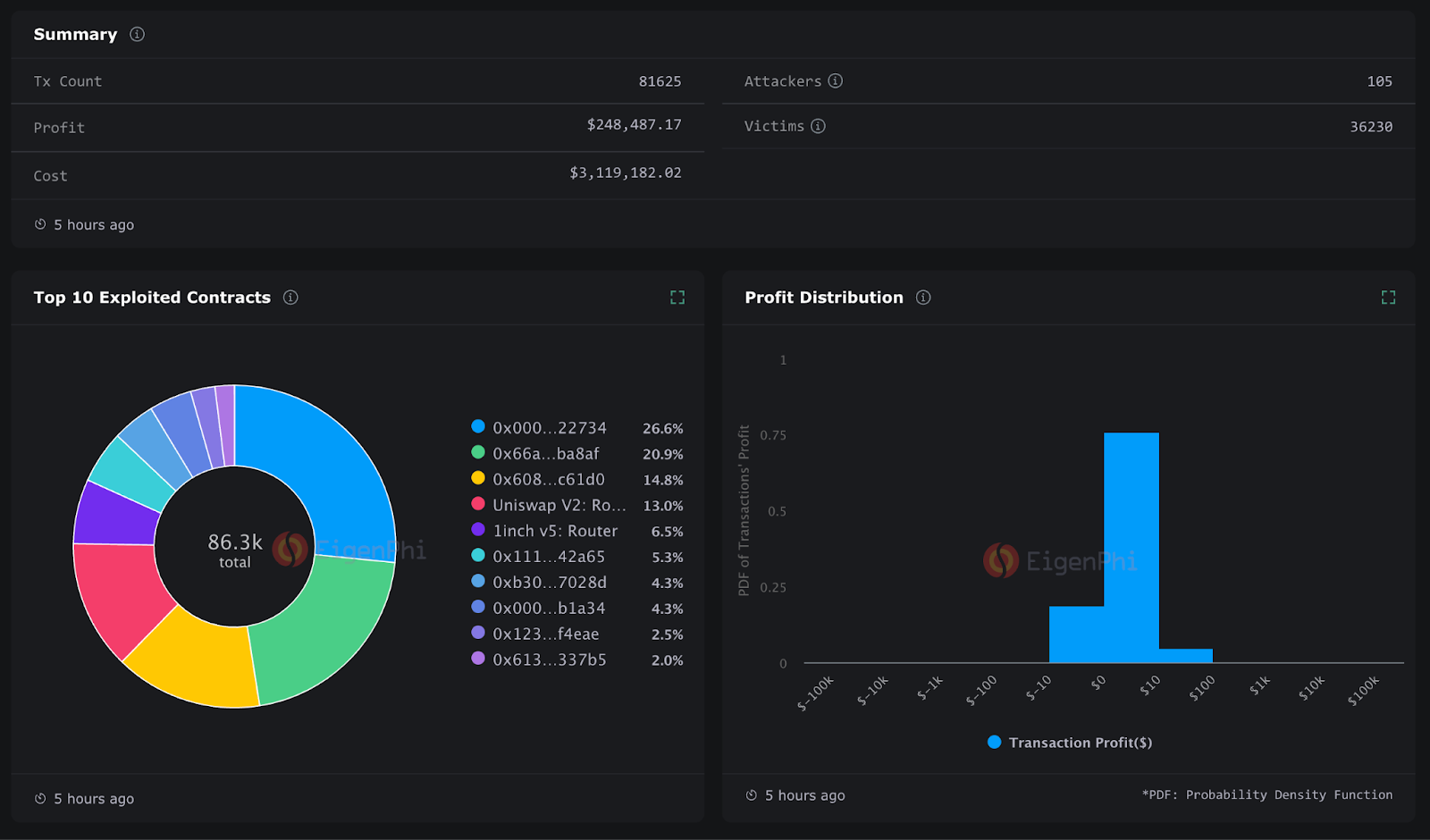
MIT Brothers Who Exploited MEV Bots for $25M Must Face Trial, Judge RulesSource: EigenPhi

These attacks now account for nearly $1 billion in weekly trading volume on Ethereum-based decentralized exchanges.

Flashbots has proposed new frameworks to address MEV abuse, including explicit MEV auctions and programmable privacy using Trusted Execution Environments.

The organization argues that current spam from MEV bots creates artificial fee floors, undermining the promise of near-zero transaction costs on scaled networks.

The brothers’ trial, scheduled for October, is likely to set precedents for future MEV-related prosecutions, as it isn’t technically precise whether it can be attributed to an exploit of a technical oversight.


Market Opportunity
NEAR Logo
NEAR Price(NEAR)
$1.0748
$1.0748$1.0748
+10.45%
USD
NEAR (NEAR) Live Price Chart
Disclaimer: The articles reposted on this site are sourced from public platforms and are provided for informational purposes only. They do not necessarily reflect the views of MEXC. All rights remain with the original authors. If you believe any content infringes on third-party rights, please contact crypto.news@mexc.com for removal. MEXC makes no guarantees regarding the accuracy, completeness, or timeliness of the content and is not responsible for any actions taken based on the information provided. The content does not constitute financial, legal, or other professional advice, nor should it be considered a recommendation or endorsement by MEXC.

You May Also Like

Exploring Market Buzz: Unique Opportunities in Cryptocurrencies

Exploring Market Buzz: Unique Opportunities in Cryptocurrencies

In the ever-evolving world of cryptocurrencies, recent developments have sparked significant interest. A closer look at pricing forecasts for Cardano (ADA) and rumors surrounding a Solana (SOL) ETF, coupled with the emergence of a promising new entrant, Layer Brett, reveals a complex market dynamic. Cardano's Prospects: A Closer Look Cardano, a stalwart in the blockchain space, continues to hold its ground with its research-driven development strategy. The latest price predictions for ADA suggest potential gains, predicting a double or even quadruple increase in its valuation. Despite these optimistic forecasts, the allure of exponential gains drives traders toward more speculative ventures. The Buzz Around Solana ETF The potential introduction of a Solana ETF has the crypto community abuzz, potentially catapulting SOL prices to new heights. As investors await regulatory decisions, the impact of such an ETF on Solana's value could be substantial, potentially reaching up to $300. However, as with Cardano, the substantial market capitalization of Solana may temper its growth potential. Why Layer Brett is Gaining Traction Amidst established names, a new contender, Layer Brett, has started to capture the market's attention with its early presale stages. Offering a low entry price of just $0.0058 and promising over 700% in staking rewards, Layer Brett presents a tempting proposition for those looking to maximize returns. Comparative Analysis: ADA, SOL, and $LBRETT While both ADA and SOL offer stable investment choices with reliable growth, Layer Brett emerges as a high-risk, high-reward option that could potentially offer significantly higher returns due to its nascent market position and aggressive economic model. Initial presale pricing lets investors get in on the ground floor. Staking rewards currently exceed 690%, a persuasive incentive for early adopters. Backed by Ethereum's Layer 2 for enhanced transaction speed and reduced costs. A community-focused $1 million giveaway to further drive engagement and investor interest. Predicted by some analysts to offer up to 50x returns in coming years. Shifting Sands: Investor Movements As the crypto market landscape shifts, many investors, including those traditionally holding ADA and SOL, are beginning to diversify their portfolios by turning to high-potential opportunities like Layer Brett. The combination of strategic presale pricing and significant staking rewards is creating a momentum of its own. Act Fast: Time-Sensitive Opportunities As September progresses, opportunities to capitalize on these low entry points and high yield offerings from Layer Brett are likely to diminish. With increasing attention and funds being directed towards this new asset, the window to act is closing quickly. Invest in Layer Brett now to secure your position before the next price hike and staking rewards reduction. For more information, visit the Layer Brett website, join their Telegram group, or follow them on X by clicking the following links: Website Telegram X Disclaimer: This is a sponsored press release and is for informational purposes only. It does not reflect the views of Bitzo, nor is it intended to be used as legal, tax, investment, or financial advice.
Share
Coinstats2025/09/18 18:39
Trump's 'pretty boring' State of the Union was a flop: MS NOW's Lemire

Trump's 'pretty boring' State of the Union was a flop: MS NOW's Lemire

Donald Trump's record-long State of the Union address got about as low of marks as possible from MS NOW’s Jonathan Lemire who claimed he couldn’t see it changing
Share
Rawstory2026/02/25 20:03
Ripple Links RLUSD Stablecoin to Franklin Templeton Fund on DBS Digital Exchange

Ripple Links RLUSD Stablecoin to Franklin Templeton Fund on DBS Digital Exchange

TLDR: DBS, Ripple, and Franklin Templeton will enable sgBENJI token trades using RLUSD stablecoin on DBS Digital Exchange. Investors can rebalance portfolios 24/7 and earn yield by holding tokenized money market funds on the XRP Ledger. DBS will explore repo lending, allowing sgBENJI tokens to serve as collateral for credit and wider liquidity access. Franklin [...] The post Ripple Links RLUSD Stablecoin to Franklin Templeton Fund on DBS Digital Exchange appeared first on Blockonomi.
Share
Blockonomi2025/09/18 13:21