Galaxy Digital is warning that the Bitcoin selloff may not be finished, arguing that on-chain data, weakening technical levels, and a thin catalyst calendar leaveGalaxy Digital is warning that the Bitcoin selloff may not be finished, arguing that on-chain data, weakening technical levels, and a thin catalyst calendar leave

Bitcoin Price May Slide To $58,000, Galaxy Digital Warns

2026/02/04 01:00
4 min read

Galaxy Digital is warning that the Bitcoin selloff may not be finished, arguing that on-chain data, weakening technical levels, and a thin catalyst calendar leave BTC vulnerable to a deeper retracement toward the high-$50,000s over the coming weeks or months.

In a client note dated Feb. 1, 2026, Galaxy researcher Alex Thorn framed last week’s drawdown as more than a brief shakeout. Bitcoin fell 15% from Monday, Jan. 28 through Saturday, Jan. 31, with the move accelerating into the weekend. Saturday alone saw a 10% slide that, according to the note, triggered one of the largest liquidation events on record, wiping out more than $2 billion in long positions across futures venues.

Why The Next Weeks, Months Look Bearish For Bitcoin

The selloff pushed BTC as low as $75,644 on Coinbase and briefly drove the spot price below several widely watched investor cost bases. Thorn noted that BTC dipped as much as 10% beneath the average cost basis of US spot ETFs, estimated around $84,000 based on the prices at which creations occurred, before recovering some ground. At one point, BTC also pierced Strategy’s average cost basis of $76,037, and nearly revisited the 1-year low of $74,420 set during the April 2025 “Tariff Tantrum.”

At the time of writing, Thorn pegged Bitcoin at roughly 38% below its Oct. 6, 2025 all-time high of $126,296. Historically, he argued, that magnitude matters: with the exception of 2017, the asset has not typically stopped at a 40% drawdown from peak without extending toward 50% within three months. A 50% decline from the October high would imply a move toward roughly $63,000.

Thorn’s central roadmap was defined by two long-term reference points that have repeatedly acted as “gravity” in prior cycles after key supports failed. Bitcoin lost its 50-week moving average in November 2025, and the note argued that, in previous bull markets, losing that level often preceded a deeper mean reversion to the 200-week moving average which currently sits around the $58,000 price mark.

Meanwhile, realized price, an on-chain proxy for the average cost basis of coins based on their last movement, is around $56,000. Both metrics rise over time if BTC trades above them.

The note pointed to ETF positioning as an additional stress test. US spot Bitcoin ETFs, launched in January 2024, had amassed $54 billion in net inflows as of the week ending Jan. 30, 2026, down from a peak of $62.2 billion in early October 2025. Thorn highlighted that the prior two weeks were the second- and third-worst for ETF flows, with combined outflows of $2.8 billion, even as ETF holders largely remained in place through the broader drawdown.

On-chain distribution data also suggested to Galaxy that the $82,000–$70,000 region could be lightly defended, increasing the odds of a downward probe. Thorn described a noticeable ownership “gap” in that band, and argued that price often seeks out zones where demand has previously been established, particularly after sharp deleveraging events.

Thorn also flagged a deteriorating narrative backdrop. “Catalysts remain hard to find. Narratives are working against Bitcoin. There’s little evidence of significant accumulation,” he wrote, adding that BTC’s recent failure to track gold and silver amid macro uncertainty has undercut the “debasement hedge” framing.

Even so, the note stopped short of calling a clean break into the $50,000s inevitable. Thorn emphasized that long-term holder profit-taking, described as exceptionally heavy in 2024 and 2025, has begun to abate, a condition that has historically coincided with late-stage selloffs.

For traders, Galaxy’s framing sets up a tactical question: whether the current ETF cost basis area near $84,000 can hold as a near-term anchor, or whether the supply gap below turns into a vacuum that pulls BTC toward the $70,000 handle. If that gives way, the more consequential test is whether realized price and the 200-week moving average in the high $50,000s again function as the kind of cycle-defined floor Galaxy believes long-term investors have historically treated as an entry zone.

At press time, Bitcoin traded at $78,301.
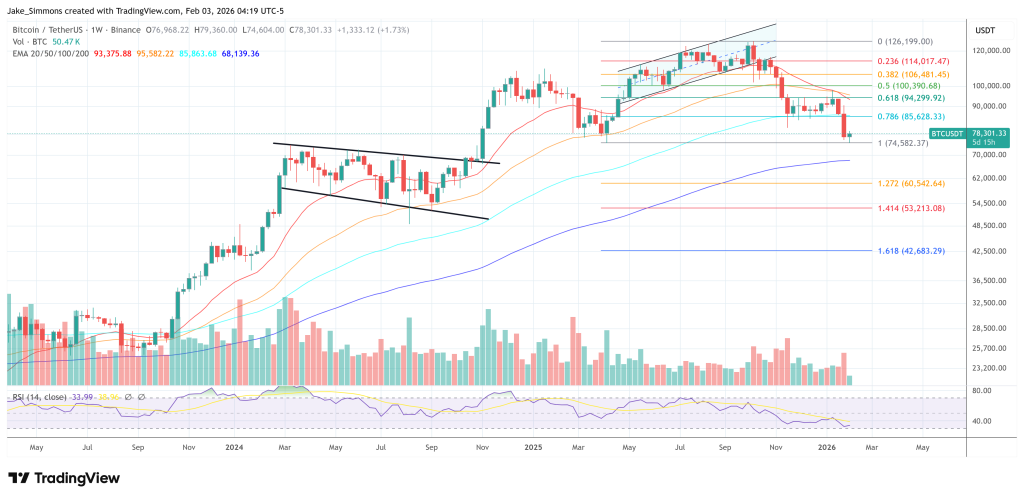
Bitcoin price chart
Disclaimer: The articles reposted on this site are sourced from public platforms and are provided for informational purposes only. They do not necessarily reflect the views of MEXC. All rights remain with the original authors. If you believe any content infringes on third-party rights, please contact service@support.mexc.com for removal. MEXC makes no guarantees regarding the accuracy, completeness, or timeliness of the content and is not responsible for any actions taken based on the information provided. The content does not constitute financial, legal, or other professional advice, nor should it be considered a recommendation or endorsement by MEXC.

You May Also Like

The Channel Factories We’ve Been Waiting For

The Channel Factories We’ve Been Waiting For

The post The Channel Factories We’ve Been Waiting For appeared on BitcoinEthereumNews.com. Visions of future technology are often prescient about the broad strokes while flubbing the details. The tablets in “2001: A Space Odyssey” do indeed look like iPads, but you never see the astronauts paying for subscriptions or wasting hours on Candy Crush.  Channel factories are one vision that arose early in the history of the Lightning Network to address some challenges that Lightning has faced from the beginning. Despite having grown to become Bitcoin’s most successful layer-2 scaling solution, with instant and low-fee payments, Lightning’s scale is limited by its reliance on payment channels. Although Lightning shifts most transactions off-chain, each payment channel still requires an on-chain transaction to open and (usually) another to close. As adoption grows, pressure on the blockchain grows with it. The need for a more scalable approach to managing channels is clear. Channel factories were supposed to meet this need, but where are they? In 2025, subnetworks are emerging that revive the impetus of channel factories with some new details that vastly increase their potential. They are natively interoperable with Lightning and achieve greater scale by allowing a group of participants to open a shared multisig UTXO and create multiple bilateral channels, which reduces the number of on-chain transactions and improves capital efficiency. Achieving greater scale by reducing complexity, Ark and Spark perform the same function as traditional channel factories with new designs and additional capabilities based on shared UTXOs.  Channel Factories 101 Channel factories have been around since the inception of Lightning. A factory is a multiparty contract where multiple users (not just two, as in a Dryja-Poon channel) cooperatively lock funds in a single multisig UTXO. They can open, close and update channels off-chain without updating the blockchain for each operation. Only when participants leave or the factory dissolves is an on-chain transaction…
Share
BitcoinEthereumNews2025/09/18 00:09
Polygon Tops RWA Rankings With $1.1B in Tokenized Assets

Polygon Tops RWA Rankings With $1.1B in Tokenized Assets

The post Polygon Tops RWA Rankings With $1.1B in Tokenized Assets appeared on BitcoinEthereumNews.com. Key Notes A new report from Dune and RWA.xyz highlights Polygon’s role in the growing RWA sector. Polygon PoS currently holds $1.13 billion in RWA Total Value Locked (TVL) across 269 assets. The network holds a 62% market share of tokenized global bonds, driven by European money market funds. The Polygon POL $0.25 24h volatility: 1.4% Market cap: $2.64 B Vol. 24h: $106.17 M network is securing a significant position in the rapidly growing tokenization space, now holding over $1.13 billion in total value locked (TVL) from Real World Assets (RWAs). This development comes as the network continues to evolve, recently deploying its major “Rio” upgrade on the Amoy testnet to enhance future scaling capabilities. This information comes from a new joint report on the state of the RWA market published on Sept. 17 by blockchain analytics firm Dune and data platform RWA.xyz. The focus on RWAs is intensifying across the industry, coinciding with events like the ongoing Real-World Asset Summit in New York. Sandeep Nailwal, CEO of the Polygon Foundation, highlighted the findings via a post on X, noting that the TVL is spread across 269 assets and 2,900 holders on the Polygon PoS chain. The Dune and https://t.co/W6WSFlHoQF report on RWA is out and it shows that RWA is happening on Polygon. Here are a few highlights: – Leading in Global Bonds: Polygon holds 62% share of tokenized global bonds (driven by Spiko’s euro MMF and Cashlink euro issues) – Spiko U.S.… — Sandeep | CEO, Polygon Foundation (※,※) (@sandeepnailwal) September 17, 2025 Key Trends From the 2025 RWA Report The joint publication, titled “RWA REPORT 2025,” offers a comprehensive look into the tokenized asset landscape, which it states has grown 224% since the start of 2024. The report identifies several key trends driving this expansion. According to…
Share
BitcoinEthereumNews2025/09/18 00:40
Explosive 25% Penalty On Nations Trading With Tehran

Explosive 25% Penalty On Nations Trading With Tehran

The post Explosive 25% Penalty On Nations Trading With Tehran appeared on BitcoinEthereumNews.com. Trump Iran Tariffs: Explosive 25% Penalty On Nations Trading
Share
BitcoinEthereumNews2026/02/07 08:10





