As digital transactions continue to rise across Europe, the European Central Bank (ECB) is doubling down on its commitment to preserve physical cash. In a blog post titled “Making euro cash fit for the future,” ECB Executive Board Member Piero Cipollone outlines why cash remains indispensable—and how the ECB plans to ensure it stays that way. Cash is indispensable as a way to pay and to store value, says Executive Board member Piero Cipollone. We are modernising banknotes, ensuring they remain accessible and widely accepted. A digital euro will complement this by bringing the benefits of cash to digital payments. — European Central Bank (@ecb) August 4, 2025 A Dual Payment Future: Cash and Digital Euro The ECB explains that while digital payments are growing rapidly, especially following the COVID-19 pandemic, Cipollone made it clear: physical cash isn’t being phased out. Instead, it’s being preserved and modernised to coexist with digital innovations, such as the upcoming digital euro. To support this dual system, the European Commission’s 2023 Single Currency Package introduced two legislative proposals. One protects the legal tender status of euro cash, and the other lays the groundwork for a digital euro. Together, these laws aim to ensure that Europeans continue to have a wide range of payment choices—both online and offline. Cash Still in High Demand Across Europe Despite digital trends, the ECB reports that euro banknotes remain a trusted store of value. Over €1.6 trillion worth of euro banknotes—around €5,000 per eurozone citizen—is currently in circulation. While usage dipped slightly during interest rate hikes, cash demand continues to rise at an annual rate of 2.3% in volume. Cipollone stresses that during past crises—the 2008 financial crash, the sovereign debt crisis, and the pandemic—cash demand surged, reinforcing its role as a stabilising tool in uncertain times. “Cash is always there when you need it,” he notes. Access to Cash Must Be Protected, Says ECB One of the ECB’s key concerns is making sure there is equitable access to cash services. As bank branches close and ATMs become less common, rural and underserved regions risk being cut off. To counter this, the proposed Legal Tender of Cash Regulation includes mandatory monitoring and assessment of cash access points across the eurozone. The ECB says it is working with national central banks to create metrics that account for geographic and population differences. Cipollone stresses that commercial banks have a duty to maintain both withdrawal and deposit services—essential for keeping cash circulating in local economies. No-Cash Policies Face Legal Pushback Retailers and public services increasingly refusing to accept cash is another red flag for the ECB. The central bank has criticised “no cash” signs and has called for rules to enforce cash acceptance, particularly in essential services like public transport. The Court of Justice of the European Union supports this stance, affirming that cash must be accepted unless both parties agree otherwise. The ECB also plans to modernise banknotes—both in design and anti-counterfeit technology—to ensure they remain practical and appealing well into the digital age. The ECB is clear—cash is not going anywhere. Instead, it’s being future-proofed to stand strong alongside the digital euro, offering Europeans flexibility, security, and inclusivity in how they pay. ECB Approves Central Bank Money for DLT Transactions In July, the ECB approved a two-track plan that will utilise central bank money for distributed ledger technology (DLT) transactions. The first short-term track approach, dubbed “Pontes”, will connect DLT platforms with Eurosystem TARGET services, to be launched by 2026. The track will ensure the free flow of cash, securities and collateral across Europe. Meanwhile, before the launch of the Pontes pilot in Q3 2026, the ECB will consider DLT-based trial and experiment requests.As digital transactions continue to rise across Europe, the European Central Bank (ECB) is doubling down on its commitment to preserve physical cash. In a blog post titled “Making euro cash fit for the future,” ECB Executive Board Member Piero Cipollone outlines why cash remains indispensable—and how the ECB plans to ensure it stays that way. Cash is indispensable as a way to pay and to store value, says Executive Board member Piero Cipollone. We are modernising banknotes, ensuring they remain accessible and widely accepted. A digital euro will complement this by bringing the benefits of cash to digital payments. — European Central Bank (@ecb) August 4, 2025 A Dual Payment Future: Cash and Digital Euro The ECB explains that while digital payments are growing rapidly, especially following the COVID-19 pandemic, Cipollone made it clear: physical cash isn’t being phased out. Instead, it’s being preserved and modernised to coexist with digital innovations, such as the upcoming digital euro. To support this dual system, the European Commission’s 2023 Single Currency Package introduced two legislative proposals. One protects the legal tender status of euro cash, and the other lays the groundwork for a digital euro. Together, these laws aim to ensure that Europeans continue to have a wide range of payment choices—both online and offline. Cash Still in High Demand Across Europe Despite digital trends, the ECB reports that euro banknotes remain a trusted store of value. Over €1.6 trillion worth of euro banknotes—around €5,000 per eurozone citizen—is currently in circulation. While usage dipped slightly during interest rate hikes, cash demand continues to rise at an annual rate of 2.3% in volume. Cipollone stresses that during past crises—the 2008 financial crash, the sovereign debt crisis, and the pandemic—cash demand surged, reinforcing its role as a stabilising tool in uncertain times. “Cash is always there when you need it,” he notes. Access to Cash Must Be Protected, Says ECB One of the ECB’s key concerns is making sure there is equitable access to cash services. As bank branches close and ATMs become less common, rural and underserved regions risk being cut off. To counter this, the proposed Legal Tender of Cash Regulation includes mandatory monitoring and assessment of cash access points across the eurozone. The ECB says it is working with national central banks to create metrics that account for geographic and population differences. Cipollone stresses that commercial banks have a duty to maintain both withdrawal and deposit services—essential for keeping cash circulating in local economies. No-Cash Policies Face Legal Pushback Retailers and public services increasingly refusing to accept cash is another red flag for the ECB. The central bank has criticised “no cash” signs and has called for rules to enforce cash acceptance, particularly in essential services like public transport. The Court of Justice of the European Union supports this stance, affirming that cash must be accepted unless both parties agree otherwise. The ECB also plans to modernise banknotes—both in design and anti-counterfeit technology—to ensure they remain practical and appealing well into the digital age. The ECB is clear—cash is not going anywhere. Instead, it’s being future-proofed to stand strong alongside the digital euro, offering Europeans flexibility, security, and inclusivity in how they pay. ECB Approves Central Bank Money for DLT Transactions In July, the ECB approved a two-track plan that will utilise central bank money for distributed ledger technology (DLT) transactions. The first short-term track approach, dubbed “Pontes”, will connect DLT platforms with Eurosystem TARGET services, to be launched by 2026. The track will ensure the free flow of cash, securities and collateral across Europe. Meanwhile, before the launch of the Pontes pilot in Q3 2026, the ECB will consider DLT-based trial and experiment requests.

ECB Says Cash Will Stay, Even as Digital Payments Grow

2025/08/04 19:05
3 min read
For feedback or concerns regarding this content, please contact us at crypto.news@mexc.com

As digital transactions continue to rise across Europe, the European Central Bank (ECB) is doubling down on its commitment to preserve physical cash.

In a blog post titled “Making euro cash fit for the future,” ECB Executive Board Member Piero Cipollone outlines why cash remains indispensable—and how the ECB plans to ensure it stays that way.

A Dual Payment Future: Cash and Digital Euro

The ECB explains that while digital payments are growing rapidly, especially following the COVID-19 pandemic, Cipollone made it clear: physical cash isn’t being phased out. Instead, it’s being preserved and modernised to coexist with digital innovations, such as the upcoming digital euro.

To support this dual system, the European Commission’s 2023 Single Currency Package introduced two legislative proposals.

One protects the legal tender status of euro cash, and the other lays the groundwork for a digital euro. Together, these laws aim to ensure that Europeans continue to have a wide range of payment choices—both online and offline.

Cash Still in High Demand Across Europe

Despite digital trends, the ECB reports that euro banknotes remain a trusted store of value. Over €1.6 trillion worth of euro banknotes—around €5,000 per eurozone citizen—is currently in circulation. While usage dipped slightly during interest rate hikes, cash demand continues to rise at an annual rate of 2.3% in volume.
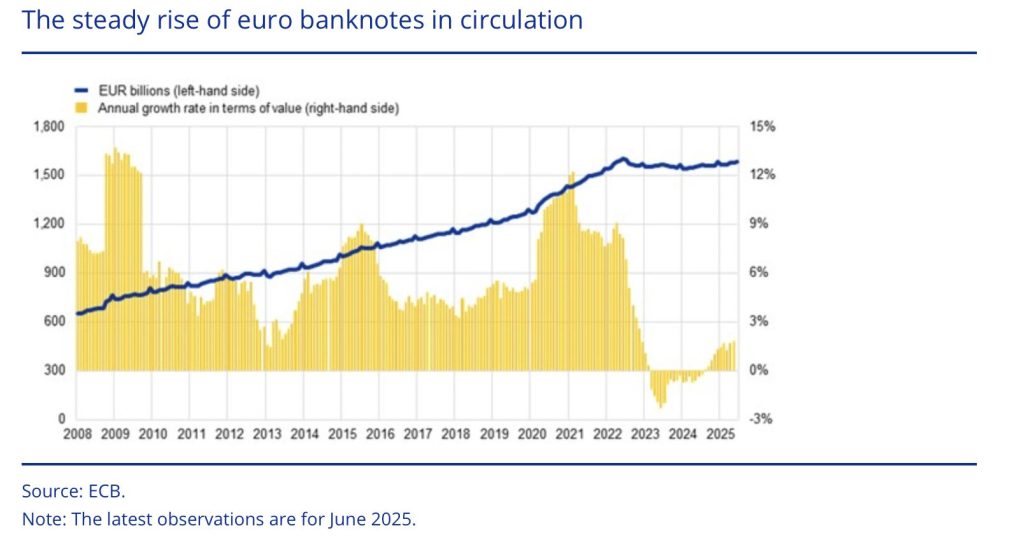
Cipollone stresses that during past crises—the 2008 financial crash, the sovereign debt crisis, and the pandemic—cash demand surged, reinforcing its role as a stabilising tool in uncertain times. “Cash is always there when you need it,” he notes.

Access to Cash Must Be Protected, Says ECB

One of the ECB’s key concerns is making sure there is equitable access to cash services. As bank branches close and ATMs become less common, rural and underserved regions risk being cut off. To counter this, the proposed Legal Tender of Cash Regulation includes mandatory monitoring and assessment of cash access points across the eurozone.

The ECB says it is working with national central banks to create metrics that account for geographic and population differences. Cipollone stresses that commercial banks have a duty to maintain both withdrawal and deposit services—essential for keeping cash circulating in local economies.

No-Cash Policies Face Legal Pushback

Retailers and public services increasingly refusing to accept cash is another red flag for the ECB. The central bank has criticised “no cash” signs and has called for rules to enforce cash acceptance, particularly in essential services like public transport.

The Court of Justice of the European Union supports this stance, affirming that cash must be accepted unless both parties agree otherwise. The ECB also plans to modernise banknotes—both in design and anti-counterfeit technology—to ensure they remain practical and appealing well into the digital age.

The ECB is clear—cash is not going anywhere. Instead, it’s being future-proofed to stand strong alongside the digital euro, offering Europeans flexibility, security, and inclusivity in how they pay.

ECB Approves Central Bank Money for DLT Transactions

In July, the ECB approved a two-track plan that will utilise central bank money for distributed ledger technology (DLT) transactions.

The first short-term track approach, dubbed “Pontes”, will connect DLT platforms with Eurosystem TARGET services, to be launched by 2026. The track will ensure the free flow of cash, securities and collateral across Europe.

Meanwhile, before the launch of the Pontes pilot in Q3 2026, the ECB will consider DLT-based trial and experiment requests.


Market Opportunity
Threshold Logo
Threshold Price(T)
$0.006526
$0.006526$0.006526
+0.27%
USD
Threshold (T) Live Price Chart
Disclaimer: The articles reposted on this site are sourced from public platforms and are provided for informational purposes only. They do not necessarily reflect the views of MEXC. All rights remain with the original authors. If you believe any content infringes on third-party rights, please contact crypto.news@mexc.com for removal. MEXC makes no guarantees regarding the accuracy, completeness, or timeliness of the content and is not responsible for any actions taken based on the information provided. The content does not constitute financial, legal, or other professional advice, nor should it be considered a recommendation or endorsement by MEXC.

You May Also Like

World Gold Council’s Pivotal Framework Promises Unprecedented Market Trust

World Gold Council’s Pivotal Framework Promises Unprecedented Market Trust

The post World Gold Council’s Pivotal Framework Promises Unprecedented Market Trust appeared on BitcoinEthereumNews.com. Tokenized Gold Revolution: World Gold Council
Share
BitcoinEthereumNews2026/03/20 03:58
Aave DAO to Shut Down 50% of L2s While Doubling Down on GHO

Aave DAO to Shut Down 50% of L2s While Doubling Down on GHO

The post Aave DAO to Shut Down 50% of L2s While Doubling Down on GHO appeared on BitcoinEthereumNews.com. Aave DAO is gearing up for a significant overhaul by shutting down over 50% of underperforming L2 instances. It is also restructuring its governance framework and deploying over $100 million to boost GHO. This could be a pivotal moment that propels Aave back to the forefront of on-chain lending or sparks unprecedented controversy within the DeFi community. Sponsored Sponsored ACI Proposes Shutting Down 50% of L2s The “State of the Union” report by the Aave Chan Initiative (ACI) paints a candid picture. After a turbulent period in the DeFi market and internal challenges, Aave (AAVE) now leads in key metrics: TVL, revenue, market share, and borrowing volume. Aave’s annual revenue of $130 million surpasses the combined cash reserves of its competitors. Tokenomics improvements and the AAVE token buyback program have also contributed to the ecosystem’s growth. Aave global metrics. Source: Aave However, the ACI’s report also highlights several pain points. First, regarding the Layer-2 (L2) strategy. While Aave’s L2 strategy was once a key driver of success, it is no longer fit for purpose. Over half of Aave’s instances on L2s and alt-L1s are not economically viable. Based on year-to-date data, over 86.6% of Aave’s revenue comes from the mainnet, indicating that everything else is a side quest. On this basis, ACI proposes closing underperforming networks. The DAO should invest in key networks with significant differentiators. Second, ACI is pushing for a complete overhaul of the “friendly fork” framework, as most have been unimpressive regarding TVL and revenue. In some cases, attackers have exploited them to Aave’s detriment, as seen with Spark. Sponsored Sponsored “The friendly fork model had a good intention but bad execution where the DAO was too friendly towards these forks, allowing the DAO only little upside,” the report states. Third, the instance model, once a smart…
Share
BitcoinEthereumNews2025/09/18 02:28
Shiba Inu Price Prediction 2026: SHIB Fights to Reclaim Its Glory While Pepeto Offers the 150x Early Window That SHIB Already Closed

Shiba Inu Price Prediction 2026: SHIB Fights to Reclaim Its Glory While Pepeto Offers the 150x Early Window That SHIB Already Closed

A truck driver put $650 into Shiba Inu in 2020 and quit his job after his bag grew to $1.7 million. Two brothers invested $7,900 during the COVID lockdowns and
Share
Blockonomi2026/03/20 04:32