Stellar (XLM) depreciates by nearly 2% at press time on Wednesday as it continues to trade within a falling channel pattern on the 4-hour time frame. Investors anticipate a steeper correction as optimism in XLM derivatives wanes, with bearish bets rising and open interest declines.Stellar (XLM) depreciates by nearly 2% at press time on Wednesday as it continues to trade within a falling channel pattern on the 4-hour time frame. Investors anticipate a steeper correction as optimism in XLM derivatives wanes, with bearish bets rising and open interest declines.

Stellar Price Forecast: XLM downtrend likely to continue as bearish bets surge

  • Stellar continues to trade within a falling channel on the 4-hour chart, risking a steeper correction below the 200-period EMA.
  • Open Interest has decreased by 9% in the last 24 hours, indicating a decline in optimism among traders.
  • Short positions in XLM derivatives have increased to 54% over the last 24 hours.

Stellar (XLM) depreciates by nearly 2% at press time on Wednesday as it continues to trade within a falling channel pattern on the 4-hour time frame. Investors anticipate a steeper correction as optimism in XLM derivatives wanes, with bearish bets rising and open interest declines. 

XLM traders bet against recovery as Open Interest declines

Investors are losing confidence in Stellar as capital outflows surge from the XLM derivatives market amid the broader market pullback.

CoinGlass data shows that Open Interest (OI) has decreased by 9% over the last 24 hours, reaching $308.99 million. A pullback in OI reflects capital outflow from the futures and options, suggesting investors are adopting a wait-and-see approach to avoid losses.
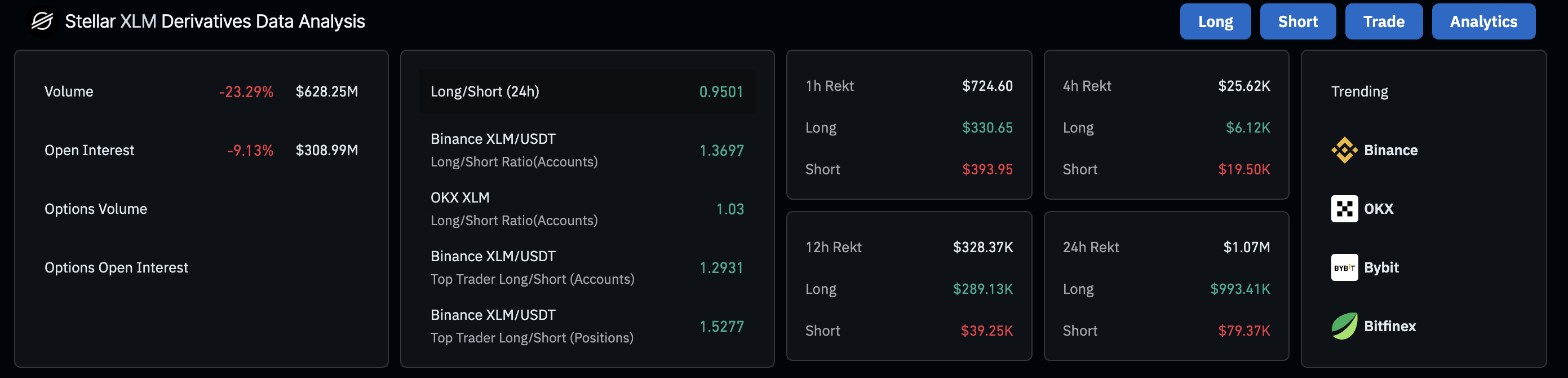
XLM Open Interest. Source: Coinglass

Traders with a higher risk appetite are betting against the XLM recovery chances by holding bearish positions. According to the XLM long-to-short ratio chart, short positions have increased to 54.26% from 51.81% on Tuesday. 
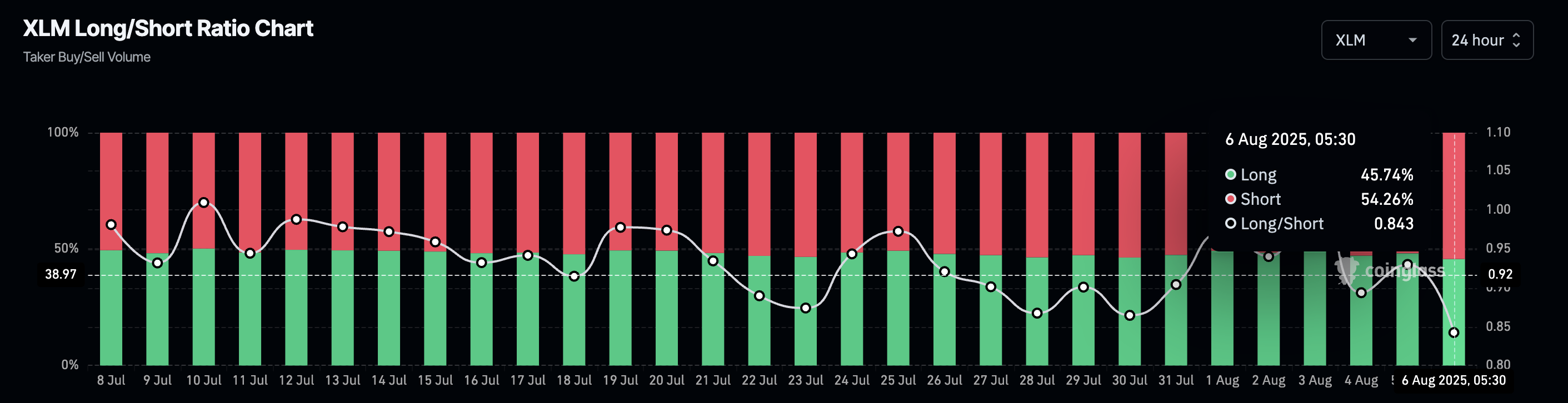
XLM long/short ratio chart. Source: Coinglass

Stellar risks 11% pullback within falling channel

Stellar tests the 200-period Exponential Moving Average (EMA) at $0.3884 on the 4-hour chart, extending the 4.30% drop from the previous day. The declining trend steps below the 23.6% Fibonacci level at $0.3980, drawn from the $0.5166 peak on July 14 to the 0.3613 low on Sunday. 

A decisive close below the said dynamic support could extend the decline to the $0.3613 support.

However, the bearish pattern highlights the risk of XLM retesting the lower support trendline near $0.3460. This pullback would account for an 11% drop from the current market price. 

The technical indicators maintain a neutral stance as the Moving Average Convergence Divergence (MACD) line crossed below its signal line, but moves sideways closely, indicating low momentum. 

A decline in buying pressure causes the Relative Strength Index (RSI) to drop to 44 on the 4-hour chart, below the halfway line. If RSI extends the declining trend, it could increase the chances of a double-digit fall. 
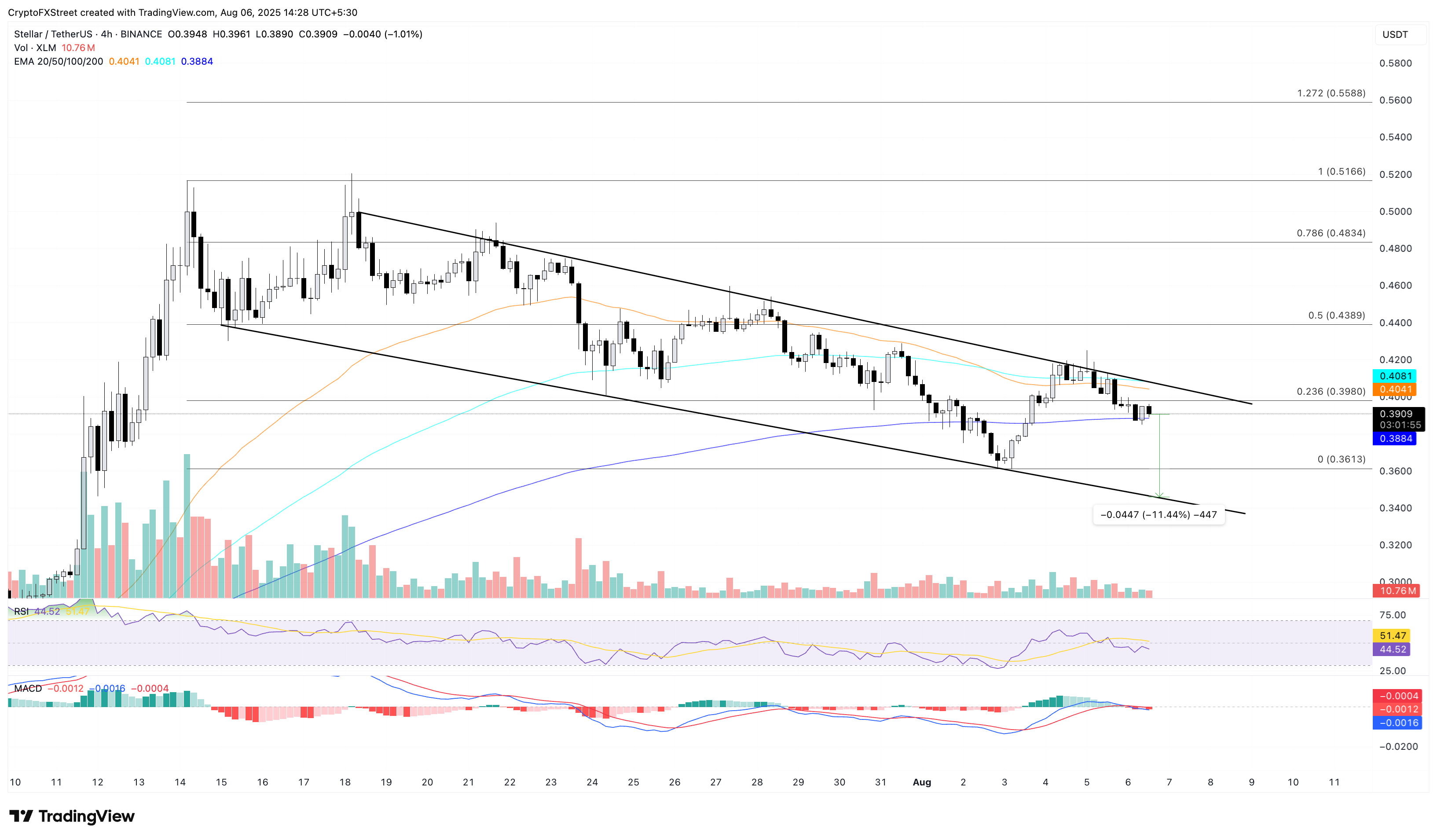
XLM/USDT daily price chart.

On the contrary, if XLM bounces off the 200-period EMA, it should surpass the 100-period EMA at $0.4082 at the overhead trendline, to reinforce an uptrend. In such a case, Stellar could extend the rally to the 50% retracement level at $0.4389. 


Market Opportunity
Stellar Logo
Stellar Price(XLM)
$0.2316
$0.2316$0.2316
+0.73%
USD
Stellar (XLM) Live Price Chart
Disclaimer: The articles reposted on this site are sourced from public platforms and are provided for informational purposes only. They do not necessarily reflect the views of MEXC. All rights remain with the original authors. If you believe any content infringes on third-party rights, please contact service@support.mexc.com for removal. MEXC makes no guarantees regarding the accuracy, completeness, or timeliness of the content and is not responsible for any actions taken based on the information provided. The content does not constitute financial, legal, or other professional advice, nor should it be considered a recommendation or endorsement by MEXC.

You May Also Like

VivoPower To Load Up On XRP At 65% Discount: Here’s How

VivoPower To Load Up On XRP At 65% Discount: Here’s How

VivoPower International, a Nasdaq-listed B-Corp now pivoting to an XRP-centric treasury, said on September 16 it has structured its mining and treasury operations so that it can acquire the token “at up to a 65% discount” to prevailing market prices—by mining other proof-of-work assets and swapping those mined tokens. VivoPower Doubles Down On XRP The […]
Share
Bitcoinist2025/09/18 10:00
WIF price reclaims 200-day moving average

WIF price reclaims 200-day moving average

WIF (WIF) price is entering a critical technical phase as price action reclaims the 200-day moving average, a level that often separates bearish control from bullish
Share
Crypto.news2026/01/13 23:44
China Blocks Nvidia’s RTX Pro 6000D as Local Chips Rise

China Blocks Nvidia’s RTX Pro 6000D as Local Chips Rise

The post China Blocks Nvidia’s RTX Pro 6000D as Local Chips Rise appeared on BitcoinEthereumNews.com. China Blocks Nvidia’s RTX Pro 6000D as Local Chips Rise China’s internet regulator has ordered the country’s biggest technology firms, including Alibaba and ByteDance, to stop purchasing Nvidia’s RTX Pro 6000D GPUs. According to the Financial Times, the move shuts down the last major channel for mass supplies of American chips to the Chinese market. Why Beijing Halted Nvidia Purchases Chinese companies had planned to buy tens of thousands of RTX Pro 6000D accelerators and had already begun testing them in servers. But regulators intervened, halting the purchases and signaling stricter controls than earlier measures placed on Nvidia’s H20 chip. Image: Nvidia An audit compared Huawei and Cambricon processors, along with chips developed by Alibaba and Baidu, against Nvidia’s export-approved products. Regulators concluded that Chinese chips had reached performance levels comparable to the restricted U.S. models. This assessment pushed authorities to advise firms to rely more heavily on domestic processors, further tightening Nvidia’s already limited position in China. China’s Drive Toward Tech Independence The decision highlights Beijing’s focus on import substitution — developing self-sufficient chip production to reduce reliance on U.S. supplies. “The signal is now clear: all attention is focused on building a domestic ecosystem,” said a representative of a leading Chinese tech company. Nvidia had unveiled the RTX Pro 6000D in July 2025 during CEO Jensen Huang’s visit to Beijing, in an attempt to keep a foothold in China after Washington restricted exports of its most advanced chips. But momentum is shifting. Industry sources told the Financial Times that Chinese manufacturers plan to triple AI chip production next year to meet growing demand. They believe “domestic supply will now be sufficient without Nvidia.” What It Means for the Future With Huawei, Cambricon, Alibaba, and Baidu stepping up, China is positioning itself for long-term technological independence. Nvidia, meanwhile, faces…
Share
BitcoinEthereumNews2025/09/18 01:37