The Ethereum Foundation has once again thrown its support behind Tornado Cash developer Roman Storm, pledging $500,000 in donations to fund the privacy-protocol developer’s legal defense. This announcement comes just days after the Tornado Cash co-founder was convicted on one of three federal charges that legal experts warn could set a dangerous precedent for criminalizing open-source development. Privacy is normal, and writing code is not a crime. https://t.co/BD55K5GDW3 — Ethereum (@ethereum) August 7, 2025 In an August 7 announcement , Hsiao-Wei Wang, co-executive director of the Ethereum Foundation, disclosed details of the donation and called upon the broader crypto community to contribute to the Tornado Cash developer’s legal defense fund. Ethereum Foundation Support Ambitious $7M donation goal as Storm Faces 5-Year Prison According to the “ freeromanstorm ” donation tracker, the Ethereum Foundation has contributed only 2% of the $500,000 target, while total legal fund support received by the Tornado Cash developer currently exceeds $4.7 million, still 31% short of the ambitious $7 million goal. Source: Free Roman Storm Supporting Roman Storm’s cause, Wang emphasized that “Privacy is normal, and writing code is not a crime.” Storm himself has been actively soliciting public contributions to his legal defense fund. A July 26 X post from the Tornado Cash developer urgently stated: “We’re running out of time — legal costs are piling up fast, and we urgently need your help.” The current legal urgency and plea for donations comes as a Manhattan jury on August 6 found Storm guilty of conspiring to operate an unlicensed money transmitter. Coin Center’s Seven Takeaways from the Storm Verdict: ▪️ 1. The sole conviction—unlicensed money transmission (18 U.S.C. § 1960)—turns mainly on legal/regulatory interpretation (“does this count as money transmission?”), not jury fact-finding. ▪️ 2. The court, at the… — Peter Van Valkenburgh (@valkenburgh) August 6, 2025 However, jurors remained deadlocked on separate conspiracy charges for money laundering and sanctions evasion after four days of deliberation. Under 18 U.S. Code Section 1960 , Storm was convicted of operating an unlicensed money transmitting business, which stipulates that anyone who “knowingly conducts, controls, manages, supervises, directs, or owns all or part of an unlicensed money transmitting business, shall be fined under this title or imprisoned not more than 5 years, or both.” The Free Pertsev & Storm legal aid organization highlighted the urgency of continued funding, confirming that Storm “risks up to 5 years of jail time if he doesn’t win the appeal, and potentially decades if the government decides to retry Counts 1 & 3.” Counts 1 and 3, which remain in legal deadlock, include charges of conspiracy to commit money laundering and conspiracy to violate U.S. sanctions, respectively. Roman has been convicted on Count 2 of conspiracy to Operate an Unlicensed Money Transmitting Business (max sentence of 5 years in prison). Here's a good thread by @valkenburgh about this charge + why it makes no sense: https://t.co/GlyEj9kPyy — Free Pertsev & Storm (@FreeAlexeyRoman) August 6, 2025 The organization noted that this case’s outcome “will set a major precedent for developers worldwide.” “Sad Day for DeFi”: Crypto Lawyers And Community Rally Support for Tornado Cash Developers The crypto community has widely criticized the unfairness of Storm’s case. On August 6, crypto lawyer Jake Chervinsky called the recent verdict “a sad day for DeFi,” arguing that “the government should never have brought this case.” He contended that Section 1960 should not apply to developers of non-custodial protocols who lack control over user funds. The government should never have brought this case. Section 1960 should not apply to the developer of a non-custodial protocol who lacks control of user funds. This case should go up on appeal. Hopefully the Second Circuit will correct this (and many other) errors in the case. — Jake Chervinsky (@jchervinsky) August 6, 2025 Chervinsky urged the case to proceed on appeal, expressing hope that “the Second Circuit will correct this (and many other) errors.” Storm’s legal difficulties stem from his role in developing Tornado Cash, a cryptocurrency mixer that enables users to obscure transaction histories by pooling funds with other users. The U.S. Treasury Department sanctioned the protocol in August 2022, alleging that $7 billion had been laundered through the platform since 2019, including frequent use by North Korea’s Lazarus Group hackers. Federal prosecutors characterized Storm as someone who profited from “hiding dirty money for criminals.” At the same time, his defense team argued that Tornado Cash was designed as a privacy tool for legitimate users, not specifically for illicit activities. Storm was indicted on these charges and sanctions violations alongside Tornado Cash co-founder Roman Semenov and Alexey Pertsev, another developer associated with the cryptocurrency-mixing platform. Tornado Cash users, developers, and crypto executives continue challenging the Treasury’s sanctions in court, arguing that the platform’s immutable smart contracts should not be subject to OFAC restrictions. 👨‍⚖️ Roman Storm, co-founder of the crypto mixing platform Tornado Cash, is urging a U.S. federal judge to dismiss all criminal charges against him. #TornadoCash #Storm https://t.co/UR6SpxMSw3 — Cryptonews.com (@cryptonews) December 20, 2024 On March 24, Coinbase’s Chief Legal Officer, Paul Grewal, demanded a final court judgment in the Tornado Case, despite the U.S. Department of the Treasury’s decision to delist the crypto mixer.The Ethereum Foundation has once again thrown its support behind Tornado Cash developer Roman Storm, pledging $500,000 in donations to fund the privacy-protocol developer’s legal defense. This announcement comes just days after the Tornado Cash co-founder was convicted on one of three federal charges that legal experts warn could set a dangerous precedent for criminalizing open-source development. Privacy is normal, and writing code is not a crime. https://t.co/BD55K5GDW3 — Ethereum (@ethereum) August 7, 2025 In an August 7 announcement , Hsiao-Wei Wang, co-executive director of the Ethereum Foundation, disclosed details of the donation and called upon the broader crypto community to contribute to the Tornado Cash developer’s legal defense fund. Ethereum Foundation Support Ambitious $7M donation goal as Storm Faces 5-Year Prison According to the “ freeromanstorm ” donation tracker, the Ethereum Foundation has contributed only 2% of the $500,000 target, while total legal fund support received by the Tornado Cash developer currently exceeds $4.7 million, still 31% short of the ambitious $7 million goal. Source: Free Roman Storm Supporting Roman Storm’s cause, Wang emphasized that “Privacy is normal, and writing code is not a crime.” Storm himself has been actively soliciting public contributions to his legal defense fund. A July 26 X post from the Tornado Cash developer urgently stated: “We’re running out of time — legal costs are piling up fast, and we urgently need your help.” The current legal urgency and plea for donations comes as a Manhattan jury on August 6 found Storm guilty of conspiring to operate an unlicensed money transmitter. Coin Center’s Seven Takeaways from the Storm Verdict: ▪️ 1. The sole conviction—unlicensed money transmission (18 U.S.C. § 1960)—turns mainly on legal/regulatory interpretation (“does this count as money transmission?”), not jury fact-finding. ▪️ 2. The court, at the… — Peter Van Valkenburgh (@valkenburgh) August 6, 2025 However, jurors remained deadlocked on separate conspiracy charges for money laundering and sanctions evasion after four days of deliberation. Under 18 U.S. Code Section 1960 , Storm was convicted of operating an unlicensed money transmitting business, which stipulates that anyone who “knowingly conducts, controls, manages, supervises, directs, or owns all or part of an unlicensed money transmitting business, shall be fined under this title or imprisoned not more than 5 years, or both.” The Free Pertsev & Storm legal aid organization highlighted the urgency of continued funding, confirming that Storm “risks up to 5 years of jail time if he doesn’t win the appeal, and potentially decades if the government decides to retry Counts 1 & 3.” Counts 1 and 3, which remain in legal deadlock, include charges of conspiracy to commit money laundering and conspiracy to violate U.S. sanctions, respectively. Roman has been convicted on Count 2 of conspiracy to Operate an Unlicensed Money Transmitting Business (max sentence of 5 years in prison). Here's a good thread by @valkenburgh about this charge + why it makes no sense: https://t.co/GlyEj9kPyy — Free Pertsev & Storm (@FreeAlexeyRoman) August 6, 2025 The organization noted that this case’s outcome “will set a major precedent for developers worldwide.” “Sad Day for DeFi”: Crypto Lawyers And Community Rally Support for Tornado Cash Developers The crypto community has widely criticized the unfairness of Storm’s case. On August 6, crypto lawyer Jake Chervinsky called the recent verdict “a sad day for DeFi,” arguing that “the government should never have brought this case.” He contended that Section 1960 should not apply to developers of non-custodial protocols who lack control over user funds. The government should never have brought this case. Section 1960 should not apply to the developer of a non-custodial protocol who lacks control of user funds. This case should go up on appeal. Hopefully the Second Circuit will correct this (and many other) errors in the case. — Jake Chervinsky (@jchervinsky) August 6, 2025 Chervinsky urged the case to proceed on appeal, expressing hope that “the Second Circuit will correct this (and many other) errors.” Storm’s legal difficulties stem from his role in developing Tornado Cash, a cryptocurrency mixer that enables users to obscure transaction histories by pooling funds with other users. The U.S. Treasury Department sanctioned the protocol in August 2022, alleging that $7 billion had been laundered through the platform since 2019, including frequent use by North Korea’s Lazarus Group hackers. Federal prosecutors characterized Storm as someone who profited from “hiding dirty money for criminals.” At the same time, his defense team argued that Tornado Cash was designed as a privacy tool for legitimate users, not specifically for illicit activities. Storm was indicted on these charges and sanctions violations alongside Tornado Cash co-founder Roman Semenov and Alexey Pertsev, another developer associated with the cryptocurrency-mixing platform. Tornado Cash users, developers, and crypto executives continue challenging the Treasury’s sanctions in court, arguing that the platform’s immutable smart contracts should not be subject to OFAC restrictions. 👨‍⚖️ Roman Storm, co-founder of the crypto mixing platform Tornado Cash, is urging a U.S. federal judge to dismiss all criminal charges against him. #TornadoCash #Storm https://t.co/UR6SpxMSw3 — Cryptonews.com (@cryptonews) December 20, 2024 On March 24, Coinbase’s Chief Legal Officer, Paul Grewal, demanded a final court judgment in the Tornado Case, despite the U.S. Department of the Treasury’s decision to delist the crypto mixer.

Ethereum Foundation Backs Tornado Cash Developer with $500K Legal Defense Fund

The Ethereum Foundation has once again thrown its support behind Tornado Cash developer Roman Storm, pledging $500,000 in donations to fund the privacy-protocol developer’s legal defense.

This announcement comes just days after the Tornado Cash co-founder was convicted on one of three federal charges that legal experts warn could set a dangerous precedent for criminalizing open-source development.

In an August 7 announcement, Hsiao-Wei Wang, co-executive director of the Ethereum Foundation, disclosed details of the donation and called upon the broader crypto community to contribute to the Tornado Cash developer’s legal defense fund.

Ethereum Foundation Support Ambitious $7M donation goal as Storm Faces 5-Year Prison

According to the “freeromanstorm” donation tracker, the Ethereum Foundation has contributed only 2% of the $500,000 target, while total legal fund support received by the Tornado Cash developer currently exceeds $4.7 million, still 31% short of the ambitious $7 million goal.
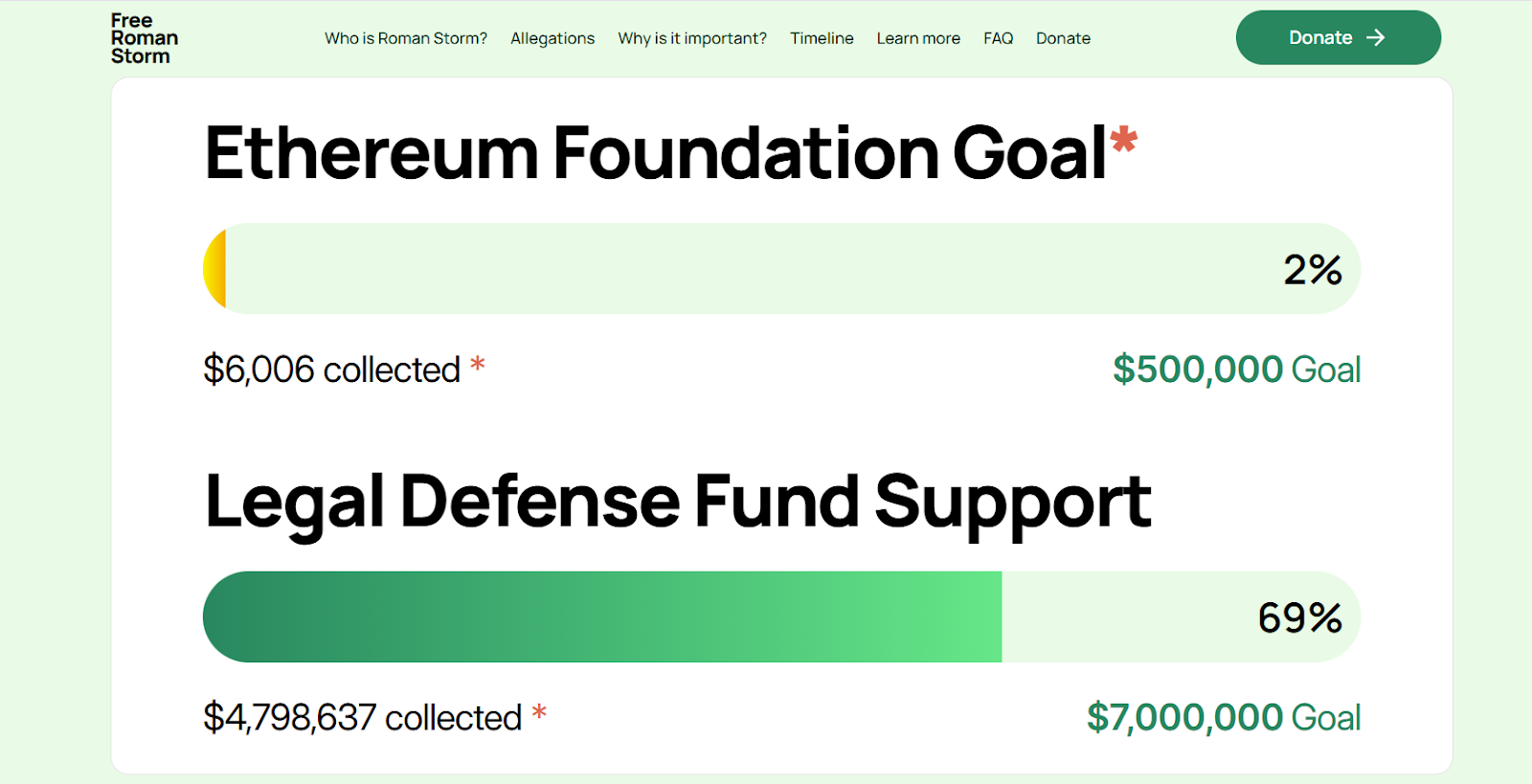
Ethereum Foundation Backs Tornado Cash Developer with $500K Legal Defense FundSource: Free Roman Storm

Supporting Roman Storm’s cause, Wang emphasized that “Privacy is normal, and writing code is not a crime.”

Storm himself has been actively soliciting public contributions to his legal defense fund.

A July 26 X post from the Tornado Cash developer urgently stated: “We’re running out of time — legal costs are piling up fast, and we urgently need your help.”

The current legal urgency and plea for donations comes as a Manhattan jury on August 6 found Storm guilty of conspiring to operate an unlicensed money transmitter.

However, jurors remained deadlocked on separate conspiracy charges for money laundering and sanctions evasion after four days of deliberation.

Under 18 U.S. Code Section 1960, Storm was convicted of operating an unlicensed money transmitting business, which stipulates that anyone who “knowingly conducts, controls, manages, supervises, directs, or owns all or part of an unlicensed money transmitting business, shall be fined under this title or imprisoned not more than 5 years, or both.”

The Free Pertsev & Storm legal aid organization highlighted the urgency of continued funding, confirming that Storm “risks up to 5 years of jail time if he doesn’t win the appeal, and potentially decades if the government decides to retry Counts 1 & 3.”

Counts 1 and 3, which remain in legal deadlock, include charges of conspiracy to commit money laundering and conspiracy to violate U.S. sanctions, respectively.

The organization noted that this case’s outcome “will set a major precedent for developers worldwide.”

“Sad Day for DeFi”: Crypto Lawyers And Community Rally Support for Tornado Cash Developers

The crypto community has widely criticized the unfairness of Storm’s case.

On August 6, crypto lawyer Jake Chervinsky called the recent verdict “a sad day for DeFi,” arguing that “the government should never have brought this case.”

He contended that Section 1960 should not apply to developers of non-custodial protocols who lack control over user funds.

Chervinsky urged the case to proceed on appeal, expressing hope that “the Second Circuit will correct this (and many other) errors.”

Storm’s legal difficulties stem from his role in developing Tornado Cash, a cryptocurrency mixer that enables users to obscure transaction histories by pooling funds with other users.

The U.S. Treasury Department sanctioned the protocol in August 2022, alleging that $7 billion had been laundered through the platform since 2019, including frequent use by North Korea’s Lazarus Group hackers.

Federal prosecutors characterized Storm as someone who profited from “hiding dirty money for criminals.” At the same time, his defense team argued that Tornado Cash was designed as a privacy tool for legitimate users, not specifically for illicit activities.

Storm was indicted on these charges and sanctions violations alongside Tornado Cash co-founder Roman Semenov and Alexey Pertsev, another developer associated with the cryptocurrency-mixing platform.

Tornado Cash users, developers, and crypto executives continue challenging the Treasury’s sanctions in court, arguing that the platform’s immutable smart contracts should not be subject to OFAC restrictions.

On March 24, Coinbase’s Chief Legal Officer, Paul Grewal, demanded a final court judgment in the Tornado Case, despite the U.S. Department of the Treasury’s decision to delist the crypto mixer.


Market Opportunity
Chainbase Logo
Chainbase Price(C)
$0.08016
$0.08016$0.08016
-0.39%
USD
Chainbase (C) Live Price Chart
Disclaimer: The articles reposted on this site are sourced from public platforms and are provided for informational purposes only. They do not necessarily reflect the views of MEXC. All rights remain with the original authors. If you believe any content infringes on third-party rights, please contact service@support.mexc.com for removal. MEXC makes no guarantees regarding the accuracy, completeness, or timeliness of the content and is not responsible for any actions taken based on the information provided. The content does not constitute financial, legal, or other professional advice, nor should it be considered a recommendation or endorsement by MEXC.

You May Also Like

The Channel Factories We’ve Been Waiting For

The Channel Factories We’ve Been Waiting For

The post The Channel Factories We’ve Been Waiting For appeared on BitcoinEthereumNews.com. Visions of future technology are often prescient about the broad strokes while flubbing the details. The tablets in “2001: A Space Odyssey” do indeed look like iPads, but you never see the astronauts paying for subscriptions or wasting hours on Candy Crush.  Channel factories are one vision that arose early in the history of the Lightning Network to address some challenges that Lightning has faced from the beginning. Despite having grown to become Bitcoin’s most successful layer-2 scaling solution, with instant and low-fee payments, Lightning’s scale is limited by its reliance on payment channels. Although Lightning shifts most transactions off-chain, each payment channel still requires an on-chain transaction to open and (usually) another to close. As adoption grows, pressure on the blockchain grows with it. The need for a more scalable approach to managing channels is clear. Channel factories were supposed to meet this need, but where are they? In 2025, subnetworks are emerging that revive the impetus of channel factories with some new details that vastly increase their potential. They are natively interoperable with Lightning and achieve greater scale by allowing a group of participants to open a shared multisig UTXO and create multiple bilateral channels, which reduces the number of on-chain transactions and improves capital efficiency. Achieving greater scale by reducing complexity, Ark and Spark perform the same function as traditional channel factories with new designs and additional capabilities based on shared UTXOs.  Channel Factories 101 Channel factories have been around since the inception of Lightning. A factory is a multiparty contract where multiple users (not just two, as in a Dryja-Poon channel) cooperatively lock funds in a single multisig UTXO. They can open, close and update channels off-chain without updating the blockchain for each operation. Only when participants leave or the factory dissolves is an on-chain transaction…
Share
BitcoinEthereumNews2025/09/18 00:09
Onyxcoin Price Breakout Coming — Is a 38% Move Next?

Onyxcoin Price Breakout Coming — Is a 38% Move Next?

The post Onyxcoin Price Breakout Coming — Is a 38% Move Next? appeared on BitcoinEthereumNews.com. Onyxcoin price action has entered a tense standoff between bulls
Share
BitcoinEthereumNews2026/01/14 00:33
Trading time: Tonight, the US GDP and the upcoming non-farm data will become the market focus. Institutions are bullish on BTC to $120,000 in the second quarter.

Trading time: Tonight, the US GDP and the upcoming non-farm data will become the market focus. Institutions are bullish on BTC to $120,000 in the second quarter.

Daily market key data review and trend analysis, produced by PANews.
Share
PANews2025/04/30 13:50