In crypto, theories have a way of spinning up like dust devils, and lately, one in particular has been making the rounds — that bitcoin’s notorious four-year cycle may have run its course. Supporters of the “cycle is dead” camp say the pattern is breaking apart, citing shifts like rising institutional participation, the advent of […]In crypto, theories have a way of spinning up like dust devils, and lately, one in particular has been making the rounds — that bitcoin’s notorious four-year cycle may have run its course. Supporters of the “cycle is dead” camp say the pattern is breaking apart, citing shifts like rising institutional participation, the advent of […]

Bitcoin’s 4-Year Cycle on the Chopping Block: Has the Halving Era Finally Ended?

In crypto, theories have a way of spinning up like dust devils, and lately, one in particular has been making the rounds — that bitcoin’s notorious four-year cycle may have run its course. Supporters of the “cycle is dead” camp say the pattern is breaking apart, citing shifts like rising institutional participation, the advent of exchange-traded funds (ETFs), moves toward clearer regulations, and steady accumulation by governments and major corporations.

End of an Era? Crypto Proponents Declare Bitcoin’s Famous Cycle ‘Dead’

Since Bitcoin’s debut, its native token has followed a familiar four-year rhythm driven by the halving — the event that cuts mining rewards in half every four years. This shift has traditionally set off a chain reaction: a bull run, a steep fall into bear market territory, and then a gradual rebound before the next BTC halving kicks things off again. In the past, this cycle has pushed bitcoin’s price higher after each halving before tumbling sharply, but this time, many believe the pattern may not repeat.
Bitcoin’s 4-Year Cycle on the Chopping Block: Has the Halving Era Finally Ended?

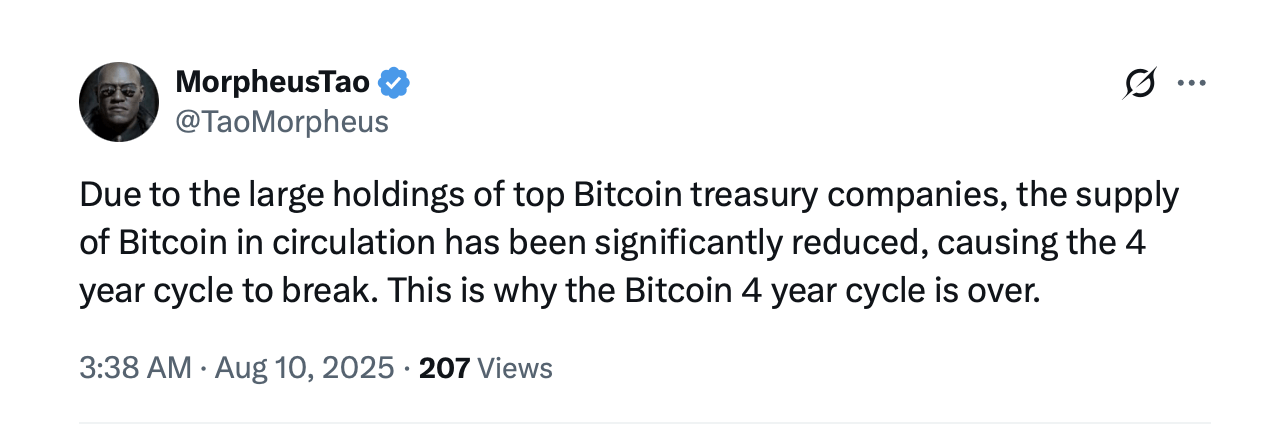
Matthew Hougan, chief investment officer at Bitwise Asset Management, told CNBC earlier this week that he believes the cycle has come to an end. “It’s not officially over until we see positive returns in 2026. But I think we will, so let’s say this: I think the 4-year cycle is over,” Hougan detailed. The debate has also spilled onto social platforms like Reddit and X. On X, the account Simplifying Stocks, CPA declared, “Bitcoin’s 4 year cycle is dead. Why?”

The X account then followed up with its own answer:

A growing chorus of influencers, analysts, and media voices contend that the cycle is outdated, pointing to bitcoin’s evolution into a mainstream institutional asset. While some disagreement remains, many back the idea with data and reasoned arguments. Some predict the “prolonged bear market” is still a long way off, and one user confidently claims, “we will go all the way far into Q2/Q4 2026, depending on factors such as global liquidity.”

Bitcoin’s 4-Year Cycle on the Chopping Block: Has the Halving Era Finally Ended?

On the other hand, the X account Crypto Dad pushes back against the popular belief that bitcoin’s four-year cycle is over because of institutional adoption.

In a detailed post, Crypto Dad contends the cycle isn’t solely the product of halving events, as many assume, but is instead deeply connected to the global liquidity cycle — a pattern that runs on a roughly four- to five-year cadence and was reset by the 2008 financial crisis. According to the post, bitcoin’s past all-time highs have aligned with peaks in global liquidity, not just halvings, pointing to “QE1–QE3, ZIRP” fueling the 2009–2013 bull run, QE spillover for 2014–2017, and pandemic QE for 2018–2021.

The post wraps with:

On July 23, crypto influencer Marty Party told his 226,000 followers on X, “Bitcoin Basics 2025—The 4 year cycle is long gone. The 2020 bear market was created by the previous government to try [to] stop bitcoin. It failed. Bitcoin is absorbing fiat to at least 2050. The new administration is on board. The system is moving to hard money. This is a good thing. It will solve all our problems.”

The ongoing dispute reflects more than a clash of data points—it highlights a shift in how market participants define bitcoin’s future. With narratives now shaped as much by macroeconomic policy as by blockchain mechanics, the community faces a test: adapt to evolving signals or cling to a model born in the asset’s earliest, less institutionalized years.

Bitcoin’s 4-Year Cycle on the Chopping Block: Has the Halving Era Finally Ended?

As debates intensify, the market itself will likely render the final verdict. Whether driven by liquidity tides, halving sparks, or new layers of adoption, bitcoin’s price action in the coming years will likely speak louder than any theory. Until then, traders and analysts remain in a holding pattern, watching for confirmation that one of crypto’s most enduring patterns has truly reached its end.


Market Opportunity
Wink Logo
Wink Price(LIKE)
$0.002686
$0.002686$0.002686
-1.14%
USD
Wink (LIKE) Live Price Chart
Disclaimer: The articles reposted on this site are sourced from public platforms and are provided for informational purposes only. They do not necessarily reflect the views of MEXC. All rights remain with the original authors. If you believe any content infringes on third-party rights, please contact service@support.mexc.com for removal. MEXC makes no guarantees regarding the accuracy, completeness, or timeliness of the content and is not responsible for any actions taken based on the information provided. The content does not constitute financial, legal, or other professional advice, nor should it be considered a recommendation or endorsement by MEXC.

You May Also Like

How to earn from cloud mining: IeByte’s upgraded auto-cloud mining platform unlocks genuine passive earnings

How to earn from cloud mining: IeByte’s upgraded auto-cloud mining platform unlocks genuine passive earnings

The post How to earn from cloud mining: IeByte’s upgraded auto-cloud mining platform unlocks genuine passive earnings appeared on BitcoinEthereumNews.com. contributor Posted: September 17, 2025 As digital assets continue to reshape global finance, cloud mining has become one of the most effective ways for investors to generate stable passive income. Addressing the growing demand for simplicity, security, and profitability, IeByte has officially upgraded its fully automated cloud mining platform, empowering both beginners and experienced investors to earn Bitcoin, Dogecoin, and other mainstream cryptocurrencies without the need for hardware or technical expertise. Why cloud mining in 2025? Traditional crypto mining requires expensive hardware, high electricity costs, and constant maintenance. In 2025, with blockchain networks becoming more competitive, these barriers have grown even higher. Cloud mining solves this by allowing users to lease professional mining power remotely, eliminating the upfront costs and complexity. IeByte stands at the forefront of this transformation, offering investors a transparent and seamless path to daily earnings. IeByte’s upgraded auto-cloud mining platform With its latest upgrade, IeByte introduces: Full Automation: Mining contracts can be activated in just one click, with all processes handled by IeByte’s servers. Enhanced Security: Bank-grade encryption, cold wallets, and real-time monitoring protect every transaction. Scalable Options: From starter packages to high-level investment contracts, investors can choose the plan that matches their goals. Global Reach: Already trusted by users in over 100 countries. Mining contracts for 2025 IeByte offers a wide range of contracts tailored for every investor level. From entry-level plans with daily returns to premium high-yield packages, the platform ensures maximum accessibility. Contract Type Duration Price Daily Reward Total Earnings (Principal + Profit) Starter Contract 1 Day $200 $6 $200 + $6 + $10 bonus Bronze Basic Contract 2 Days $500 $13.5 $500 + $27 Bronze Basic Contract 3 Days $1,200 $36 $1,200 + $108 Silver Advanced Contract 1 Day $5,000 $175 $5,000 + $175 Silver Advanced Contract 2 Days $8,000 $320 $8,000 + $640 Silver…
Share
BitcoinEthereumNews2025/09/17 23:48
China Blocks Nvidia’s RTX Pro 6000D as Local Chips Rise

China Blocks Nvidia’s RTX Pro 6000D as Local Chips Rise

The post China Blocks Nvidia’s RTX Pro 6000D as Local Chips Rise appeared on BitcoinEthereumNews.com. China Blocks Nvidia’s RTX Pro 6000D as Local Chips Rise China’s internet regulator has ordered the country’s biggest technology firms, including Alibaba and ByteDance, to stop purchasing Nvidia’s RTX Pro 6000D GPUs. According to the Financial Times, the move shuts down the last major channel for mass supplies of American chips to the Chinese market. Why Beijing Halted Nvidia Purchases Chinese companies had planned to buy tens of thousands of RTX Pro 6000D accelerators and had already begun testing them in servers. But regulators intervened, halting the purchases and signaling stricter controls than earlier measures placed on Nvidia’s H20 chip. Image: Nvidia An audit compared Huawei and Cambricon processors, along with chips developed by Alibaba and Baidu, against Nvidia’s export-approved products. Regulators concluded that Chinese chips had reached performance levels comparable to the restricted U.S. models. This assessment pushed authorities to advise firms to rely more heavily on domestic processors, further tightening Nvidia’s already limited position in China. China’s Drive Toward Tech Independence The decision highlights Beijing’s focus on import substitution — developing self-sufficient chip production to reduce reliance on U.S. supplies. “The signal is now clear: all attention is focused on building a domestic ecosystem,” said a representative of a leading Chinese tech company. Nvidia had unveiled the RTX Pro 6000D in July 2025 during CEO Jensen Huang’s visit to Beijing, in an attempt to keep a foothold in China after Washington restricted exports of its most advanced chips. But momentum is shifting. Industry sources told the Financial Times that Chinese manufacturers plan to triple AI chip production next year to meet growing demand. They believe “domestic supply will now be sufficient without Nvidia.” What It Means for the Future With Huawei, Cambricon, Alibaba, and Baidu stepping up, China is positioning itself for long-term technological independence. Nvidia, meanwhile, faces…
Share
BitcoinEthereumNews2025/09/18 01:37
Stablecoin rewards provisions face industry test in Senate crypto bill

Stablecoin rewards provisions face industry test in Senate crypto bill

With the CLARITY Act scheduled for a markup on Thursday, some lawmakers could still be at odds over decentralized finance, stablecoins and ethical concerns.As US
Share
Coinstats2026/01/14 01:52