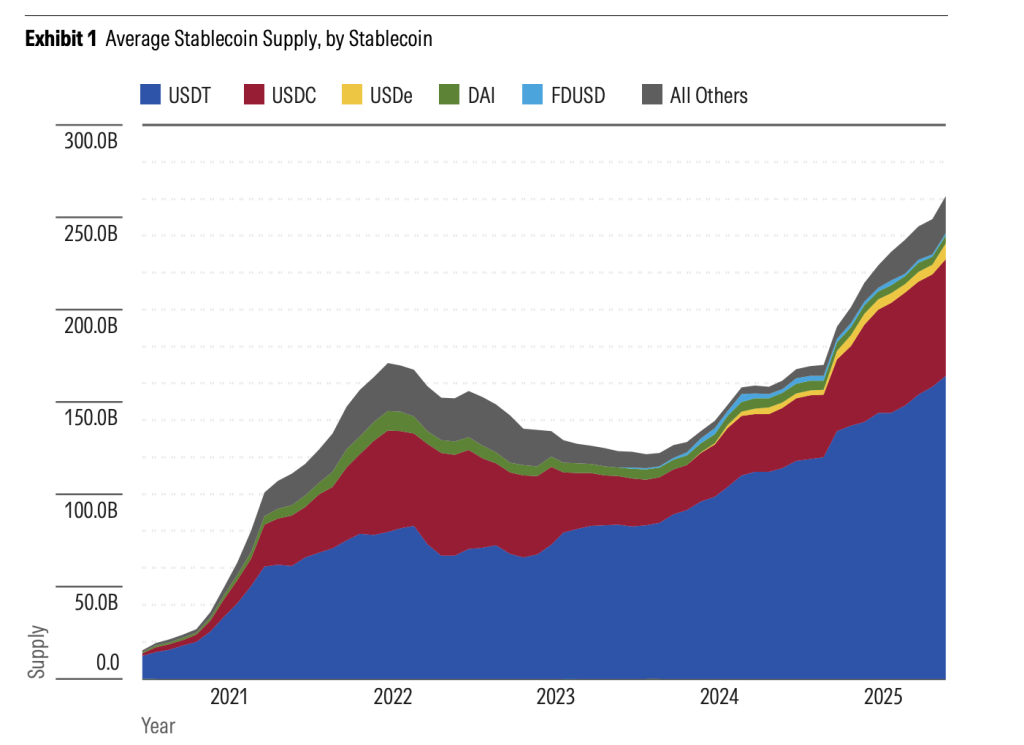
Stablecoins have rapidly become a central pillar of the digital asset economy, now exceeding a combined market capitalization of $230 billion as of mid-2025, according to Morningstar DBRS. The market is led by Tether (USDT) and Circle (USDC), with other players including USDe, DAI, and FDUSD (see Exhibit 1). This growth has been fuelled by their stability — pegged to the U.S. dollar — and their ability to function as digital cash within the blockchain ecosystem. The passage of the first federal stablecoin legislation on July 17 has also accelerated adoption. With regulation in place, U.S. banks are beginning to explore launching their own stablecoins, notes the agency. “Stablecoins offer efficiency and innovation in the financial system, but they also pose both opportunities and risks for banks,” Morningstar DBRS analysts wrote in a report published Tuesday. How Stablecoins Work: Cheaper, Faster, Smarter Money Morningstar explains stablecoins are designed to combine the reliability of fiat currencies with the efficiency of blockchain. Unlike traditional payment rails — credit cards, ACH, or wire transfers — stablecoin transactions settle in seconds. “Stablecoins are programmable money,” Morningstar notes, highlighting their use in smart contracts that automatically execute financial operations. This has made them attractive for cross-border payments, e-commerce, and remittances. Major issuers like Tether, Circle, and PayPal back their coins with reserves of short-term U.S. Treasuries and cash equivalents, ensuring stability and redeemability. The efficiency advantage is stark: where wire transfers can cost up to $50 and take days to settle, stablecoins move instantly with negligible fees. This dynamic is drawing users away from banks’ legacy systems. Risks to U.S. Banks: Deposits and Payments at Stake Morningstar warns that the rise of stablecoins poses real risks to U.S. banks’ core business models. The most immediate concern is deposit flight. If consumers increasingly hold funds in stablecoins for rewards, convenience, or integration with decentralized finance, banks could lose the deposits that underpin their lending operations. According to the Bank for International Settlements, stablecoins still account for just 1.5% of total U.S. deposits, but growth is accelerating. “ A large-scale shift of funds from bank accounts into stablecoins could constrain banks’ ability to fund new loans or extend credit,” Morningstar analysts said. Banks also risk losing lucrative payment fees. Stablecoins bypass networks like ACH and SWIFT, enabling cheaper and faster transfers. As Exhibit 2 shows, the cost advantage is significant, threatening revenue from transaction services. Not All Bad News: A Path Forward for Banks Despite the risks, Morningstar highlights potential opportunities. Banks could leverage their regulatory credibility to serve as custodians of stablecoin reserves, manage U.S. Treasury holdings, and provide settlement and compliance infrastructure. These services could open new fee income streams. The newly passed GENIUS Act (Guiding and Establishing National Innovation for U.S. Stablecoins Act) sets capital and reserve requirements for issuers, creating a more level playing field. Some banks are considering launching their own fully backed stablecoins, integrated into existing compliance systems, to retain deposits and stay competitive. “Whether stablecoins ultimately represent an opportunity or a threat to U.S. banks will depend on regulatory design and market adoption,” Morningstar concludes.Stablecoins have rapidly become a central pillar of the digital asset economy, now exceeding a combined market capitalization of $230 billion as of mid-2025, according to Morningstar DBRS. The market is led by Tether (USDT) and Circle (USDC), with other players including USDe, DAI, and FDUSD (see Exhibit 1). This growth has been fuelled by their stability — pegged to the U.S. dollar — and their ability to function as digital cash within the blockchain ecosystem. The passage of the first federal stablecoin legislation on July 17 has also accelerated adoption. With regulation in place, U.S. banks are beginning to explore launching their own stablecoins, notes the agency. “Stablecoins offer efficiency and innovation in the financial system, but they also pose both opportunities and risks for banks,” Morningstar DBRS analysts wrote in a report published Tuesday. How Stablecoins Work: Cheaper, Faster, Smarter Money Morningstar explains stablecoins are designed to combine the reliability of fiat currencies with the efficiency of blockchain. Unlike traditional payment rails — credit cards, ACH, or wire transfers — stablecoin transactions settle in seconds. “Stablecoins are programmable money,” Morningstar notes, highlighting their use in smart contracts that automatically execute financial operations. This has made them attractive for cross-border payments, e-commerce, and remittances. Major issuers like Tether, Circle, and PayPal back their coins with reserves of short-term U.S. Treasuries and cash equivalents, ensuring stability and redeemability. The efficiency advantage is stark: where wire transfers can cost up to $50 and take days to settle, stablecoins move instantly with negligible fees. This dynamic is drawing users away from banks’ legacy systems. Risks to U.S. Banks: Deposits and Payments at Stake Morningstar warns that the rise of stablecoins poses real risks to U.S. banks’ core business models. The most immediate concern is deposit flight. If consumers increasingly hold funds in stablecoins for rewards, convenience, or integration with decentralized finance, banks could lose the deposits that underpin their lending operations. According to the Bank for International Settlements, stablecoins still account for just 1.5% of total U.S. deposits, but growth is accelerating. “ A large-scale shift of funds from bank accounts into stablecoins could constrain banks’ ability to fund new loans or extend credit,” Morningstar analysts said. Banks also risk losing lucrative payment fees. Stablecoins bypass networks like ACH and SWIFT, enabling cheaper and faster transfers. As Exhibit 2 shows, the cost advantage is significant, threatening revenue from transaction services. Not All Bad News: A Path Forward for Banks Despite the risks, Morningstar highlights potential opportunities. Banks could leverage their regulatory credibility to serve as custodians of stablecoin reserves, manage U.S. Treasury holdings, and provide settlement and compliance infrastructure. These services could open new fee income streams. The newly passed GENIUS Act (Guiding and Establishing National Innovation for U.S. Stablecoins Act) sets capital and reserve requirements for issuers, creating a more level playing field. Some banks are considering launching their own fully backed stablecoins, integrated into existing compliance systems, to retain deposits and stay competitive. “Whether stablecoins ultimately represent an opportunity or a threat to U.S. banks will depend on regulatory design and market adoption,” Morningstar concludes.

Stablecoins Threaten to Disrupt U.S. Bank Deposits and Payments, Morningstar DBRS Warns

Stablecoins have rapidly become a central pillar of the digital asset economy, now exceeding a combined market capitalization of $230 billion as of mid-2025, according to Morningstar DBRS.

The market is led by Tether (USDT) and Circle (USDC), with other players including USDe, DAI, and FDUSD (see Exhibit 1). This growth has been fuelled by their stability — pegged to the U.S. dollar — and their ability to function as digital cash within the blockchain ecosystem.
The passage of the first federal stablecoin legislation on July 17 has also accelerated adoption. With regulation in place, U.S. banks are beginning to explore launching their own stablecoins, notes the agency.

“Stablecoins offer efficiency and innovation in the financial system, but they also pose both opportunities and risks for banks,” Morningstar DBRS analysts wrote in a report published Tuesday.

How Stablecoins Work: Cheaper, Faster, Smarter Money

Morningstar explains stablecoins are designed to combine the reliability of fiat currencies with the efficiency of blockchain. Unlike traditional payment rails — credit cards, ACH, or wire transfers — stablecoin transactions settle in seconds.

“Stablecoins are programmable money,” Morningstar notes, highlighting their use in smart contracts that automatically execute financial operations.

This has made them attractive for cross-border payments, e-commerce, and remittances. Major issuers like Tether, Circle, and PayPal back their coins with reserves of short-term U.S. Treasuries and cash equivalents, ensuring stability and redeemability.

The efficiency advantage is stark: where wire transfers can cost up to $50 and take days to settle, stablecoins move instantly with negligible fees. This dynamic is drawing users away from banks’ legacy systems.

Risks to U.S. Banks: Deposits and Payments at Stake

Morningstar warns that the rise of stablecoins poses real risks to U.S. banks’ core business models. The most immediate concern is deposit flight.

If consumers increasingly hold funds in stablecoins for rewards, convenience, or integration with decentralized finance, banks could lose the deposits that underpin their lending operations.

According to the Bank for International Settlements, stablecoins still account for just 1.5% of total U.S. deposits, but growth is accelerating. “

A large-scale shift of funds from bank accounts into stablecoins could constrain banks’ ability to fund new loans or extend credit,” Morningstar analysts said.

Banks also risk losing lucrative payment fees. Stablecoins bypass networks like ACH and SWIFT, enabling cheaper and faster transfers. As Exhibit 2 shows, the cost advantage is significant, threatening revenue from transaction services.

Not All Bad News: A Path Forward for Banks

Despite the risks, Morningstar highlights potential opportunities. Banks could leverage their regulatory credibility to serve as custodians of stablecoin reserves, manage U.S. Treasury holdings, and provide settlement and compliance infrastructure. These services could open new fee income streams.

The newly passed GENIUS Act (Guiding and Establishing National Innovation for U.S. Stablecoins Act) sets capital and reserve requirements for issuers, creating a more level playing field. Some banks are considering launching their own fully backed stablecoins, integrated into existing compliance systems, to retain deposits and stay competitive.

“Whether stablecoins ultimately represent an opportunity or a threat to U.S. banks will depend on regulatory design and market adoption,” Morningstar concludes.


Market Opportunity
RealLink Logo
RealLink Price(REAL)
$0.07908
$0.07908$0.07908
+2.94%
USD
RealLink (REAL) Live Price Chart
Disclaimer: The articles reposted on this site are sourced from public platforms and are provided for informational purposes only. They do not necessarily reflect the views of MEXC. All rights remain with the original authors. If you believe any content infringes on third-party rights, please contact service@support.mexc.com for removal. MEXC makes no guarantees regarding the accuracy, completeness, or timeliness of the content and is not responsible for any actions taken based on the information provided. The content does not constitute financial, legal, or other professional advice, nor should it be considered a recommendation or endorsement by MEXC.

You May Also Like

Aave CEO Breaks Silence on Game-changing Upgrade in Q4: Details

Aave CEO Breaks Silence on Game-changing Upgrade in Q4: Details

The post Aave CEO Breaks Silence on Game-changing Upgrade in Q4: Details appeared on BitcoinEthereumNews.com. Aave CEO and founder Stani Kulechov has broken his silence on a major upgrade coming to Aave in Q4, 2025. The Aave v4 upgrade is anticipated to be one of the major events in DeFi in 2025, including features such as a Hub-and-Spoke architecture, reinvestment module and others, boosting Aave liquidity and saving gas. The upgrade will also include UX improvements and a new liquidation engine. The Reinvestment Module would help Aave earn more from unused capital, utilizing idle liquidity. On Sept. 15, the Aave founder informed the crypto community of the Aave v4 upgrade roadmap, which highlights where the project is currently at in its development. Aave CEO reacts The Aave founder commented in reaction to a tweet highlighting the features of Aave V4, “very nice overview of the Aave V4 feature,” adding that the Reinvestment Module was not part of the initial design. Very nice overview of the Aave V4 features. Interestingly, the Reinvestment Module wasn’t part of our original design a couple of years ago when we laid down the protocol architecture. It actually emerged later as an unexpected, but exciting, “last-minute” addition. The… https://t.co/Zkp3bmrCAZ — Stani.eth (@StaniKulechov) September 17, 2025 “Interestingly, the Reinvestment Module wasn’t part of our original design a couple of years ago when we laid down the protocol architecture. It actually emerged later as an unexpected, but exciting, last-minute addition,” Kulechov added. The Aave CEO explained the reinvestment feature further as one that allows the protocol to deploy pool float into low-risk, highly liquid yield strategies, creating additional efficiency for LPs. The feature is somewhat inspired by Ethena’s rebalance to USDtb but applied natively within Aave. The Aave team shared the launch roadmap for the Aave upgrade on Sept. 15, revealing a recent V4 Development Update. Source: https://u.today/aave-ceo-breaks-silence-on-game-changing-upgrade-in-q4-details
Share
BitcoinEthereumNews2025/09/18 16:57
NZD/USD holds losses below 0.5750 ahead of China trade data

NZD/USD holds losses below 0.5750 ahead of China trade data

The post NZD/USD holds losses below 0.5750 ahead of China trade data appeared on BitcoinEthereumNews.com. NZD/USD extends its losses for the second successive day
Share
BitcoinEthereumNews2026/01/14 09:54
Will dogwifhat [WIF] break $1.29 or stay stuck in consolidation?

Will dogwifhat [WIF] break $1.29 or stay stuck in consolidation?

WIF traders leaned hard on the buy side, setting up a breakout battle at $1.29.
Share
Coinstats2025/09/18 07:00




