

Must Read
'It can affect other aspects of same-sex relationship because there is now a recognition under the law of their status as a relationship that our laws need to recognize'It can affect other aspects of same-sex relationship because there is now a recognition under the law of their status as a relationship that our laws need to recognize
SC rules that same-sex couples may co-own properties. Why this matters.
For feedback or concerns regarding this content, please contact us at crypto.news@mexc.com
The Supreme Court (SC) has clarified an important legal concept that could benefit same-sex relationships: Homosexual couples who live together may now be considered as co-owners of their properties.
Ruling on the Josef v. Ursua case, the High Court said that same-sex couples may be recognized as property co-owners under Article 148 of the Family Code, as long as they have proof of actual contribution for the said assets.
Associate Justice Jhosep Lopez penned the 2nd Division’s ruling, with concurrences from Senior Associate Justice Marvic Leonen, and Associate Justices Amy Lazaro Javier, Mario Lopez (retired as of 2025), and Antonio Kho Jr.
“[This] a tool for them to be able to assert their contribution to the acquisition of the property, a recognition that as a domestic partner, their share must be respected and recognized,” family law practitioner and professor Flordeliza Vargas told Rappler.
The case stemmed from a petition filed by Jennifer Josef against her former partner, Evalyn Ursua, to settle a property ownership dispute. The two lived together as a couple and purchased a house and lot, but both agreed to register the property under Ursua.
When they separated, the two agreed to sell the property and divide the proceeds equally. Ursua even executed an acknowledgment, noting that Josef’s co-ownership of the property. But later, Ursua changed her mind, refusing to sell the property and acknowledge her former partner as a co-owner.
Josef brought the case to the Regional Trial Court (RTC), but her petition was denied. She later brought the case to the Court of Appeals, but to no avail, thus, filing the petition with the High Court.
Apart from granting Josef’s petition and acknowledging her co-ownership in the property, the SC remanded or returned the case to Quezon City RTC Branch 87 for further proceedings.
Court’s explanation
The decision dwelled on the country’s Family Code, which governs marriage, relationships, separations, and even property relations of families. In this specific case, the SC heavily discussed Articles 147 and 148 that cover the properties of unmarried individuals.
Article 147 explains that a man and a woman in a relationship, but not married, shall have equal shares to their wages and salaries. As to their properties, “acquired by both of them through their work or industry,” they will be guided by the rules on co-ownership.
Meanwhile, Article 148 covers cohabitations which are not under the preceding article. Under this provision, properties acquired by the couple through joint contribution “shall be owned by them in common in proportion to their respective contributions.”
In her petition, Josef said that the two articles clearly protect the rights of heterosexual relationships without the benefit of marriage, but the said protection was not available to homosexual couples.
“With this, there is a clear lack of protection provided by our laws, primarily the Family Code, given its inherent and discriminatory favor towards heterosexual couples, which deprives petitioner of her property rights and interests,” the petitioner said.
The SC, in the ruling, acknowledged that the application of these Family Code provisions among same-sex couples actually became a “nuanced question” in the legal community.
The presence of the phrase “capacitated to marry each other” under Article 147 pertains to marriage, and under the Family Code, marriage is a union between a man and a woman. Since the petitioner and the respondent have the same sex, they cannot marry each other, so Article 148 covers their property relations, the SC explained.
According to the High Court, under Article 148, the properties acquired can be considered common if:
- The assets were acquired during cohabitation
- There is evidence showing that the properties were acquired through actual joint contribution of money, property, or industry
“Considering that there is co-ownership between petitioner and respondent, then each co-owner may demand at any time the partition of the thing owned in common, insofar as her share is concerned. Having rightful interest over the subject property, petitioner has the right to demand the division of the subject property,” the SC said.
Play Video 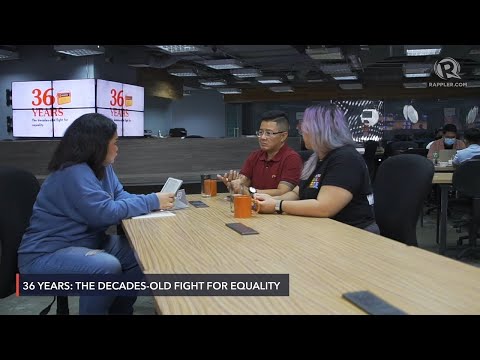
A needed clarification
Citing Valdes v. Regional Trial Court, Branch 102, Quezon City, Leonen said in his separate concurring opinion that Article 148 refers to any kind of cohabitation that doesn’t fall under Article 147. Although Article 147 is particular in gender (man and woman), Article 148 is not, he said.
“As a result, Article 148 may also govern the property relations of same-sex couples who cohabitate,” Leonen explained.
According to Leonen, the country’s laws should be interpreted to have a more mature understanding of the complexities of relationships. And among these complexities, he said, is the truth that there are same-sex couples who cohabitate with each other.
“To be different is not to be abnormal. A same-sex relationship is a normal relationship and therefore should be covered by Article 148 of the Family Code. Otherwise, we render legally invisible some forms of legitimate intimate relationships,” the senior magistrate added.
Lazaro-Javier, in her separate concurring opinion, said Article 148’s first sentence is too general and may be interpreted to cover even same-sex couples’ cohabitations.
“Given the prevailing values in modern society as well as the glaring yet unjustified difference in the treatment of heterosexual couples vis-à-vis their homosexual counterparts, I do not see any reason why the protection of Article 148 of the Family Code should not be extended to members of the LGBTQI+ community,” Lazaro-Javier said.
The Josef v. Ursua case ultimately settled the discussion on the applicability of Article 148. Prior to the ruling on the case, University of the Philippines College of Law Associate Dean Paolo Tamase said it was not clear whether Article 148 could also apply to same-sex couples.
Vargas also shared the same view: “In fact, in our book, Family Law Volume II, we stated that Art. 148 can apply to same-sex couples. The framers of our Family Code had no discussion concerning its applicability only to heterosexual couples.”
A win, but more work ahead
Although the Philippines has yet to acknowledge same-sex unions, the Josef case is a major development in ensuring the rights of homosexual couples. Vargas explained that the SC ruling is considered a win because at least an aspect of their relationship — property relations — is now recognized under Philippine domestic laws.
“It can affect other aspects of same-sex relationship because there is now a recognition under the law of their status as a relationship that our laws need to recognize and protect,” Vargas said.
“While Congress will still need to enact laws that will be protective of the rights of those in same-sex relationships, the ruling in Josef v. Ursua can impact asserting their right to healthcare decision-making and their right to inherit from their partner,” she added.
Bahaghari chaiperson Reyna Valmores Salinas welcomed the SC ruling, calling it a landmark jurisprudence for the civil rights of LGBTQ+ members in the Philippines. Although this acknowledgment is a win by itself, like Vargas, Salinas believes that the country still needs to enact other laws to ensure the rights of LGBTQ+ members.
“So more than this ruling — a great change in interpretation of the law where LGBTQ+ Filipinos have been dismissed for so long — we must call for a change in the law itself. It is time we amend the Family Code and institute marriage equality, otherwise known as same-sex marriage,” the Bahaghari chairperson said.
The Philippine LGBT Chamber of Commerce also noted that the SC decision showed how far the community has come as same-sex couples can now enjoy a semblance of protection.
“As we build on this progress, we continue to call for the passage of the Equality Bill; the creation of an LGBTQIA+ Enterprise Fund; incentives for Micro, Small, and Medium Queer Enterprises; free access to state-led capacity programs; LGBTQ+ representation in public-private business councils; and legal recognition of the Right to Care,” the group said. – Rappler.com
Market Opportunity
Siacoin Price(SC)
$0.0009509
$0.0009509$0.0009509
USD
Siacoin (SC) Live Price Chart


Disclaimer: The articles reposted on this site are sourced from public platforms and are provided for informational purposes only. They do not necessarily reflect the views of MEXC. All rights remain with the original authors. If you believe any content infringes on third-party rights, please contact crypto.news@mexc.com for removal. MEXC makes no guarantees regarding the accuracy, completeness, or timeliness of the content and is not responsible for any actions taken based on the information provided. The content does not constitute financial, legal, or other professional advice, nor should it be considered a recommendation or endorsement by MEXC.
You May Also Like

U.S. Army Pairs Drone With Bunker Buster Bomb In First Use
The post U.S. Army Pairs Drone With Bunker Buster Bomb In First Use appeared on BitcoinEthereumNews.com. A U.S. Army attack drone operator operates a suicide drone
Share
BitcoinEthereumNews2026/04/25 00:31

USDT, Gold, and Bitcoin in One App: An Overview of the New Tether Wallet Ecosystem
Beyond the Stablecoin: How Tether’s new unified ecosystem integrates USDT, Physical Gold, and Bitcoin into a single, high-liquidity wealth fortress.USDT, Gold,
Share
Medium2026/04/25 01:24

BitGo Launches Revolutionary Institutional Stablecoin Service for Major Financial Players
BitcoinWorld BitGo Launches Revolutionary Institutional Stablecoin Service for Major Financial Players In a significant development for institutional cryptocurrency
Share
bitcoinworld2026/04/02 19:40



