This article introduces a novel arithmetical puzzle dataset designed to test and enhance AI reasoning capabilities. The puzzles involve manipulating integers through arithmetic operations to reach a target, with each number used exactly once. A data synthesis pipeline generates large-scale datasets, with controlled parameters for training, in-distribution testing, and out-of-distribution evaluation. Using the LLaMA architecture with LoRA fine-tuning, the study achieves efficient parameter reduction while benchmarking AI’s ability to generalize across numerical scales and abstract puzzle forms.This article introduces a novel arithmetical puzzle dataset designed to test and enhance AI reasoning capabilities. The puzzles involve manipulating integers through arithmetic operations to reach a target, with each number used exactly once. A data synthesis pipeline generates large-scale datasets, with controlled parameters for training, in-distribution testing, and out-of-distribution evaluation. Using the LLaMA architecture with LoRA fine-tuning, the study achieves efficient parameter reduction while benchmarking AI’s ability to generalize across numerical scales and abstract puzzle forms.

A Framework for Synthesizing Arithmetical Puzzle Datasets for Large Language Models

:::info Authors:

(1) Haolong Li, Tongji Universiy and work done during internship at ByteDance (furlongli322@gmail.com);

(2) Yu Ma, Seed Foundation, ByteDance (mayu.1231@bytedance.com);

(3) Yinqi Zhang, East China Normal University and work done during internship at ByteDance (zhang.inch@gmail.com);

(4) Chen Ye (Corresponding Author), ESSC Lab, Tongji Universiy (yechen@tongji.edu.cn);

(5) Jie Chen, Seed Foundation, ByteDance and a Project Leader (chenjiexjtu@gmail.com).

:::

Abstract and 1 Introduction

2 Problem Definition

2.1 Arithmetical Puzzle Problem

2.2 Data Synthesizing

2.3 Dataset

3 Model

4 Experiments

4.1 Evaluation

4.2 Results

4.3 Case Studies

5 Conclusion and Acknowledgements

6 Limitations

7 Ethics Statement and References

\ A Appendix

A.1 Hyperparameter Settings

A.2 Evaluation of the Base Model

A.3 Case Study

A.4 Visualization of the Proposed Puzzle

2.1 Arithmetical Puzzle Problem

Arithmetical puzzle problem denotes a mathematical puzzle involving arithmetic operations and requires logical reasoning and numerical manipulation to derive a solution. The 24 Puzzle and Arithmetic Grid Puzzle are well-known examples of arithmetical puzzle problems.

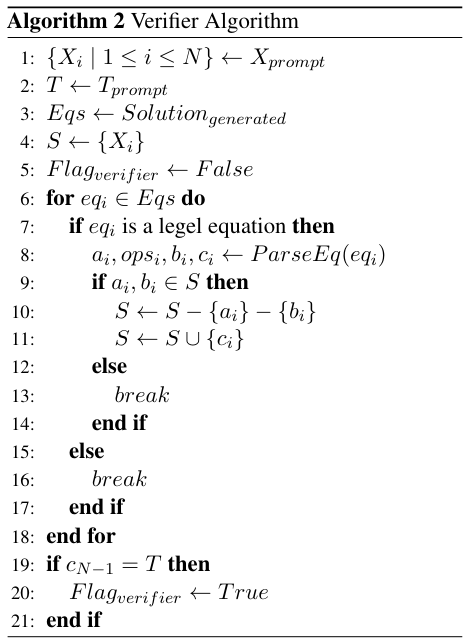
\ In this paper, we propose a challenging arithmetical puzzle. Its objective is intricate yet precise: to deftly manipulate a set of given integers through a calculated sequence of arithmetic operations, to achieve a predetermined target integer. The problem strictly limits each integer to be used by one time exactly. For example, for the integers 3, 6, 7, 51, 58 and the target integer 4, one possible solution is: 58−51 = 7, 6−7 = −1, 3×−1 = −3, −3 + 7 = 4, as shown in Figure 5 in Appendix A.4.

\
2.2 Data Synthesizing

Given the arithmetical puzzle described above in Section 2.1, we create a data synthesizing pipeline to efficiently generate the proposed dataset.

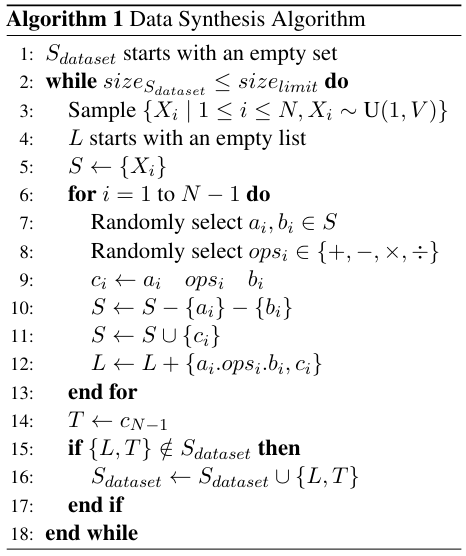
\ Denote the set of candidate integers as X = {X1, X2, . . . , XN } and the target number as T, where N is the total number of candidate integers in a puzzle sample. Each candidate integer Xi is independently sampled from a uniform distribution Xi ∼ U(1, V ), where V is the upper bound of the sampled integers. To avoid data overlapping, we have strictly ensured that for each puzzle, the candidate integers are a set of distinct numbers. The arithmetic operators involved in this problem are ops = {+, −, ×, ÷} and all operations are limited to integer operations. For example, when solving the puzzle with a division operator, the operation should be considered in integer division like 14/3 = 4. The detailed steps of synthesizing data for this puzzle is described in Algorithm 1.

\ Besides, to construct the SFT dataset, the prompt is deliberately designed to excludes any natural language cues and instead focuses on purely symbolic language. See Table 1 for an example of the constructed prompt and response.

2.3 Dataset

We split the dataset into training and in-distribution and out-of-distribution test dataset by controlling the total number of candidate integers N and the upper bound of the sampled integers V . We set

\ \
\ \ V = 60 for the training dataset, and sampled the candidate integers with N = 5, 6, 7. Three training datasets with different sizes scaling from 1 million to 10 millions and 100 millions are generated. And another 7500 samples (2500 samples for each N) under the same setting are generated as the in-distribution test dataset. Figure. 1 shows the distribution of N and X in these three training datasets. And the corresponding distribution of the tokenized prompt and response length is shown in Figure. 2.

\ To further evaluate the model’s performance on extrapolation, we have also designed two benchmarks of out-of-distribution dataset:

\ Numerical OOD test datasets. The upper bound of the sampled integers V is raised to 100 and 1000 separately to test the model’s generalization ability with unseen larger numbers. Specifically, 6000 samples are generated for each value of V with 2000 samples for each N. An additional filtering pipeline is applied to ensure that for each sample, there exists at least one integer Xi that satisfies 60 < Xi < 100 for the dataset with V = 100 and 100 < Xi < 1000 for that with V = 1000.

\ Form OOD test dataset. In mathematics, abstract forms often extend, such as expanding from a two-variable linear equation to one with three variables. For the proposed arithmetic puzzle, the extrapolation of abstract forms can be achieved by changing the number of candidate integers N. Clearly, when N increases, the exploration space leading to a feasible solution would expand exponentially, which results in an increased demand for precise reasoning steps. From another perspective, when the total number of the candidate integers changes, it actually requires the model’s ability to absorb and adapt to the puzzle’s abstract forms. Therefore, to test the model’s generalization capability from this point of view, we create another benchmark for OOD test dataset with 5000 samples generated with setting N to 8. To control variables, all the candidate integers in this dataset are sampled with the same upper bound V = 60 as the training dataset.

3 Model

3.1 Framework

We adopt the llama architecture (Touvron et al., 2023a) and employ low-rank adaptation (LoRA) tuning (Hu et al., 2021) based on the implementation of TRL full stack library (von Werra et al., 2020). LoRA achieves a remarkable reduction of 89% in our trainable parameters, from 3B to 0.3B.

3.2 Implementation Details

We train our model by fine-tuning open-llama-3B. We systematically apply left-padding to the query text and right-padding to the answer text to control the overall context length. All experiments are conducted with 8× NVIDIA A100-SXM4-80GB GPUs. The specific hyperparameter settings are listed in Table 3 in Appendix A.1.

\

:::info This paper is available on arxiv under CC BY-NC-SA 4.0 Deed (Attribution-Noncommercial-Sharelike 4.0 International) license.

:::

\

Market Opportunity
Sleepless AI Logo
Sleepless AI Price(AI)
$0,03791
$0,03791$0,03791
-0,96%
USD
Sleepless AI (AI) Live Price Chart
Disclaimer: The articles reposted on this site are sourced from public platforms and are provided for informational purposes only. They do not necessarily reflect the views of MEXC. All rights remain with the original authors. If you believe any content infringes on third-party rights, please contact service@support.mexc.com for removal. MEXC makes no guarantees regarding the accuracy, completeness, or timeliness of the content and is not responsible for any actions taken based on the information provided. The content does not constitute financial, legal, or other professional advice, nor should it be considered a recommendation or endorsement by MEXC.

You May Also Like

How to earn from cloud mining: IeByte’s upgraded auto-cloud mining platform unlocks genuine passive earnings

How to earn from cloud mining: IeByte’s upgraded auto-cloud mining platform unlocks genuine passive earnings

The post How to earn from cloud mining: IeByte’s upgraded auto-cloud mining platform unlocks genuine passive earnings appeared on BitcoinEthereumNews.com. contributor Posted: September 17, 2025 As digital assets continue to reshape global finance, cloud mining has become one of the most effective ways for investors to generate stable passive income. Addressing the growing demand for simplicity, security, and profitability, IeByte has officially upgraded its fully automated cloud mining platform, empowering both beginners and experienced investors to earn Bitcoin, Dogecoin, and other mainstream cryptocurrencies without the need for hardware or technical expertise. Why cloud mining in 2025? Traditional crypto mining requires expensive hardware, high electricity costs, and constant maintenance. In 2025, with blockchain networks becoming more competitive, these barriers have grown even higher. Cloud mining solves this by allowing users to lease professional mining power remotely, eliminating the upfront costs and complexity. IeByte stands at the forefront of this transformation, offering investors a transparent and seamless path to daily earnings. IeByte’s upgraded auto-cloud mining platform With its latest upgrade, IeByte introduces: Full Automation: Mining contracts can be activated in just one click, with all processes handled by IeByte’s servers. Enhanced Security: Bank-grade encryption, cold wallets, and real-time monitoring protect every transaction. Scalable Options: From starter packages to high-level investment contracts, investors can choose the plan that matches their goals. Global Reach: Already trusted by users in over 100 countries. Mining contracts for 2025 IeByte offers a wide range of contracts tailored for every investor level. From entry-level plans with daily returns to premium high-yield packages, the platform ensures maximum accessibility. Contract Type Duration Price Daily Reward Total Earnings (Principal + Profit) Starter Contract 1 Day $200 $6 $200 + $6 + $10 bonus Bronze Basic Contract 2 Days $500 $13.5 $500 + $27 Bronze Basic Contract 3 Days $1,200 $36 $1,200 + $108 Silver Advanced Contract 1 Day $5,000 $175 $5,000 + $175 Silver Advanced Contract 2 Days $8,000 $320 $8,000 + $640 Silver…
Share
BitcoinEthereumNews2025/09/17 23:48
The aftermath of the energy war: As Microsoft, BlackRock monopolize infrastructure, Eden Miner becomes retail’s last backdoor to the “hashrate yield network”

The aftermath of the energy war: As Microsoft, BlackRock monopolize infrastructure, Eden Miner becomes retail’s last backdoor to the “hashrate yield network”

As mining goes institutional in 2025, Eden Miner opens retail access to hashrate investing through a new model. The year 2025 marks a watershed moment for global
Share
Crypto.news2025/12/17 00:08
Why The Green Bay Packers Must Take The Cleveland Browns Seriously — As Hard As That Might Be

Why The Green Bay Packers Must Take The Cleveland Browns Seriously — As Hard As That Might Be

The post Why The Green Bay Packers Must Take The Cleveland Browns Seriously — As Hard As That Might Be appeared on BitcoinEthereumNews.com. Jordan Love and the Green Bay Packers are off to a 2-0 start. Getty Images The Green Bay Packers are, once again, one of the NFL’s better teams. The Cleveland Browns are, once again, one of the league’s doormats. It’s why unbeaten Green Bay (2-0) is a 8-point favorite at winless Cleveland (0-2) Sunday according to betmgm.com. The money line is also Green Bay -500. Most expect this to be a Packers’ rout, and it very well could be. But Green Bay knows taking anyone in this league for granted can prove costly. “I think if you look at their roster, the paper, who they have on that team, what they can do, they got a lot of talent and things can turn around quickly for them,” Packers safety Xavier McKinney said. “We just got to kind of keep that in mind and know we not just walking into something and they just going to lay down. That’s not what they going to do.” The Browns certainly haven’t laid down on defense. Far from. Cleveland is allowing an NFL-best 191.5 yards per game. The Browns gave up 141 yards to Cincinnati in Week 1, including just seven in the second half, but still lost, 17-16. Cleveland has given up an NFL-best 45.5 rushing yards per game and just 2.1 rushing yards per attempt. “The biggest thing is our defensive line is much, much improved over last year and I think we’ve got back to our personality,” defensive coordinator Jim Schwartz said recently. “When we play our best, our D-line leads us there as our engine.” The Browns rank third in the league in passing defense, allowing just 146.0 yards per game. Cleveland has also gone 30 straight games without allowing a 300-yard passer, the longest active streak in the NFL.…
Share
BitcoinEthereumNews2025/09/18 00:41