Using a panel of 709 volunteers who shared archives of their Facebook data, Consumer Reports found that a total of 186,892 companies sent data about them to the social network. On average, each participant in the study had their data sent to Facebook by 2,230 companies. That number varied significantly, with some panelists’ data listing over 7,000 companies providing their data.Using a panel of 709 volunteers who shared archives of their Facebook data, Consumer Reports found that a total of 186,892 companies sent data about them to the social network. On average, each participant in the study had their data sent to Facebook by 2,230 companies. That number varied significantly, with some panelists’ data listing over 7,000 companies providing their data.

If You're a Facebook User, You're Being Monitored by Thousands of Companies

2025/08/24 20:00
8 min read
For feedback or concerns regarding this content, please contact us at crypto.news@mexc.com

This article was copublished with Consumer Reports, an independent, nonprofit organization that works side by side with consumers for truth, transparency and fairness in the marketplace. Learn more here.


By now most internet users know their online activity is constantly tracked. No one should be shocked to see ads for items they previously searched for, or to be asked if their data can be shared with an unknown number of “partners.”

\ But what is the scale of this surveillance? Judging from data collected by Facebook and newly described in a unique study by non-profit consumer watchdog Consumer Reports, it’s massive, and examining the data may leave you with more questions than answers.

\ Using a panel of 709 volunteers who shared archives of their Facebook data, Consumer Reports found that a total of 186,892 companies sent data about them to the social network. On average, each participant in the study had their data sent to Facebook by 2,230 companies. That number varied significantly, with some panelists’ data listing over 7,000 companies providing their data.

\ The Markup helped Consumer Reports recruit participants for the study. Participants downloaded an archive of the last three years of their data from their Facebook settings, then provided it to Consumer Reports.

\ By collecting data this way, the study was able to examine a form of tracking that is normally hidden: so-called “server-to-server” tracking, in which personal data goes from a company’s servers to Meta’s servers. Another form of tracking, in which Meta tracking pixels are placed on company websites, is visible to users’ browsers.

\ Because the data came from a self-selected group of users, and because the results were not demographically adjusted, the study does not “make any claims about how representative this sample is of the U.S. population as a whole,” Consumer Reports noted. Participants were also likely more privacy conscious and technically inclined than typical users and more likely to be members of Consumers Reports.

\ Despite its limitations, the study offers a rare look, using data directly from Meta, on how personal information is collected and aggregated online.

\ Meta spokesperson Emil Vazquez defended the company’s practices. “We offer a number of transparency tools to help people understand the information that businesses choose to share with us, and manage how it’s used,” wrote Vazquez in an emailed statement to The Markup.

\ While Meta does provide transparency tools like the one that enabled the study, Consumer Reports identified problems with them, including that the identity of many data providers is unclear from the names disclosed to users and that companies that provide services to advertisers are often allowed to ignore opt-out requests.

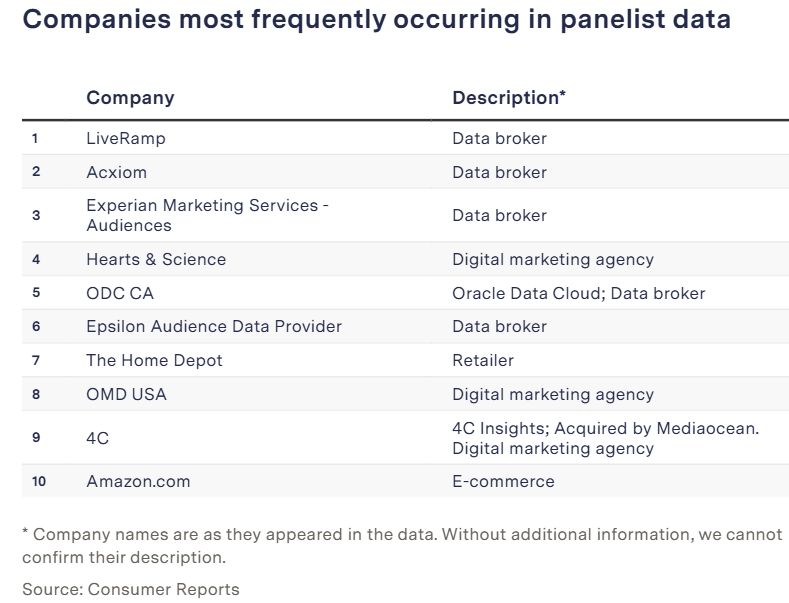
\ One company appeared in 96% of participants’ the San Francisco-based data broker LiveRamp. But the companies sharing your online activity to Facebook aren’t just little-known data brokers. Retailers like Home Depot, Walmart and Macy’s all were in the top 100 most frequently-seen companies in the study. Credit reporting and consumer data companies such as Experian and TransUnion’s Neustar also made the list, as did Amazon, Etsy and PayPal.

\ LiveRamp did not respond to a request for comment.
What Exactly Does This Data Contain?

The data examined by Consumer Reports in this study comes from two types of collection: events and custom audiences. Both categories include information about what people do outside of Meta’s platforms.

\ Custom audiences allow advertisers to upload customer lists to Meta, often including identifiers like email addresses and mobile advertising IDs. These customers, and so-called “lookalike audiences” made up of similar people, can then be targeted with ads on Meta’s platforms.

\ The other category of data collection, “events,” describes interactions that the user had with a brand, which can occur outside of Meta’s apps and in the real world. Events can include visiting a page on a company’s website, leveling up in a game, visiting a physical store, or purchasing a product. These signals originate from Meta software code included in many mobile apps, their tracking pixel, which is included on many websites, and from server-to-server tracking, where a company’s server passes data to a Meta server.

\ The Markup has written extensively about the Meta Pixel and how it has been used to surveil people as they dial suicide hotlines, buy their groceries, take the SATs, file their taxes, and book appointments with their doctors. Website owners can configure the pixel to track user website interactions such as searches or filling out a form, sending each action to Meta, even if the user doesn’t have an account on Facebook. Although research tools like The Markup’s “Pixel Hunt” can detect the Meta pixel or SDK tracking, there is no way for a consumer to monitor the traffic between a company’s server and Meta’s. This Consumer Reports study looks at server-to-server data along with the rest.

How Can I See My Data?

Facebook users can browse through the list of companies that have sent their data to Facebook by going to: https://accountscenter.facebook.com/info_and_permissions

\ From this menu, users can either download or access their information. To see the companies outside of Meta that have been sharing your information, select “Your activity off Meta technologies,” then “Recent activity.” You might be prompted to re-enter your password at this point. This view will show you the number of recent connections between various third-party businesses you visited and Meta, and examples of the activity that was shared. You can choose to prevent future sharing by the company by selecting “Disconnect.” To see detailed information about these interactions, request a copy of your data.

\ But after jumping through the many hoops required to actually get your hands on this data, you may still be left with lingering questions. For example, in addition to easily recognizable company names, more than 7,000 companies in Consumer Reports’ study were named using unreadable gibberish, or just numbers that don’t mean anything to most users. Even those companies with readable names often did not include links to the company website. Some company names were ambiguous, such as “Viking,” which could be a number of different businesses.

\ “This type of tracking which occurs entirely outside of the user’s view is just so far outside of what people expect when they use the internet,” Caitriona Fitzgerald, Deputy Director of the Electronic Privacy Information Center, told The Markup in an interview. Fitzgerald said that while users are likely aware that Meta knows what they are doing while they are on Facebook and Instagram, “they don’t expect Meta to know what stores they walk into or what news articles they’re reading or every site they visit online.”

\ In the report, Consumer Reports calls for a number of policy proposals covering data collection practices, some of which could be part of a national digital privacy law, something that the organization has long advocated for. Among the recommendations specifically aimed at Meta’s technology and the advertisers who use it:

\

  • Require companies to adopt “data minimization” strategies which call for the collection of the absolute minimum amount of data needed to provide the service being offered.
  • Expand the powers of “authorized agents” to act on behalf of consumers to act on their rights. Permission Slip is a mobile app by Consumer Reports that allows users to quickly opt-out of and delete data from a long list of companies and data brokers on behalf of users; the app takes advantage of state privacy laws’ authorized agent provisions.
  • Increase ad transparency by creating ad archives that allow the public to see all ads that have been served to users on a platform, following the lead of the EU's Digital Services Act.
  • Existing Meta transparency tools should improve the quality and readability of the data that is made available so consumers can actually act on the information they review.

\ Fitzgerald echoed these recommendations, saying the problem lies with the fact that the burden is on the consumer to take action to prevent this data collection. Even a “global opt-out” mechanism allowing users to avoid having their data shared is not enough because “that still requires the user to take an action to protect their privacy. A lot of people are not going to have the time or knowledge to do that,” said Fitzgerald.

\ Vazquez, Meta’s spokesperson, said the company would “continue to invest in data minimization technologies to keep up with evolving expectations. As we cover in our terms, businesses are responsible for getting permission to share people’s information with companies like ours.”

\ For now, the lack of a federal privacy law leaves consumers in most states with few options. “I think people should be encouraging their elected officials to pass privacy laws that require businesses to change some of these business practices to stop this ubiquitous tracking of our every click and every movement,” said Fitzgerald.


Credits

  • Jon Keegan, Investigative Data Journalist

Illustration

  • Carlo Cadenas

Art Direction

  • Gabriel Hongsdusit

Engagement

  • Maria Puertas

Editing

  • Ryan Tate
  • Michael Reilly

\ Also published here

\ Photo by Tao Yuan on Unsplash

Disclaimer: The articles reposted on this site are sourced from public platforms and are provided for informational purposes only. They do not necessarily reflect the views of MEXC. All rights remain with the original authors. If you believe any content infringes on third-party rights, please contact crypto.news@mexc.com for removal. MEXC makes no guarantees regarding the accuracy, completeness, or timeliness of the content and is not responsible for any actions taken based on the information provided. The content does not constitute financial, legal, or other professional advice, nor should it be considered a recommendation or endorsement by MEXC.

You May Also Like

Bitcoin Price Under Pressure: Can the Decline Continue?

Bitcoin Price Under Pressure: Can the Decline Continue?

After last night's drop, speculation is beginning to circulate suggesting that the risks of further declines in Bitcoin's price have increased.
Share
The Cryptonomist2026/04/02 17:30
Vodacom Tanzania Modernises M-Pesa With $28m Infrastructure Upgrade

Vodacom Tanzania Modernises M-Pesa With $28m Infrastructure Upgrade

Dar es Salaam, April 2nd, 2026: Vodacom Tanzania today announced the successful transformation of its M-Pesa platform following a $28 million strategic investment
Share
TechFinancials2026/04/02 18:47
Lovable AI’s Astonishing Rise: Anton Osika Reveals Startup Secrets at Bitcoin World Disrupt 2025

Lovable AI’s Astonishing Rise: Anton Osika Reveals Startup Secrets at Bitcoin World Disrupt 2025

BitcoinWorld Lovable AI’s Astonishing Rise: Anton Osika Reveals Startup Secrets at Bitcoin World Disrupt 2025 Are you ready to witness a phenomenon? The world of technology is abuzz with the incredible rise of Lovable AI, a startup that’s not just breaking records but rewriting the rulebook for rapid growth. Imagine creating powerful apps and websites just by speaking to an AI – that’s the magic Lovable brings to the masses. This groundbreaking approach has propelled the company into the spotlight, making it one of the fastest-growing software firms in history. And now, the visionary behind this sensation, co-founder and CEO Anton Osika, is set to share his invaluable insights on the Disrupt Stage at the highly anticipated Bitcoin World Disrupt 2025. If you’re a founder, investor, or tech enthusiast eager to understand the future of innovation, this is an event you cannot afford to miss. Lovable AI’s Meteoric Ascent: Redefining Software Creation In an era where digital transformation is paramount, Lovable AI has emerged as a true game-changer. Its core premise is deceptively simple yet profoundly impactful: democratize software creation. By enabling anyone to build applications and websites through intuitive AI conversations, Lovable is empowering the vast majority of individuals who lack coding skills to transform their ideas into tangible digital products. This mission has resonated globally, leading to unprecedented momentum. The numbers speak for themselves: Achieved an astonishing $100 million Annual Recurring Revenue (ARR) in less than a year. Successfully raised a $200 million Series A funding round, valuing the company at $1.8 billion, led by industry giant Accel. Is currently fielding unsolicited investor offers, pushing its valuation towards an incredible $4 billion. As industry reports suggest, investors are unequivocally “loving Lovable,” and it’s clear why. This isn’t just about impressive financial metrics; it’s about a company that has tapped into a fundamental need, offering a solution that is both innovative and accessible. The rapid scaling of Lovable AI provides a compelling case study for any entrepreneur aiming for similar exponential growth. The Visionary Behind the Hype: Anton Osika’s Journey to Innovation Every groundbreaking company has a driving force, and for Lovable, that force is co-founder and CEO Anton Osika. His journey is as fascinating as his company’s success. A physicist by training, Osika previously contributed to the cutting-edge research at CERN, the European Organization for Nuclear Research. This deep technical background, combined with his entrepreneurial spirit, has been instrumental in Lovable’s rapid ascent. Before Lovable, he honed his skills as a co-founder of Depict.ai and a Founding Engineer at Sana. Based in Stockholm, Osika has masterfully steered Lovable from a nascent idea to a global phenomenon in record time. His leadership embodies a unique blend of profound technical understanding and a keen, consumer-first vision. At Bitcoin World Disrupt 2025, attendees will have the rare opportunity to hear directly from Osika about what it truly takes to build a brand that not only scales at an incredible pace in a fiercely competitive market but also adeptly manages the intense cultural conversations that inevitably accompany such swift and significant success. His insights will be crucial for anyone looking to understand the dynamics of high-growth tech leadership. Unpacking Consumer Tech Innovation at Bitcoin World Disrupt 2025 The 20th anniversary of Bitcoin World is set to be marked by a truly special event: Bitcoin World Disrupt 2025. From October 27–29, Moscone West in San Francisco will transform into the epicenter of innovation, gathering over 10,000 founders, investors, and tech leaders. It’s the ideal platform to explore the future of consumer tech innovation, and Anton Osika’s presence on the Disrupt Stage is a highlight. His session will delve into how Lovable is not just participating in but actively shaping the next wave of consumer-facing technologies. Why is this session particularly relevant for those interested in the future of consumer experiences? Osika’s discussion will go beyond the superficial, offering a deep dive into the strategies that have allowed Lovable to carve out a unique category in a market long thought to be saturated. Attendees will gain a front-row seat to understanding how to identify unmet consumer needs, leverage advanced AI to meet those needs, and build a product that captivates users globally. The event itself promises a rich tapestry of ideas and networking opportunities: For Founders: Sharpen your pitch and connect with potential investors. For Investors: Discover the next breakout startup poised for massive growth. For Innovators: Claim your spot at the forefront of technological advancements. The insights shared regarding consumer tech innovation at this event will be invaluable for anyone looking to navigate the complexities and capitalize on the opportunities within this dynamic sector. Mastering Startup Growth Strategies: A Blueprint for the Future Lovable’s journey isn’t just another startup success story; it’s a meticulously crafted blueprint for effective startup growth strategies in the modern era. Anton Osika’s experience offers a rare glimpse into the practicalities of scaling a business at breakneck speed while maintaining product integrity and managing external pressures. For entrepreneurs and aspiring tech leaders, his talk will serve as a masterclass in several critical areas: Strategy Focus Key Takeaways from Lovable’s Journey Rapid Scaling How to build infrastructure and teams that support exponential user and revenue growth without compromising quality. Product-Market Fit Identifying a significant, underserved market (the 99% who can’t code) and developing a truly innovative solution (AI-powered app creation). Investor Relations Balancing intense investor interest and pressure with a steadfast focus on product development and long-term vision. Category Creation Carving out an entirely new niche by democratizing complex technologies, rather than competing in existing crowded markets. Understanding these startup growth strategies is essential for anyone aiming to build a resilient and impactful consumer experience. Osika’s session will provide actionable insights into how to replicate elements of Lovable’s success, offering guidance on navigating challenges from product development to market penetration and investor management. Conclusion: Seize the Future of Tech The story of Lovable, under the astute leadership of Anton Osika, is a testament to the power of innovative ideas meeting flawless execution. Their remarkable journey from concept to a multi-billion-dollar valuation in record time is a compelling narrative for anyone interested in the future of technology. By democratizing software creation through Lovable AI, they are not just building a company; they are fostering a new generation of creators. His appearance at Bitcoin World Disrupt 2025 is an unmissable opportunity to gain direct insights from a leader who is truly shaping the landscape of consumer tech innovation. Don’t miss this chance to learn about cutting-edge startup growth strategies and secure your front-row seat to the future. Register now and save up to $668 before Regular Bird rates end on September 26. To learn more about the latest AI market trends, explore our article on key developments shaping AI features. This post Lovable AI’s Astonishing Rise: Anton Osika Reveals Startup Secrets at Bitcoin World Disrupt 2025 first appeared on BitcoinWorld.
Share
Coinstats2025/09/17 23:40

USD1 Genesis: 0 Fees + 12% APR

USD1 Genesis: 0 Fees + 12% APRUSD1 Genesis: 0 Fees + 12% APR

New users: stake for up to 600% APR. Limited time!