This article explores how block-based parallelization improves the efficiency of probabilistic circuits by reducing both IO and computation overhead. Starting with fully connected sum layers, it explains how assigning indices, grouping node blocks, and padding with pseudo-nodes enable optimized kernel launches. Using dynamic programming for partitioning ensures minimal overhead while maximizing speed. Results show that larger block sizes cut IO operations dramatically, achieving up to 50x faster performance without significant cost from padded edges.This article explores how block-based parallelization improves the efficiency of probabilistic circuits by reducing both IO and computation overhead. Starting with fully connected sum layers, it explains how assigning indices, grouping node blocks, and padding with pseudo-nodes enable optimized kernel launches. Using dynamic programming for partitioning ensures minimal overhead while maximizing speed. Results show that larger block sizes cut IO operations dramatically, achieving up to 50x faster performance without significant cost from padded edges.

How Block-Based Parallelization Cuts IO and Computation Overhead

2025/08/25 07:11

Abstract and 1. Introduction

  1. Preliminaries and Related Work

  2. Key Bottlenecks in PC Parallelization

  3. Harnessing Block-Based PC Parallelization

    4.1. Fully Connected Sum Layers

    4.2. Generalizing To Practical Sum Layers

    4.3. Efficient Implementations by Compiling PC Layers

    4.4. Analysis: IO and Computation Overhead

  4. Optimizing Backpropagation with PC Flows

  5. Experiments

    6.1. Faster Models with PyJuice

    6.2. Better PCs At Scale

    6.3. Benchmarking Existing PCs

  6. Conclusion, Acknowledgements, Impact Statement, and References

A. Algorithm Details

B. Additional Technical Details

C. Experimental Details

D. Additional Experiments

\

4. Harnessing Block-Based PC Parallelization

This section takes gradual steps toward demonstrating how we can reduce both the IO and computation overhead using block-based parallelization. Specifically, we first utilize a fully connected sum layer to sketch the high-level idea (Sec. 4.1). Consequently, we move on to the general case, providing further details of the algorithm (Secs. 4.2, 4.3).

4.1. Fully Connected Sum Layers

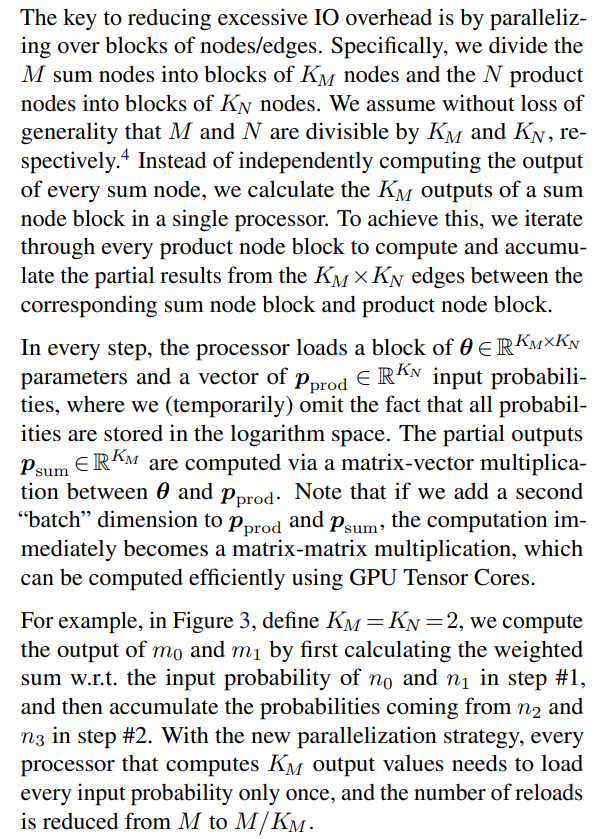
Consider a fully connected sum layer comprised of M sum nodes, each connected to the same set of N product nodes as inputs. Under the parallelization strategy mentioned in

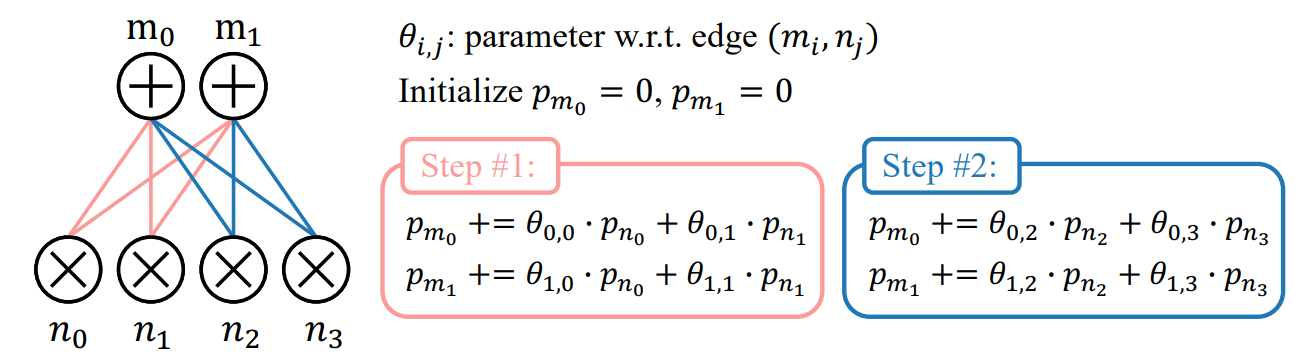
\ Figure 3. Illustration of block-based parallelization. A processor computes the output of 2 sum nodes, by iterating through blocks of 2 input product nodes and accumulating partial results.
\ Section 3, with a single sample, we have M processors each computing the output of a sum node. Since the layer is fully connected, every processor loads all N input log-probabilities, which results in M reloads of every input.

\
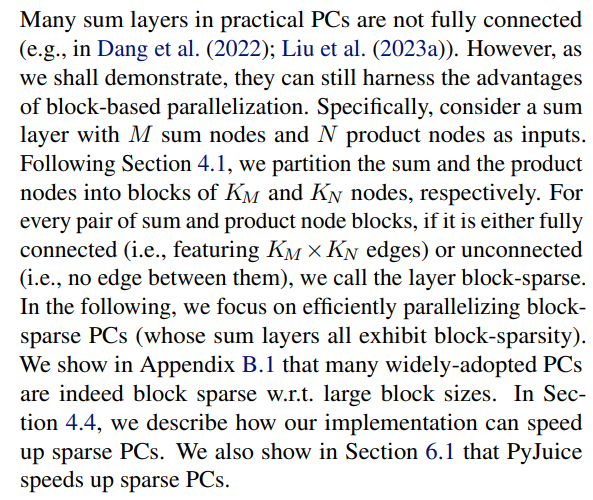
4.2. Generalizing To Practical Sum Layers

\
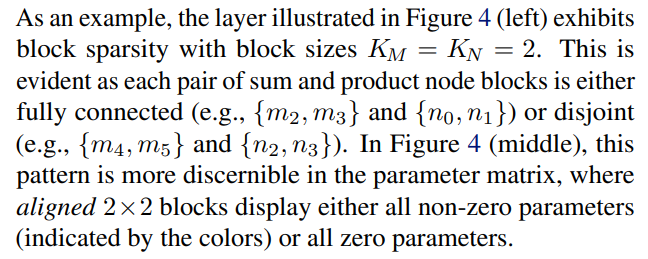
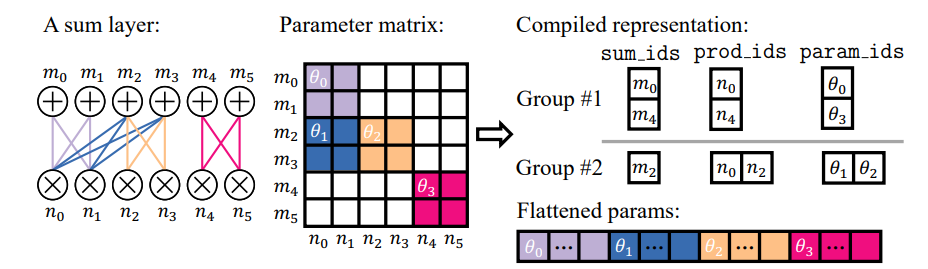
\ \ \ Figure 4. A sum layer (left) with a block-sparse parameter matrix (middle) is compiled into two kernels (right) each with a balanced workload. During execution, each kernel uses the compiled sum/prod/param indices to compute the outputs of m0, . . . , m5.
\ \ \

\ \ \

4.3. Efficient Implementations by Compiling PC Layers

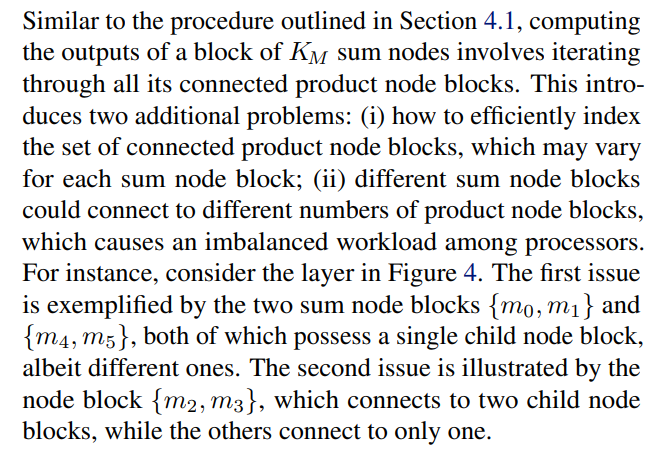
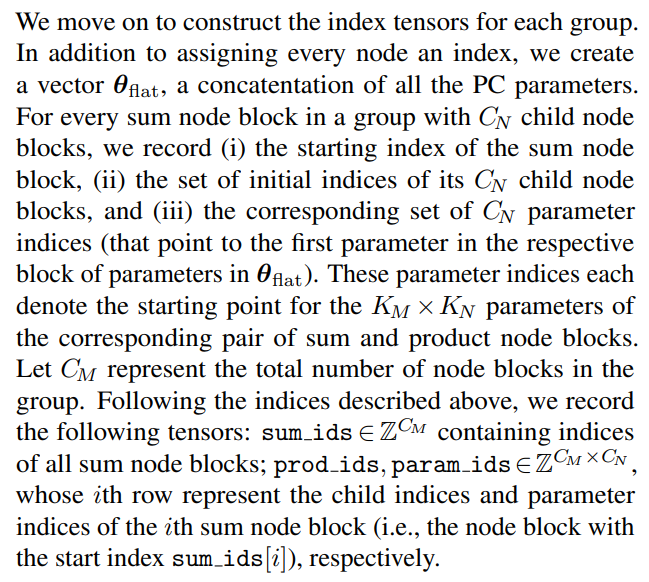
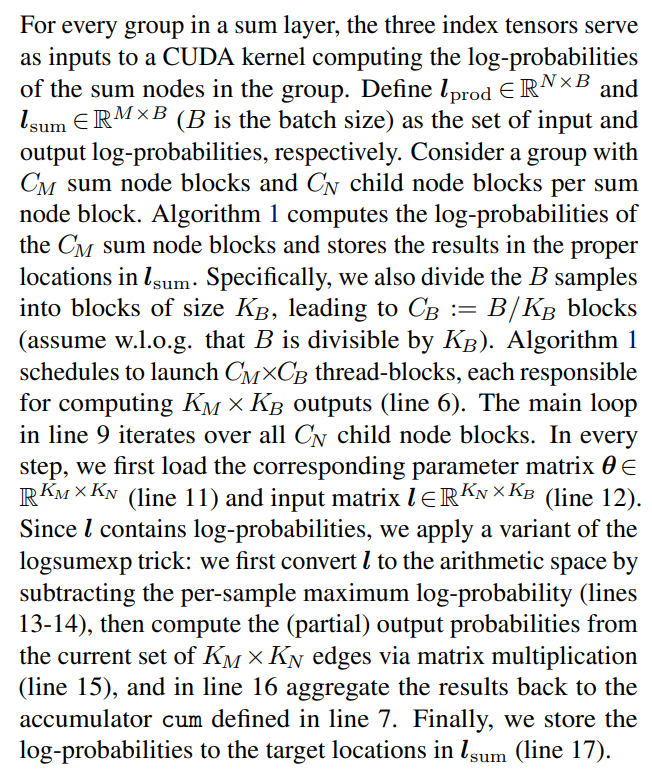
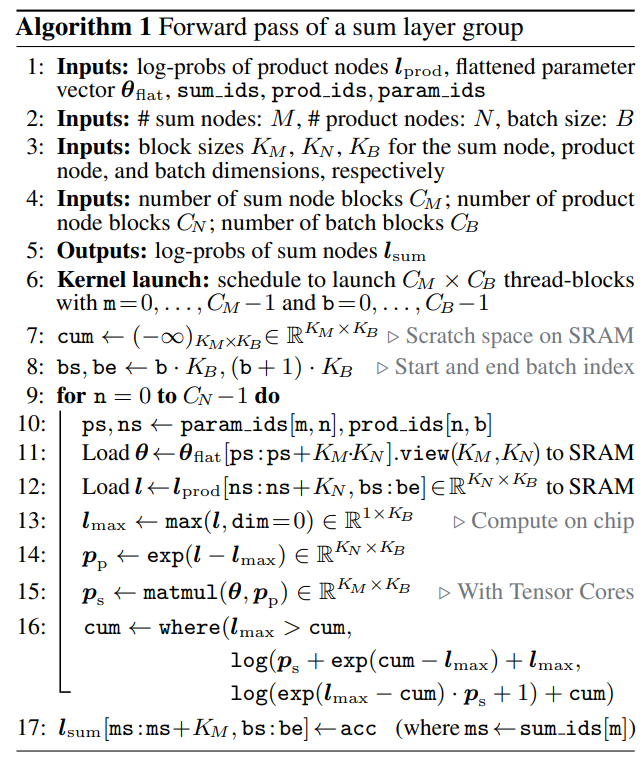
We address both problems through a compilation process, where we assign every node an index, and precompute index tensors that enable efficient block-based parallelization. The first step is to partition the sum node blocks into groups, such that every node block within a group has a similar number of connected child node blocks. We then pad the children with pseudo-product node blocks with probability 0 such that all sum node blocks in a group have the same number of children. The partition is generated by a dynamic programming algorithm that aims to divide the layer into the smallest possible number of groups while ensuring that the fraction of added pseudo-node blocks does not exceed a predefined threshold. Due to space constraints, we elaborate the node block partitioning algorithm in Appendix A.1. We also discuss its optimality and time/memory efficiency.

\ \
\ \ \
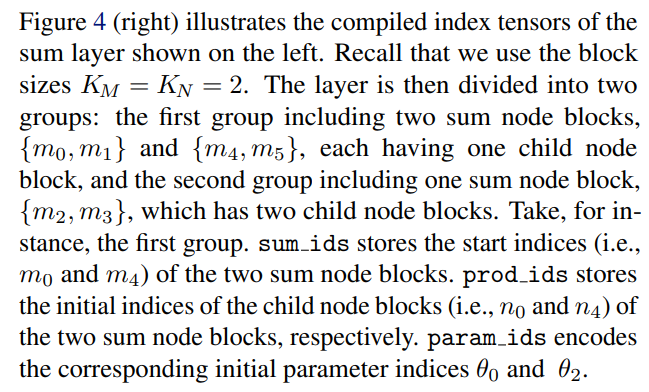
\ \ Partitioning a layer into groups with the same number of children allows us to use different kernel launching hyperparameters according to the specific setup of every node group (e.g., number of nodes) to achieve better performance.

\ \
\ \ \
\

4.4. Analysis: IO and Computation Overhead

\
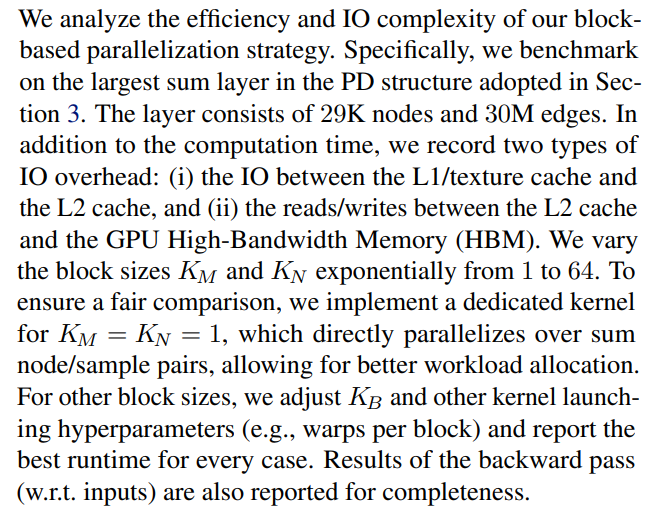
\ \ \ igure 5. Runtime and IO overhead of a sum layer from the PD structure (with 29K nodes and 30M edges). The results demonstrate significant performance gains from our block-based parallelization, even with small block sizes.
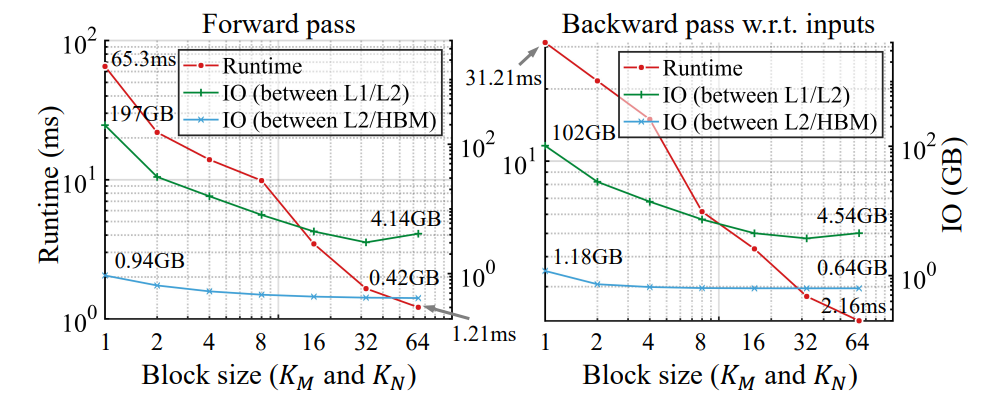
\ \ Results are shown in Figure 5. As the block size increases, both the forward and the backward pass become significantly faster. Notably, this is accompanied by a significant drop in IO overhead. Specifically, with a large block size, the kernel consumes 2x fewer reads/writes between the L2 cache and the HBM, and 25-50x fewer IO between the L1 and L2 cache. This corroborates the hypothesis stated in Section 3 that the extensive value reloads significantly slow down the computation.

\ \
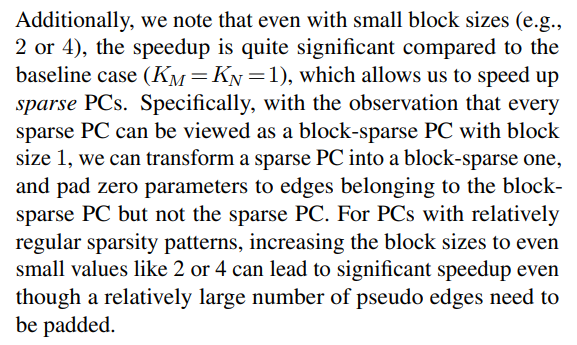
\ \ the speedup obtained by having a larger block size outpaces the overhead caused by padded edges with zero parameters, which leads to speed-ups.

\ \

:::info Authors:

(1) Anji Liu, Department of Computer Science, University of California, Los Angeles, USA (liuanji@cs.ucla.edu);

(2) Kareem Ahmed, Department of Computer Science, University of California, Los Angeles, USA;

(3) Guy Van den Broeck, Department of Computer Science, University of California, Los Angeles, USA;

:::


:::info This paper is available on arxiv under CC BY 4.0 DEED license.

:::
Disclaimer: The articles reposted on this site are sourced from public platforms and are provided for informational purposes only. They do not necessarily reflect the views of MEXC. All rights remain with the original authors. If you believe any content infringes on third-party rights, please contact service@support.mexc.com for removal. MEXC makes no guarantees regarding the accuracy, completeness, or timeliness of the content and is not responsible for any actions taken based on the information provided. The content does not constitute financial, legal, or other professional advice, nor should it be considered a recommendation or endorsement by MEXC.

You May Also Like

American Bitcoin’s $5B Nasdaq Debut Puts Trump-Backed Miner in Crypto Spotlight

American Bitcoin’s $5B Nasdaq Debut Puts Trump-Backed Miner in Crypto Spotlight

The post American Bitcoin’s $5B Nasdaq Debut Puts Trump-Backed Miner in Crypto Spotlight appeared on BitcoinEthereumNews.com. Key Takeaways: American Bitcoin (ABTC) surged nearly 85% on its Nasdaq debut, briefly reaching a $5B valuation. The Trump family, alongside Hut 8 Mining, controls 98% of the newly merged crypto-mining entity. Eric Trump called Bitcoin “modern-day gold,” predicting it could reach $1 million per coin. American Bitcoin, a fast-rising crypto mining firm with strong political and institutional backing, has officially entered Wall Street. After merging with Gryphon Digital Mining, the company made its Nasdaq debut under the ticker ABTC, instantly drawing global attention to both its stock performance and its bold vision for Bitcoin’s future. Read More: Trump-Backed Crypto Firm Eyes Asia for Bold Bitcoin Expansion Nasdaq Debut: An Explosive First Day ABTC’s first day of trading proved as dramatic as expected. Shares surged almost 85% at the open, touching a peak of $14 before settling at lower levels by the close. That initial spike valued the company around $5 billion, positioning it as one of 2025’s most-watched listings. At the last session, ABTC has been trading at $7.28 per share, which is a small positive 2.97% per day. Although the price has decelerated since opening highs, analysts note that the company has been off to a strong start and early investor activity is a hard-to-find feat in a newly-launched crypto mining business. According to market watchers, the listing comes at a time of new momentum in the digital asset markets. With Bitcoin trading above $110,000 this quarter, American Bitcoin’s entry comes at a time when both institutional investors and retail traders are showing heightened interest in exposure to Bitcoin-linked equities. Ownership Structure: Trump Family and Hut 8 at the Helm Its management and ownership set up has increased the visibility of the company. The Trump family and the Canadian mining giant Hut 8 Mining jointly own 98 percent…
Share
BitcoinEthereumNews2025/09/18 01:33
Pound Sterling softens as traders eye BoE rate cut next week

Pound Sterling softens as traders eye BoE rate cut next week

The post Pound Sterling softens as traders eye BoE rate cut next week appeared on BitcoinEthereumNews.com. The GBP/USD pair trades in negative territory near 1.3365 during the early European trading hours on Thursday, pressured by the rebound in the US Dollar (USD). Nonetheless, the potential downside might be limited after the US Federal Reserve (Fed) delivered a rate cut at its December policy meeting. Traders brace for the US weekly Initial Jobless Claims report, which will be published later on Thursday.  Markets continue to digest the largely anticipated rate cut by the Fed on Wednesday. The US central bank reduced its key interest rate for the third time in a row at its December meeting but signaled that it may leave rates unchanged in the coming months. Two Fed officials voted to keep the rate unchanged, while Stephen Miran, whom Trump appointed in September, voted for a larger rate cut. During the press conference, Fed Chair Jerome Powell said central bankers need time to see how the three reductions this year work their way through the US economy. Powell added that he will closely examine incoming data leading up to the next meeting in January. The Fed’s economic projections suggested one rate cut will take place next year, although new data could change this. On the other hand, the prospect of the Bank of England (BoE) rate reductions could drag the Pound Sterling (GBP) lower against the Greenback. Financial markets are now pricing in nearly an 88% chance of the BoE rate cut next week after signs from economic data that inflation pressure has eased.  Pound Sterling FAQs The Pound Sterling (GBP) is the oldest currency in the world (886 AD) and the official currency of the United Kingdom. It is the fourth most traded unit for foreign exchange (FX) in the world, accounting for 12% of all transactions, averaging $630 billion a day, according to 2022…
Share
BitcoinEthereumNews2025/12/11 13:40