Key Takeaways: Ethereum’s recent outperformance has reignited interest in its role as infrastructure, particularly among structured treasury firms. Republic Technologies’ strategy focuses on yield through validators and derivatives rather than speculative accumulation. CEO Daniel Liu views Ethereum as a functional asset, distinct from Bitcoin’s store-of-value positioning. Ethereum has outperformed major tokens in recent weeks, with its ETH/BTC ratio climbing from 0.025 to nearly 0.04—an over 40% gain. Stablecoin volumes, validator activity, and tokenization pilots are intensifying on the network, while major institutions explore deployment options amid growing regulatory clarity. Ethereum’s position as the base layer for much of the crypto economy appears to be solidifying, even as market volatility persists. In contrast to the speculation-driven spikes of earlier cycles, this phase is influenced by legal frameworks and infrastructure development. The GENIUS Act is paving the way for U.S. institutions, while stablecoin regulations are progressing in Asia. As a result, Ethereum is increasingly perceived not just as a trading asset but as a comprehensive system. Among the firms embracing that view is Republic Technologies, a publicly listed Ethereum treasury company led by CEO and co-founder Daniel Liu. Republic accumulates ETH and deploys it through validator networks and structured yield strategies. Liu, who worked on large-scale energy financing, believes Ethereum is not simply an asset—it’s infrastructure. Ethereum Functions as Digital Fuel in a Financial Engine With years of experience in energy finance, Liu draws parallels between Ethereum’s fee dynamics and traditional power markets. He likens validator incentives and gas pricing to demand-driven energy curves: costlier at peak usage, cheaper when demand drops. “Ethereum is digital fuel,” Liu said. “It’s very similar to how oil powered the industrial age… gas fees, validators, everything in the infrastructure system depends on it.” This analogy isn’t just theoretical. It shapes how Liu explains Ethereum’s utility to investors and institutions. “When I go talk to some of my old directors or colleagues from the energy industry, they really understand that it makes sense,” he said. In Liu’s view, Ethereum is not trying to be digital gold like Bitcoin. It powers applications, including stablecoins, tokenization platforms, and DeFi protocols, similar to how energy supports industrial functions. That underlying utility, he argues, is what gives ETH long-term relevance. Regulatory Clarity Is Catalyzing Ethereum’s Institutional Phase Liu believes recent policy developments are unlocking Ethereum’s next growth phase. Chief among them is the GENIUS Act, a U.S. legislative effort that has introduced new clarity around stablecoins and digital assets. “The GENIUS Act really removed [regulatory] blockers… it unlocked the floodgates for all this capital to come in,” he said. He compares Ethereum’s current moment to Bitcoin’s breakout in 2017, when Wall Street began viewing BTC as a treasury asset, even if most institutions stayed on the sidelines. For Ethereum, Liu argues, the difference is that its use cases are already operational. Stablecoins are built on it. Tokenized equities are testing it. Internal banking assets are being issued on it. Though ETH and BTC still move in tandem, Liu argues Ethereum’s differentiated role is starting to matter. While Bitcoin remains a passive holding, Ethereum is being integrated into active systems—payment rails, liquidity networks, and validator infrastructure. Republic Technologies Adopts a Yield-Focused ETH Strategy Republic Technologies has structured itself around a simple principle: accumulate ETH and make it productive. The company acquires ETH through structured derivative strategies and runs it through validator networks operated by third-party partners. The approach is modeled on Metaplanet, the Japanese company that took a similar path with Bitcoin. “We hope to have a very similar performance,” Liu said. But he emphasized the company’s risk ceiling when it comes to native yield generation, saying, “We are not chasing double-digit on-chain yields.” Without taking “unnecessary risks,” the company is targeting a 6-8% annual return. He believes that Ethereum treasuries, like public companies, will ultimately be judged on operational performance—how efficiently they accumulate ETH, how they manage validator returns, and how they protect downside exposure. “Anyone looking at these treasuries long term will look toward those metrics,” Liu said. Republic recently completed a restructuring and rebrand, and while Liu declined to preview future moves, he said partnerships and fundraising activity are in progress. “We want to protect our investors’ assets and our assets as much as possible,” he added. Frequently Asked Questions (FAQs) How do Ethereum treasuries differ from corporate BTC holdings like MicroStrategy’s? ETH treasuries often involve active staking, validator operations, and derivatives, whereas BTC holdings are typically passive, held in cold storage. Are validator partnerships a point of centralization risk for ETH treasuries? Potentially. If too few third-party validators control large amounts of staked ETH, it could raise security and governance concerns for corporate treasuries. How liquid are ETH treasury assets compared to traditional holdings? ETH can be liquid but may face slippage or protocol-level constraints when staked or used in derivatives, unlike fiat or short-term bonds. Key Takeaways: Ethereum’s recent outperformance has reignited interest in its role as infrastructure, particularly among structured treasury firms. Republic Technologies’ strategy focuses on yield through validators and derivatives rather than speculative accumulation. CEO Daniel Liu views Ethereum as a functional asset, distinct from Bitcoin’s store-of-value positioning. Ethereum has outperformed major tokens in recent weeks, with its ETH/BTC ratio climbing from 0.025 to nearly 0.04—an over 40% gain. Stablecoin volumes, validator activity, and tokenization pilots are intensifying on the network, while major institutions explore deployment options amid growing regulatory clarity. Ethereum’s position as the base layer for much of the crypto economy appears to be solidifying, even as market volatility persists. In contrast to the speculation-driven spikes of earlier cycles, this phase is influenced by legal frameworks and infrastructure development. The GENIUS Act is paving the way for U.S. institutions, while stablecoin regulations are progressing in Asia. As a result, Ethereum is increasingly perceived not just as a trading asset but as a comprehensive system. Among the firms embracing that view is Republic Technologies, a publicly listed Ethereum treasury company led by CEO and co-founder Daniel Liu. Republic accumulates ETH and deploys it through validator networks and structured yield strategies. Liu, who worked on large-scale energy financing, believes Ethereum is not simply an asset—it’s infrastructure. Ethereum Functions as Digital Fuel in a Financial Engine With years of experience in energy finance, Liu draws parallels between Ethereum’s fee dynamics and traditional power markets. He likens validator incentives and gas pricing to demand-driven energy curves: costlier at peak usage, cheaper when demand drops. “Ethereum is digital fuel,” Liu said. “It’s very similar to how oil powered the industrial age… gas fees, validators, everything in the infrastructure system depends on it.” This analogy isn’t just theoretical. It shapes how Liu explains Ethereum’s utility to investors and institutions. “When I go talk to some of my old directors or colleagues from the energy industry, they really understand that it makes sense,” he said. In Liu’s view, Ethereum is not trying to be digital gold like Bitcoin. It powers applications, including stablecoins, tokenization platforms, and DeFi protocols, similar to how energy supports industrial functions. That underlying utility, he argues, is what gives ETH long-term relevance. Regulatory Clarity Is Catalyzing Ethereum’s Institutional Phase Liu believes recent policy developments are unlocking Ethereum’s next growth phase. Chief among them is the GENIUS Act, a U.S. legislative effort that has introduced new clarity around stablecoins and digital assets. “The GENIUS Act really removed [regulatory] blockers… it unlocked the floodgates for all this capital to come in,” he said. He compares Ethereum’s current moment to Bitcoin’s breakout in 2017, when Wall Street began viewing BTC as a treasury asset, even if most institutions stayed on the sidelines. For Ethereum, Liu argues, the difference is that its use cases are already operational. Stablecoins are built on it. Tokenized equities are testing it. Internal banking assets are being issued on it. Though ETH and BTC still move in tandem, Liu argues Ethereum’s differentiated role is starting to matter. While Bitcoin remains a passive holding, Ethereum is being integrated into active systems—payment rails, liquidity networks, and validator infrastructure. Republic Technologies Adopts a Yield-Focused ETH Strategy Republic Technologies has structured itself around a simple principle: accumulate ETH and make it productive. The company acquires ETH through structured derivative strategies and runs it through validator networks operated by third-party partners. The approach is modeled on Metaplanet, the Japanese company that took a similar path with Bitcoin. “We hope to have a very similar performance,” Liu said. But he emphasized the company’s risk ceiling when it comes to native yield generation, saying, “We are not chasing double-digit on-chain yields.” Without taking “unnecessary risks,” the company is targeting a 6-8% annual return. He believes that Ethereum treasuries, like public companies, will ultimately be judged on operational performance—how efficiently they accumulate ETH, how they manage validator returns, and how they protect downside exposure. “Anyone looking at these treasuries long term will look toward those metrics,” Liu said. Republic recently completed a restructuring and rebrand, and while Liu declined to preview future moves, he said partnerships and fundraising activity are in progress. “We want to protect our investors’ assets and our assets as much as possible,” he added. Frequently Asked Questions (FAQs) How do Ethereum treasuries differ from corporate BTC holdings like MicroStrategy’s? ETH treasuries often involve active staking, validator operations, and derivatives, whereas BTC holdings are typically passive, held in cold storage. Are validator partnerships a point of centralization risk for ETH treasuries? Potentially. If too few third-party validators control large amounts of staked ETH, it could raise security and governance concerns for corporate treasuries. How liquid are ETH treasury assets compared to traditional holdings? ETH can be liquid but may face slippage or protocol-level constraints when staked or used in derivatives, unlike fiat or short-term bonds.

Ethereum Is Digital Fuel Powering the Next Financial Era, Says Crypto Treasury CEO

2025/08/25 23:04
5 min read

Key Takeaways:

  • Ethereum’s recent outperformance has reignited interest in its role as infrastructure, particularly among structured treasury firms.
  • Republic Technologies’ strategy focuses on yield through validators and derivatives rather than speculative accumulation.
  • CEO Daniel Liu views Ethereum as a functional asset, distinct from Bitcoin’s store-of-value positioning.

Ethereum has outperformed major tokens in recent weeks, with its ETH/BTC ratio climbing from 0.025 to nearly 0.04—an over 40% gain. Stablecoin volumes, validator activity, and tokenization pilots are intensifying on the network, while major institutions explore deployment options amid growing regulatory clarity.

Ethereum’s position as the base layer for much of the crypto economy appears to be solidifying, even as market volatility persists.

In contrast to the speculation-driven spikes of earlier cycles, this phase is influenced by legal frameworks and infrastructure development. The GENIUS Act is paving the way for U.S. institutions, while stablecoin regulations are progressing in Asia. As a result, Ethereum is increasingly perceived not just as a trading asset but as a comprehensive system.

Among the firms embracing that view is Republic Technologies, a publicly listed Ethereum treasury company led by CEO and co-founder Daniel Liu. Republic accumulates ETH and deploys it through validator networks and structured yield strategies. Liu, who worked on large-scale energy financing, believes Ethereum is not simply an asset—it’s infrastructure.

Ethereum Functions as Digital Fuel in a Financial Engine

With years of experience in energy finance, Liu draws parallels between Ethereum’s fee dynamics and traditional power markets. He likens validator incentives and gas pricing to demand-driven energy curves: costlier at peak usage, cheaper when demand drops.

“Ethereum is digital fuel,” Liu said. “It’s very similar to how oil powered the industrial age… gas fees, validators, everything in the infrastructure system depends on it.”
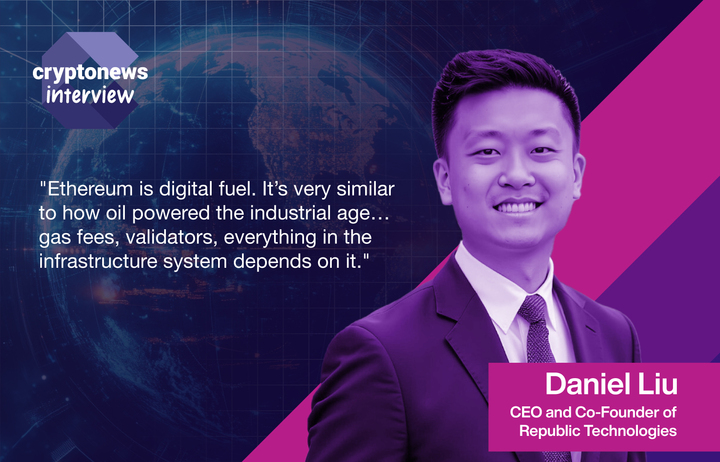
This analogy isn’t just theoretical. It shapes how Liu explains Ethereum’s utility to investors and institutions. “When I go talk to some of my old directors or colleagues from the energy industry, they really understand that it makes sense,” he said.

In Liu’s view, Ethereum is not trying to be digital gold like Bitcoin. It powers applications, including stablecoins, tokenization platforms, and DeFi protocols, similar to how energy supports industrial functions. That underlying utility, he argues, is what gives ETH long-term relevance.

Regulatory Clarity Is Catalyzing Ethereum’s Institutional Phase

Liu believes recent policy developments are unlocking Ethereum’s next growth phase. Chief among them is the GENIUS Act, a U.S. legislative effort that has introduced new clarity around stablecoins and digital assets.

“The GENIUS Act really removed [regulatory] blockers… it unlocked the floodgates for all this capital to come in,” he said.

He compares Ethereum’s current moment to Bitcoin’s breakout in 2017, when Wall Street began viewing BTC as a treasury asset, even if most institutions stayed on the sidelines.

For Ethereum, Liu argues, the difference is that its use cases are already operational. Stablecoins are built on it. Tokenized equities are testing it. Internal banking assets are being issued on it.

Though ETH and BTC still move in tandem, Liu argues Ethereum’s differentiated role is starting to matter. While Bitcoin remains a passive holding, Ethereum is being integrated into active systems—payment rails, liquidity networks, and validator infrastructure.

Republic Technologies Adopts a Yield-Focused ETH Strategy

Republic Technologies has structured itself around a simple principle: accumulate ETH and make it productive. The company acquires ETH through structured derivative strategies and runs it through validator networks operated by third-party partners.

The approach is modeled on Metaplanet, the Japanese company that took a similar path with Bitcoin. “We hope to have a very similar performance,” Liu said.

But he emphasized the company’s risk ceiling when it comes to native yield generation, saying, “We are not chasing double-digit on-chain yields.” Without taking “unnecessary risks,” the company is targeting a 6-8% annual return.

He believes that Ethereum treasuries, like public companies, will ultimately be judged on operational performance—how efficiently they accumulate ETH, how they manage validator returns, and how they protect downside exposure.

“Anyone looking at these treasuries long term will look toward those metrics,” Liu said.

Republic recently completed a restructuring and rebrand, and while Liu declined to preview future moves, he said partnerships and fundraising activity are in progress. “We want to protect our investors’ assets and our assets as much as possible,” he added.

Frequently Asked Questions (FAQs)

How do Ethereum treasuries differ from corporate BTC holdings like MicroStrategy’s?

ETH treasuries often involve active staking, validator operations, and derivatives, whereas BTC holdings are typically passive, held in cold storage.

Are validator partnerships a point of centralization risk for ETH treasuries?

Potentially. If too few third-party validators control large amounts of staked ETH, it could raise security and governance concerns for corporate treasuries.

How liquid are ETH treasury assets compared to traditional holdings?

ETH can be liquid but may face slippage or protocol-level constraints when staked or used in derivatives, unlike fiat or short-term bonds.

Market Opportunity
Fuel Logo
Fuel Price(FUEL)
$0.00121
$0.00121$0.00121
-1.62%
USD
Fuel (FUEL) Live Price Chart
Disclaimer: The articles reposted on this site are sourced from public platforms and are provided for informational purposes only. They do not necessarily reflect the views of MEXC. All rights remain with the original authors. If you believe any content infringes on third-party rights, please contact crypto.news@mexc.com for removal. MEXC makes no guarantees regarding the accuracy, completeness, or timeliness of the content and is not responsible for any actions taken based on the information provided. The content does not constitute financial, legal, or other professional advice, nor should it be considered a recommendation or endorsement by MEXC.

You May Also Like

North America Sees $2.3T in Crypto

North America Sees $2.3T in Crypto

The post North America Sees $2.3T in Crypto appeared on BitcoinEthereumNews.com. Key Notes North America received $2.3 trillion in crypto value between July 2024 and June 2025, representing 26% of global activity. Tokenized U.S. treasuries saw assets under management (AUM) grow from $2 billion to over $7 billion in the last twelve months. U.S.-listed Bitcoin ETFs now account for over $120 billion in AUM, signaling strong institutional demand for the asset. . North America has established itself as a major center for cryptocurrency activity, with significant transaction volumes recorded over the past year. The region’s growth highlights an increasing institutional and retail interest in digital assets, particularly within the United States. According to a new report from blockchain analytics firm Chainalysis published on September 17, North America received $2.3 trillion in cryptocurrency value between July 2024 and June 2025. This volume represents 26% of all global transaction activity during that period. The report suggests this activity was influenced by a more favorable regulatory outlook and institutional trading strategies. A peak in monthly value was recorded in December 2024, when an estimated $244 billion was transferred in a single month. ETFs and Tokenization Drive Adoption The rise of spot Bitcoin BTC $115 760 24h volatility: 0.5% Market cap: $2.30 T Vol. 24h: $43.60 B ETFs has been a significant factor in the market’s expansion. U.S.-listed Bitcoin ETFs now hold over $120 billion in assets under management (AUM), making up a large portion of the roughly $180 billion held globally. The strong demand is reflected in a recent resumption of inflows, although the products are not without their detractors, with author Robert Kiyosaki calling ETFs “for losers.” The market for tokenized real-world assets also saw notable growth. While funds holding tokenized U.S. treasuries expanded their AUM from approximately $2 billion to more than $7 billion, the trend is expanding into other asset classes.…
Share
BitcoinEthereumNews2025/09/18 02:07
The Critical Path To A Potential $10k Milestone

The Critical Path To A Potential $10k Milestone

The post The Critical Path To A Potential $10k Milestone appeared on BitcoinEthereumNews.com. Ethereum Price Prediction 2026-2030: The Critical Path To A Potential
Share
BitcoinEthereumNews2026/02/27 14:40
Priced Below $0.003, Google’s AI Says This is the Most Promising Crypto in 2025, Beating Solana (SOL)

Priced Below $0.003, Google’s AI Says This is the Most Promising Crypto in 2025, Beating Solana (SOL)

The post Priced Below $0.003, Google’s AI Says This is the Most Promising Crypto in 2025, Beating Solana (SOL) appeared on BitcoinEthereumNews.com. Little Pepe ($LILPEPE) may be the next cryptocurrency that investors are looking for to compete with Solana (SOL) and Ethereum (ETH). Google’s AI models say it’s the best choice for 2025. This meme-powered Layer 2 blockchain is currently in Stage 12 of its presale, with a cost of $0.0021. Traders, analysts, and meme coin fans are all interested in it. A Presale That’s Almost Sold Out Momentum for Little Pepe is undeniable. At the time of writing: Stage 12 Price: $0.0021 (Next Stage: $0.0022) USD Raised: $25.3 million / $25.4 million Tokens Sold: 15,692,215,448 / 15,750,000,000 Completion: 99.63% With only a fraction of tokens left before advancing to the next stage, early investors are racing to secure their positions. Once the presale ends, $LILPEPE will list on two major centralized exchanges (CEX) at launch, followed by listings on top decentralized exchanges with deep liquidity support. What is Unique about Little Pepe? Little Pepe is the world’s first Layer 2 blockchain, designed specifically for meme coins, offering a dedicated ecosystem where speed, security, and ultra-low fees are core component. Ultra-Fast & Cheap Transactions: Built to outpace Ethereum and even Solana in cost-efficiency. No Sniper Bots: Designed to keep trading fair and free from predatory bots. Utility-Powered Ecosystem: $LILPEPE is the lifeblood of the chain, powering everything from transfers to staking and participation on the launchpad. Zero Tax Policy: True DeFi freedom—no hidden buy/sell taxes. Little Pepe positions itself as a meme icon and an unstoppable kingdom for meme coin culture, where Pepe reigns supreme and innovation meets fun. Security First: The CertiK Audit Trust is critical in DeFi, and Little Pepe has taken steps to ensure investors feel secure. The project recently completed a CertiK audit, one of the industry’s gold standards for blockchain security. Audit Score: 95.49% Coverage Areas: Smart…
Share
BitcoinEthereumNews2025/09/19 05:40