The future of DeFi does not lie in multi-chain expansion, but in protocols that can transform industry narratives into user habits.The future of DeFi does not lie in multi-chain expansion, but in protocols that can transform industry narratives into user habits.

Migration of on-chain liquidity: After 15 months of ups and downs, who will remain standing after the hype subsides?

2025/04/17 20:28
8 min read

By Stacy Muur

Compiled by: Tim, PANews

Over the past 15 months, the DeFi liquidity landscape has been reshaped across chains, with projects driven by hype gradually exiting the stage and liquidity quietly concentrated in places where fundamentals are strong rather than driven by market hype.

Key insights

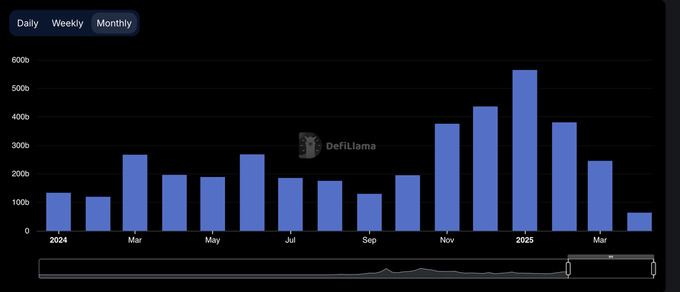
  • After DEX trading volume hit an all-time high of $380 billion in January 2025, it fell 35% in the following two months, which suggests that January may have formed a short-term top.
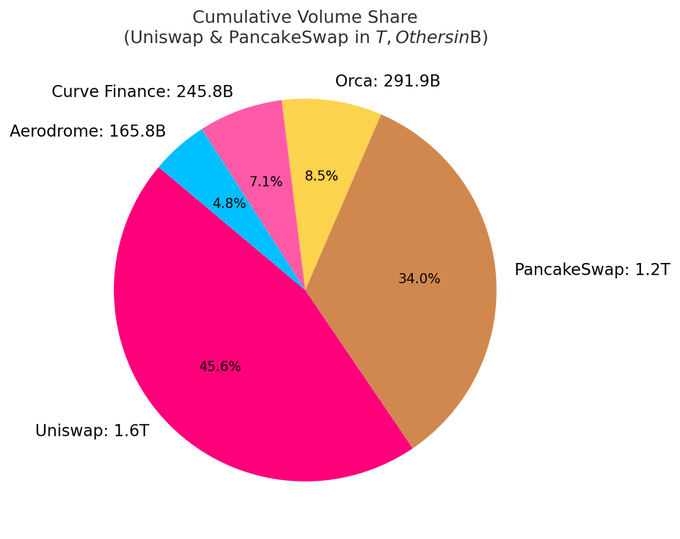
  • Currently, the top ten DEXs account for nearly 80% of the total trading volume; Uniswap and PancakeSwap alone account for about 40% of the share.
  • Solana-based DEXs have quietly dominated the rankings, occupying 5 of the top 10 spots, with their market share growth driven primarily by trading volume from the meme coin craze.
  • Hyperliquid has completely changed the landscape of perpetual contracts, rising from a newcomer in the industry to occupying more than 60% of the market share by March 2025.

All insights in this article are based on public data. Special thanks to DefiLlama for continuing to provide high-quality statistics.

Cycles defined by surges and slowdowns

At the beginning of 2024, DEX trading volume was strong in March and May, then gradually slowed down until mid-year.

The situation changed dramatically in the fourth quarter, with trading volumes surging in November and December, a trend that continued until January 2025, when it reached an explosive peak of $380 billion.

However, the rebound was short-lived. By February, market volume had plummeted to $245 billion, a 35% drop that ended a three-month vertical surge. The pullback set the tone for a more cautious second quarter.
Migration of on-chain liquidity: After 15 months of ups and downs, who will remain standing after the hype subsides?

DEX dominance: Top protocols take the reins

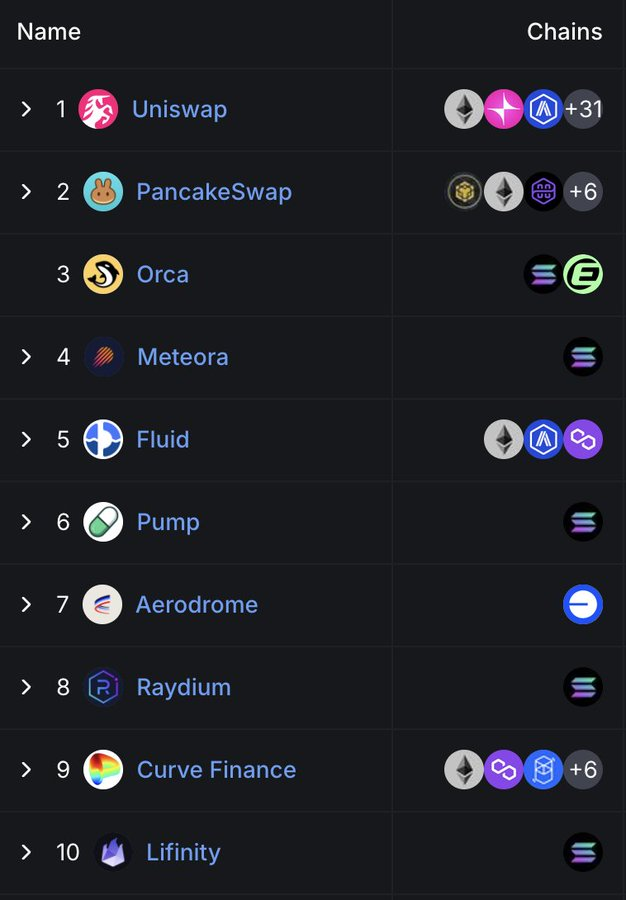
The DEX market landscape remains highly concentrated. Currently, the top ten protocols account for 79.5% of daily trading volume, while the top five alone account for 59.1%.

Uniswap and PancakeSwap account for about 40% of DEX trading volume and are the only two platforms with cumulative trading volume exceeding one trillion US dollars so far. Their leading position stems from first-mover advantage, extensive support for multi-chain ecology, and deep liquidity.

Uniswap Labs also launched Unichain, a second-layer network on Ethereum built on the Optimism Superchain. The chain aims to enable fast and low-cost transactions through native multi-chain interoperability.
Migration of on-chain liquidity: After 15 months of ups and downs, who will remain standing after the hype subsides?

The Quiet Rise of Solana

It is noteworthy that Solana is becoming increasingly prominent in the DEX field. Five of the top ten DEXs, including Orca, Meteora, Raydium, Lifinity, and Pump.fun, are natively developed based on Solana.

Orca (8.02%) and Meteora (6.70%) alone account for approximately 15% of global DEX activity.

This growth is due to low gas fees, fast block times, and the Solana meme coin craze. Pump.fun’s surge into the top 10 is a testament to this enthusiasm.
Migration of on-chain liquidity: After 15 months of ups and downs, who will remain standing after the hype subsides?

Emerging protocols: Fluid and Aerodrome

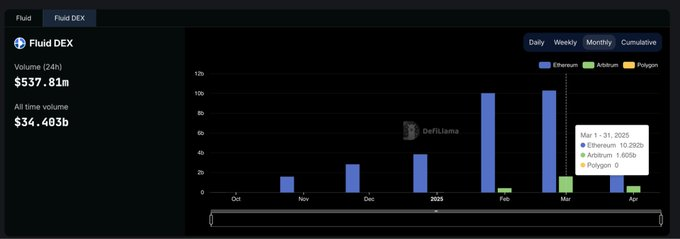
Fluid (7.09%) is the most capital efficient platform among the top five DEXs. The protocol is active on Ethereum, with monthly liquidations exceeding $10 billion. It has been particularly impressive since the launch of the Arbitrum ecosystem: trading volume surged from $426 million in February to $1.6 billion in March, fully demonstrating that its adoption rate is far faster than the industry average.

As a native project of Base, Aerodrome demonstrates the continued growth of liquidity on Base L2.

Although Hyperliquid is not ranked high in the spot market, it dominates the perpetual contract market with a market share of over 60%.
Migration of on-chain liquidity: After 15 months of ups and downs, who will remain standing after the hype subsides?

Market share of DEX chains: easy to grow, difficult to retain

The past 15 months have clearly shown a phenomenon: most blockchain projects can attract attention, but only a few can maintain their appeal. From January 2024 to March 2025, the market share of chain-level decentralized exchanges changed rapidly, and only a few projects really had user stickiness.
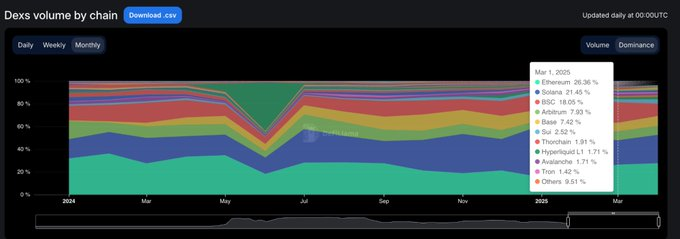
Migration of on-chain liquidity: After 15 months of ups and downs, who will remain standing after the hype subsides?

Solana achieved the biggest breakthrough. It climbed steadily in 2024, driven by the TRUMP and MELANIA meme coin craze, and reached a peak market share of 45.8% in January 2025. But by March, its market share was halved to 21.5%, but it still ranked first among all public chains with an average share of 25.1%.

Ethereum is the exact opposite. It starts 2024 with a share of about 32%, falls to 15.3% in January 2025, and then rebounds to 26.4% in March. Of course, even if Ethereum loses its growth momentum, its ecological resilience remains.

Base is the most stable follower. It continued to grow from 3% in March 2024 to 12.4% in December, and then fell back to 7.4% in March 2025, maintaining an average share of 6.6% during the period. There is no hype, only slow but sticky growth.

BNB Chain remained stable with an average share of 14.7%. There was no sharp rise or fall, and the flow of retail funds was always stable.

Arbitrum had a strong start (16% share) but subsequently lost momentum, and by January 2025 it had fallen to 4.8%, surpassed by both Base and Solana.

Blast reached a peak market share of 42.3% in June 2024, but disappeared the following month. This is a typical case of incentive-driven transaction volume and zero user retention rate.

Summary: The dominance of DEX in each public chain is highly volatile. Solana once emerged, Ethereum achieved value restoration, Base gradually expanded its ecosystem, and the market hype cycle showed ups and downs. The public chain that ultimately occupies a dominant position is not the one with the loudest voice, but the network with the highest actual usage rate.
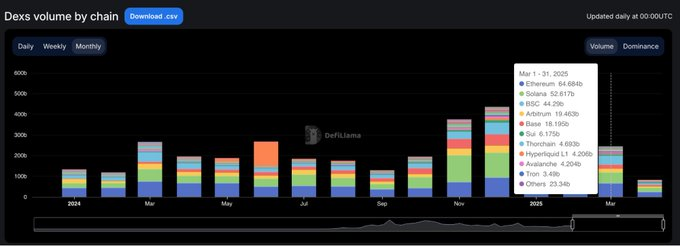
Migration of on-chain liquidity: After 15 months of ups and downs, who will remain standing after the hype subsides?

Centralized exchanges still dominate spot trading volume

Despite the explosive growth of DEXs in early 2025, centralized exchanges still dominate the spot market. Even in January, when DEX trading volume peaked, CEXs still accounted for nearly 80% of total trading volume.

While the dominance of centralized exchanges has fallen from 90% at the beginning of 2024 to a low of 79%, the broader trend is clear: while DEXs continue to grow, CEXs remain the default choice for most traders.
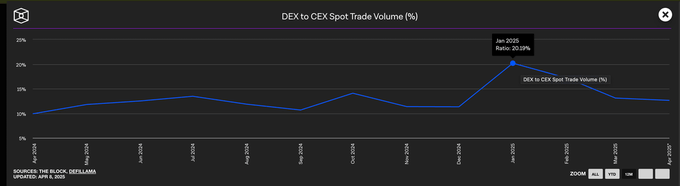
Migration of on-chain liquidity: After 15 months of ups and downs, who will remain standing after the hype subsides?

Perpetual Protocol Market Share

The landscape of on-chain perpetual contracts has undergone a fundamental shift in 2024.

More than two years after dYdX took the top spot in perpetual contract trading, Hyperliquid emerged and redefined what dominance means. The platform first topped the list in February, but was briefly surpassed by SynFutures in the middle of the year. After regaining the top spot in August, it has been far ahead. As of March 2025, Hyperliquid has accounted for nearly 59% of the total perpetual contract trading volume, completely consolidating its position as the preferred platform for professional traders.

This rising momentum has attracted a lot of market attention, and its product experience is closer to centralized exchanges than any previous decentralized exchanges. In contrast, dYdX's market share has declined rapidly. From 13.2% of the market share at the beginning of 2024, it has plummeted to only 2.7% in March 2025, and users have turned to faster, simpler, and more modern alternative platforms.

Jupiter's perpetual contract took a different approach. With Solana's native liquidity and the diversion effect of its spot DEX, it climbed to the second place with a market share of 8.8%. Although it rose rapidly, it lacked stamina and eventually ranked behind Hyperliquid. Other projects such as SynFutures, Vertex Protocol and Paradex also briefly emerged.
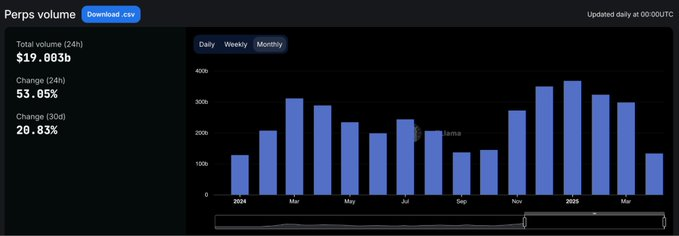
Migration of on-chain liquidity: After 15 months of ups and downs, who will remain standing after the hype subsides?

Perpetual Contract Chain: The execution layer is reconstructed within one cycle

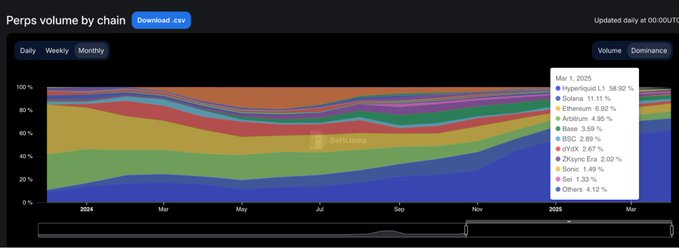
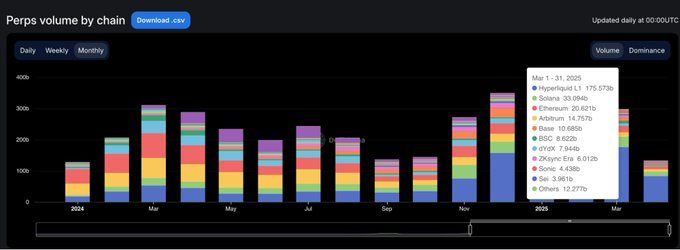
The biggest shift in perpetual swap infrastructure over the past year has not been about which protocols users prefer, but rather which chains they trust to execute transactions.

By March 2025, Ethereum and Arbitrum’s share of perpetual contract trading volume had plummeted to 11.8%, in stark contrast to their combined market dominance of over 65% in January 2024, as newer, faster execution layers took over.
Migration of on-chain liquidity: After 15 months of ups and downs, who will remain standing after the hype subsides?

The core force driving this transformation is Hyperliquid's self-developed blockchain. The chain has significantly increased its market share from 13.6% to 58.9% during the same period. In less than a year, it has replaced various Layer 1 and Layer 2 solutions that once defined industry standards and become the default execution environment for perpetual contract transactions. Its advantages are not only reflected in faster transaction speeds, but more importantly, it provides the reliability and low latency required by professional traders.

Solana also experienced a strong rise. Driven by the Jupiter and Phoenix projects at the end of 2024, its market share once climbed to nearly 16%. But it eventually stabilized in the 10-11% range and failed to continue its breakthrough growth momentum. Although the Base and ZKsync ecosystems showed vitality (the peak market share reached 6-7%), they have never been able to rank among the top public chains.

Meanwhile, Blast has become a cautionary tale: this short-lived project reached 18.8% market share in June 2024, but disappeared at the same alarming speed. In a field driven by product quality and user retention, pure hype will not last long. The new industry execution standard has been clarified: performance-centric public chains have redefined the competitive benchmark, and traditional infrastructure no longer occupies a default advantage.
Migration of on-chain liquidity: After 15 months of ups and downs, who will remain standing after the hype subsides?

The future of DeFi does not lie in multi-chain expansion, but in protocols that can transform industry narratives into user habits.


Market Opportunity
Hyperliquid Logo
Hyperliquid Price(HYPE)
$35.19
$35.19$35.19
+7.45%
USD
Hyperliquid (HYPE) Live Price Chart
Disclaimer: The articles reposted on this site are sourced from public platforms and are provided for informational purposes only. They do not necessarily reflect the views of MEXC. All rights remain with the original authors. If you believe any content infringes on third-party rights, please contact service@support.mexc.com for removal. MEXC makes no guarantees regarding the accuracy, completeness, or timeliness of the content and is not responsible for any actions taken based on the information provided. The content does not constitute financial, legal, or other professional advice, nor should it be considered a recommendation or endorsement by MEXC.

You May Also Like

SBI VC Trade Adds Litecoin to Japanese Lending Program

SBI VC Trade Adds Litecoin to Japanese Lending Program

The post SBI VC Trade Adds Litecoin to Japanese Lending Program appeared on BitcoinEthereumNews.com. SBI VC Trade added Litecoin to its regulated lending program
Share
BitcoinEthereumNews2026/02/03 19:53
Work Dogs TGE Is Running — Is WD About to Drop in Q2 After March 30?

Work Dogs TGE Is Running — Is WD About to Drop in Q2 After March 30?

Work Dogs Token Listing Date Expected in Q2 2026 as WD TGE Nears Completion The countdown to the Work Dogs (WD) token listing date has officially begun. Afte
Share
Hokanews2026/02/03 20:16
Bitcoin: Treasury Corporation’s Strategic OTCQX Listing Unlocks New Growth

Bitcoin: Treasury Corporation’s Strategic OTCQX Listing Unlocks New Growth

BitcoinWorld Bitcoin: Treasury Corporation’s Strategic OTCQX Listing Unlocks New Growth The world of cryptocurrency is constantly evolving, and a recent development has captured the attention of investors and enthusiasts alike. Bitcoin Treasury Corporation, a a company dedicated to accumulating digital assets, has made a significant move by listing on the U.S. OTCQX Best Market under the ticker BTCFF. This isn’t just another listing; it signals a growing trend of institutional confidence in digital assets and their long-term potential. What Does This Strategic OTCQX Listing Mean for Bitcoin Treasury Corporation? For those unfamiliar, the OTCQX Best Market is the highest tier of the three marketplaces for the over-the-counter (OTC) trading of stocks. It’s designed for established, investor-focused U.S. and international companies. Being listed here offers several distinct advantages for a company like Bitcoin Treasury Corporation. Enhanced Visibility: The listing provides a more transparent and regulated trading environment, making the company more attractive to a broader range of institutional and retail investors. Increased Liquidity: A higher-tier market often leads to greater trading volumes, which can improve the liquidity of the company’s shares. Credibility Boost: Operating on a recognized market lends significant credibility, especially for an entity deeply involved in the nascent crypto space. Bitcoin Treasury Corporation began its journey of accumulating BTC in June and has rapidly grown its holdings to over 700 BTC. This strategic accumulation underscores their belief in Bitcoin as a foundational asset for the future. Why Are More Companies Embracing Bitcoin for Their Treasuries? The move by Bitcoin Treasury Corporation isn’t an isolated incident. We’ve witnessed a remarkable shift in corporate finance over the past few years, with numerous companies integrating digital assets into their balance sheets. Why this sudden embrace of Bitcoin? Many view Bitcoin as a powerful hedge against inflation, especially in an era of quantitative easing and rising global debt. Its decentralized nature and finite supply of 21 million coins make it an appealing “digital gold” alternative to traditional fiat currencies. Companies like MicroStrategy have famously adopted Bitcoin as their primary treasury reserve asset, demonstrating a bold vision for corporate capital allocation. While the potential for significant gains is attractive, companies must also navigate the inherent volatility of the crypto market and evolving regulatory landscapes. Despite these challenges, the long-term strategic benefits often outweigh the risks for those with a strong conviction in this digital asset. How Does This Listing Impact the Broader Bitcoin Market? Each time a company like Bitcoin Treasury Corporation makes such a move, it sends a ripple through the entire crypto ecosystem. It serves as a strong validation of Bitcoin as a legitimate and valuable asset class, not just a speculative tool. This increased institutional involvement can lead to: Greater Stability: As more large entities hold Bitcoin for the long term, it could potentially reduce some of the extreme price swings often associated with the asset. Mainstream Acceptance: Corporate adoption paves the way for wider public acceptance and understanding of cryptocurrencies. Regulatory Clarity: With more traditional companies engaging, regulators may be compelled to provide clearer guidelines, fostering a more secure environment for everyone involved with digital currencies. For individual investors, this trend suggests a maturation of the market. It implies that fundamental analysis and long-term investment strategies are becoming increasingly relevant in the Bitcoin space. Navigating the Future of Corporate Bitcoin Holdings The listing of Bitcoin Treasury Corporation on the OTCQX Best Market marks a pivotal moment. It highlights a growing confidence among corporations in integrating digital assets into their financial strategies. As the digital economy continues to expand, we can expect more companies to explore similar avenues for their Bitcoin investments. However, it’s crucial for any company considering Bitcoin for its treasury to conduct thorough due diligence. Understanding market dynamics, regulatory compliance, and secure custody solutions are paramount. The journey into corporate crypto holdings is still relatively new, but pioneers like Bitcoin Treasury Corporation are charting a course for others to follow. In conclusion, Bitcoin Treasury Corporation’s OTCQX listing is more than just a procedural step; it’s a powerful testament to the enduring appeal and increasing institutional acceptance of Bitcoin. This move not only benefits the company but also reinforces the broader narrative of digital assets’ emergence as a crucial component of modern financial portfolios. It’s an exciting time to watch the intersection of traditional finance and digital assets evolve. Frequently Asked Questions About Bitcoin Treasury Corporation’s Listing Q1: What is the OTCQX Best Market? A1: The OTCQX Best Market is the highest tier for over-the-counter (OTC) stock trading in the U.S. It’s for established companies that meet stringent financial and disclosure requirements, offering enhanced transparency and credibility for investors. Q2: Why is Bitcoin Treasury Corporation’s listing significant for Bitcoin? A2: This listing signifies increasing institutional confidence in Bitcoin as a legitimate asset. It provides a regulated platform for a company focused on accumulating Bitcoin, potentially encouraging more traditional investors and corporations to consider digital assets. Q3: How much Bitcoin does Bitcoin Treasury Corporation hold? A3: As of their announcement, Bitcoin Treasury Corporation holds over 700 BTC, having begun its accumulation strategy in June. Q4: What are the benefits for Bitcoin Treasury Corporation by listing on OTCQX? A4: Benefits include enhanced visibility, increased liquidity for its shares, and a significant boost in credibility by operating on a recognized and regulated market, making it more attractive to a wider investor base. Q5: Does this mean Bitcoin is becoming more mainstream? A5: Yes, corporate actions like this listing contribute significantly to Bitcoin‘s mainstream acceptance. It helps validate digital assets as a serious component of financial portfolios, paving the way for wider public and institutional understanding. If you found this article insightful and believe in the growing importance of corporate Bitcoin adoption, please share it with your network! Your support helps us continue to provide valuable insights into the evolving world of cryptocurrency. To learn more about the latest Bitcoin trends, explore our article on key developments shaping Bitcoin institutional adoption. This post Bitcoin: Treasury Corporation’s Strategic OTCQX Listing Unlocks New Growth first appeared on BitcoinWorld.
Share
Coinstats2025/09/18 19:40