PUMP price is tightening below a descending trendline as a new cashback model reshapes trader incentives. Pump.fun’s native token PUMP was trading at $0.002162 PUMP price is tightening below a descending trendline as a new cashback model reshapes trader incentives. Pump.fun’s native token PUMP was trading at $0.002162

PUMP price compresses below descending trendline — will new Cashback Coins fuel rebound?

2026/02/18 13:58
3 min read

PUMP price is tightening below a descending trendline as a new cashback model reshapes trader incentives.

Summary
  • PUMP is compressing beneath a descending trendline after a recent recovery.
  • Pump.fun’s new Cashback Coins shift fee rewards from creators to traders.
  • A decisive breakout could trigger expansion, while rejection keeps downside risk in play.

Pump.fun’s native token PUMP was trading at $0.002162 at press time, down 3.2% in the past 24 hours. Over the last seven days, it has moved between $0.001843 and $0.002355, placing the current price close to the upper end of that range.

The token is up 13% on the week, but still down around 15% over the past month. Trading activity has accelerated. Spot volume reached $110 million in the last 24 hours, a 56% increase from the previous day.

Derivatives show a similar pickup in activity. According to CoinGlass data, futures volume climbed 38% to $234 million, while open interest rose 1.08% to $174 million.

Rising volume alongside a slight increase in open interest suggests that new positions are being opened, though leverage growth remains limited. 

Cashback Coins introduce new incentive model

The recent compression in price comes as Pump.fun (PUMP) rolls out a structural change to its launch model.

On Feb. 17, the platform announced Cashback Coins, a feature that lets creators choose between traditional Creator Fees or redirecting those fees entirely to traders and holders. The decision must be made before launch, and once a token goes live, it cannot be changed.

https://twitter.com/pumpfun/status/2023781347831971916?s=46&t=nznXkss3debX8JIhNzHmzw

Under the Cashback model, market participants, not the deployer, receive all creator fees. The goal is to address criticism that some token deployers collect fees without contributing long-term value. 

This change could have an impact on short-term trading behavior. Rewards are tied to trading activity as opposed to passive holding. If volume increases, more fees are generated and redistributed. 

That structure may encourage higher turnover and short bursts of speculation. At the same time, it can amplify volatility if traders rotate quickly in and out of positions to maximize rewards.

PUMP price technical analysis

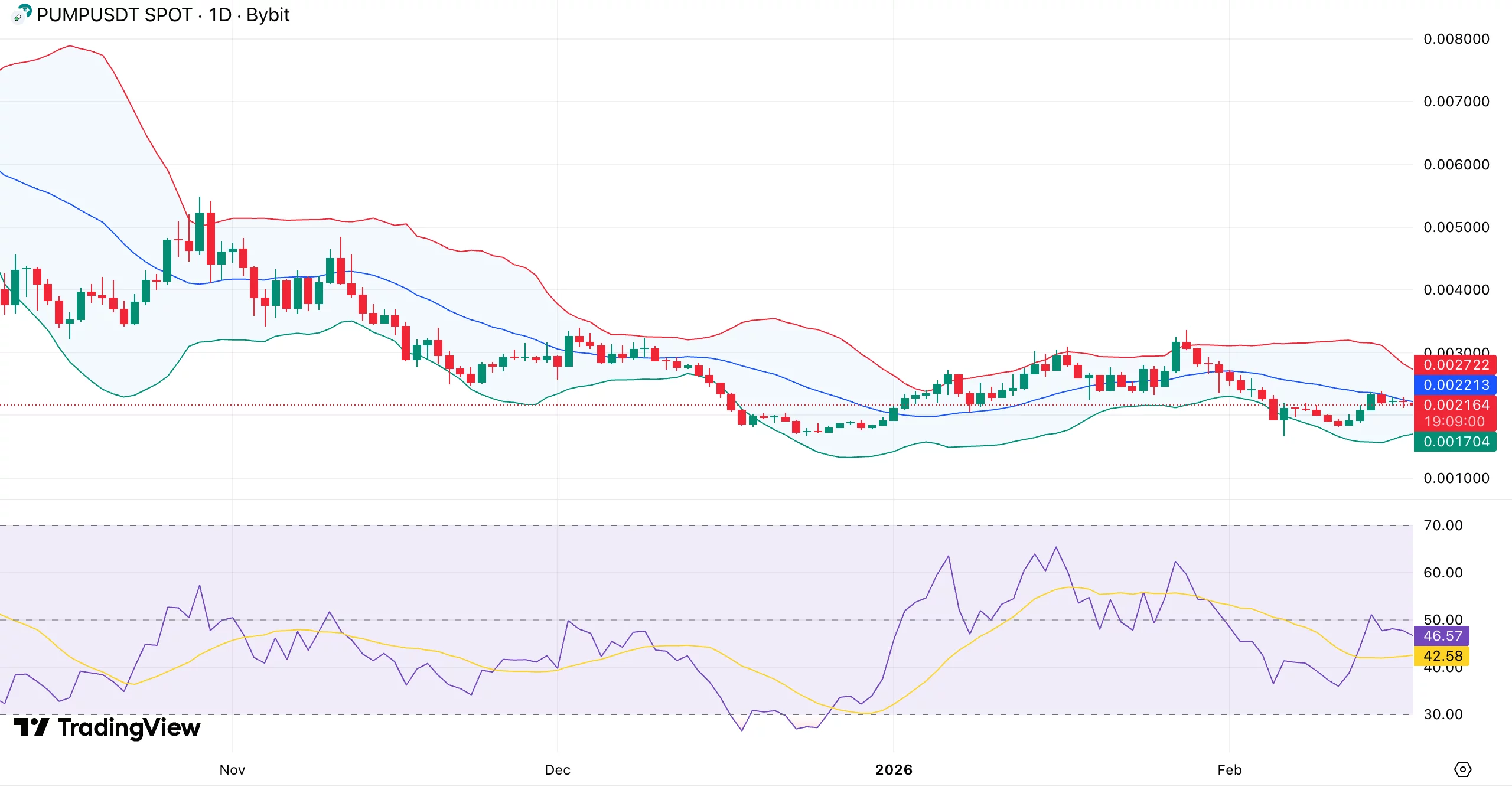
On the daily chart, PUMP is trading below a clear descending trendline drawn from a prior swing high. The pattern shows lower highs, while lows have begun to stabilize near $0.0021. Price is compressing between $0.0021 support and $0.0023 resistance.
PUMP price compresses below descending trendline — will new Cashback Coins fuel rebound? - 1

Bollinger Bands are tightening, indicating volatility contraction. When ranges narrow this way, expansion usually follows. Direction will depend on which level breaks first.

Momentum has improved but has not flipped bullish. The relative strength index is near 45, after bouncing from lower levels earlier in the month. It remains below 50, meaning buyers have not taken control.

A sustained move above 50 would strengthen upside momentum. To regain traction, bulls must close above the descending trendline and the 20-day moving average, ideally with a strong volume increase. 

The immediate resistance lies around $0.0023. A breakout above that level might signal the start of a move toward the most recent high at $0.002355. A decisive decline below $0.0021 would reveal a lower liquidity pocket and shift momentum back toward sellers.


Market Opportunity
pump.fun Logo
pump.fun Price(PUMP)
$0.002192
$0.002192$0.002192
-1.61%
USD
pump.fun (PUMP) Live Price Chart
Disclaimer: The articles reposted on this site are sourced from public platforms and are provided for informational purposes only. They do not necessarily reflect the views of MEXC. All rights remain with the original authors. If you believe any content infringes on third-party rights, please contact service@support.mexc.com for removal. MEXC makes no guarantees regarding the accuracy, completeness, or timeliness of the content and is not responsible for any actions taken based on the information provided. The content does not constitute financial, legal, or other professional advice, nor should it be considered a recommendation or endorsement by MEXC.

You May Also Like

The Channel Factories We’ve Been Waiting For

The Channel Factories We’ve Been Waiting For

The post The Channel Factories We’ve Been Waiting For appeared on BitcoinEthereumNews.com. Visions of future technology are often prescient about the broad strokes while flubbing the details. The tablets in “2001: A Space Odyssey” do indeed look like iPads, but you never see the astronauts paying for subscriptions or wasting hours on Candy Crush.  Channel factories are one vision that arose early in the history of the Lightning Network to address some challenges that Lightning has faced from the beginning. Despite having grown to become Bitcoin’s most successful layer-2 scaling solution, with instant and low-fee payments, Lightning’s scale is limited by its reliance on payment channels. Although Lightning shifts most transactions off-chain, each payment channel still requires an on-chain transaction to open and (usually) another to close. As adoption grows, pressure on the blockchain grows with it. The need for a more scalable approach to managing channels is clear. Channel factories were supposed to meet this need, but where are they? In 2025, subnetworks are emerging that revive the impetus of channel factories with some new details that vastly increase their potential. They are natively interoperable with Lightning and achieve greater scale by allowing a group of participants to open a shared multisig UTXO and create multiple bilateral channels, which reduces the number of on-chain transactions and improves capital efficiency. Achieving greater scale by reducing complexity, Ark and Spark perform the same function as traditional channel factories with new designs and additional capabilities based on shared UTXOs.  Channel Factories 101 Channel factories have been around since the inception of Lightning. A factory is a multiparty contract where multiple users (not just two, as in a Dryja-Poon channel) cooperatively lock funds in a single multisig UTXO. They can open, close and update channels off-chain without updating the blockchain for each operation. Only when participants leave or the factory dissolves is an on-chain transaction…
Share
BitcoinEthereumNews2025/09/18 00:09
eToro (ETOR) Stock Surges 20% – Here’s What Drove the Q4 Beat

eToro (ETOR) Stock Surges 20% – Here’s What Drove the Q4 Beat

TLDR eToro (ETOR) shares jumped over 20% Tuesday after Q4 earnings beat analyst expectations Q4 net income rose 16% year-over-year to $68.7 million; EPS of $0.71
Share
Coincentral2026/02/18 16:13
What Are the Trending Narratives in Crypto 2026?

What Are the Trending Narratives in Crypto 2026?

Cryptsy - Latest Cryptocurrency News and Predictions Cryptsy - Latest Cryptocurrency News and Predictions - Experts in Crypto Casinos Crypto markets are undergoing
Share
Cryptsy2026/02/18 16:13