This deep-dive analysis proves why SymTax works, showing its 'symbiotic' enricher and taxonomy fusion are essential for its state-of-the-art performance.This deep-dive analysis proves why SymTax works, showing its 'symbiotic' enricher and taxonomy fusion are essential for its state-of-the-art performance.

A Quantitative and Qualitative Analysis of the SymTax Citation Recommendation Model

Abstract and 1. Introduction

  1. Related Work

  2. Proposed Dataset

  3. SymTax Model

    4.1 Prefetcher

    4.2 Enricher

    4.3 Reranker

  4. Experiments and Results

  5. Analysis

    6.1 Ablation Study

    6.2 Quantitative Analysis and 6.3 Qualitative Analysis

  6. Conclusion

  7. Limitations

  8. Ethics Statement and References

Appendix

6 Analysis

We conduct extensive analysis to assess further the modularity of SymTax, the importance of different modules, combinatorial choice of LM and taxonomy fusion, and the usage of hyperbolic space over Euclidean space. Furthermore, we analysed the effect of using section heading as an additional signal (shown in Appendix A).

\

6.1 Ablation Study

We perform an ablation study to highlight the importance of Symbiosis, taxonomy fusion and hyperbolic space. We consider two variants of SymTax, namely SciBERTvector and SPECTERgraph. For each of these two variants, we further conduct three experiments by (i) removing the Enricher module that works on the principle of Symbiosis, (ii) not considering the taxonomy attribute associated with the citation context and (iii) using Euclidean space to calculate the separation score.

\ As evident from Table 3, Symbiosis exclusion results in a drop of 21.40% and 24.45% in Recall@5 and NDCG respectively for SciBERTvector whereas for SPECTERgraph, it leads to a drop of 17.84% and 20.32% in Recall@5 and NDCG respectively. Similarly, taxonomy exclusion results in a drop of 34.94% and 27.88% in Recall@5 and NDCG respectively for SciBERTvector whereas for SPECTERgraph, it leads to a drop of 14.81% and 12.51% in Recall@5 and NDCG respectively. It is clear from Table 3 that the use of Euclidean space instead of hyperbolic space leads to performance drop across all metrics in both variants. Exclusion of Symbiosis impacts higher recall metrics more in comparison to excluding taxonomy fusion and hyperbolic space.

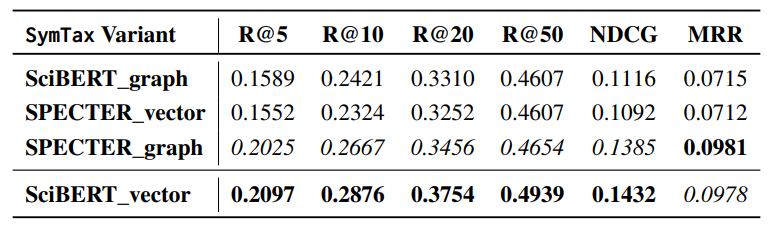
\ Table 4: Analysis on choice of LM and taxonomy fusion on 10k random samples from ArSyTa. Best results are highlighted in bold and second best are italicised.
\

6.2 Quantitative Analysis

We consider two available LMs, i.e. SciBERT and SPECTER, and the two types of taxonomy fusion, i.e. graph-based and vector-based. This results in four variants, as shown in Table 4. As evident from the results, SciBERTvector and SPECTERgraph are the best-performing variants. So, the combinatorial choice of LM and taxonomy fusion plays a vital role in model performance. The above observations can be attributed to SciBERT being a LM trained on plain scientific text. In contrast, SPECTER is a LM trained with Triplet loss using 1-hop neighbours of the positive sample from the citation graph as hard negative samples. So, SPECTER embodies graph information inside itself, whereas SciBERT does not.

\

6.3 Qualitative Analysis

We assess the quality of recommendations given by different algorithms by randomly choosing an example. Though random, we choose the example that has multiple citations in a given context so that we can present the qualitative analysis well by investigating the top-10 ranked predictions. As shown in Table 5, we consider an excerpt from Liu et al. (2020) that contains five citations. As we can see that Symtax correctly recommend three citations in the top-10, whereas HAtten only recommend one citation correctly at rank 1 and BM25 only suggest one correct citation at rank 10. The use of title is crucial to performance, as we can see that many recommendations consist of the words “BERT" and “Pretraining", which are the keywords present in the title. One more observation is that the taxonomy plays a vital role in recommendations. The taxonomy category of the query is ‘Computation and Language‘, and most of the recommended articles are from the same category. SymTax gives only one recommendation (Deep Residual Learning for Image Recognition) from a different category, i.e.“Computer Vision", whereas HAtten recommends three citations from different categories, i.e. (Deep Residual Learning for Image Recognition) from “Computer Vision" and (Batch Normalization, and Adam) from “Machine Learning".
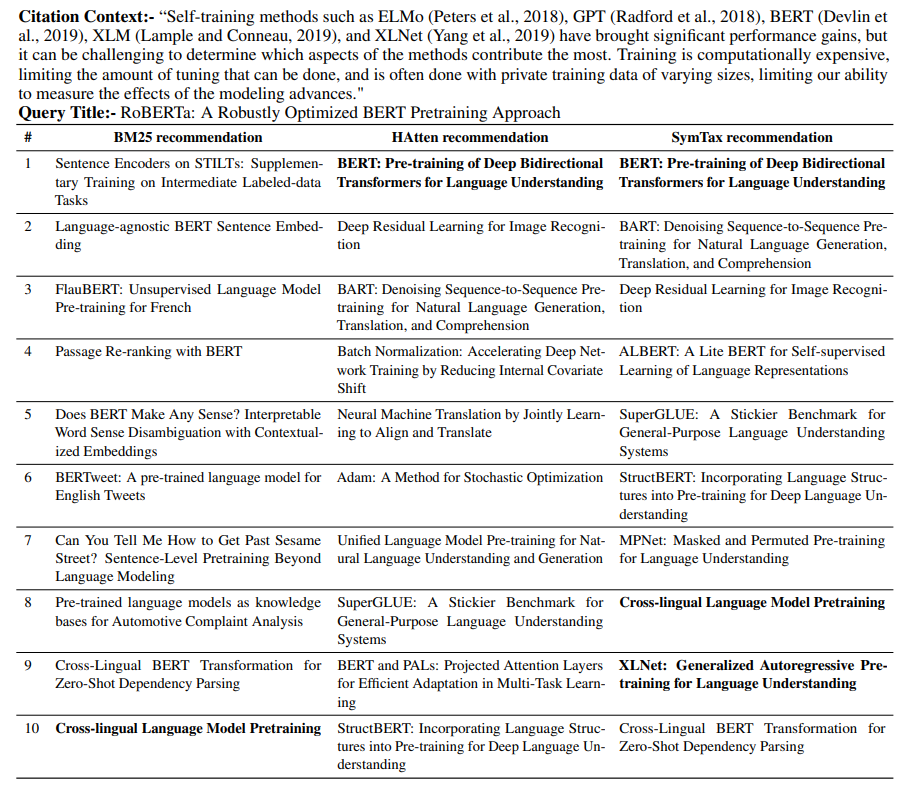
Table 5: The table shows the top-10 citation recommendations given by various algorithms for a randomly chosen example from ArSyTa. Valid predictions are highlighted in bold. It clearly shows that SymTax (SciBERT_vector) is able to recommend three valid articles in the top-10. In contrast, each of the HAtten and BM25 could recommend only one valid article for the given citation context. # denotes the rank of the recommended citations.

\

:::info Authors:

(1) Karan Goyal, IIIT Delhi, India (karang@iiitd.ac.in);

(2) Mayank Goel, NSUT Delhi, India (mayank.co19@nsut.ac.in);

(3) Vikram Goyal, IIIT Delhi, India (vikram@iiitd.ac.in);

(4) Mukesh Mohania, IIIT Delhi, India (mukesh@iiitd.ac.in).

:::


:::info This paper is available on arxiv under CC by-SA 4.0 Deed (Attribution-Sharealike 4.0 International) license.

:::

\

Market Opportunity
DeepBook Logo
DeepBook Price(DEEP)
$0.049118
$0.049118$0.049118
-5.20%
USD
DeepBook (DEEP) Live Price Chart
Disclaimer: The articles reposted on this site are sourced from public platforms and are provided for informational purposes only. They do not necessarily reflect the views of MEXC. All rights remain with the original authors. If you believe any content infringes on third-party rights, please contact service@support.mexc.com for removal. MEXC makes no guarantees regarding the accuracy, completeness, or timeliness of the content and is not responsible for any actions taken based on the information provided. The content does not constitute financial, legal, or other professional advice, nor should it be considered a recommendation or endorsement by MEXC.

You May Also Like

WIF Price Prediction: Dogwifhat Targets $0.47 Breakout After Recent Whale Accumulation

WIF Price Prediction: Dogwifhat Targets $0.47 Breakout After Recent Whale Accumulation

The post WIF Price Prediction: Dogwifhat Targets $0.47 Breakout After Recent Whale Accumulation appeared on BitcoinEthereumNews.com. James Ding Jan 15, 2026
Share
BitcoinEthereumNews2026/01/16 06:53
Trading time: Tonight, the US GDP and the upcoming non-farm data will become the market focus. Institutions are bullish on BTC to $120,000 in the second quarter.

Trading time: Tonight, the US GDP and the upcoming non-farm data will become the market focus. Institutions are bullish on BTC to $120,000 in the second quarter.

Daily market key data review and trend analysis, produced by PANews.
Share
PANews2025/04/30 13:50
IP Hits $11.75, HYPE Climbs to $55, BlockDAG Surpasses Both with $407M Presale Surge!

IP Hits $11.75, HYPE Climbs to $55, BlockDAG Surpasses Both with $407M Presale Surge!

The post IP Hits $11.75, HYPE Climbs to $55, BlockDAG Surpasses Both with $407M Presale Surge! appeared on BitcoinEthereumNews.com. Crypto News 17 September 2025 | 18:00 Discover why BlockDAG’s upcoming Awakening Testnet launch makes it the best crypto to buy today as Story (IP) price jumps to $11.75 and Hyperliquid hits new highs. Recent crypto market numbers show strength but also some limits. The Story (IP) price jump has been sharp, fueled by big buybacks and speculation, yet critics point out that revenue still lags far behind its valuation. The Hyperliquid (HYPE) price looks solid around the mid-$50s after a new all-time high, but questions remain about sustainability once the hype around USDH proposals cools down. So the obvious question is: why chase coins that are either stretched thin or at risk of retracing when you could back a network that’s already proving itself on the ground? That’s where BlockDAG comes in. While other chains are stuck dealing with validator congestion or outages, BlockDAG’s upcoming Awakening Testnet will be stress-testing its EVM-compatible smart chain with real miners before listing. For anyone looking for the best crypto coin to buy, the choice between waiting on fixes or joining live progress feels like an easy one. BlockDAG: Smart Chain Running Before Launch Ethereum continues to wrestle with gas congestion, and Solana is still known for network freezes, yet BlockDAG is already showing a different picture. Its upcoming Awakening Testnet, set to launch on September 25, isn’t just a demo; it’s a live rollout where the chain’s base protocols are being stress-tested with miners connected globally. EVM compatibility is active, account abstraction is built in, and tools like updated vesting contracts and Stratum integration are already functional. Instead of waiting for fixes like other networks, BlockDAG is proving its infrastructure in real time. What makes this even more important is that the technology is operational before the coin even hits exchanges. That…
Share
BitcoinEthereumNews2025/09/18 00:32