This article evaluates six deep-learning feature extractors for content-based image retrieval (CBIR), spanning both self-supervised and supervised approaches. It analyzes DINOv1, DINOv2, and DreamSim as ImageNet-pretrained self-supervised models, and contrasts them with SwinTransformer and two ResNet50 variants—one trained on RadImageNet and another on fractal geometry renderings. By extending earlier studies, the comparison highlights how backbone choice, training data, and pretraining strategies impact performance across medical and synthetic imaging tasks.This article evaluates six deep-learning feature extractors for content-based image retrieval (CBIR), spanning both self-supervised and supervised approaches. It analyzes DINOv1, DINOv2, and DreamSim as ImageNet-pretrained self-supervised models, and contrasts them with SwinTransformer and two ResNet50 variants—one trained on RadImageNet and another on fractal geometry renderings. By extending earlier studies, the comparison highlights how backbone choice, training data, and pretraining strategies impact performance across medical and synthetic imaging tasks.

Comparing Six Deep Learning Feature Extractors for CBIR Tasks

Abstract and 1. Introduction

  1. Materials and Methods

    2.1 Vector Database and Indexing

    2.2 Feature Extractors

    2.3 Dataset and Pre-processing

    2.4 Search and Retrieval

    2.5 Re-ranking retrieval and evaluation

  2. Evaluation and 3.1 Search and Retrieval

    3.2 Re-ranking

  3. Discussion

    4.1 Dataset and 4.2 Re-ranking

    4.3 Embeddings

    4.4 Volume-based, Region-based and Localized Retrieval and 4.5 Localization-ratio

  4. Conclusion, Acknowledgement, and References

2.2 Feature Extractors

We extend the analysis of Khun Jush et al. [2023] by adding two ResNet50 embeddings and evaluating the performance of six different slice embedding extractors for CBIR tasks. All the feature extractors are based on deep-learning-based models.

\ Table 1: Mapping of the original TS classes to 29 coarse anatomical regions.
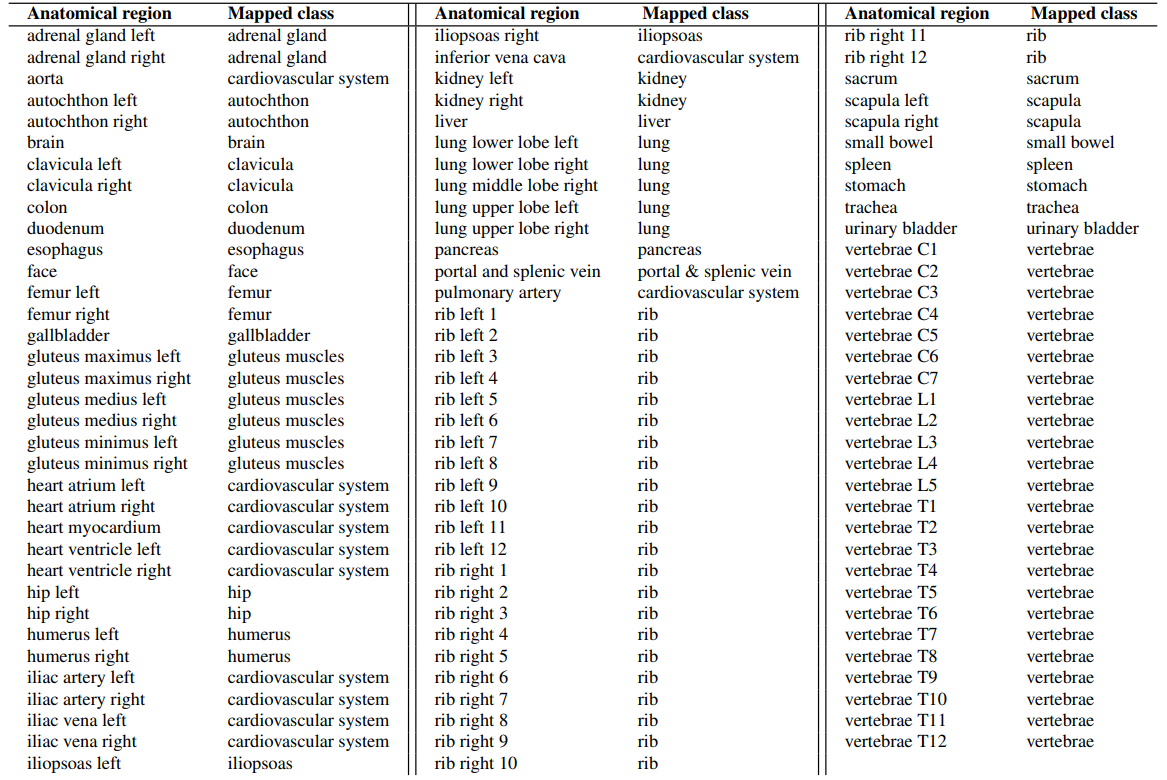
\ Self-supervised Models: We employed three self-supervised models pre-trained on ImageNet [Deng et al., 2009]. DINOv1 [Caron et al., 2021], that demonstrated learning efficient image representations from unlabeled data using self-distillation. DINOv2 [Oquab et al., 2023], is built upon DINOv1 [Caron et al., 2021], and this model scales the pre-training process by combining an improved training dataset, patchwise objectives during training and introducing a new regularization technique, which gives rise to superior performance on segmentation tasks. DreamSim [Fu et al., 2023], built upon the foundation of DINOv1 [Caron et al., 2021], fine-tunes the model using synthetic data triplets specifically designed to be cognitively impenetrable with human judgments. For the self-supervised models, we used the best-performing backbone reported by the developers of the models.

\ Supervised Models: We included a SwinTransformer model [Liu et al., 2021] and a ResNet50 model [He et al., 2016] trained in a supervised manner using the RadImageNet dataset [Mei et al., 2022] that includes 5 million annotated 2D CT, MRI, and ultrasound images of musculoskeletal, neurologic, oncologic, gastrointestinal, endocrine, and pulmonary pathology. Furthermore, a ResNet50 model pre-trained on rendered images of fractal geometries was included based on [Kataoka et al., 2022]. These training images are formula-derived, non-natural, and do not require any human annotation.

\

:::info Authors:

(1) Farnaz Khun Jush, Bayer AG, Berlin, Germany (farnaz.khunjush@bayer.com);

(2) Steffen Vogler, Bayer AG, Berlin, Germany (steffen.vogler@bayer.com);

(3) Tuan Truong, Bayer AG, Berlin, Germany (tuan.truong@bayer.com);

(4) Matthias Lenga, Bayer AG, Berlin, Germany (matthias.lenga@bayer.com).

:::


:::info This paper is available on arxiv under CC BY 4.0 DEED license.

:::

\

Market Opportunity
SIX Logo
SIX Price(SIX)
$0.01206
$0.01206$0.01206
-1.30%
USD
SIX (SIX) Live Price Chart
Disclaimer: The articles reposted on this site are sourced from public platforms and are provided for informational purposes only. They do not necessarily reflect the views of MEXC. All rights remain with the original authors. If you believe any content infringes on third-party rights, please contact service@support.mexc.com for removal. MEXC makes no guarantees regarding the accuracy, completeness, or timeliness of the content and is not responsible for any actions taken based on the information provided. The content does not constitute financial, legal, or other professional advice, nor should it be considered a recommendation or endorsement by MEXC.

You May Also Like

Is Doge Losing Steam As Traders Choose Pepeto For The Best Crypto Investment?

Is Doge Losing Steam As Traders Choose Pepeto For The Best Crypto Investment?

The post Is Doge Losing Steam As Traders Choose Pepeto For The Best Crypto Investment? appeared on BitcoinEthereumNews.com. Crypto News 17 September 2025 | 17:39 Is dogecoin really fading? As traders hunt the best crypto to buy now and weigh 2025 picks, Dogecoin (DOGE) still owns the meme coin spotlight, yet upside looks capped, today’s Dogecoin price prediction says as much. Attention is shifting to projects that blend culture with real on-chain tools. Buyers searching “best crypto to buy now” want shipped products, audits, and transparent tokenomics. That frames the true matchup: dogecoin vs. Pepeto. Enter Pepeto (PEPETO), an Ethereum-based memecoin with working rails: PepetoSwap, a zero-fee DEX, plus Pepeto Bridge for smooth cross-chain moves. By fusing story with tools people can use now, and speaking directly to crypto presale 2025 demand, Pepeto puts utility, clarity, and distribution in front. In a market where legacy meme coin leaders risk drifting on sentiment, Pepeto’s execution gives it a real seat in the “best crypto to buy now” debate. First, a quick look at why dogecoin may be losing altitude. Dogecoin Price Prediction: Is Doge Really Fading? Remember when dogecoin made crypto feel simple? In 2013, DOGE turned a meme into money and a loose forum into a movement. A decade on, the nonstop momentum has cooled; the backdrop is different, and the market is far more selective. With DOGE circling ~$0.268, the tape reads bearish-to-neutral for the next few weeks: hold the $0.26 shelf on daily closes and expect choppy range-trading toward $0.29–$0.30 where rallies keep stalling; lose $0.26 decisively and momentum often bleeds into $0.245 with risk of a deeper probe toward $0.22–$0.21; reclaim $0.30 on a clean daily close and the downside bias is likely neutralized, opening room for a squeeze into the low-$0.30s. Source: CoinMarketcap / TradingView Beyond the dogecoin price prediction, DOGE still centers on payments and lacks native smart contracts; ZK-proof verification is proposed,…
Share
BitcoinEthereumNews2025/09/18 00:14
Pastor Involved in High-Stakes Crypto Fraud

Pastor Involved in High-Stakes Crypto Fraud

A gripping tale of deception has captured the media’s spotlight, especially in foreign outlets, centering on a cryptocurrency fraud case from Denver, Colorado. Eli Regalado, a pastor, alongside his wife Kaitlyn, was convicted, but what makes this case particularly intriguing is their unconventional defense.Continue Reading:Pastor Involved in High-Stakes Crypto Fraud
Share
Coinstats2025/09/18 00:38
Nexus Traps Tightening Nationwide

Nexus Traps Tightening Nationwide

Digital marketplaces and remote services have transformed how technology businesses operate across borders, but they’ve also intensified sales tax compliance challenges
Share
Techbullion2026/01/16 13:41