The ‘Capital Is Selective Again’ panel concluded that institutional investors are becoming far more selective in the current crypto cycle, prioritizing real revenueThe ‘Capital Is Selective Again’ panel concluded that institutional investors are becoming far more selective in the current crypto cycle, prioritizing real revenue

Tokenization, Transparency, And Institutional Demand Dominate Discussion At HSC’s ‘Capital Is Selective Again’ Panel
2026/02/20 20:50
3 min read
Tokenization, Transparency, And Institutional Demand Dominate Discussion At HSC’s ‘Capital Is Selective Again’ Panel

In the middle of February, HSC Asset Management held its event in Hong Kong, bringing together institutional investors, hedge funds, Web2 and crypto‑focused asset managers, and family offices to examine the latest trends shaping the institutional digital‑asset landscape.

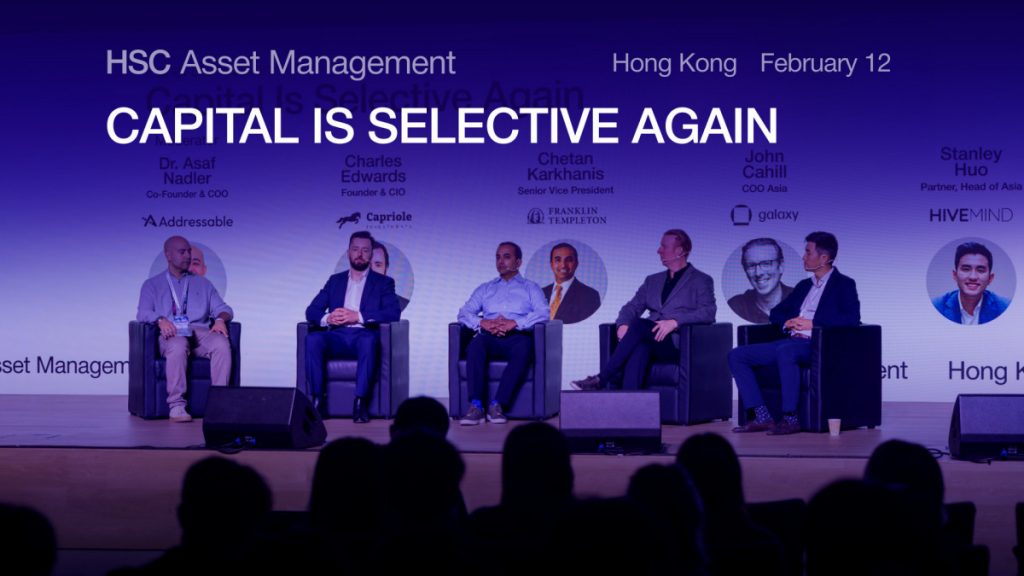
One of the central sessions was the “Capital Is Selective Again” panel, which opened the conference and featured Dr. Asaf Nadler of Addressable, Charles Edwards of Capriole Investments, Chetan Karkhanis of Franklin Templeton, John Cahill of Galaxy Digital, and Stanley Huo of Hivemind Capital. The discussion focused on how capital deployment has become significantly more selective in the current cycle, with speakers emphasizing rigorous due diligence, sustainable revenue models, and the reality that only fundamentally strong projects are now securing institutional backing.

Speakers began by noting that the crypto market has moved through several cycles—from the ICO boom to DeFi summer to the collapse of major platforms—which collectively eroded trust and pushed investors toward more disciplined evaluation. Earlier phases were driven by hype, retail speculation, and untested ideas, but the current environment demands revenue, product‑market fit, and sustainable token economics. Only a small fraction of tokens meet these standards, and the era of raising capital on vision alone has ended. The shift from a “tell me” to a “show me” market now requires real business models, identifiable customers, and measurable traction.

Institutionalization And The Rise Of Tokenized Assets

The conversation then turned to institutionalization and real‑world asset tokenization. Institutional participation has grown steadily, particularly in stablecoins, money‑market funds, and tokenized real‑world assets. Speakers highlighted that institutional use cases such as collateral management, treasury operations, and intraday liquidity are advancing faster than retail adoption. Tokenization continues to expand across chains, supported by rising stablecoin issuance and RWA growth, while regulatory clarity remains essential as global institutions operate within jurisdiction‑specific frameworks. The panel noted that tokenization is progressing from simple instruments toward more complex assets such as private credit and private company shares, with compliance and risk management at the core.

How Investors Evaluate Projects Today

When evaluating projects, speakers stressed that transparency does not guarantee accuracy, as on‑chain data can be distorted by artificial activity or inflated metrics. To assess real traction, investors rely on verified customer usage, partner validation, sustainable incentive structures, token‑supply dynamics, revenue trends, and team credibility. Some participants added that macroeconomic conditions, sentiment, and technical indicators also influence decision‑making, especially for liquid token strategies.

Convergence Of Traditional Finance And Web3

The discussion also underscored the growing convergence between traditional finance and Web3. Unified digital wallets offering a holistic view of assets and liabilities, rising interest from banks and asset managers in on‑chain products, and the expectation that automated agents will eventually handle portfolio construction all point to a long‑term structural shift. This transition requires compliant, cross‑border infrastructure capable of supporting tokenized assets at scale, with early progress already visible across Asia, Europe, and the United States.

Finally, the panel examined Asia’s role in the evolving landscape. While global fundamentals are similar, Asia stands out for its large consumer base, rapid adoption of new technologies, and strong engineering talent. High demand for cross‑border payments, growing use of stablecoins for trade and remittances, interest in tokenizing private assets and cultural products, and a strong appetite for consumer‑facing applications all position the region as a fertile ground for Web3 innovation.

The post Tokenization, Transparency, And Institutional Demand Dominate Discussion At HSC’s ‘Capital Is Selective Again’ Panel appeared first on Metaverse Post.


Market Opportunity
FIT Logo
FIT Price(FIT)
$0.00004753
$0.00004753$0.00004753
-0.37%
USD
FIT (FIT) Live Price Chart
Disclaimer: The articles reposted on this site are sourced from public platforms and are provided for informational purposes only. They do not necessarily reflect the views of MEXC. All rights remain with the original authors. If you believe any content infringes on third-party rights, please contact service@support.mexc.com for removal. MEXC makes no guarantees regarding the accuracy, completeness, or timeliness of the content and is not responsible for any actions taken based on the information provided. The content does not constitute financial, legal, or other professional advice, nor should it be considered a recommendation or endorsement by MEXC.

You May Also Like

Supreme Court Strikes Down Most of Donald Trump Tariffs

Supreme Court Strikes Down Most of Donald Trump Tariffs

TL;DR Court rules IEEPA does not authorize presidential tariff powers. Decision invalidates reciprocal and fentanyl-linked tariffs. Steel and aluminum tariffs under
Share
Coincentral2026/02/21 00:15
Franklin Templeton CEO Dismisses 50bps Rate Cut Ahead FOMC

Franklin Templeton CEO Dismisses 50bps Rate Cut Ahead FOMC

The post Franklin Templeton CEO Dismisses 50bps Rate Cut Ahead FOMC appeared on BitcoinEthereumNews.com. Franklin Templeton CEO Jenny Johnson has weighed in on whether the Federal Reserve should make a 25 basis points (bps) Fed rate cut or 50 bps cut. This comes ahead of the Fed decision today at today’s FOMC meeting, with the market pricing in a 25 bps cut. Bitcoin and the broader crypto market are currently trading flat ahead of the rate cut decision. Franklin Templeton CEO Weighs In On Potential FOMC Decision In a CNBC interview, Jenny Johnson said that she expects the Fed to make a 25 bps cut today instead of a 50 bps cut. She acknowledged the jobs data, which suggested that the labor market is weakening. However, she noted that this data is backward-looking, indicating that it doesn’t show the current state of the economy. She alluded to the wage growth, which she remarked is an indication of a robust labor market. She added that retail sales are up and that consumers are still spending, despite inflation being sticky at 3%, which makes a case for why the FOMC should opt against a 50-basis-point Fed rate cut. In line with this, the Franklin Templeton CEO said that she would go with a 25 bps rate cut if she were Jerome Powell. She remarked that the Fed still has the October and December FOMC meetings to make further cuts if the incoming data warrants it. Johnson also asserted that the data show a robust economy. However, she noted that there can’t be an argument for no Fed rate cut since Powell already signaled at Jackson Hole that they were likely to lower interest rates at this meeting due to concerns over a weakening labor market. Notably, her comment comes as experts argue for both sides on why the Fed should make a 25 bps cut or…
Share
BitcoinEthereumNews2025/09/18 00:36
Why The Green Bay Packers Must Take The Cleveland Browns Seriously — As Hard As That Might Be

Why The Green Bay Packers Must Take The Cleveland Browns Seriously — As Hard As That Might Be

The post Why The Green Bay Packers Must Take The Cleveland Browns Seriously — As Hard As That Might Be appeared on BitcoinEthereumNews.com. Jordan Love and the Green Bay Packers are off to a 2-0 start. Getty Images The Green Bay Packers are, once again, one of the NFL’s better teams. The Cleveland Browns are, once again, one of the league’s doormats. It’s why unbeaten Green Bay (2-0) is a 8-point favorite at winless Cleveland (0-2) Sunday according to betmgm.com. The money line is also Green Bay -500. Most expect this to be a Packers’ rout, and it very well could be. But Green Bay knows taking anyone in this league for granted can prove costly. “I think if you look at their roster, the paper, who they have on that team, what they can do, they got a lot of talent and things can turn around quickly for them,” Packers safety Xavier McKinney said. “We just got to kind of keep that in mind and know we not just walking into something and they just going to lay down. That’s not what they going to do.” The Browns certainly haven’t laid down on defense. Far from. Cleveland is allowing an NFL-best 191.5 yards per game. The Browns gave up 141 yards to Cincinnati in Week 1, including just seven in the second half, but still lost, 17-16. Cleveland has given up an NFL-best 45.5 rushing yards per game and just 2.1 rushing yards per attempt. “The biggest thing is our defensive line is much, much improved over last year and I think we’ve got back to our personality,” defensive coordinator Jim Schwartz said recently. “When we play our best, our D-line leads us there as our engine.” The Browns rank third in the league in passing defense, allowing just 146.0 yards per game. Cleveland has also gone 30 straight games without allowing a 300-yard passer, the longest active streak in the NFL.…
Share
BitcoinEthereumNews2025/09/18 00:41



