Cryptocurrency may be going mainstream, but traditional banks are still struggling to keep pace, and the disconnect is becoming increasingly visible. Recent dataCryptocurrency may be going mainstream, but traditional banks are still struggling to keep pace, and the disconnect is becoming increasingly visible. Recent data

Crypto Is Going Mainstream: So Why Are Banks Still Blocking It?

2026/02/21 03:19
3 min read

Cryptocurrency may be going mainstream, but traditional banks are still struggling to keep pace, and the disconnect is becoming increasingly visible.

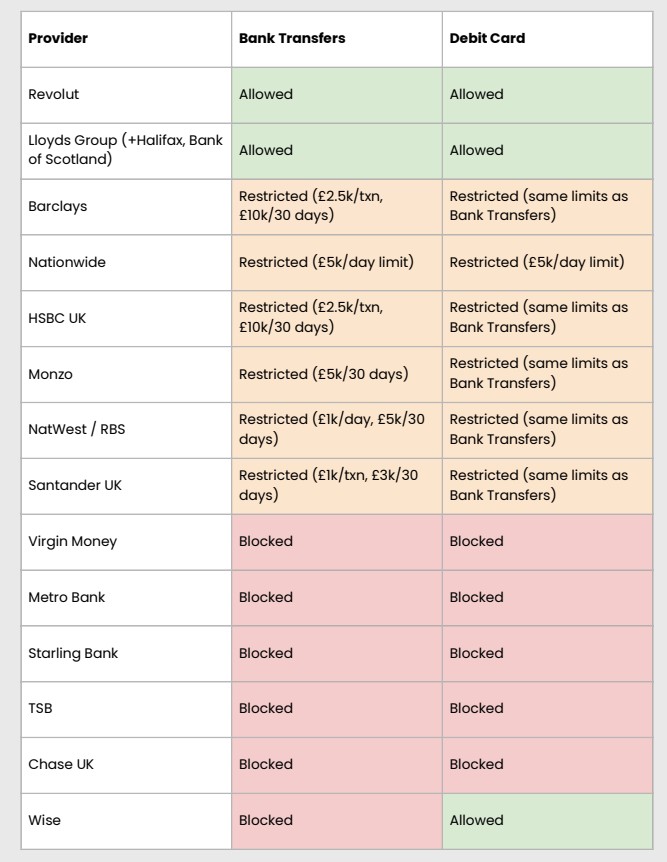
Recent data comparing major UK banks shows a fragmented and often restrictive approach toward crypto transactions. While some institutions allow both bank transfers and debit card purchases, many impose strict limits, and several block crypto-related payments altogether.
Source: https://x.com/Cointelegraph/status/2024732196293267600

UK Banks: Restrictions and Blocks

Among UK providers, Revolut and Lloyds Group (including Halifax and Bank of Scotland) currently allow crypto transactions through both bank transfers and debit cards. However, others are significantly more restrictive.

Barclays and HSBC UK impose transaction limits such as £2,500 per transaction and £10,000 per 30 days. Nationwide caps activity at £5,000 per day. NatWest and Santander apply even tighter monthly thresholds.

Several major names, including Virgin Money, Metro Bank, Starling Bank, TSB, and Chase UK, have outright blocked crypto-related transactions through both bank transfers and debit cards. Wise blocks bank transfers but still allows debit card purchases.

The pattern suggests that while crypto access exists, it is often throttled by internal risk controls rather than fully integrated into banking services.

U.S. Banks: Limited Bitcoin Services

The situation in the United States reflects a different but related constraint.

Among the top 25 U.S. banks, Bitcoin trading and custody services remain limited. JP Morgan Chase has announced trading support, but custody is not yet available.

Citigroup is exploring custody solutions, and several banks, including Wells Fargo, Goldman Sachs, and Morgan Stanley, restrict crypto trading to high-net-worth clients only.

Retail access remains constrained, and full custody services are largely absent across major institutions.

XRP Adds $1.3 Billion in 2026, Already Surpasses All of 2025

A Structural Gap

The contrast is clear: crypto markets operate 24/7 globally, spot Bitcoin ETFs are live, and tokenized assets are expanding rapidly, yet mainstream banking rails remain hesitant, limited, or outright closed.

Banks cite fraud risk, regulatory ambiguity, and consumer protection concerns. However, the restrictions also highlight an operational lag. Traditional banking systems were not built for decentralized, always-on digital assets, and integration has proven slower than adoption.

As institutional capital increases exposure to digital assets, the friction between banking infrastructure and crypto markets becomes more visible. While crypto has moved into exchange-traded products and sovereign-level discussions, many consumers still face limits or blocks at the bank level.

The post Crypto Is Going Mainstream: So Why Are Banks Still Blocking It? appeared first on ETHNews.


Market Opportunity
Major Logo
Major Price(MAJOR)
$0.07437
$0.07437$0.07437
+0.13%
USD
Major (MAJOR) Live Price Chart
Disclaimer: The articles reposted on this site are sourced from public platforms and are provided for informational purposes only. They do not necessarily reflect the views of MEXC. All rights remain with the original authors. If you believe any content infringes on third-party rights, please contact service@support.mexc.com for removal. MEXC makes no guarantees regarding the accuracy, completeness, or timeliness of the content and is not responsible for any actions taken based on the information provided. The content does not constitute financial, legal, or other professional advice, nor should it be considered a recommendation or endorsement by MEXC.
Tags:

You May Also Like

Spur Protocol Daily Quiz 21 February 2026: Claim Free Tokens and Boost Your Crypto Wallet

Spur Protocol Daily Quiz 21 February 2026: Claim Free Tokens and Boost Your Crypto Wallet

Spur Protocol Daily Quiz February 21 2026: Today’s Correct Answer and How to Earn Free In-App Tokens The Spur Protocol Daily Quiz for February 21, 2026, is
Share
Hokanews2026/02/21 17:10
SEC Eases Stablecoin Capital Rules

SEC Eases Stablecoin Capital Rules

The post SEC Eases Stablecoin Capital Rules appeared on BitcoinEthereumNews.com. Regulations The U.S. Securities and Exchange Commission introduced a major shift
Share
BitcoinEthereumNews2026/02/21 17:01
Crypto phone thefts on the rise in London as thieves drain wallets

Crypto phone thefts on the rise in London as thieves drain wallets

The post Crypto phone thefts on the rise in London as thieves drain wallets appeared on BitcoinEthereumNews.com. London sees a spike in phone snatchings targeting crypto holders, with thieves stealing phones to drain wallets. Young men aged 18 to 34 are prime targets, often hit after nights out in places like Old Street. Stolen phones expose passwords and two factor codes, but UK police struggle to track crypto thefts. London is turning into a tough spot for crypto followers with a wave of phone snatchings letting thieves raid digital wallets. According to a report by The Financial Times, earlier this month, a 42 year old guy named Christian D’Ippolito lost almost £40,000 in crypto after four men grabbed his phone near Old Street roundabout on his way home from a night out. They drained his wallet in hours. Rising Street Smarts Behind Crypto Heists This kind of hit is not rare anymore. The London Metropolitan Police report a big jump in street thefts of phones from crypto holders, especially around Old Street and Brixton. Thieves grab the devices to break into wallets and swipe thousands of pounds worth of assets. Young people aged 18 to 34 make up the main targets, with one in four owning crypto and guys most at risk. Thieves spot young men coming back from evenings out, chat them up casually, then snag the phone. They dodge locks, reset Apple IDs, or use crypto apps to move the cash fast. Neil Kotak, another victim, lost £10,000 that way. He said the guys seemed friendly, asked for his number, and grabbed the phone when he logged in. Our heavy use of phones for everything amps up the danger. An open device spills emails, passwords, two factor codes, and even passport pics, handing thieves the keys to your digital life. Crypto moves can be traced, but most crooks get off scot free. UK cops often…
Share
BitcoinEthereumNews2025/09/21 10:57