

XRP’s Brutal Supply Compression Signals A Repeat Of The 2024 Expansion
XRP is struggling to reclaim higher price levels as persistent selling pressure and broader market uncertainty continue to weigh on sentiment. Despite intermittent rebound attempts, momentum remains fragile, with traders hesitant to commit capital amid elevated volatility and cautious liquidity conditions. The asset has yet to establish a convincing higher high, reinforcing the perception that XRP remains in a transitional phase rather than a confirmed recovery trend.
A recent CryptoQuant report provides additional context through exchange flow data. According to the analysis, Binance recorded a sharp spike in XRP exchange inflows during a previously highlighted period that preceded a strong rally. Large inflows typically reflect tokens moving onto exchanges, a dynamic often interpreted as potential sell pressure since assets become readily available for liquidation. Such spikes can increase short-term supply and amplify volatility.

However, inflows do not always result in immediate distribution. In the referenced case, the surge in exchange deposits coincided with rising volatility and ultimately preceded a significant price expansion. This suggests that some inflow events may represent strategic positioning, liquidity preparation, or internal reallocation rather than outright selling. As XRP navigates current uncertainty, monitoring exchange flow behavior remains critical for assessing whether renewed volatility could once again precede a directional breakout.
Liquidity Compression Signals Rising Volatility Risk
The report explains that liquidity dynamics provide important context for understanding XRP market structure, particularly when evaluating volatility risk and potential price inflection points. USD liquidity measures the depth of capital supporting XRP trading pairs. During the previous rally phase, USD liquidity expanded significantly, allowing price advances to be absorbed without excessive volatility. Recently, however, USD liquidity has been declining, suggesting thinner market depth compared with the expansion period. Reduced depth typically increases sensitivity to order flow and can amplify price swings.

Liquidity measured in XRP terms reflects the availability of tokens on the sell side. Prior to the last major breakout, XRP liquidity compressed notably, indicating reduced active supply on exchanges. That contraction phase aligned closely with the beginning of the strong upward move. Currently, XRP liquidity is trending lower again, showing similarities with earlier pre-expansion conditions.
Historically, this combination of exchange inflow spikes alongside liquidity compression has preceded volatility expansion. Rising USD liquidity tends to support sustained trends, while declining liquidity often introduces fragility into market structure.
At present, exchange inflows remain moderate, but both USD and XRP liquidity are contracting. This suggests a thinner environment where price reactions could become sharper. These indicators provide structural context, but they should be evaluated alongside derivatives positioning, funding trends, and broader macro conditions before drawing directional conclusions.
XRP Remains Under Pressure As Key Support Levels Face Ongoing Tests
XRP remains under sustained technical pressure, with the weekly chart reflecting a clear corrective phase following the sharp rally that pushed the price above the $3.00 region in 2025. Since that peak, price structure has shifted toward a sequence of lower highs and lower lows, a pattern typically associated with weakening momentum rather than consolidation. The recent move toward the $1.40 area highlights continued selling pressure and cautious positioning among market participants.
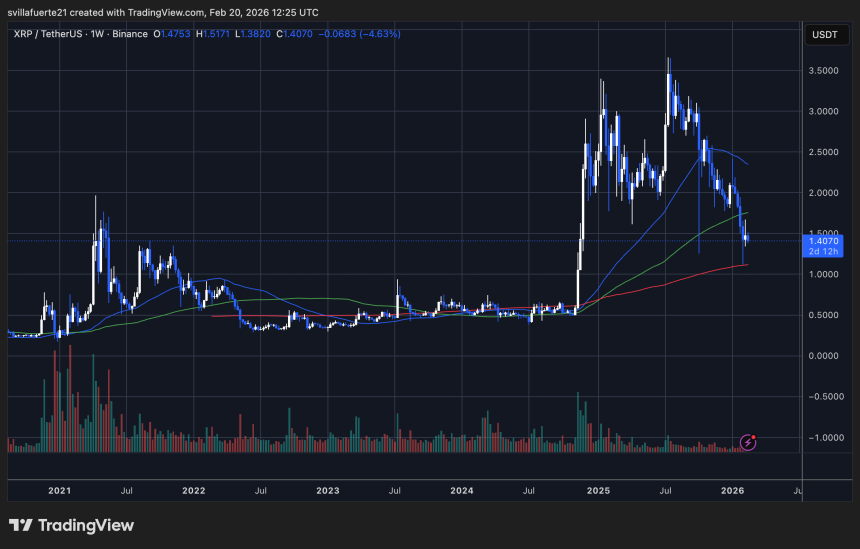
From a technical standpoint, XRP is currently trading below key moving averages that previously acted as dynamic support. These averages now function as overhead resistance, limiting upside attempts unless price can reclaim them decisively. The shorter-term average has rolled over more aggressively, while the longer-term trend line remains upward sloping but lagging, suggesting residual macro support alongside deteriorating short-term momentum.
Volume activity has moderated compared with the impulsive rally phase, indicating reduced speculative participation. However, declining volume during corrections can also signal seller exhaustion if accompanied by stabilization in price structure.
Immediate support appears concentrated near the recent lows around the $1.30–$1.40 zone, while resistance remains clustered near the $1.80–$2.20 range. Until XRP reclaims higher levels with strong participation, the broader trend remains fragile.
Featured image from ChatGPT, chart from TradingView.com


You May Also Like

Shield: CFO of Doginal Dogs

Ranjan Roy: AI is shifting towards consumption-based models, public fear stems from rapid advancements, and large language models are often overhyped




