The post New laws threatens $4b market appeared on BitcoinEthereumNews.com. Just how important is the Indian market to online gambling titan Flutter? The world’s largest online betting firm, Flutter Entertainment Plc (NASDAQ: FLUT), officially declared on Monday that it had been forced to withdraw its real-money gaming (RMG) subsidiary ‘Junglee Games’ from the Indian iGaming market. The move was triggered as a result of new laws passed last week that banned the highly popular gambling format. In a press statement released on Monday, Flutter confirmed that it had wrapped up its Indian operations on Friday, August 22, the same day the Promotion and Regulation of Online Gaming Bill was granted Presidential assent. Reacting to the news of the rule changes, Flutter’s CEO, Peter Jackson, was pushed to admit he was “extremely disappointed” with the decision before going on to warn, “We believe this change will drive customers to the unregulated market, offering limited consumer protections and providing no contribution to the local economy.” Incidentally, the news from India comes just days after Flutter’s shares rose following the announcement that its FanDuel subsidiary had penned a deal with CME Group (NASDAQ: CME) to enter the lucrative predictions market in the U.S. Contrastingly, the unexpected turn of events in India could dampen Flutter’s overall global growth predictions, particularly as Junglee was forecast to deliver $200 million in revenue and $50 million in adjusted EBITDA in 2025. However, the move to ban RMGs is a devastating blow to Junglee, which was once the nation’s most popular rummy platform, hosting over 100 million regular users. Legislative rollback rocks India’s thriving RMG sector Nevertheless, Flutter’s Junglee is certainly not the only gaming studio to be affected, with countless firms reeling from the abrupt changes made by the nation’s lawmakers. Popular platforms, including those by Dream11, MPL, and Probo, were also required to shut down their… The post New laws threatens $4b market appeared on BitcoinEthereumNews.com. Just how important is the Indian market to online gambling titan Flutter? The world’s largest online betting firm, Flutter Entertainment Plc (NASDAQ: FLUT), officially declared on Monday that it had been forced to withdraw its real-money gaming (RMG) subsidiary ‘Junglee Games’ from the Indian iGaming market. The move was triggered as a result of new laws passed last week that banned the highly popular gambling format. In a press statement released on Monday, Flutter confirmed that it had wrapped up its Indian operations on Friday, August 22, the same day the Promotion and Regulation of Online Gaming Bill was granted Presidential assent. Reacting to the news of the rule changes, Flutter’s CEO, Peter Jackson, was pushed to admit he was “extremely disappointed” with the decision before going on to warn, “We believe this change will drive customers to the unregulated market, offering limited consumer protections and providing no contribution to the local economy.” Incidentally, the news from India comes just days after Flutter’s shares rose following the announcement that its FanDuel subsidiary had penned a deal with CME Group (NASDAQ: CME) to enter the lucrative predictions market in the U.S. Contrastingly, the unexpected turn of events in India could dampen Flutter’s overall global growth predictions, particularly as Junglee was forecast to deliver $200 million in revenue and $50 million in adjusted EBITDA in 2025. However, the move to ban RMGs is a devastating blow to Junglee, which was once the nation’s most popular rummy platform, hosting over 100 million regular users. Legislative rollback rocks India’s thriving RMG sector Nevertheless, Flutter’s Junglee is certainly not the only gaming studio to be affected, with countless firms reeling from the abrupt changes made by the nation’s lawmakers. Popular platforms, including those by Dream11, MPL, and Probo, were also required to shut down their…

New laws threatens $4b market

Just how important is the Indian market to online gambling titan Flutter?

The world’s largest online betting firm, Flutter Entertainment Plc (NASDAQ: FLUT), officially declared on Monday that it had been forced to withdraw its real-money gaming (RMG) subsidiary ‘Junglee Games’ from the Indian iGaming market.

The move was triggered as a result of new laws passed last week that banned the highly popular gambling format. In a press statement released on Monday, Flutter confirmed that it had wrapped up its Indian operations on Friday, August 22, the same day the Promotion and Regulation of Online Gaming Bill was granted Presidential assent.

Reacting to the news of the rule changes, Flutter’s CEO, Peter Jackson, was pushed to admit he was “extremely disappointed” with the decision before going on to warn, “We believe this change will drive customers to the unregulated market, offering limited consumer protections and providing no contribution to the local economy.”

Incidentally, the news from India comes just days after Flutter’s shares rose following the announcement that its FanDuel subsidiary had penned a deal with CME Group (NASDAQ: CME) to enter the lucrative predictions market in the U.S.

Contrastingly, the unexpected turn of events in India could dampen Flutter’s overall global growth predictions, particularly as Junglee was forecast to deliver $200 million in revenue and $50 million in adjusted EBITDA in 2025.

However, the move to ban RMGs is a devastating blow to Junglee, which was once the nation’s most popular rummy platform, hosting over 100 million regular users.

Legislative rollback rocks India’s thriving RMG sector

Nevertheless, Flutter’s Junglee is certainly not the only gaming studio to be affected, with countless firms reeling from the abrupt changes made by the nation’s lawmakers. Popular platforms, including those by Dream11, MPL, and Probo, were also required to shut down their real-money game titles last week.

Having pulled the plug on one of iGaming’s fastest-growing revenue sectors almost overnight, critics argue the move will undoubtedly put the brakes on India’s unprecedented online gaming boom, which was operating over 400 active game studios and RMG platforms. The Indian market was valued at over $4 billion in 2024.

Market analysts have claimed the regulatory introduction outlawing RMGs could also have a negative impact on future foreign and domestic investment into the gaming industry. It makes for a worrying illustration of how the legislative about-face could completely undermine the online gaming sector, which a recent report had established was on course for a $60 billion valuation by 2034.

While Flutter has reluctantly withdrawn from the Indian market, it’s India’s home-grown studios such as Dream11 and Probo that must now shift focus towards other gaming formats.

For these operators, they must seek out other game models – including social sweepstakes and ad-infused games – if they are to save the sector that, up until recently, was employing over 130,000 workers in India.

Detractors claim enforced player protections could backfire

Furthermore, concerns have been raised by industry insiders who state that the primary initiative of protecting consumers could essentially undermine its own objective.

The argument here is that, although the move will indeed protect citizens from the financial hazards associated with RMGs, by prohibiting the practice, they could indirectly be channeling gamblers to wager on riskier, unregulated platforms instead.

Consequently, in doing so, India may have unwittingly just become a case study showcasing that even prosperous gaming sectors are still susceptible to sudden governmental regulatory policy shifts. Not only could the speedy nature of the decision potentially unnerve prospective investors, but it will also dent India’s sizable gaming tax revenues.

That being said, should the eventual benefits of enhanced player protections supersede the financial implications, then other emerging markets may also follow suit. But, for now at least, Flutter’s high-profile exit will, in all likelihood, stem the flow of international investment into the Indian gaming ecosystem moving forward.

Source: https://www.fxstreet.com/news/flutters-india-shock-new-laws-threatens-4b-market-202508280534

Market Opportunity
RealLink Logo
RealLink Price(REAL)
$0.0789
$0.0789$0.0789
-2.04%
USD
RealLink (REAL) Live Price Chart
Disclaimer: The articles reposted on this site are sourced from public platforms and are provided for informational purposes only. They do not necessarily reflect the views of MEXC. All rights remain with the original authors. If you believe any content infringes on third-party rights, please contact service@support.mexc.com for removal. MEXC makes no guarantees regarding the accuracy, completeness, or timeliness of the content and is not responsible for any actions taken based on the information provided. The content does not constitute financial, legal, or other professional advice, nor should it be considered a recommendation or endorsement by MEXC.

You May Also Like

A Netflix ‘KPop Demon Hunters’ Short Film Has Been Rated For Release

A Netflix ‘KPop Demon Hunters’ Short Film Has Been Rated For Release

The post A Netflix ‘KPop Demon Hunters’ Short Film Has Been Rated For Release appeared on BitcoinEthereumNews.com. KPop Demon Hunters Netflix Everyone has wondered what may be the next step for KPop Demon Hunters as an IP, given its record-breaking success on Netflix. Now, the answer may be something exactly no one predicted. According to a new filing with the MPA, something called Debut: A KPop Demon Hunters Story has been rated PG by the ratings body. It’s listed alongside some other films, and this is obviously something that has not been publicly announced. A short film could be well, very short, a few minutes, and likely no more than ten. Even that might be pushing it. Using say, Pixar shorts as a reference, most are between 4 and 8 minutes. The original movie is an hour and 36 minutes. The “Debut” in the title indicates some sort of flashback, perhaps to when HUNTR/X first arrived on the scene before they blew up. Previously, director Maggie Kang has commented about how there were more backstory components that were supposed to be in the film that were cut, but hinted those could be explored in a sequel. But perhaps some may be put into a short here. I very much doubt those scenes were fully produced and simply cut, but perhaps they were finished up for this short film here. When would Debut: KPop Demon Hunters theoretically arrive? I’m not sure the other films on the list are much help. Dead of Winter is out in less than two weeks. Mother Mary does not have a release date. Ne Zha 2 came out earlier this year. I’ve only seen news stories saying The Perfect Gamble was supposed to come out in Q1 2025, but I’ve seen no evidence that it actually has. KPop Demon Hunters Netflix It could be sooner rather than later as Netflix looks to capitalize…
Share
BitcoinEthereumNews2025/09/18 02:23
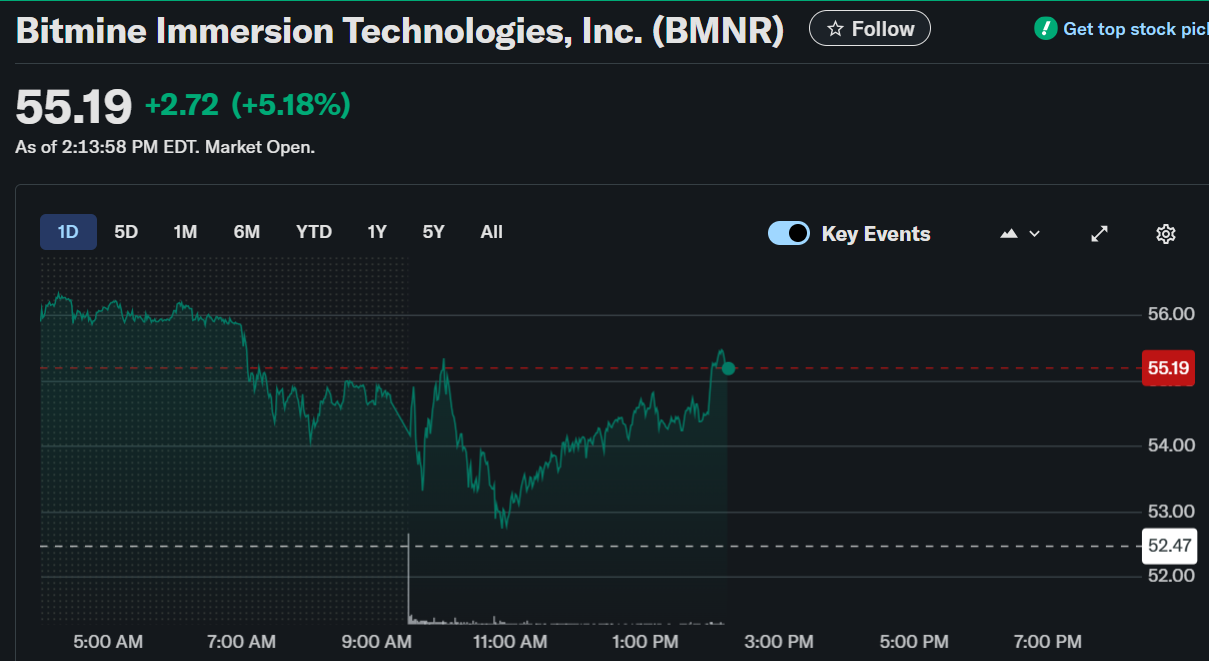
Bitmine Immersion Technologies (BMNR) stock :soars 5% as $13.4B Crypto Treasury Propels Ethereum Supercycle Vision

Bitmine Immersion Technologies (BMNR) stock :soars 5% as $13.4B Crypto Treasury Propels Ethereum Supercycle Vision

TLDR Bitmine surges 5.18% as $13.4B ETH treasury cements crypto dominance. Bitmine’s $12.6B Ethereum trove fuels bold 5% market ownership goal. Bitmine rebounds strong—ETH hoard drives record treasury valuation. Bitmine’s ETH empire grows to 3M coins, powering stock’s sharp rally. With record ETH and cash reserves, Bitmine solidifies crypto supremacy. Bitmine Immersion Technologies closed 5.18% [...] The post Bitmine Immersion Technologies (BMNR) stock :soars 5% as $13.4B Crypto Treasury Propels Ethereum Supercycle Vision appeared first on CoinCentral.
Share
Coincentral2025/10/14 02:40
Headwind Helps Best Wallet Token

Headwind Helps Best Wallet Token

The post Headwind Helps Best Wallet Token appeared on BitcoinEthereumNews.com. Google has announced the launch of a new open-source protocol called Agent Payments Protocol (AP2) in partnership with Coinbase, the Ethereum Foundation, and 60 other organizations. This allows AI agents to make payments on behalf of users using various methods such as real-time bank transfers, credit and debit cards, and, most importantly, stablecoins. Let’s explore in detail what this could mean for the broader cryptocurrency markets, and also highlight a presale crypto (Best Wallet Token) that could explode as a result of this development. Google’s Push for Stablecoins Agent Payments Protocol (AP2) uses digital contracts known as ‘Intent Mandates’ and ‘Verifiable Credentials’ to ensure that AI agents undertake only those payments authorized by the user. Mandates, by the way, are cryptographically signed, tamper-proof digital contracts that act as verifiable proof of a user’s instruction. For example, let’s say you instruct an AI agent to never spend more than $200 in a single transaction. This instruction is written into an Intent Mandate, which serves as a digital contract. Now, whenever the AI agent tries to make a payment, it must present this mandate as proof of authorization, which will then be verified via the AP2 protocol. Alongside this, Google has also launched the A2A x402 extension to accelerate support for the Web3 ecosystem. This production-ready solution enables agent-based crypto payments and will help reshape the growth of cryptocurrency integration within the AP2 protocol. Google’s inclusion of stablecoins in AP2 is a massive vote of confidence in dollar-pegged cryptocurrencies and a huge step toward making them a mainstream payment option. This widens stablecoin usage beyond trading and speculation, positioning them at the center of the consumption economy. The recent enactment of the GENIUS Act in the U.S. gives stablecoins more structure and legal support. Imagine paying for things like data crawls, per-task…
Share
BitcoinEthereumNews2025/09/18 01:27