The New Monetary Order: Why Capital Is Rotating Into Gold, XRP, and XLM
Veteran investor Versan, founder of Black Swan Capitalist, published a detailed thesis on X outlining what he calls the next phase of capital migration. His argument is related to the structural change in how money moves and where value seeks protection during periods of monetary debasement.
Based on Versan’s insights, we are witnessing a layered evolution of the global financial system. As fiat currencies lose purchasing power through persistent balance sheet expansion and sovereign debt growth, capital does not vanish. It reallocates. And that reallocation is now becoming visible across both traditional and digital markets.
Phase One: Rotation Into Hard Collateral
Versan’s framework begins with monetary debasement. Governments continue operating in structural deficits. Central banks expand liquidity to absorb sovereign debt. The process is gradual, not explosive, but the cumulative effect is currency erosion.
When fiat weakens, capital seeks preservation. Historically, that preservation has centered on scarce, non-sovereign assets. Gold remains the primary anchor.
Gold carries no counterparty risk. It cannot be printed. It does not depend on digital rails or political approval. Central banks have been accumulating gold at record levels, reinforcing its role as balance sheet stabilizer. Under Basel III reforms, gold’s treatment as Tier 1 capital further solidified its status as monetary collateral.
In Versan’s view, this is the first phase of capital migration: protection through scarcity.
But gold alone does not solve the demands of a digitized global economy.
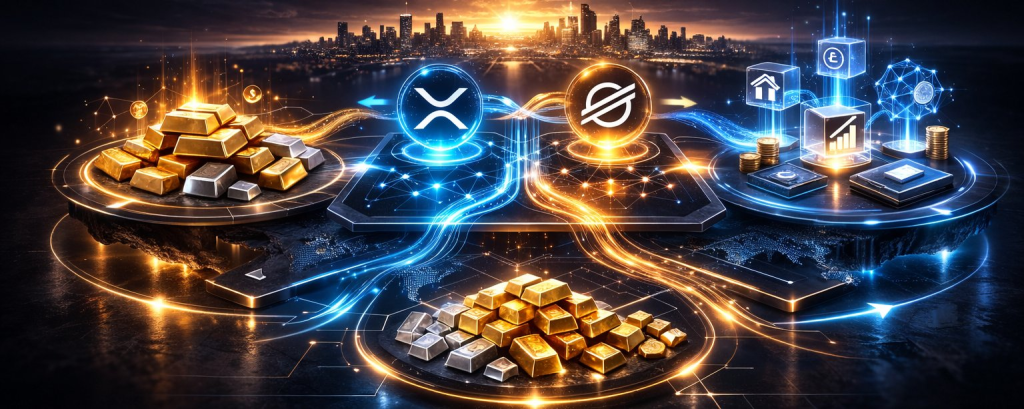 Source: X/@VersanAljarrah
Phase Two: Rotation Into Digital Liquidity Rails
Once capital anchors in hard collateral, a second requirement emerges. Value must move efficiently across borders, institutions, and tokenized financial systems.
Versan identifies XRP and XLM as assets architected for this function.
XRP was designed as a bridge asset that removes the need for pre-funded correspondent banking accounts. Institutions can convert local currency into XRP, settle across the ledger within seconds, and convert into another currency on the receiving side. This increases liquidity efficiency and reduces trapped capital.
XLM follows a similar settlement philosophy, with strong positioning in remittance corridors and emerging markets. Its infrastructure facilitates low-cost transfers and streamlined on-ramps between fiat and digital value.
Versan emphasizes that these networks were not built as speculative ecosystems. They were designed to move value. In a system where tokenized assets, stablecoins, and central bank digital currencies expand, fast and neutral liquidity rails become foundational.
His thesis does not frame this as a competition between gold and digital assets. Instead, it presents a layered model:
Layer 1 anchors value through hard collateral such as gold.
Layer 2 mobilizes that value through digital bridge assets such as XRP and XLM.
Layer 3 supports tokenized assets and programmable finance operating above both.
In this structure, gold preserves. XRP and XLM transmit.
Versan argues that debt expansion is unlikely to reverse, meaning monetary debasement will continue. As that process unfolds, capital will first secure itself in scarcity, then integrate into digital settlement infrastructure capable of supporting the next financial architecture.
The transition is gradual. Fiat does not disappear overnight. But the direction of migration is becoming clearer.
For allocators watching structural trends rather than daily volatility, the shift into both hard collateral and digital liquidity networks represents not speculation, but positioning within an evolving monetary system.
Read also: Shanghai Silver Squeeze Alert: Physical Prices Hit $95 as Vaults Drain
Subscribe to our YouTube channel for daily crypto updates, market insights, and expert analysis.
The post The New Monetary Order: Why Capital Is Rotating Into Gold, XRP, and XLM appeared first on CaptainAltcoin.


You May Also Like

Whales Are Pulling XRP Off Exchanges. Here’s What Could Happen Next

From Coffee Kiosk To Billion-Dollar Business: How Scooter’s Became One Of America’s Top Franchises