Fresh from two decades at BlackRock, Joseph Chalom has stepped out of retirement to lead SharpLink Gaming Inc., a Nasdaq-listed company that has drawn comparisons to MicroStrategy for its aggressive Ethereum treasury strategy. In an exclusive interview with CryptoNews, Chalom outlines why he left traditional finance, what SharpLink is trying to achieve with ETH, and why he sees Ethereum as the foundation for the future of tokenization and decentralized finance. From BlackRock to SharpLink Chalom spent 20 years at BlackRock, where his career spanned both traditional finance and digital assets. He points to two accomplishments that defined his tenure: scaling Aladdin, BlackRock’s enterprise risk management system used by many of the world’s largest asset managers, and later leading the firm’s digital asset team. That latter role focused on bridging traditional investors with crypto markets, preparing institutions for the shift he believes is inevitable. After retiring from BlackRock in June 2025, Chalom was pulled back into the industry following a conversation with co-founder of Ethereum and CEO of Consensys, Joseph Lubin, who now serves as chairman of SharpLink’s board. “We both have a vision of a world where more efficient systems allow the exchange of value in a fundamentally different way than exists today,” Chalom said, pointing to Ethereum’s ability to settle transactions trustlessly and instantly. On Being Called the ‘MicroStrategy of Ethereum’ The comparison to Michael Saylor’s MicroStrategy, which famously accumulated billions of dollars in Bitcoin, has followed SharpLink since it began deploying its capital into ETH. Chalom acknowledges the parallel while stressing the differences between Bitcoin and Ethereum. “Michael Saylor has demonstrated that over a multi-year period, you can have a public company that buys a crypto asset and that company can trade at a premium in value,” he said. “We are trying to do a very similar thing with Ethereum, which is be a public treasury, raise capital from investors, buy Ethereum, and allow investors to participate in three things: capital appreciation, staking yield, and supporting the ecosystem,” Chalom said. Unlike Bitcoin, he added, Ethereum is a productive asset. Staking ETH can generate yield that is considered revenue, giving SharpLink an additional income stream. “We tip our hat to Michael Saylor in demonstrating that a crypto strategy in a treasury can work,” Chalom said. “We just think Ethereum is a more ideal treasury asset.” Ethereum, Tokenization, and the Long-Term Opportunity Chalom frames SharpLink’s mission around what he calls the “long-term Ethereum opportunity,” which he breaks down into three categories: stablecoins, tokenized real-world assets, and broader financial and non-financial applications. Stablecoins, the majority of which are issued on Ethereum or its Layer 2 networks, have grown into a $275 billion market. U.S. Treasury Secretary Janet Yellen has suggested that it could rise to several trillion in the coming years. Tokenization of traditional assets is the second leg of the thesis. From tokenized treasuries to equities and funds, Chalom sees programmable, instantly settling assets as a structural shift away from legacy systems that take days to settle. “When assets or securities or funds are held in tokenized format, they are programmable, tradable, sometimes 24/7, and most importantly, they settle instantly,” he said. Finally, as more real-world activity is represented in tokenized form on Ethereum, demand for ETH as the network’s native asset should rise. Chalom points to a framework: Historically, every $2 of high-quality assets secured on Ethereum translates into roughly a $1 increase in ETH’s market cap. “We’re accumulating as much ether as possible right now at the current prices, because we see significant appreciation in its value,” he said. Competition and Differentiation SharpLink is not alone in pursuing an Ethereum-focused treasury strategy. Rival BitMine has announced plans for a massive $24.5 billion raise to build its own ETH war chest, a sign of how corporate ether accumulation is accelerating. With ETH hovering near record highs, institutions are targeting a larger share of the supply. Chalom welcomes the competition. “If others have the same investment thesis, it means some of the best minds are validating this thesis, and we actually welcome that.” Still, he argues that SharpLink is uniquely positioned. The firm has built a team of institutional-grade investors and strategists and maintains a strategic partnership with ConsenSys, the Ethereum development company founded by Lubin. “That partnership gives us opportunities to participate in DeFi, capture the most expert staking yields, and potentially build Ethereum-denominated operating companies,” he said. “That is a true differentiator.” Regulation and Institutional Access Chalom is optimistic about the regulatory environment in the U.S., pointing to two developments: the GENIUS Act, which clarifies ownership and participation in crypto, and the pending CLARITY Act, which lays out market structure. Historically, institutions faced challenges around custody and mandates. But with ETFs now available and a public company wrapper via SharpLink’s Nasdaq listing, access is expanding. “Owning ETH through SharpLink is just like owning an equity,” Chalom said. “That is the first unlock. The second unlock is regulatory clarity. The headwinds have been released, and we’re at the point where there is a well-defined institutional path to owning Ethereum.” Looking Back: The First ETF Launch Chalom also reflects on his time at BlackRock during the approval of the first Bitcoin and Ethereum exchange-traded products in 2024, which he describes as “a seminal moment in the adoption of crypto by traditional institutions.” Those launches brought over $100 billion of traditional capital into Bitcoin and Ethereum, he notes, and set the stage for companies like SharpLink to strengthen the bridge between traditional markets and digital assets. “I still think it’s early in the investment opportunity in Ethereum,” Chalom adds, comparing the current moment to the early days of the internet. “The most transformation is ahead of us.” As SharpLink leans into its Ethereum-centric strategy, the comparisons to MicroStrategy may persist. But Chalom insists the company’s approach is more than a trade—it’s about building a long-term platform around a productive, revenue-generating, and programmable network asset. Whether SharpLink ultimately becomes known as the “MicroStrategy of Ethereum” or something else, the company’s moves will remain closely watched by both Wall Street and the crypto community. Price Action SharpLink Gaming Inc. (NASDAQ: SBET) has delivered a considerable rally in 2025, with shares up 128% year-to-date at $18.46 despite a volatile trading range. The stock surged to a 52-week high of $124.12 earlier this year on the back of its aggressive Ethereum treasury strategy, before retracing as markets absorbed the scale of its purchases. Still, with a market cap of $3.22 billion, SharpLink remains one of the most closely watched public companies, tying its fortunes directly to ETHFresh from two decades at BlackRock, Joseph Chalom has stepped out of retirement to lead SharpLink Gaming Inc., a Nasdaq-listed company that has drawn comparisons to MicroStrategy for its aggressive Ethereum treasury strategy. In an exclusive interview with CryptoNews, Chalom outlines why he left traditional finance, what SharpLink is trying to achieve with ETH, and why he sees Ethereum as the foundation for the future of tokenization and decentralized finance. From BlackRock to SharpLink Chalom spent 20 years at BlackRock, where his career spanned both traditional finance and digital assets. He points to two accomplishments that defined his tenure: scaling Aladdin, BlackRock’s enterprise risk management system used by many of the world’s largest asset managers, and later leading the firm’s digital asset team. That latter role focused on bridging traditional investors with crypto markets, preparing institutions for the shift he believes is inevitable. After retiring from BlackRock in June 2025, Chalom was pulled back into the industry following a conversation with co-founder of Ethereum and CEO of Consensys, Joseph Lubin, who now serves as chairman of SharpLink’s board. “We both have a vision of a world where more efficient systems allow the exchange of value in a fundamentally different way than exists today,” Chalom said, pointing to Ethereum’s ability to settle transactions trustlessly and instantly. On Being Called the ‘MicroStrategy of Ethereum’ The comparison to Michael Saylor’s MicroStrategy, which famously accumulated billions of dollars in Bitcoin, has followed SharpLink since it began deploying its capital into ETH. Chalom acknowledges the parallel while stressing the differences between Bitcoin and Ethereum. “Michael Saylor has demonstrated that over a multi-year period, you can have a public company that buys a crypto asset and that company can trade at a premium in value,” he said. “We are trying to do a very similar thing with Ethereum, which is be a public treasury, raise capital from investors, buy Ethereum, and allow investors to participate in three things: capital appreciation, staking yield, and supporting the ecosystem,” Chalom said. Unlike Bitcoin, he added, Ethereum is a productive asset. Staking ETH can generate yield that is considered revenue, giving SharpLink an additional income stream. “We tip our hat to Michael Saylor in demonstrating that a crypto strategy in a treasury can work,” Chalom said. “We just think Ethereum is a more ideal treasury asset.” Ethereum, Tokenization, and the Long-Term Opportunity Chalom frames SharpLink’s mission around what he calls the “long-term Ethereum opportunity,” which he breaks down into three categories: stablecoins, tokenized real-world assets, and broader financial and non-financial applications. Stablecoins, the majority of which are issued on Ethereum or its Layer 2 networks, have grown into a $275 billion market. U.S. Treasury Secretary Janet Yellen has suggested that it could rise to several trillion in the coming years. Tokenization of traditional assets is the second leg of the thesis. From tokenized treasuries to equities and funds, Chalom sees programmable, instantly settling assets as a structural shift away from legacy systems that take days to settle. “When assets or securities or funds are held in tokenized format, they are programmable, tradable, sometimes 24/7, and most importantly, they settle instantly,” he said. Finally, as more real-world activity is represented in tokenized form on Ethereum, demand for ETH as the network’s native asset should rise. Chalom points to a framework: Historically, every $2 of high-quality assets secured on Ethereum translates into roughly a $1 increase in ETH’s market cap. “We’re accumulating as much ether as possible right now at the current prices, because we see significant appreciation in its value,” he said. Competition and Differentiation SharpLink is not alone in pursuing an Ethereum-focused treasury strategy. Rival BitMine has announced plans for a massive $24.5 billion raise to build its own ETH war chest, a sign of how corporate ether accumulation is accelerating. With ETH hovering near record highs, institutions are targeting a larger share of the supply. Chalom welcomes the competition. “If others have the same investment thesis, it means some of the best minds are validating this thesis, and we actually welcome that.” Still, he argues that SharpLink is uniquely positioned. The firm has built a team of institutional-grade investors and strategists and maintains a strategic partnership with ConsenSys, the Ethereum development company founded by Lubin. “That partnership gives us opportunities to participate in DeFi, capture the most expert staking yields, and potentially build Ethereum-denominated operating companies,” he said. “That is a true differentiator.” Regulation and Institutional Access Chalom is optimistic about the regulatory environment in the U.S., pointing to two developments: the GENIUS Act, which clarifies ownership and participation in crypto, and the pending CLARITY Act, which lays out market structure. Historically, institutions faced challenges around custody and mandates. But with ETFs now available and a public company wrapper via SharpLink’s Nasdaq listing, access is expanding. “Owning ETH through SharpLink is just like owning an equity,” Chalom said. “That is the first unlock. The second unlock is regulatory clarity. The headwinds have been released, and we’re at the point where there is a well-defined institutional path to owning Ethereum.” Looking Back: The First ETF Launch Chalom also reflects on his time at BlackRock during the approval of the first Bitcoin and Ethereum exchange-traded products in 2024, which he describes as “a seminal moment in the adoption of crypto by traditional institutions.” Those launches brought over $100 billion of traditional capital into Bitcoin and Ethereum, he notes, and set the stage for companies like SharpLink to strengthen the bridge between traditional markets and digital assets. “I still think it’s early in the investment opportunity in Ethereum,” Chalom adds, comparing the current moment to the early days of the internet. “The most transformation is ahead of us.” As SharpLink leans into its Ethereum-centric strategy, the comparisons to MicroStrategy may persist. But Chalom insists the company’s approach is more than a trade—it’s about building a long-term platform around a productive, revenue-generating, and programmable network asset. Whether SharpLink ultimately becomes known as the “MicroStrategy of Ethereum” or something else, the company’s moves will remain closely watched by both Wall Street and the crypto community. Price Action SharpLink Gaming Inc. (NASDAQ: SBET) has delivered a considerable rally in 2025, with shares up 128% year-to-date at $18.46 despite a volatile trading range. The stock surged to a 52-week high of $124.12 earlier this year on the back of its aggressive Ethereum treasury strategy, before retracing as markets absorbed the scale of its purchases. Still, with a market cap of $3.22 billion, SharpLink remains one of the most closely watched public companies, tying its fortunes directly to ETH

SharpLink Co-CEO Joseph Chalom on Being Dubbed the ‘MicroStrategy of Ethereum’

2025/08/30 00:16
6 min read

Fresh from two decades at BlackRock, Joseph Chalom has stepped out of retirement to lead SharpLink Gaming Inc., a Nasdaq-listed company that has drawn comparisons to MicroStrategy for its aggressive Ethereum treasury strategy.

In an exclusive interview with CryptoNews, Chalom outlines why he left traditional finance, what SharpLink is trying to achieve with ETH, and why he sees Ethereum as the foundation for the future of tokenization and decentralized finance.

Chalom spent 20 years at BlackRock, where his career spanned both traditional finance and digital assets. He points to two accomplishments that defined his tenure: scaling Aladdin, BlackRock’s enterprise risk management system used by many of the world’s largest asset managers, and later leading the firm’s digital asset team.

That latter role focused on bridging traditional investors with crypto markets, preparing institutions for the shift he believes is inevitable.

After retiring from BlackRock in June 2025, Chalom was pulled back into the industry following a conversation with co-founder of Ethereum and CEO of Consensys, Joseph Lubin, who now serves as chairman of SharpLink’s board.

“We both have a vision of a world where more efficient systems allow the exchange of value in a fundamentally different way than exists today,” Chalom said, pointing to Ethereum’s ability to settle transactions trustlessly and instantly.

On Being Called the ‘MicroStrategy of Ethereum’

The comparison to Michael Saylor’s MicroStrategy, which famously accumulated billions of dollars in Bitcoin, has followed SharpLink since it began deploying its capital into ETH. Chalom acknowledges the parallel while stressing the differences between Bitcoin and Ethereum.

“Michael Saylor has demonstrated that over a multi-year period, you can have a public company that buys a crypto asset and that company can trade at a premium in value,” he said.

“We are trying to do a very similar thing with Ethereum, which is be a public treasury, raise capital from investors, buy Ethereum, and allow investors to participate in three things: capital appreciation, staking yield, and supporting the ecosystem,” Chalom said.

Unlike Bitcoin, he added, Ethereum is a productive asset. Staking ETH can generate yield that is considered revenue, giving SharpLink an additional income stream.

“We tip our hat to Michael Saylor in demonstrating that a crypto strategy in a treasury can work,” Chalom said. “We just think Ethereum is a more ideal treasury asset.”

Ethereum, Tokenization, and the Long-Term Opportunity

Chalom frames SharpLink’s mission around what he calls the “long-term Ethereum opportunity,” which he breaks down into three categories: stablecoins, tokenized real-world assets, and broader financial and non-financial applications.

Stablecoins, the majority of which are issued on Ethereum or its Layer 2 networks, have grown into a $275 billion market. U.S. Treasury Secretary Janet Yellen has suggested that it could rise to several trillion in the coming years.

Tokenization of traditional assets is the second leg of the thesis. From tokenized treasuries to equities and funds, Chalom sees programmable, instantly settling assets as a structural shift away from legacy systems that take days to settle.

“When assets or securities or funds are held in tokenized format, they are programmable, tradable, sometimes 24/7, and most importantly, they settle instantly,” he said.

Finally, as more real-world activity is represented in tokenized form on Ethereum, demand for ETH as the network’s native asset should rise. Chalom points to a framework: Historically, every $2 of high-quality assets secured on Ethereum translates into roughly a $1 increase in ETH’s market cap.

“We’re accumulating as much ether as possible right now at the current prices, because we see significant appreciation in its value,” he said.

Competition and Differentiation

SharpLink is not alone in pursuing an Ethereum-focused treasury strategy. Rival BitMine has announced plans for a massive $24.5 billion raise to build its own ETH war chest, a sign of how corporate ether accumulation is accelerating. With ETH hovering near record highs, institutions are targeting a larger share of the supply.

Chalom welcomes the competition. “If others have the same investment thesis, it means some of the best minds are validating this thesis, and we actually welcome that.”

Still, he argues that SharpLink is uniquely positioned. The firm has built a team of institutional-grade investors and strategists and maintains a strategic partnership with ConsenSys, the Ethereum development company founded by Lubin.

“That partnership gives us opportunities to participate in DeFi, capture the most expert staking yields, and potentially build Ethereum-denominated operating companies,” he said. “That is a true differentiator.”

Regulation and Institutional Access

Chalom is optimistic about the regulatory environment in the U.S., pointing to two developments: the GENIUS Act, which clarifies ownership and participation in crypto, and the pending CLARITY Act, which lays out market structure.

Historically, institutions faced challenges around custody and mandates. But with ETFs now available and a public company wrapper via SharpLink’s Nasdaq listing, access is expanding.

“Owning ETH through SharpLink is just like owning an equity,” Chalom said. “That is the first unlock. The second unlock is regulatory clarity. The headwinds have been released, and we’re at the point where there is a well-defined institutional path to owning Ethereum.”

Looking Back: The First ETF Launch

Chalom also reflects on his time at BlackRock during the approval of the first Bitcoin and Ethereum exchange-traded products in 2024, which he describes as “a seminal moment in the adoption of crypto by traditional institutions.”

Those launches brought over $100 billion of traditional capital into Bitcoin and Ethereum, he notes, and set the stage for companies like SharpLink to strengthen the bridge between traditional markets and digital assets.

“I still think it’s early in the investment opportunity in Ethereum,” Chalom adds, comparing the current moment to the early days of the internet. “The most transformation is ahead of us.”

As SharpLink leans into its Ethereum-centric strategy, the comparisons to MicroStrategy may persist. But Chalom insists the company’s approach is more than a trade—it’s about building a long-term platform around a productive, revenue-generating, and programmable network asset.

Whether SharpLink ultimately becomes known as the “MicroStrategy of Ethereum” or something else, the company’s moves will remain closely watched by both Wall Street and the crypto community.

Price Action

SharpLink Gaming Inc. (NASDAQ: SBET) has delivered a considerable rally in 2025, with shares up 128% year-to-date at $18.46 despite a volatile trading range.
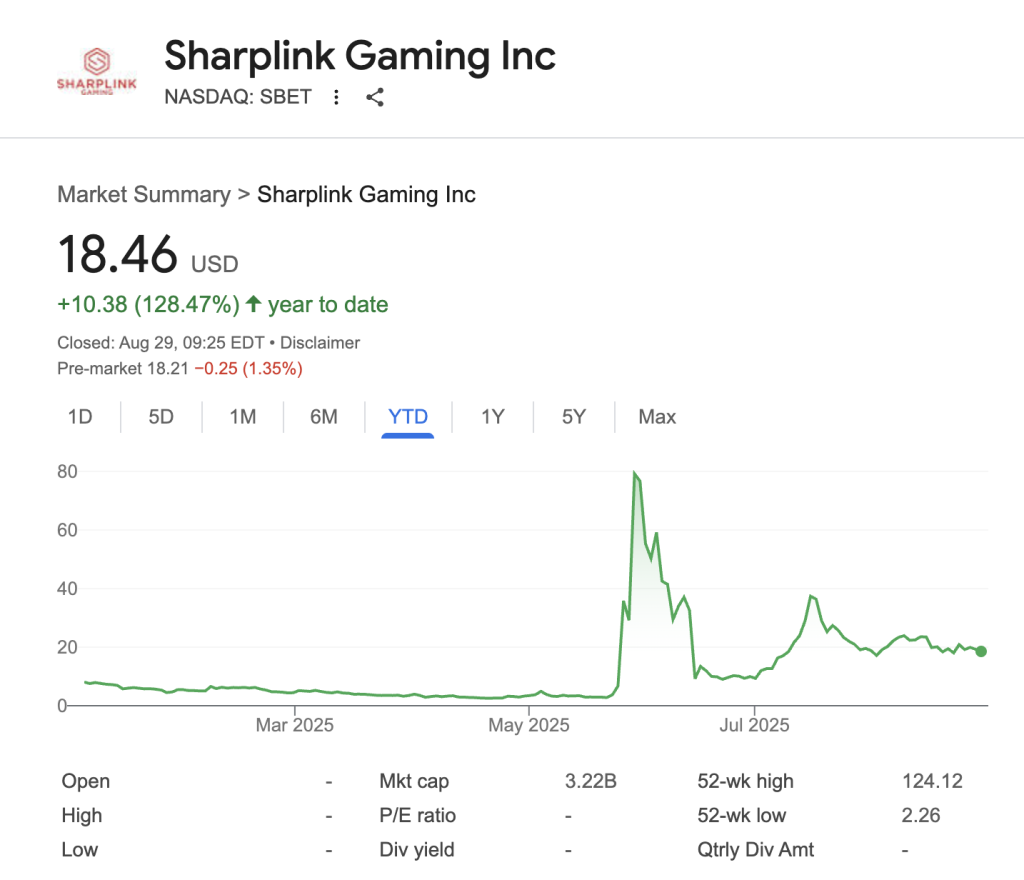
The stock surged to a 52-week high of $124.12 earlier this year on the back of its aggressive Ethereum treasury strategy, before retracing as markets absorbed the scale of its purchases. Still, with a market cap of $3.22 billion, SharpLink remains one of the most closely watched public companies, tying its fortunes directly to ETH.


Disclaimer: The articles reposted on this site are sourced from public platforms and are provided for informational purposes only. They do not necessarily reflect the views of MEXC. All rights remain with the original authors. If you believe any content infringes on third-party rights, please contact crypto.news@mexc.com for removal. MEXC makes no guarantees regarding the accuracy, completeness, or timeliness of the content and is not responsible for any actions taken based on the information provided. The content does not constitute financial, legal, or other professional advice, nor should it be considered a recommendation or endorsement by MEXC.

You May Also Like

Buterin pushes Layer 2 interoperability as cornerstone of Ethereum’s future

Buterin pushes Layer 2 interoperability as cornerstone of Ethereum’s future

Ethereum founder, Vitalik Buterin, has unveiled new goals for the Ethereum blockchain today at the Japan Developer Conference. The plan lays out short-term, mid-term, and long-term goals touching on L2 interoperability and faster responsiveness among others. In terms of technology, he said again that he is sure that Layer 2 options are the best way […]
Share
Cryptopolitan2025/09/18 01:15
Ray Data and Docling Tackle Enterprise AI’s Biggest Pain Point

Ray Data and Docling Tackle Enterprise AI’s Biggest Pain Point

The post Ray Data and Docling Tackle Enterprise AI’s Biggest Pain Point appeared on BitcoinEthereumNews.com. Zach Anderson Feb 27, 2026 16:58 New integration
Share
BitcoinEthereumNews2026/02/28 12:33
3 Paradoxes of Altcoin Season in September

3 Paradoxes of Altcoin Season in September

The post 3 Paradoxes of Altcoin Season in September appeared on BitcoinEthereumNews.com. Analyses and data indicate that the crypto market is experiencing its most active altcoin season since early 2025, with many altcoins outperforming Bitcoin. However, behind this excitement lies a paradox. Most retail investors remain uneasy as their portfolios show little to no profit. This article outlines the main reasons behind this situation. Altcoin Market Cap Rises but Dominance Shrinks Sponsored TradingView data shows that the TOTAL3 market cap (excluding BTC and ETH) reached a new high of over $1.1 trillion in September. Yet the share of OTHERS (excluding the top 10) has declined since 2022, now standing at just 8%. OTHERS Dominance And TOTAL3 Capitalization. Source: TradingView. In past cycles, such as 2017 and 2021, TOTAL3 and OTHERS.D rose together. That trend reflected capital flowing not only into large-cap altcoins but also into mid-cap and low-cap ones. The current divergence shows that capital is concentrated in stablecoins and a handful of top-10 altcoins such as SOL, XRP, BNB, DOG, HYPE, and LINK. Smaller altcoins receive far less liquidity, making it hard for their prices to return to levels where investors previously bought. This creates a situation where only a few win while most face losses. Retail investors also tend to diversify across many coins instead of adding size to top altcoins. That explains why many portfolios remain stagnant despite a broader market rally. Sponsored “Position sizing is everything. Many people hold 25–30 tokens at once. A 100x on a token that makes up only 1% of your portfolio won’t meaningfully change your life. It’s better to make a few high-conviction bets than to overdiversify,” analyst The DeFi Investor said. Altcoin Index Surges but Investor Sentiment Remains Cautious The Altcoin Season Index from Blockchain Center now stands at 80 points. This indicates that over 80% of the top 50 altcoins outperformed…
Share
BitcoinEthereumNews2025/09/18 01:43