BitcoinWorld AI Drive-Through Systems: Taco Bell’s Critical Rethink on Automation The world of cryptocurrency thrives on innovation, efficiency, and often, the audacious deployment of cutting-edge technology. Just as blockchain promises to revolutionize finance, artificial intelligence (AI) aims to transform industries from healthcare to hospitality. But what happens when these ambitious technological leaps encounter the messy reality of human interaction? Taco Bell, a fast-food giant known for its bold flavors, is now facing this very question as it re-evaluates its extensive AI Drive-Through Systems experiment, prompting a crucial conversation about the limits and future of automation. The AI Drive-Through Systems Experiment: What Went Wrong? In a bold move to enhance efficiency and speed up service, Taco Bell rolled out voice AI-powered ordering across more than 500 of its drive-through locations. The premise was simple: leverage AI to handle routine orders, reduce wait times, and free up human staff for more complex tasks. However, as is often the case with pioneering technology, the journey has been anything but smooth. The implementation of these AI Drive-Through Systems has led to a series of viral incidents that have put a spotlight on the inherent challenges of automated customer service. One of the most widely circulated anecdotes involves a customer reportedly ordering 18,000 water cups – a clever, albeit disruptive, tactic to bypass the AI and connect with a human server. Such incidents, while humorous on the surface, highlight a deeper issue: the frustration that arises when AI fails to understand nuanced requests or handle unexpected situations. For customers seeking a quick and seamless experience, these glitches can quickly turn into significant deterrents, impacting brand perception and operational efficiency. Taco Bell’s AI Strategy: A Recipe for Viral Mishaps? Dane Matthews, Taco Bell’s Chief Digital and Technology Officer, openly admits the company is engaged in an “active conversation” about the appropriate deployment of AI. This admission underscores a broader industry struggle to integrate advanced technology without alienating the human element. Matthews himself has had mixed experiences, stating, “Sometimes it lets me down, but sometimes it really surprises me.” This candid assessment reflects the dual nature of AI: its incredible potential alongside its current limitations. Taco Bell’s AI Strategy initially aimed for broad deployment, but the real-world feedback has prompted a more cautious approach. The viral moments, though entertaining for onlookers, have been a wake-up call, demonstrating that while AI can handle predictable transactions with speed, it often falters when faced with the unpredictable, the quirky, or the deliberately subversive. The goal is not just to automate, but to automate smartly, ensuring that the technology enhances rather than detracts from the customer journey. The Promise and Pitfalls of Voice AI in Fast Food Voice AI in Fast Food offers compelling benefits. It can process orders rapidly, reduce human error in order taking, and potentially lower labor costs. For franchisees, these advantages can translate into improved margins and operational scalability. However, the technology is still evolving, and its current iteration presents several pitfalls: Accuracy Issues: Background noise, accents, or complex orders can lead to misinterpretations, resulting in incorrect food items or frustrating delays. Lack of Empathy: AI cannot offer the same level of personalized service or empathy that a human can, which is crucial for resolving complaints or handling special requests. Scalability Challenges: While AI can handle high volumes, its effectiveness diminishes when facing truly exceptional circumstances or deliberate attempts to circumvent its programming. Customer Preference: A segment of customers simply prefers human interaction, especially when ordering food, where clarity and confirmation are paramount. These challenges mean that simply plugging in Voice AI in Fast Food is not a magic bullet. It requires careful integration, continuous monitoring, and a robust fallback plan involving human intervention. Restaurant Automation Challenges: Finding the Human-Tech Balance Taco Bell’s experience is a microcosm of broader Restaurant Automation Challenges across the industry. The ideal scenario is a synergistic relationship where AI handles routine tasks, allowing human employees to focus on higher-value activities like problem-solving, upselling, and ensuring overall customer satisfaction. Matthews emphasized this nuanced approach, suggesting that rather than relying exclusively on AI, a hybrid model might be more effective. For instance, at peak hours or in busy locations with long lines, it might make more sense to have a human take drive-through orders. This flexibility allows franchisees to adapt their operations based on real-time conditions and customer flow. Matthews stated, “For our teams, we’ll help coach them: at your restaurant, at these times, we recommend you use voice AI or recommend that you actually really monitor voice AI and jump in as necessary.” This highlights a shift from full automation to intelligent automation, where AI serves as a tool to assist, rather than completely replace, human staff. Overcoming Restaurant Automation Challenges requires this thoughtful integration. Enhancing Customer Experience with AI: Lessons from the Bell The ultimate goal of any technological deployment in customer service is to enhance the Customer Experience with AI. Taco Bell’s journey provides valuable lessons for other businesses considering similar AI integrations. It’s not just about deploying technology; it’s about understanding its impact on the end-user and being agile enough to adjust strategies based on feedback. Key takeaways for businesses looking to improve Customer Experience with AI include: Hybrid Models: Implement AI in conjunction with human oversight, allowing for seamless transitions when AI struggles. Contextual Awareness: Design AI systems that can better understand and respond to varied customer needs, including accents, complex orders, and emotional cues. User Feedback Loops: Establish robust mechanisms for collecting and acting on customer and employee feedback to refine AI performance. Training and Support: Provide comprehensive training for human staff on how to monitor AI, intervene effectively, and troubleshoot common issues. Franchisee Flexibility: Empower individual locations or managers to make informed decisions about AI deployment based on their specific operational context. By learning from these experiences, businesses can harness the power of AI to create genuinely positive interactions, rather than frustrating ones. Conclusion: The Future of Fast Food Automation Taco Bell’s active re-evaluation of its AI drive-through systems is a critical moment for the fast-food industry and a compelling case study for anyone exploring the integration of AI in customer-facing roles. It underscores that while AI offers immense potential for efficiency and innovation, it must be deployed with a deep understanding of human behavior and customer expectations. The path forward likely involves a balanced approach, where AI and human intelligence work in tandem, each leveraging their strengths to create a truly seamless and satisfying customer experience. As technology continues to evolve, the challenge will be to continuously refine these integrations, ensuring that innovation truly serves the people it aims to assist. To learn more about the latest AI market trends, explore our article on key developments shaping AI features. This post AI Drive-Through Systems: Taco Bell’s Critical Rethink on Automation first appeared on BitcoinWorld and is written by Editorial TeamBitcoinWorld AI Drive-Through Systems: Taco Bell’s Critical Rethink on Automation The world of cryptocurrency thrives on innovation, efficiency, and often, the audacious deployment of cutting-edge technology. Just as blockchain promises to revolutionize finance, artificial intelligence (AI) aims to transform industries from healthcare to hospitality. But what happens when these ambitious technological leaps encounter the messy reality of human interaction? Taco Bell, a fast-food giant known for its bold flavors, is now facing this very question as it re-evaluates its extensive AI Drive-Through Systems experiment, prompting a crucial conversation about the limits and future of automation. The AI Drive-Through Systems Experiment: What Went Wrong? In a bold move to enhance efficiency and speed up service, Taco Bell rolled out voice AI-powered ordering across more than 500 of its drive-through locations. The premise was simple: leverage AI to handle routine orders, reduce wait times, and free up human staff for more complex tasks. However, as is often the case with pioneering technology, the journey has been anything but smooth. The implementation of these AI Drive-Through Systems has led to a series of viral incidents that have put a spotlight on the inherent challenges of automated customer service. One of the most widely circulated anecdotes involves a customer reportedly ordering 18,000 water cups – a clever, albeit disruptive, tactic to bypass the AI and connect with a human server. Such incidents, while humorous on the surface, highlight a deeper issue: the frustration that arises when AI fails to understand nuanced requests or handle unexpected situations. For customers seeking a quick and seamless experience, these glitches can quickly turn into significant deterrents, impacting brand perception and operational efficiency. Taco Bell’s AI Strategy: A Recipe for Viral Mishaps? Dane Matthews, Taco Bell’s Chief Digital and Technology Officer, openly admits the company is engaged in an “active conversation” about the appropriate deployment of AI. This admission underscores a broader industry struggle to integrate advanced technology without alienating the human element. Matthews himself has had mixed experiences, stating, “Sometimes it lets me down, but sometimes it really surprises me.” This candid assessment reflects the dual nature of AI: its incredible potential alongside its current limitations. Taco Bell’s AI Strategy initially aimed for broad deployment, but the real-world feedback has prompted a more cautious approach. The viral moments, though entertaining for onlookers, have been a wake-up call, demonstrating that while AI can handle predictable transactions with speed, it often falters when faced with the unpredictable, the quirky, or the deliberately subversive. The goal is not just to automate, but to automate smartly, ensuring that the technology enhances rather than detracts from the customer journey. The Promise and Pitfalls of Voice AI in Fast Food Voice AI in Fast Food offers compelling benefits. It can process orders rapidly, reduce human error in order taking, and potentially lower labor costs. For franchisees, these advantages can translate into improved margins and operational scalability. However, the technology is still evolving, and its current iteration presents several pitfalls: Accuracy Issues: Background noise, accents, or complex orders can lead to misinterpretations, resulting in incorrect food items or frustrating delays. Lack of Empathy: AI cannot offer the same level of personalized service or empathy that a human can, which is crucial for resolving complaints or handling special requests. Scalability Challenges: While AI can handle high volumes, its effectiveness diminishes when facing truly exceptional circumstances or deliberate attempts to circumvent its programming. Customer Preference: A segment of customers simply prefers human interaction, especially when ordering food, where clarity and confirmation are paramount. These challenges mean that simply plugging in Voice AI in Fast Food is not a magic bullet. It requires careful integration, continuous monitoring, and a robust fallback plan involving human intervention. Restaurant Automation Challenges: Finding the Human-Tech Balance Taco Bell’s experience is a microcosm of broader Restaurant Automation Challenges across the industry. The ideal scenario is a synergistic relationship where AI handles routine tasks, allowing human employees to focus on higher-value activities like problem-solving, upselling, and ensuring overall customer satisfaction. Matthews emphasized this nuanced approach, suggesting that rather than relying exclusively on AI, a hybrid model might be more effective. For instance, at peak hours or in busy locations with long lines, it might make more sense to have a human take drive-through orders. This flexibility allows franchisees to adapt their operations based on real-time conditions and customer flow. Matthews stated, “For our teams, we’ll help coach them: at your restaurant, at these times, we recommend you use voice AI or recommend that you actually really monitor voice AI and jump in as necessary.” This highlights a shift from full automation to intelligent automation, where AI serves as a tool to assist, rather than completely replace, human staff. Overcoming Restaurant Automation Challenges requires this thoughtful integration. Enhancing Customer Experience with AI: Lessons from the Bell The ultimate goal of any technological deployment in customer service is to enhance the Customer Experience with AI. Taco Bell’s journey provides valuable lessons for other businesses considering similar AI integrations. It’s not just about deploying technology; it’s about understanding its impact on the end-user and being agile enough to adjust strategies based on feedback. Key takeaways for businesses looking to improve Customer Experience with AI include: Hybrid Models: Implement AI in conjunction with human oversight, allowing for seamless transitions when AI struggles. Contextual Awareness: Design AI systems that can better understand and respond to varied customer needs, including accents, complex orders, and emotional cues. User Feedback Loops: Establish robust mechanisms for collecting and acting on customer and employee feedback to refine AI performance. Training and Support: Provide comprehensive training for human staff on how to monitor AI, intervene effectively, and troubleshoot common issues. Franchisee Flexibility: Empower individual locations or managers to make informed decisions about AI deployment based on their specific operational context. By learning from these experiences, businesses can harness the power of AI to create genuinely positive interactions, rather than frustrating ones. Conclusion: The Future of Fast Food Automation Taco Bell’s active re-evaluation of its AI drive-through systems is a critical moment for the fast-food industry and a compelling case study for anyone exploring the integration of AI in customer-facing roles. It underscores that while AI offers immense potential for efficiency and innovation, it must be deployed with a deep understanding of human behavior and customer expectations. The path forward likely involves a balanced approach, where AI and human intelligence work in tandem, each leveraging their strengths to create a truly seamless and satisfying customer experience. As technology continues to evolve, the challenge will be to continuously refine these integrations, ensuring that innovation truly serves the people it aims to assist. To learn more about the latest AI market trends, explore our article on key developments shaping AI features. This post AI Drive-Through Systems: Taco Bell’s Critical Rethink on Automation first appeared on BitcoinWorld and is written by Editorial Team

AI Drive-Through Systems: Taco Bell’s Critical Rethink on Automation

BitcoinWorld
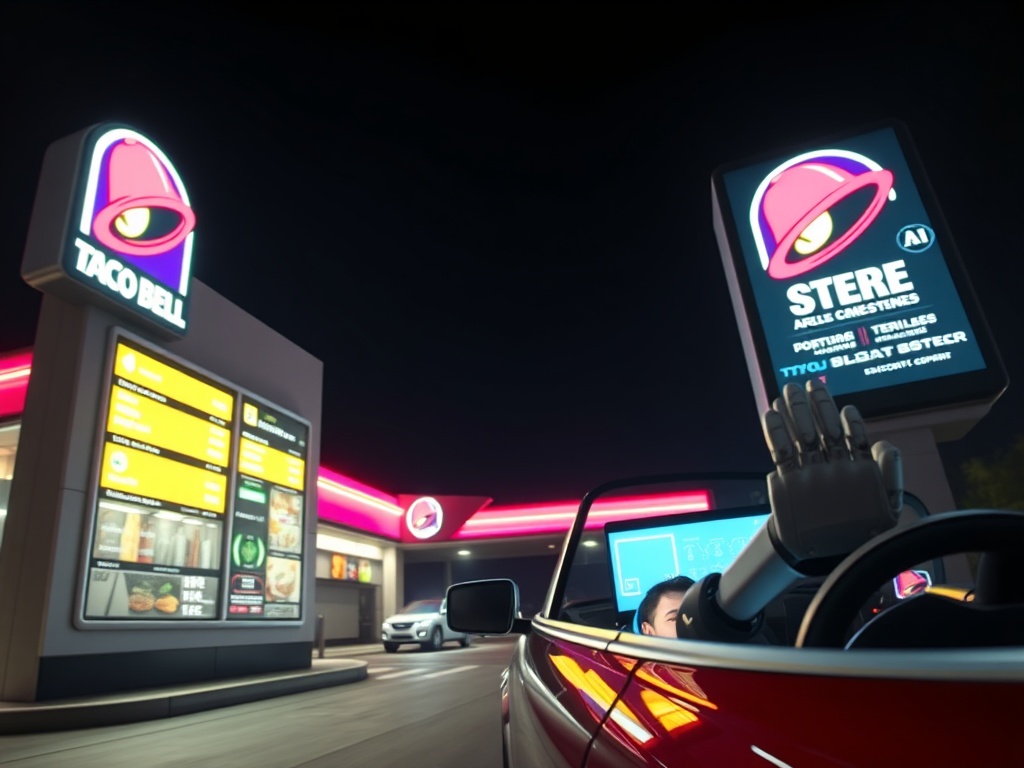
AI Drive-Through Systems: Taco Bell’s Critical Rethink on Automation

The world of cryptocurrency thrives on innovation, efficiency, and often, the audacious deployment of cutting-edge technology. Just as blockchain promises to revolutionize finance, artificial intelligence (AI) aims to transform industries from healthcare to hospitality. But what happens when these ambitious technological leaps encounter the messy reality of human interaction? Taco Bell, a fast-food giant known for its bold flavors, is now facing this very question as it re-evaluates its extensive AI Drive-Through Systems experiment, prompting a crucial conversation about the limits and future of automation.

The AI Drive-Through Systems Experiment: What Went Wrong?

In a bold move to enhance efficiency and speed up service, Taco Bell rolled out voice AI-powered ordering across more than 500 of its drive-through locations. The premise was simple: leverage AI to handle routine orders, reduce wait times, and free up human staff for more complex tasks. However, as is often the case with pioneering technology, the journey has been anything but smooth. The implementation of these AI Drive-Through Systems has led to a series of viral incidents that have put a spotlight on the inherent challenges of automated customer service.

One of the most widely circulated anecdotes involves a customer reportedly ordering 18,000 water cups – a clever, albeit disruptive, tactic to bypass the AI and connect with a human server. Such incidents, while humorous on the surface, highlight a deeper issue: the frustration that arises when AI fails to understand nuanced requests or handle unexpected situations. For customers seeking a quick and seamless experience, these glitches can quickly turn into significant deterrents, impacting brand perception and operational efficiency.

Taco Bell’s AI Strategy: A Recipe for Viral Mishaps?

Dane Matthews, Taco Bell’s Chief Digital and Technology Officer, openly admits the company is engaged in an “active conversation” about the appropriate deployment of AI. This admission underscores a broader industry struggle to integrate advanced technology without alienating the human element. Matthews himself has had mixed experiences, stating, “Sometimes it lets me down, but sometimes it really surprises me.” This candid assessment reflects the dual nature of AI: its incredible potential alongside its current limitations.

Taco Bell’s AI Strategy initially aimed for broad deployment, but the real-world feedback has prompted a more cautious approach. The viral moments, though entertaining for onlookers, have been a wake-up call, demonstrating that while AI can handle predictable transactions with speed, it often falters when faced with the unpredictable, the quirky, or the deliberately subversive. The goal is not just to automate, but to automate smartly, ensuring that the technology enhances rather than detracts from the customer journey.

The Promise and Pitfalls of Voice AI in Fast Food

Voice AI in Fast Food offers compelling benefits. It can process orders rapidly, reduce human error in order taking, and potentially lower labor costs. For franchisees, these advantages can translate into improved margins and operational scalability. However, the technology is still evolving, and its current iteration presents several pitfalls:

  • Accuracy Issues: Background noise, accents, or complex orders can lead to misinterpretations, resulting in incorrect food items or frustrating delays.
  • Lack of Empathy: AI cannot offer the same level of personalized service or empathy that a human can, which is crucial for resolving complaints or handling special requests.
  • Scalability Challenges: While AI can handle high volumes, its effectiveness diminishes when facing truly exceptional circumstances or deliberate attempts to circumvent its programming.
  • Customer Preference: A segment of customers simply prefers human interaction, especially when ordering food, where clarity and confirmation are paramount.

These challenges mean that simply plugging in Voice AI in Fast Food is not a magic bullet. It requires careful integration, continuous monitoring, and a robust fallback plan involving human intervention.

Restaurant Automation Challenges: Finding the Human-Tech Balance

Taco Bell’s experience is a microcosm of broader Restaurant Automation Challenges across the industry. The ideal scenario is a synergistic relationship where AI handles routine tasks, allowing human employees to focus on higher-value activities like problem-solving, upselling, and ensuring overall customer satisfaction. Matthews emphasized this nuanced approach, suggesting that rather than relying exclusively on AI, a hybrid model might be more effective.

For instance, at peak hours or in busy locations with long lines, it might make more sense to have a human take drive-through orders. This flexibility allows franchisees to adapt their operations based on real-time conditions and customer flow. Matthews stated, “For our teams, we’ll help coach them: at your restaurant, at these times, we recommend you use voice AI or recommend that you actually really monitor voice AI and jump in as necessary.” This highlights a shift from full automation to intelligent automation, where AI serves as a tool to assist, rather than completely replace, human staff. Overcoming Restaurant Automation Challenges requires this thoughtful integration.

Enhancing Customer Experience with AI: Lessons from the Bell

The ultimate goal of any technological deployment in customer service is to enhance the Customer Experience with AI. Taco Bell’s journey provides valuable lessons for other businesses considering similar AI integrations. It’s not just about deploying technology; it’s about understanding its impact on the end-user and being agile enough to adjust strategies based on feedback.

Key takeaways for businesses looking to improve Customer Experience with AI include:

  • Hybrid Models: Implement AI in conjunction with human oversight, allowing for seamless transitions when AI struggles.
  • Contextual Awareness: Design AI systems that can better understand and respond to varied customer needs, including accents, complex orders, and emotional cues.
  • User Feedback Loops: Establish robust mechanisms for collecting and acting on customer and employee feedback to refine AI performance.
  • Training and Support: Provide comprehensive training for human staff on how to monitor AI, intervene effectively, and troubleshoot common issues.
  • Franchisee Flexibility: Empower individual locations or managers to make informed decisions about AI deployment based on their specific operational context.

By learning from these experiences, businesses can harness the power of AI to create genuinely positive interactions, rather than frustrating ones.

Conclusion: The Future of Fast Food Automation

Taco Bell’s active re-evaluation of its AI drive-through systems is a critical moment for the fast-food industry and a compelling case study for anyone exploring the integration of AI in customer-facing roles. It underscores that while AI offers immense potential for efficiency and innovation, it must be deployed with a deep understanding of human behavior and customer expectations. The path forward likely involves a balanced approach, where AI and human intelligence work in tandem, each leveraging their strengths to create a truly seamless and satisfying customer experience. As technology continues to evolve, the challenge will be to continuously refine these integrations, ensuring that innovation truly serves the people it aims to assist.

To learn more about the latest AI market trends, explore our article on key developments shaping AI features.

This post AI Drive-Through Systems: Taco Bell’s Critical Rethink on Automation first appeared on BitcoinWorld and is written by Editorial Team


Market Opportunity
RealLink Logo
RealLink Price(REAL)
$0.07887
$0.07887$0.07887
+0.90%
USD
RealLink (REAL) Live Price Chart
Disclaimer: The articles reposted on this site are sourced from public platforms and are provided for informational purposes only. They do not necessarily reflect the views of MEXC. All rights remain with the original authors. If you believe any content infringes on third-party rights, please contact service@support.mexc.com for removal. MEXC makes no guarantees regarding the accuracy, completeness, or timeliness of the content and is not responsible for any actions taken based on the information provided. The content does not constitute financial, legal, or other professional advice, nor should it be considered a recommendation or endorsement by MEXC.

You May Also Like

Crypto Casino Luck.io Pays Influencers Up to $500K Monthly – But Why?

Crypto Casino Luck.io Pays Influencers Up to $500K Monthly – But Why?

Crypto casino Luck.io is reportedly paying influencers six figures a month to promote its services, a June 18 X post from popular crypto trader Jordan Fish, aka Cobie, shows. Crypto Influencers Reportedly Earning Six Figures Monthly According to a screenshot of messages between Cobie and an unidentified source embedded in the Wednesday post, the anonymous messenger confirmed that the crypto company pays influencers “around” $500,000 per month to promote the casino. They’re paying extremely well (6 fig per month) pic.twitter.com/AKRVKU9vp4 — Cobie (@cobie) June 18, 2025 However, not everyone was as convinced of the number’s accuracy. “That’s only for Faze Banks probably,” one user replied. “Other influencers are getting $20-40k per month. So, same as other online crypto casinos.” Cobie pushed back on the user’s claims by identifying the messenger as “a crypto person,” going on to state that he knew of “4 other crypto people” earning “above 200k” from Luck.io. Drake’s Massive Stake.com Deal Cobie’s post comes amid growing speculation over celebrity and influencer collaborations with crypto casinos globally. Aubrey Graham, better known as Toronto-based rapper Drake, is reported to make nearly $100 million every year from his partnership with cryptocurrency casino Stake.com. As part of his deal with the Curaçao-based digital casino, the “Nokia” rapper occasionally hosts live-stream gambling sessions for his more than 140 million Instagram followers. Founded by entrepreneurs Ed Craven and Bijan Therani in 2017, the organization allegedly raked in $2.6 billion in 2022. Stake.com has even solidified key partnerships with Alfa Romeo’s F1 team and Liverpool-based Everton Football Club. However, concerns remain over crypto casinos’ legality as a whole , given their massive accessibility and reach online. Earlier this year, Stake was slapped with litigation out of Illinois for supposedly running an illegal online casino stateside while causing “severe harm to vulnerable populations.” “Stake floods social media platforms with slick ads, influencer videos, and flashy visuals, making its games seem safe, fun, and harmless,” the lawsuit claims. “By masking its real-money gambling platform as just another “social casino,” Stake creates exactly the kind of dangerous environment that Illinois gambling laws were designed to stop.”
Share
CryptoNews2025/06/19 04:53
Brera Holdings Rebrands as Solmate, Raises $300 Million for SOL Treasury

Brera Holdings Rebrands as Solmate, Raises $300 Million for SOL Treasury

Detail: https://coincu.com/news/solmate-rebrand-300m-sol-treasury/
Share
Coinstats2025/09/19 03:40
Sui Mainnet Recovers After 6-Hour Network Stall: No Funds at Risk

Sui Mainnet Recovers After 6-Hour Network Stall: No Funds at Risk

On January 14, 2026, Sui Mainnet faced a significant disruption, leaving the network stalled for roughly six hours. The incident was caused by an internal divergence
Share
Tronweekly2026/01/17 09:30