

👨🏿🚀TechCabal Daily – Pesalink joins PAPSS
TGIF. 
If your week has been doing backflips on your to-do list, take a breath; tomorrow, we gather.
Saturday, February 28, is D-Day for the Zikoko Citizen Townhall. We’re taking over Four Points by Sheraton, Lagos, for what’s gearing up to be a packed afternoon of real conversations, sharp questions, and the kind of energy you only get when Nigerians gather with purpose (and a mic).
Everyone is welcome—yes, even your friend who says “I’m not really into politics” but has 17 hot takes every hour. But we only have one rule: Grab your free ticket first.
If TC Daily emails keep landing in your Promotions tab, here’s your reminder to move them back to your Primary inbox. Add our email address to your contact list so you never miss another newsletter. That said, write back and tell us how your week has been.
Let’s dive into today’s newsletter.
- Quick Fire
 with Uche Ukonu Jnr
 - Pesalink joins PAPSS
- Nigeria secures funding for Project BRIDGE
- Who secured the bag?

- World Wide Web 3
- Events
features
Quick Fire with Uche Ukonu Jnr
 Image: Uche Ukonu Jnr
Uche Ukonu Jnr is an operator and venture builder based in Lagos, Nigeria. His expertise is helping companies, firms, and other stakeholders execute special projects, optimise operations, and validate product/project pilots for scale across West and East Africa.
He also founded and bootstrapped Smallchops.ng to profitability, worked as Chief of Staff in EdenLife’s food production arm (Homemade), and most recently led the team that executed one of the largest single-entity owned electric vehicle (EV) ecosystems in Nigeria.
- Explain what you do to a 5-year-old.
-
I help people build their biggest ideas properly so that they don’t fall apart. Sometimes “adults” have powerful ideas, but they’re messy, like toys everywhere on the floor. I help organise the toys, decide which ones are important, show everyone how to play together properly, and make sure they remember how to play nice even when I’m not there.
- You’ve built, fixed, and scaled across food, mobility, and venture projects. What’s the first thing you look at when you’re dropped into a “messy” operation?
-
The first thing I look at is the definition of what success is to the sponsors and stakeholders of the operation, and this usually comes from gaining clarity on what the success indicators are, their dependencies, what the operating environment currently looks like, what the execution risks are, and how much time there is to convert the “messiness” to excellent execution.
Once success is clearly defined, the mess usually becomes a systems problem, and systems can be redesigned and optimised. - As Chief of Staff at EdenLife’s Homemade arm, you were close to food production at scale. What’s one operational lesson consumer startups underestimate?
-
One thing consumer startups underestimate is operational complexity at scale. They usually find out too late how unforgiving it can be. Demand is exciting, but if your supply chain, quality control, and cost discipline aren’t tight, growth actually magnifies your problems.
So the real work isn’t growth. It’s designing repeatable systems where quality, cost, and speed can coexist, because scale doesn’t fix weak systems. It exposes them.
We are expanding across Africa!
Fincra is expanding across Africa, building the financial infrastructure that powers Africa’s cross-border payments. Build with us. Explore open roles.
payments
Pesalink and PAPSS want cross-border transfers received in local currency
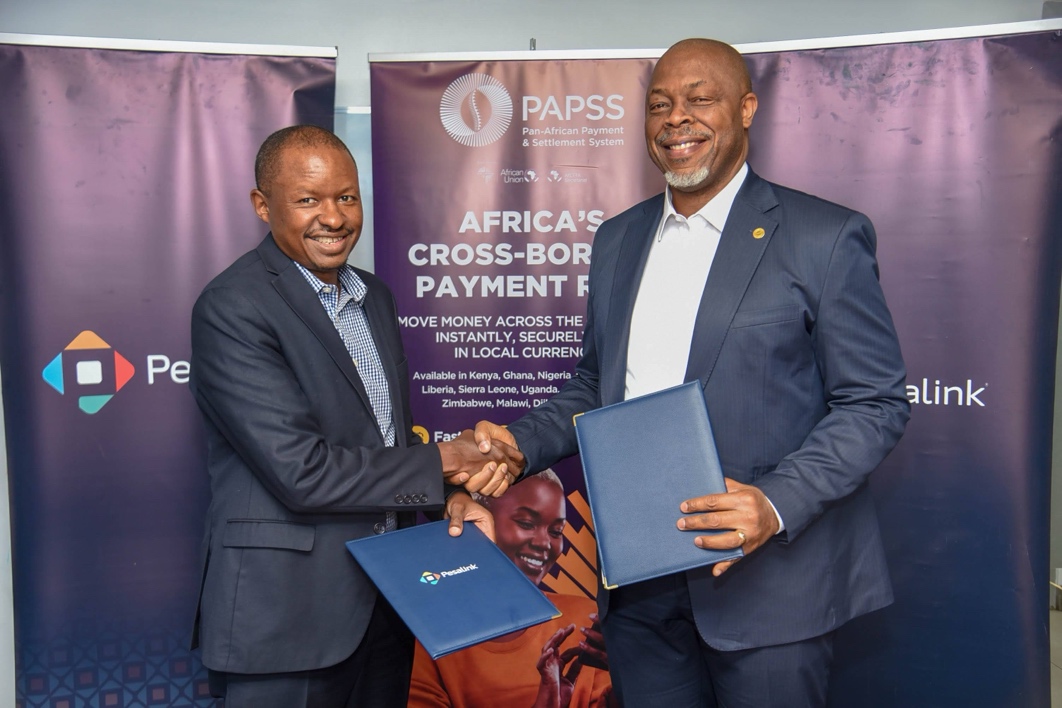 Pesalink CEO Gituku Kirika and PAPSS CEO Mike Ogbalu III. Image: Pesalink.
Pesalink, Kenya’s interbank money transfer platform, has connected to the Pan-African Payment and Settlement System (PAPSS), the intra-African payment network linking over 200 financial institutions, for banks and mobile money operators in Kenya to receive cross-border transfers in local currency.
It’s a big deal: Cross-border payments in Africa are still slow and expensive. Transfers often clear offshore, which incurs FX spreads and can take days. PAPSS’s whole mission is to fix that. It already piloted local-currency settlements in West Africa, including Nigeria and Ghana.
Kenya is now in the mix, with Pesalink acting as the technical bridge on the Kenyan side. Now, when money moves from a bank connected to PAPSS in another African country to Kenya, it can route funds directly into a Kenyan bank account, with settlement handled locally.
What happens to the crypto corridors? A recent trend in the cross-border payments sector is fintech startups building cross-border payment corridors using stablecoins and blockchain rails. Many of them use dollar-backed stablecoins or integrate with networks like Polygon as settlement layers to move money instantly and then convert to local currency on the other end. Their pitch is usually faster and cheaper payments, which sounds… very similar to what PAPSS is trying to achieve.
Will it become a bank vs blockchain race? Not quite. PAPSS brings regulatory comfort and integration into the formal banking systems, while stablecoin-based corridors promise speed. The winner that will take it all will be the rail that adequately balances pricing with reliability and user experience.
The Smarter Way to Save

At PalmPay, we don’t just talk about financial inclusion, we drive it by upskilling and empowering women for real careers in tech. Apply for Purple Woman 2026 and become one of 150 women equipped with the skills, experience, and opportunity to thrive. Learn more.
connectivity
Nigeria just pulled European money into Project BRIDGE
 Image Source: Tenor
Nigeria has secured fresh funding for Project BRIDGE, the federal government’s plan to blanket the country in fibre-optic cable. After a two-week investment tour across six European countries, the Minister of Communications, Innovation and Digital Economy, Bosun Tijani, announced that the European Bank for Reconstruction and Development (EBRD) approved a $100 million investment into the project.
This adds to the $500 million already secured from the World Bank. On top of that, the European Union (EU) signed a €45 million ($53 million) Digital Economy Package. Out of that, €22 million ($26 million) is a direct grant for Project BRIDGE, while the rest goes into digital public services.
What exactly is Project BRIDGE? Project BRIDGE is Nigeria’s plan to expand its fibre backbone from about 35,000 kilometres to 125,000 kilometres. The goal is to connect all 774 local government areas with high-speed broadband infrastructure. Right now, fibre coverage is concentrated in major cities like Lagos and Abuja. BRIDGE wants to expand that connectivity bandwidth into underserved regions.
Why it matters: More fibre is not just about having your Netflix load faster or your messages delivered at greater speeds. Infrastructure capable of supporting AI, fintechs, edtechs, SMEs, or digital public services all need a strong fiber backbone to run smoothly. And the willingness of European development lenders to commit capital suggests growing confidence that Nigeria’s fibre ambition is bankable.
Join the second edition of The Citizen Townhall
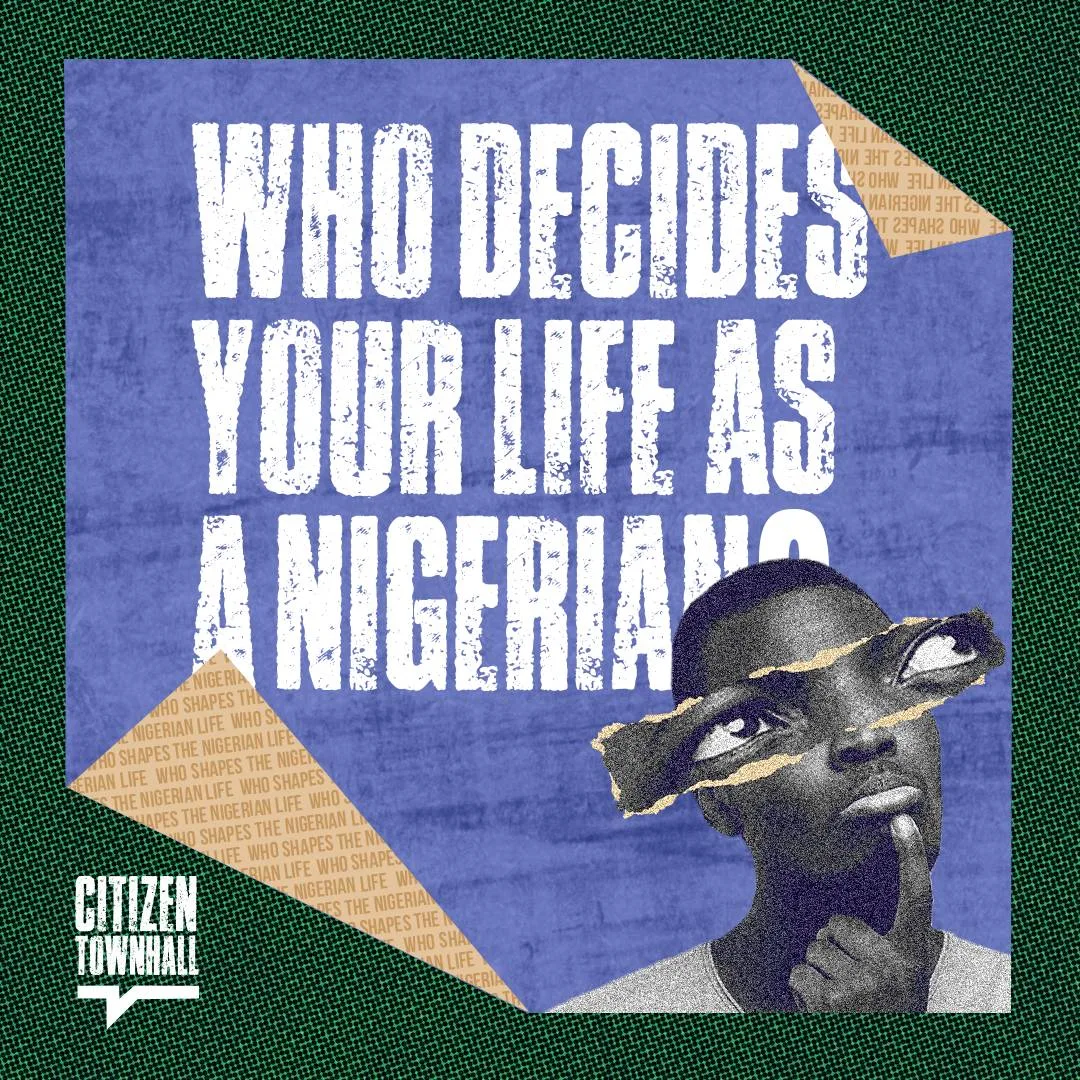
Tech is political!
Political decisions shape and reshape the tech landscape every single day. So here’s the big question: Who gets to shape our lives and what can we do about it?
That’s the conversation we’ll be having at the second edition of The Citizen Townhall; on February 28, in Lagos. Join the conversation. Register now for FREE.
insights
funding tracker
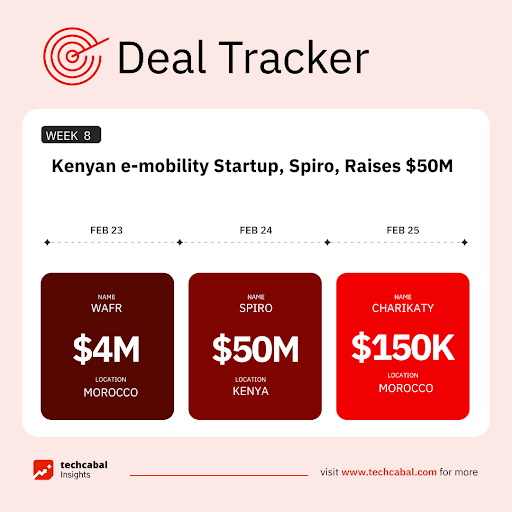 Image Source: TechCabal Insights
Spiro, a Kenyan e-mobility startup, secured $50 million in debt funding backed by African Export-Import Bank (Afreximbank), Nithio, and the Africa Go Green Fund managed by Cygnum Capital (Feb 24)
Here are the other deals for the week:
- WafR, a Moroccan retail fintech startup, raised $4 million in seed funding co-led by LoftyInc Capital, Attijariwafa Ventures, and Al Mada Ventures. (Feb 23)
- Charikaty, a Moroccan RegTech startup, raised $150,000 in funding from Ilan Benhaim and Karim Amor. (Feb 25)
Follow us on Twitter, Instagram, and LinkedIn for more funding announcements. Before you go, take a closer look at how informal healthcare providers are quietly sustaining Nigeria’s health system. Read more here.
CRYPTO TRACKER
The World Wide Web3
Source:

|
Coin Name |
Current Value |
Day |
Month |
|---|---|---|---|
| Bitcoin | $67,804 |
– 0.81% |
– 25.35% |
| Ether | $2,044 |
– 0.92% |
– 31.81% |
| XRP | $1.41 |
– 1.22% |
– 25.62% |
| Solana | $86.89 |
– 1.51% |
– 31.70% |
* Data as of 06.37 AM WAT, February 27, 2026.
JOB OPENINGS
- Big Cabal Media — Senior Motion Designer, YouTube Growth Strategist, Quality Assurance Engineer — Lagos, Nigeria
- Manny & Co — Brand Designer, Communications Specialist, Marketing & Sales Enablement Manager — Lagos, Nigeria
There are more jobs on TechCabal’s job board. If you have job opportunities to share, please submit them at bit.ly/tcxjobs.
- Delve into AI: When smart glasses harm, who is accountable?
- The citizen-led platform trying to make Nigeria’s vote collation transparent
- Nigeria’s crypto exchanges must now report trades, but enforcement remains unclear
Written by: Success Sotonwa, Opeyemi Kareem, and Emmanuel Nwosu
Edited by: Emmanuel Nwosu & Ganiu Oloruntade
Want more of TechCabal?
Sign up for our insightful newsletters on the business and economy of tech in Africa.
- The Next Wave: futuristic analysis of the business of tech in Africa.
- Francophone Weekly by TechCabal: insider insights and analysis of Francophone’s tech ecosystem
P:S If you’re often missing TC Daily in your inbox, check your Promotions folder and move any edition of TC Daily from “Promotions” to your “Main” or “Primary” folder and TC Daily will always come to you.

You May Also Like

Structural support keeps rally in play – ING

UNI Price Prediction: Targets $4.28 Resistance by March as Technical Indicators Show Mixed Signals
